
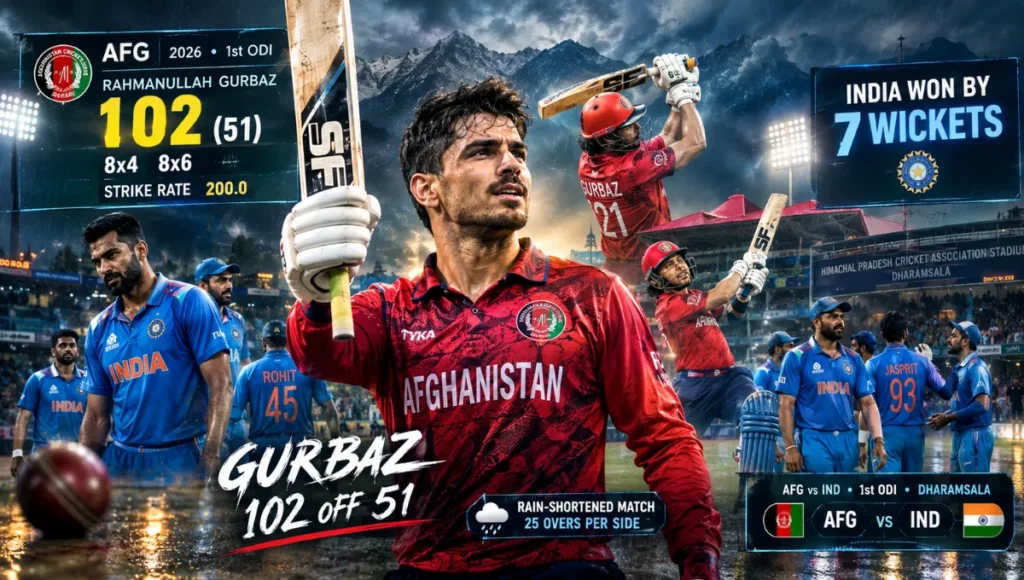

Rahmanullah Gurbaz scored 102 off 51 balls. Eight fours, eight sixes, a genuinely extraordinary rate of scoring against one of the best bowling attacks in world cricket.
Afghanistan still lost by 7 wickets.
This Afghanistan National Cricket Team vs India National Cricket Team match scorecard covers the 1st ODI of Afghanistan’s 2026 tour of India, played at a rain-shortened 25 overs a side in Dharamsala. Gurbaz’s century deserves to be remembered. It just didn’t change the outcome.
Match in 30 Seconds
| Detail | Match information |
|---|---|
| Match | 1st ODI, Afghanistan tour of India 2026 |
| Venue | Himachal Pradesh Cricket Association Stadium, Dharamsala |
| Date | 13 June 2026 |
| Toss | India won the toss and elected to field |
| Afghanistan score | 194/10 in 24.5 overs (25-over match due to rain) |
| India score | 195/3 in 22.5 overs |
| Result | India won by 7 wickets |
| Standout performer | Rahmanullah Gurbaz — 102 off 51 balls |
The one-line story: Rahmanullah Gurbaz’s stunning century single-handedly dragged Afghanistan to a total that looked competitive on paper, but Shubman Gill’s calm, unbeaten 84 ensured India were never seriously troubled in the chase.
What people think is that a century of this quality, scored against a genuinely strong bowling attack, should at minimum make a run-chase tense and difficult.
The reality here was different: India completed the chase with more than two overs to spare and never lost more than three wickets across the entire innings.
Afghanistan National Cricket Team vs India National Cricket Team Match Scorecard
Afghanistan’s innings: 194/10 in 24.5 overs
| Batter | Runs | Balls | 4s | 6s | Strike rate | Dismissal |
|---|---|---|---|---|---|---|
| Rahmanullah Gurbaz (wk) | 102 | 51 | 8 | 8 | 200.00 | b Nitish Kumar Reddy |
| Ibrahim Zadran | 1 | 4 | 0 | 0 | 25.00 | c Shubman Gill b Gurnoor Brar |
| Sediqullah Atal | 0 | 2 | 0 | 0 | 0.00 | lbw b Arshdeep Singh |
| Rahmat Shah | 3 | 8 | 0 | 0 | 37.50 | c Harsh Dubey b Arshdeep Singh |
| Hashmatullah Shahidi (c) | 27 | 30 | 3 | 0 | 90.00 | c KL Rahul b Harsh Dubey |
| Azmatullah Omarzai | 26 | 16 | 0 | 3 | 162.50 | st Ishan Kishan b Harsh Dubey |
| Mohammad Nabi | 9 | 14 | 0 | 1 | 64.29 | c Arshdeep Singh b Nitish Reddy |
| Rashid Khan | 9 | 13 | 2 | 0 | 69.23 | b Gurnoor Brar |
| AM Ghazanfar | 0 | 2 | 0 | 0 | 0.00 | c Shubman Gill b Harsh Dubey |
| Zia Ur Rahman Sharifi | 4 | 8 | 1 | 0 | 50.00 | c Arshdeep Singh b Gurnoor Brar |
| Mohammad Saleem Safi | 1 | 1 | 0 | 0 | 100.00 | not out |
| Extras | 12 | — | — | — | — | 1 b, 7 lb, 4 w |
| Total | 194/10 | 24.5 overs |
Fall of wickets: 13/1 (Ibrahim Zadran, 1.5), 16/2 (Sediqullah Atal, 2.3), 26/3 (Rahmat Shah, 4.3), 142/4 (Rahmanullah Gurbaz, 15.3), 144/5 (Hashmatullah Shahidi, 16.3), 172/6 (Mohammad Nabi, 20.3), 182/7 (Azmatullah Omarzai, 21.2), 182/8 (AM Ghazanfar, 21.4), 193/9 (Rashid Khan, 24.3), 194/10 (Zia Ur Rahman Sharifi, 24.5).
India bowling figures
| Bowler | Overs | Runs | Wickets | Economy |
|---|---|---|---|---|
| Arshdeep Singh | 5 | 27 | 2 | 5.40 |
| Gurnoor Brar | 4.5 | 27 | 3 | 5.60 |
| Prasidh Krishna | 5 | 35 | 0 | 7.00 |
| Harsh Dubey | 5 | 47 | 3 | 9.40 |
| Washington Sundar | 1 | 19 | 0 | 19.00 |
| Nitish Kumar Reddy | 4 | 31 | 2 | 7.80 |
India’s innings: 195/3 in 22.5 overs
| Batter | Runs | Balls | 4s | 6s | Strike rate | Dismissal |
|---|---|---|---|---|---|---|
| Rohit Sharma | 16 | 16 | 2 | 1 | 100.00 | run out |
| Shubman Gill (c) | 84 | 66 | 11 | 2 | 127.27 | not out |
| Ishan Kishan (wk) | 34 | 22 | 3 | 1 | 154.55 | b Rashid Khan |
| Shreyas Iyer | 12 | 15 | 1 | 0 | 80.00 | c Saleem Safi b Zia Ur Rahman Sharifi |
| KL Rahul | 39 | 19 | 4 | 3 | 205.26 | not out |
| Extras | 10 | — | — | — | — | 1 lb, 8 w, 1 nb |
| Total | 195/3 | 22.5 overs |
Did not bat: Washington Sundar, Nitish Kumar Reddy, Harsh Dubey, Gurnoor Brar, Arshdeep Singh, Prasidh Krishna.
Fall of wickets: 46/1 (Rohit Sharma, 5.4), 116/2 (Ishan Kishan, 12.5), 142/3 (Shreyas Iyer, 17.3).
Afghanistan bowling figures
| Bowler | Overs | Runs | Wickets | Economy |
|---|---|---|---|---|
| Azmatullah Omarzai | 3 | 28 | 0 | 9.30 |
| Zia Ur Rahman Sharifi | 4 | 39 | 1 | 9.80 |
| AM Ghazanfar | 5 | 28 | 0 | 5.60 |
| Mohammad Saleem Safi | 3.5 | 36 | 0 | 9.40 |
| Rashid Khan | 5 | 37 | 1 | 7.40 |
| Mohammad Nabi | 2 | 26 | 0 | 13.00 |
Read Also:- South Africa National Cricket Team Vs Sri Lanka National Cricket Team Match Scorecard
Highlights and Key Moments
1. Afghanistan’s early stumble to 26/3
Afghanistan lost three wickets for just 26 runs inside the first five overs. Ibrahim Zadran fell for 1, Sediqullah Atal for a duck, and Rahmat Shah for 3, leaving the innings in genuine early trouble against India’s disciplined new-ball attack.
What most people miss: losing three top-order wickets this quickly in a rain-reduced 25-over match is even more costly than in a full 50-over game there are simply fewer overs left to recover the lost ground. Afghanistan needed an immediate rescue act, not a gradual rebuild.
2. Gurbaz and Shahidi’s 116-run rescue stand
From 26/3, Rahmanullah Gurbaz and captain Hashmatullah Shahidi added 116 runs for the fourth wicket, with Gurbaz doing the vast majority of the scoring. By the time Gurbaz was finally dismissed at 142/4 in the 15.3rd over, Afghanistan had turned a genuine crisis into a platform for a competitive total.
Counterintuitive point: a 116-run partnership recovering from 26/3 usually signals a team firmly back in control of its innings. Here, the partnership’s value was almost entirely down to one batter’s exceptional strike rate Gurbaz scored the overwhelming majority of those runs, meaning the “recovery” was really just one player’s brilliance, not a genuine two-way rebuilding effort.
3. A late collapse undoes the recovery
After Gurbaz departed, Afghanistan lost their captain Shahidi one run later, and the innings never found fresh momentum. Azmatullah Omarzai’s quick 26 off 16 provided some late impetus, but wickets continued to fall regularly, and Afghanistan were eventually bowled out for 194 with just one ball of their 25-over allocation unused.
This is where things go wrong for a team relying on one rescue act: once the batter who built the recovery is dismissed, the rest of the order needs a clear plan to sustain the momentum. Afghanistan’s lower order added just 52 runs across their final six wickets, undermining much of the platform Gurbaz’s century had created.
4. India’s calm, four-batter chase
Chasing 195 in 25 overs a demanding rate of 7.8 an over India needed only four batters. Rohit Sharma’s brisk 16 was ended by a run out, but Shubman Gill anchored the chase throughout, finishing unbeaten on 84 off 66 balls. Ishan Kishan’s 34 and KL Rahul’s explosive unbeaten 39 off 19 balls closed out the win with more than two overs to spare.
Bold opinion: the fact that India needed only four batters to complete a chase against a total built around a century is the clearest possible evidence that Gurbaz’s brilliance, while genuinely exceptional, never came close to actually threatening the result. A chase this comfortable, against a required rate this demanding, reflects a team fully in control from the very first over of their reply.
Player Performance Breakdown
Rahmanullah Gurbaz a century in a losing cause
Gurbaz’s 102 off 51 balls, striking at exactly 200, was built on eight fours and eight sixes an extraordinary rate of boundary-hitting against a full-strength Indian attack. His innings alone accounted for more than half of Afghanistan’s entire total.
Original observation: a century that represents over half a team’s total is a genuinely rare batting achievement, but it also reveals a structural concern for the team it belongs to. When one player’s brilliance has to cover for such a large share of a total, the surrounding batting order’s fragility becomes the real story, not the individual innings itself.
Shubman Gill a captain’s innings that closed the door
Gill’s unbeaten 84 off 66 balls anchored India’s chase from start to finish. He was the only Indian batter to remain at the crease for the majority of the innings, and his calm, controlled approach striking at 127.27 rather than attempting excessive risk ensured the chase never wavered even after Rohit Sharma’s run out.
Practical lesson for a captain leading a run-chase: Gill’s specific method building a foundation methodically rather than trying to match Gurbaz’s explosive tempo shows that a comfortable chase doesn’t require replicating the opposition’s most dramatic individual performance. It simply requires controlled, risk-managed batting sustained over the full innings.
KL Rahul: the explosive finish
Rahul’s unbeaten 39 off just 19 balls, striking at 205.26 with four fours and three sixes, provided the late acceleration that turned a comfortable chase into an emphatic one, sealing the win well before the 25-over mark.
Common mistake in analysis: underrating a short, explosive cameo simply because it arrived once the match state already favoured the batting side. Rahul’s specific role arriving with the platform already secure and simply finishing the job at speed is exactly the kind of situational batting a deep order should provide.
Arshdeep Singh and Gurnoor Brar: the new-ball damage
Arshdeep’s 2/27 and Gurnoor Brar’s 3/27 combined for five of Afghanistan’s ten wickets, doing the bulk of the early damage that created the 26/3 collapse Gurbaz later had to rescue Afghanistan from.
What people think vs reality: fans often remember only the dramatic century when reviewing a match like this. The new-ball bowlers who created the initial crisis Gurbaz had to fight back from deserve equal credit without their early breakthroughs, Afghanistan’s total might have been considerably higher, and the eventual result could have looked very different.
Analysis: Why Gurbaz’s Century Wasn’t Enough
A total that never became genuinely threatening
What people think: a century of this quality, in a rain-reduced match with a demanding required rate, should make any chase genuinely tense.
Reality: India’s chase never wavered. They lost only three wickets across the entire innings and completed the target with more than two overs unused. The required rate of 7.8 an over, while demanding on paper, was comfortably matched by India’s top order without needing any batter to play with the same risk Gurbaz had taken.
The rain-reduced format, in context
Both innings were played to a 25-over allocation due to rain, changing the calculus of what a “good” total actually looked like. Afghanistan’s 194 in 24.5 overs represented a scoring rate of 7.81 competitive by rain-reduced-match standards, but ultimately not enough against an Indian batting order built for exactly this kind of demanding chase.
Practical takeaway for reading a shortened-format match: totals and required rates in rain-reduced games should never be compared directly to full-length matches. A 194 in 25 overs asks a genuinely different question of the chasing side than the same total would in a full 50-over contest, and India’s batting depth proved well-suited to that specific, compressed challenge.
India’s chase was controlled from start to finish
Bold opinion: the most telling statistic from this match isn’t Gurbaz’s strike rate it’s that India needed only four of their eleven players to bat. A genuinely contested chase against a competitive total, especially one built around a rare individual century, should require more of a batting order’s depth than this one did.
India’s chase was a demonstration of batting quality that made Afghanistan’s excellent individual performance almost irrelevant to the outcome.
Read Also:- Chennai Super Kings Vs Mumbai Indians Match Scorecard
Format Guardrail, Records and Series Context
Understanding the different Afghanistan-India fixtures in 2026
| Fixture | Format / competition | Correct use |
|---|---|---|
| Afghanistan vs India, 1st ODI, 2026 tour (this article) | 50-over ODI (rain-reduced to 25 overs), Dharamsala, June 2026 | This article’s core scorecard |
| India vs Afghanistan, Only Test, 2026 | A rare Test match between these nations | A completely different format; must not be blended with ODI figures |
| India vs Afghanistan, 3rd ODI, 2026 tour | The series decider | A different, later result from the same bilateral series |
| Afghanistan vs India, 1st T20I, 2026 | Scheduled for 13 September 2026 | Not yet played as of this brief; no result exists to report |
| Afghanistan A vs India A, Tri-Nation Series | Development-level ODI competition, Sri Lanka | A completely different squad level and tournament |
For example, the Only Test between these two nations is a genuinely rare fixture, given how infrequently full Test matches are scheduled between India and Afghanistan. Its figures belong to an entirely different format and must never be presented as part of this ODI scorecard.
Frequently Asked Questions
Ans. India won by 7 wickets. Afghanistan scored 194/10 in a rain-reduced 25-over match, and India chased it down at 195/3 in 22.5 overs at HPCA Stadium, Dharamsala.
Ans. Afghanistan scored 194/10, led by Rahmanullah Gurbaz’s century of 102. India replied with 195/3 in 22.5 overs, with Shubman Gill’s unbeaten 84 and KL Rahul’s unbeaten 39 sealing a 7-wicket win.
Ans. Gurbaz’s century made up more than half of Afghanistan’s total, but the rest of the batting order could not sustain the momentum after his dismissal. India’s batting order, led by Shubman Gill, chased the target comfortably, losing only three wickets in the process.
Ans. This was an ODI, the 1st match of a bilateral series, though it was reduced to 25 overs per side due to rain.
Ans. No. This article covers the 1st ODI of the bilateral series. The two nations also played a separate Only Test, and a 1st T20I is scheduled for 13 September 2026, which had not been played at the time of this article.