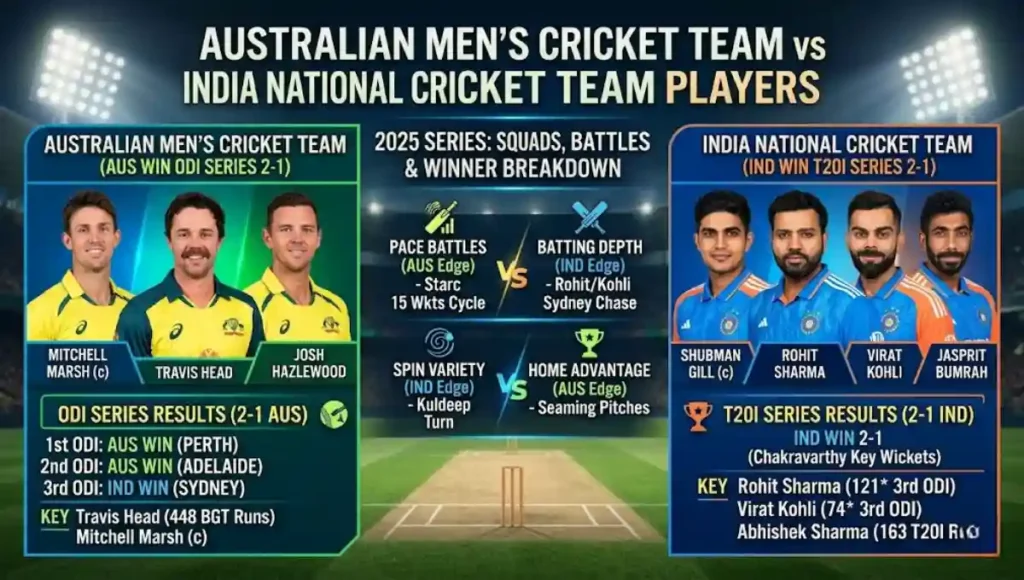

Two captains led India across this tour. Five Australian players were ruled out and replaced before the series even settled into a rhythm. And by the end, both teams had won exactly one series each Australia taking the ODIs, India winning the T20Is.
This is the complete Australian Men’s Cricket Team vs India National Cricket Team Players breakdown for the 2025-26 tour: both full squads, the injury chain that reshaped Australia’s lineup, India’s split-captaincy structure, and the individual battles that actually decided each series.
Both Squads at a Glance
Australia’s squads
| ODI Squad | T20I Squad |
|---|---|
| Mitchell Marsh (c) | Mitchell Marsh (c) |
| Xavier Bartlett | Sean Abbott |
| Alex Carey (wk) | Xavier Bartlett |
| Cooper Connolly | Mahli Beardman |
| Jack Edwards | Tim David |
| Nathan Ellis | Ben Dwarshuis |
| Josh Hazlewood | Nathan Ellis |
| Travis Head | Josh Hazlewood |
| Josh Inglis (wk) | Travis Head |
| Matthew Kuhnemann | Josh Inglis (wk) |
| Mitchell Owen | Matthew Kuhnemann |
| Josh Philippe (wk) | Glenn Maxwell |
| Matt Renshaw | Mitchell Owen |
| Matthew Short | Josh Philippe (wk) |
| Mitchell Starc | Tanveer Sangha |
| Adam Zampa | Matthew Short |
| Marcus Stoinis | |
| Adam Zampa |
India’s squads
| ODI Squad | T20I Squad |
|---|---|
| Shubman Gill (c) | Suryakumar Yadav (c) |
| Shreyas Iyer (vc) | Shubman Gill (vc) |
| Yashasvi Jaiswal | Jasprit Bumrah |
| Dhruv Jurel (wk) | Varun Chakaravarthy |
| Virat Kohli | Shivam Dube |
| Prasidh Krishna | Axar Patel |
| Axar Patel | Harshit Rana |
| KL Rahul (wk) | Nitish Kumar Reddy |
| Harshit Rana | Sanju Samson (wk) |
| Nitish Kumar Reddy | Abhishek Sharma |
| Rohit Sharma | Jitesh Sharma (wk) |
| Arshdeep Singh | Arshdeep Singh |
| Mohammed Siraj | Rinku Singh |
| Washington Sundar | Washington Sundar |
| Kuldeep Yadav | Tilak Varma |
| Kuldeep Yadav |
The Injury Saga That Reshaped Australia’s Squad
Inglis, Zampa, and the first-ODI reshuffle
Australia’s squad barely survived first contact with the series intact. On 14 October, wicketkeeper Josh Inglis was ruled out with a calf injury and leg-spinner Adam Zampa withdrew for family reasons both missing the opening ODI. Matthew Kuhnemann and Josh Philippe came in as replacements. Alex Carey, meanwhile, was released from the squad entirely for that match to play a Sheffield Shield fixture as part of his Ashes preparation.
What most people miss: losing a first-choice wicketkeeper and a frontline spinner before a single ball had been bowled isn’t a minor footnote it fundamentally changes a team’s balance and tactical options for the opener. Australia effectively fielded a squad missing two of its most experienced white-ball specialists in that very first match.
Green, Dwarshuis, and Labuschagne’s Ashes priorities
The reshuffling didn’t stop there. On 17 October, Cameron Green was ruled out of the entire ODI series with side soreness, replaced by Marnus Labuschagne. Four days later, Ben Dwarshuis withdrew from the ODI series with a calf strain. Then, on 24 October, Labuschagne himself was released from the squad without playing a single match to prioritize Sheffield Shield cricket ahead of the Ashes, and Jack Edwards came in as his replacement.
Counterintuitive point: most fans assume a national team’s white-ball squad selections are made purely to win the series in front of them. Labuschagne’s release, specifically to play domestic red-ball cricket instead of representing Australia in an ongoing international series, reveals how heavily Cricket Australia was already prioritizing that summer’s Ashes campaign over this particular white-ball tour a genuinely bold, and slightly unusual, selection call.
India’s Split-Captaincy Experiment
Shubman Gill’s first ODI captaincy assignment
Shubman Gill captained India in ODIs for the first time in the series opener, with Shreyas Iyer serving as his vice-captain. This represented a significant leadership marker for Gill, who had previously captained in other formats but was now taking charge of India’s 50-over side for the first time on tour.
Practical lesson for succession planning: handing a new captain his first assignment on a difficult overseas tour, rather than in a home series with fewer pressures, is a genuine test of both the player and the selectors’ confidence in him. Gill’s captaincy debut coincided with a rain-hit, reduced-overs match not the gentlest possible introduction to the role.
Suryakumar Yadav leads the T20I side
For the T20I leg of the tour, India used an entirely different captain: Suryakumar Yadav, with Gill serving as his vice-captain in a role reversal from the ODI structure. This split-captaincy approach one leader for the 50-over format, another for the 20-over format reflects a deliberate specialization strategy rather than a single all-format leader trying to master both.
Bold opinion: this dual-captain structure deserves more scrutiny than it typically receives. Many national teams still default to a single white-ball captain across both formats out of simplicity. India’s willingness to split the role, giving each captain a format suited to his specific strengths and tactical instincts, is a genuinely progressive structural decision that other teams may eventually follow.
Highlights and Key Moments
1. A rain-hit ODI opener and Australia’s historic venue win
The 1st ODI was reduced to 26 overs per side due to rain, with Australia set a revised target of 131. Mitchell Marsh’s unbeaten 46 guided the hosts to victory, marking Australia’s first-ever ODI win at that specific venue. India’s KL Rahul top-scored with 38, while Josh Hazlewood took 2/20.
What most people miss: a rain-reduced match changes the entire tactical calculus for both sides, and a “historic first win at this venue” note easily gets lost among the broader series narrative. For Australia, breaking a venue-specific losing streak in the same match as a heavily reshuffled squad’s debut is a genuinely notable achievement.
2. Rohit Sharma’s 3rd ODI masterclass
In the series-deciding 3rd ODI, Rohit Sharma scored an unbeaten 121 off 125 balls, guiding India to a comfortable chase of Australia’s 236.
The innings carried extraordinary milestone weight: it was his 50th international century and 33rd in ODIs specifically, and during the same match, he also took his 100th ODI catch.
Original observation: achieving three separate career milestones (a century, his 50th international hundred, and his 100th ODI catch) within a single match is a remarkable statistical convergence. It reflects not just a good day at the crease, but a genuinely complete all-round contribution arriving at exactly the moment his career statistics were aligning toward multiple round-number landmarks.
3. Abhishek Sharma’s explosive T20I series
Abhishek Sharma top-scored for India across the T20I series with 163 runs, including a rapid 68 off 37 balls in the 2nd T20I. His form across the format directly translated into the Player of the Series award for the T20I leg.
This is where a young player’s series becomes genuinely significant: Abhishek’s consistency across five T20I matches, rather than one standout innings, is what separates a good series from a match-winning cameo. His 1,000th run in T20I cricket, reached during the final match of the series, capped a genuinely complete individual campaign.
Player Performance Breakdown
Rohit Sharma a tour of individual milestones
Rohit Sharma finished as the leading run-scorer of the ODI series with 202 runs and was named Player of the Series for that format. Beyond the runs, his tour included playing his 500th international match, scoring his 50th international century, and taking his 100th ODI catch three separate career landmarks inside a three-match series.
Practical lesson for reading a veteran player’s form: a series statline alone (202 runs) doesn’t capture the full weight of what Rohit achieved here. The convergence of multiple career milestones within such a short series suggests a player timing his best form specifically for meaningful, memorable moments not simply accumulating runs incidentally.
Abhishek Sharma: Player of the Series in the T20Is
Abhishek’s 163 runs across the T20I series, at a strike rate built for the format’s demands, made him the standout Indian batter of that leg of the tour and earned him the Player of the Series award.
Common mistake in analysis: judging a young player’s breakout series purely by a single highlight innings. Abhishek’s overall consistency across five matches, culminating in his 1,000th career T20I run, is a more meaningful marker of genuine, sustained form than any one knock in isolation.
Washington Sundar: the all-round difference-maker
Washington Sundar contributed with both bat and ball throughout the tour, taking wickets across both formats and reaching his 50th career T20I wicket during the 4th T20I, where his figures of 3/3 in 1.2 overs were instrumental in bowling Australia out for just 119.
What people think vs reality: all-rounders are often remembered for their batting or bowling separately, rarely both. Sundar’s tour contributing wickets in the ODI series and delivering a genuinely destructive spell in the T20Is shows a player capable of shifting the specific skill he leans on based on what a match situation actually requires.
Mitchell Marsh and Matthew Shor: Australia’s leading contributors
Marsh’s unbeaten 46 sealed the opening ODI, while Matthew Short finished as Australia’s leading ODI run-scorer with 112. In the T20Is, Tim David’s 89 runs, including a rapid 74 in the 3rd T20I, made him Australia’s standout batter of that format, even as the overall T20I series slipped away.
Bold opinion: a losing series can still contain genuinely excellent individual performances, and Tim David’s 74 off 38 balls in a losing T20I effort deserves recognition on its own terms. Team results and individual quality are separate measures, and conflating them risks undervaluing a player’s actual series contribution.
Analysis: A Tour That Split Down Format Lines
Why “Australia dominated” misses the real story
What people think: a bilateral tour involving both ODIs and T20Is typically produces one team holding a clear overall edge across the full trip.
Reality: this tour split precisely down format lines. Australia won the ODI series 2-1. India won the T20I series 2-1. Neither side can claim genuine overall dominance across the full white-ball tour each format effectively belonged to a different team.
What the two results reveal about both squads
Australia’s ODI squad, even significantly reshuffled by injuries, proved effective enough to win the format specifically suited to its personnel Marsh’s finishing, Short’s top-order runs, and a varied pace attack. India’s T20I squad, built around Abhishek Sharma’s explosive top-order hitting and Washington Sundar’s all-round utility, proved better suited to the shorter format’s specific demands.
Practical takeaway for reading a multi-format tour: never assume a single overall “winner” narrative applies cleanly across formats with genuinely different tactical requirements. This tour is a clean illustration of how squad depth and player skillsets can be format-specific rather than universally dominant or weak.
Records, Squad Notes and Format Guardrail
Records and milestones from the tour
| Milestone | Player | Detail |
|---|---|---|
| 500th international match | Rohit Sharma | Reached during the 1st ODI |
| 50th international century, 33rd in ODIs | Rohit Sharma | Scored in the 3rd ODI |
| 100th ODI catch | Rohit Sharma | Taken during the 3rd ODI |
| Second-highest ODI run-scorer ever | Virat Kohli | Surpassed Kumar Sangakkara during the 3rd ODI |
| 3,000th ODI run | Travis Head | Reached during the 3rd ODI |
| 50th T20I match | Sanju Samson | Played in the 1st T20I |
| 1,000th T20I run | Abhishek Sharma | Reached during the 5th T20I |
| 50th T20I wicket | Washington Sundar | Reached during the 4th T20I |
Format and series guardrail
| Fixture | Correct context |
|---|---|
| India’s tour of Australia, October–November 2025 (this article) | 3 ODIs and 5 T20Is — this article’s core squad and player content |
| India tour of Australia, 2024-25 (NDTV/Cricbuzz archive) | A completely different, earlier Test series with a different squad composition |
| Australia-India cricket rivalry, all-time | Broad historical overview, not specific to this tour |
Do not present the 2024-25 Border-Gavaskar Test squads as part of this 2025-26 white-ball tour’s player content. They belong to an entirely separate series, format, and year.
Frequently Asked Questions
Ans. Shubman Gill captained India in the ODI series, with Shreyas Iyer as vice-captain. Suryakumar Yadav captained the T20I side, with Gill serving as his vice-captain.
Ans. Rohit Sharma was Player of the Series for the ODI leg with 202 runs. Abhishek Sharma was Player of the Series for the T20I leg with 163 runs.
Ans. Josh Inglis, Adam Zampa, Cameron Green, and Ben Dwarshuis were all ruled out of various parts of the ODI series due to injury or personal reasons, while Marnus Labuschagne was released to prioritize Sheffield Shield cricket ahead of the Ashes.
Ans. Australia won the 3-match ODI series 2-1. India won the 5-match T20I series 2-1.
Ans. No. This article covers India’s white-ball tour of Australia in October-November 2025 (3 ODIs and 5 T20Is). The 2024-25 tour was a separate Test series played a year earlier with a different squad composition.