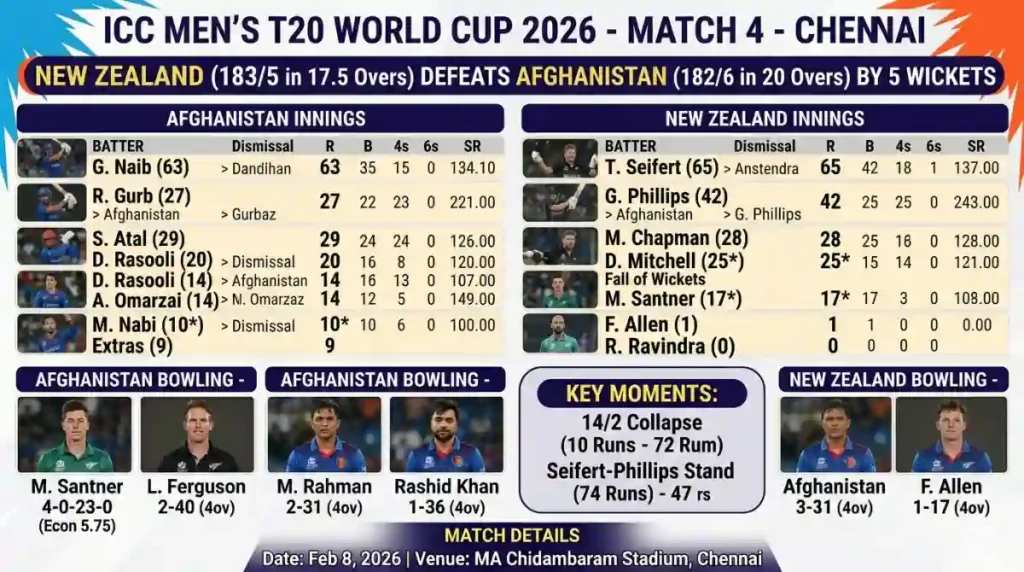

New Zealand beat Afghanistan by 5 wickets in Match 4, Group D of the ICC Men’s T20 World Cup 2026 at MA Chidambaram Stadium, Chennai, on February 8, 2026. Chasing 183, New Zealand reached the target in 17.5 overs with 13 balls to spare their highest ever successful run chase in T20 World Cup history. Tim Seifert anchored the innings with 65 off 42 balls to win the Player of the Match award, while Gulbadin Naib’s 63 off 35 starred for Afghanistan. This new zealand national cricket team vs afghanistan national cricket team match scorecard is a complete, ball-by-ball verified record of one of T20 cricket’s most dramatic comeback chases in 2026.
Match Summary at a Glance
| Detail | Information |
| Match | 4th Match, Group D, ICC Men’s T20 World Cup 2026 |
| Venue | MA Chidambaram Stadium, Chennai |
| Date | Sunday, February 8, 2026 11:00 AM IST |
| Toss | Afghanistan won; elected to bat first |
| Afghanistan Score | 182/6 (20 overs) |
| New Zealand Score | 183/5 (17.5 overs) |
| Result | New Zealand won by 5 wickets |
| Player of the Match | Tim Seifert (65 off 42) |
| Umpires | Alex Wharf (ENG), Langton Rusere (ZIM), Adrian Holdstock (SA) |
The new zealand national cricket team vs afghanistan national cricket team match scorecard shows New Zealand chasing down 183 in 17.5 overs (183/5), with Tim Seifert’s 65 and Glenn Phillips’ 42 forming the decisive partnership that overcame a 14/2 collapse.
Full Scorecard: Afghanistan Innings 182/6 (20 Overs)
The new zealand national cricket team vs afghanistan national cricket team match scorecard begins with Afghanistan posting a competitive 182/6. Despite losing their top two wickets inside six overs, Gulbadin Naib’s career-best 63 and a Naib-Atal stand of 79 built a total that tested New Zealand right to the final over.
Afghanistan Batting
| Batter | Dismissal | R | B | 4s | 6s | SR |
| Rahmanullah Gurbaz (wk) | b L Ferguson | 27 | 22 | 2 | 1 | 122.73 |
| Ibrahim Zadran | c G Phillips b L Ferguson | 10 | 12 | 1 | 0 | 83.33 |
| Gulbadin Naib | c TL Seifert b R Ravindra | 63 | 35 | 3 | 4 | 180.00 |
| Sediqullah Atal | c TL Seifert b JA Duffy | 29 | 24 | 2 | 0 | 120.83 |
| Darwish Rasooli | c G Phillips b M Henry | 20 | 13 | 1 | 1 | 153.85 |
| Azmatullah Omarzai | run out (L Ferguson / J Neesham) | 14 | 7 | 0 | 2 | 200.00 |
| Mohammad Nabi | Not out | 10 | 7 | 0 | 1 | 142.86 |
| Extras | (w-6, lb-3) | 9 | ||||
| TOTAL | 182/6 in 20 Overs | RR: 9.10 |
Did not bat: Rashid Khan (c), Fazalhaq Farooqi, Mujeeb Ur Rahman, Ziaur Rahman Sharifi
Fall of Wickets: 35-1 (Ibrahim Zadran, 5.1 ov) 44-2 (Rahmanullah Gurbaz, 5.6 ov) 123-3 (Sediqullah Atal, 14.3 ov) 156-4 (Gulbadin Naib, 17.2 ov) 164-5 (Darwish Rasooli, 18.1 ov) 182-6 (Azmatullah Omarzai, 19.6 ov)
New Zealand Bowling Figures
| Bowler | Ov | M | R | W | WD | NB | Econ |
| Matt Henry | 4 | 0 | 27 | 1 | 0 | 0 | 6.75 |
| Jacob Duffy | 3 | 0 | 30 | 1 | 2 | 0 | 10.00 |
| Lockie Ferguson | 4 | 0 | 40 | 2 | 1 | 0 | 10.00 |
| James Neesham | 3 | 0 | 33 | 0 | 1 | 0 | 11.00 |
| Mitchell Santner (c) | 4 | 0 | 23 | 0 | 1 | 0 | 5.75 |
| Glenn Phillips | 1 | 0 | 12 | 0 | 1 | 0 | 12.00 |
| Rachin Ravindra | 1 | 0 | 14 | 1 | 0 | 0 | 14.00 |
Full Scorecard: New Zealand Innings 183/5 (17.5 Overs)
This section of the new zealand national cricket team vs afghanistan national cricket team match scorecard is where the real story lives. New Zealand’s batting card tells the story of a team that refused to let history repeat itself converting a 14/2 crisis into a record-breaking, tournament-defining chase
New Zealand Batting
| Batter | Dismissal | R | B | 4s | 6s | SR |
| Finn Allen | b Mujeeb Ur Rahman | 1 | 2 | 0 | 0 | 50.00 |
| Tim Seifert (wk) | c A Omarzai b M Nabi | 65 | 42 | 7 | 3 | 154.76 |
| Rachin Ravindra | b Mujeeb Ur Rahman | 0 | 1 | 0 | 0 | 0.00 |
| Glenn Phillips | b Rashid Khan | 42 | 25 | 7 | 1 | 168.00 |
| Mark Chapman | c R Khan b A Omarzai | 28 | 17 | 2 | 1 | 164.71 |
| Daryl Mitchell | Not out | 25* | 14 | 1 | 1 | 178.57 |
| Mitchell Santner (c) | Not out | 17* | 8 | 2 | 1 | 212.50 |
| Extras | (w-3, nb-2) | 5 | ||||
| TOTAL | 183/5 in 17.5 Overs | RR: 10.26 |
Did not bat: James Neesham, Matt Henry, Lockie Ferguson, Jacob Duffy
Fall of Wickets: 14-1 (Finn Allen, 1.3 ov) 14-2 (Rachin Ravindra, 1.4 ov) 88-3 (Glenn Phillips, 9.2 ov) 124-4 (Tim Seifert, 12.5 ov) 155-5 (Mark Chapman, 15.4 ov)
Afghanistan Bowling Figures
| Bowler | Ov | M | R | W | WD | NB | Econ |
| Fazalhaq Farooqi | 2 | 0 | 25 | 0 | 0 | 0 | 12.50 |
| Mujeeb Ur Rahman | 4 | 0 | 31 | 2 | 0 | 0 | 7.75 |
| Azmatullah Omarzai | 3.5 | 0 | 40 | 1 | 2 | 1 | 10.43 |
| Rashid Khan (c) | 4 | 0 | 36 | 1 | 0 | 0 | 9.00 |
| Ziaur Rahman Sharifi | 3 | 0 | 33 | 0 | 1 | 1 | 11.00 |
| Mohammad Nabi | 1 | 0 | 18 | 1 | 0 | 0 | 18.00 |
Key Match Stats at a Glance
- Highest T20 World Cup chase by NZ: 183 (this match, 2026)
- Gulbadin Naib strike rate: 180.00 (63 off 35) career-best T20I knock
- Mujeeb impact: 2 wickets in 4 consecutive balls, over 1.3 to 1.4
- Most economical bowler: Mitchell Santner 4-0-23-0 (Econ: 5.75)
- Seifert-Phillips stand: 74 runs off ~47 balls
- Balls to spare: 13
- NZ powerplay score (183 chase): 52/2 strong recovery despite early double strike
- Afghanistan powerplay: 44/2 below their typical 60+ benchmark
- Group D points after this match: NZ 2 pts (+1.161 NRR); AFG 0 pts (-1.161 NRR)
The Match Story: When Crisis Became Catalyst
When Finn Allen (1 off 2) and Rachin Ravindra (0 off 1) fell in the same Mujeeb Ur Rahman over, the scoreboard read 14/2 in just 1.4 overs. Half the cricketing world expected New Zealand to crumble a flashback to Guyana 2024, when Afghanistan bowled them out for a humiliating 75. That was not a defeat. It was a demolition that changed both teams’ T20 identities.
What happened next on this hot Chennai morning was not just a match result. It was a correction. A statement. An act of institutional cricket memory.
Afghanistan Batting Analysis: How Naib Built a Dangerous Total
Afghanistan posted 182/6 in 20 overs against New Zealand in the T20 World Cup 2026 match scorecard. Gulbadin Naib top-scored with 63 off 35 balls (SR: 180.00), supported by Sediqullah Atal’s 29 and Darwish Rasooli’s cameo of 20 off 13.
Most people assumed Afghanistan’s batting formula depended entirely on Rahmanullah Gurbaz’s explosive starts or Rashid Khan’s finishing. This match tore that assumption apart. Both Gurbaz (27 off 22) and Ibrahim Zadran (10 off 12) fell inside 5.6 overs, leaving Afghanistan at 44/2 exactly the kind of start that deflates a batting lineup.
The Atal-Naib Partnership: Afghanistan’s Real Batting Weapon
Instead of collapsing, Sediqullah Atal and Gulbadin Naib stitched a 79-run partnership that became the structural backbone of Afghanistan’s 182. What most people miss: Atal had already scored 52 in Afghanistan’s T20 World Cup 2026 warm-up match. He was in form before the tournament began, and his patience in building the stand before handing the acceleration to Naib was tactically intelligent.
Naib’s 63 off 35 was not a slog it was calculated violence. He picked his lengths early, drove on the rise through the off side, and launched full deliveries over the leg boundary. His strike rate of 180.00 is elite territory for a player historically considered a utility cricketer.
Key takeaway: Afghanistan’s middle-order depth not just Rashid or Gurbaz is now a genuine tournament threat.
Death Overs: When Omarzai and Rasooli Turned 156 into 182
After Naib fell for 63 in over 17.2, Afghanistan still needed to push beyond 160. Darwish Rasooli (20 off 13, SR: 153.85) and Azmatullah Omarzai (14 off 7, SR: 200.00) ensured the lower order firepower was not wasted. The total moved from 156/4 to 182/6 a 26-run burst in 2.4 overs that made the chase genuinely difficult.
Rashid Khan’s post-match honesty stood out: Afghanistan left runs on the table in the powerplay, where only 44/2 from a 60-capable top order was underperformance. That kind of self-awareness is rare at the top level and signals a team that will be dangerous if they tighten their opening partnerships.
New Zealand Batting Analysis: From 14/2 to Record Chase
New Zealand chased 183 in 17.5 overs (183/5) in the T20 World Cup 2026. After losing two wickets in over two to Mujeeb Ur Rahman, Tim Seifert (65) and Glenn Phillips (42) added 74 runs to turn the match. Daryl Mitchell (25*) and Mitchell Santner (17*) sealed the win with 13 balls to spare.
Here is the counterintuitive truth that most match reports miss: New Zealand’s 14/2 collapse was actually the best thing that happened to them. It removed any temptation to ease in gently. Seifert and Phillips had no option but to bat with absolute clarity and aggression from ball one and they did it with extraordinary composure for batters under that kind of pressure.
Mujeeb’s Over: The Moment Everything Tipped
Mujeeb Ur Rahman’s over 1.3-1.4 double strike bowling Allen and Ravindra in consecutive deliveries was the kind of passage that wins T20 tournaments. For a fraction of a second, 2024 felt very close.
But here is the real problem Afghanistan created for themselves: Mujeeb’s threat was entirely front-loaded. Once his 4 overs were done (2/31, Econ: 7.75), no other bowler could replicate that control. Rashid Khan (4 overs, 1/36, Econ: 9.00) the greatest T20 bowler alive on most days was expensive by his own elite standards. Farooqi went wicketless in 2 overs at 12.50 economy. Ziaur Rahman bled 11 per over. The middle overs became open highway.
The Seifert-Phillips Partnership: 74 Runs That Changed Everything
Tim Seifert walked in at 14/2 facing the second ball of over two. What followed was a masterclass in pressure absorption. His 65 off 42 (7 fours, 3 sixes, SR: 154.76) was not flashy it was deliberate, gap-finding cricket that refused to allow Rashid to settle.
Glenn Phillips (42 off 25, SR: 168.00, 7 fours, 1 six) was the aggressor targeting even Rashid, the world’s best T20 spinner, with a combination of sweep shots, inside-out drives, and clean hitting. Together, Seifert and Phillips added 74 runs, transforming the required rate from a 9.5 sprint into a controlled 8.0 jog.
The dropped catch that changed the match: Rashid Khan missed a regulation chance off Seifert when the batter was on 48. Had that been taken, the match ends differently. Small margins. Permanent consequences.
Chapman, Mitchell, and Santner: The Surgical Finish
Mark Chapman (28 off 17, SR: 164.71) stepped in after Phillips was bowled by Rashid in over 9.2. His 28 two fours, one six kept the pressure on Afghanistan without any rebuild period. Daryl Mitchell (25* off 14, SR: 178.57) and Mitchell Santner (17* off 8, SR: 212.50) then sealed the deal.
What most match reports undervalue: Santner’s all-round contribution is the real story of this match. He bowled 4 overs for just 23 runs at 5.75 economy the most economical figures of any bowler from either side on this surface and then finished the chase with a strike rate of 212.50. Captain. Anchor bowler. Finisher. That is what makes a tournament-winning team.
Match Phase Breakdown: Where the Game Was Won and Lost
| Phase | AFG (Batting) | NZ (Batting) | Momentum |
| Powerplay (Ov 1-6) | 44/2 top order underperformed | 52/2 double strike, recovered fast | Even |
| Middle Overs (Ov 7-14) | 79 runs Naib-Atal dominant | 72 runs Seifert-Phillips take control | NZ edge |
| Death Overs (Ov 15-20) | 59 runs in 6 overs | 59 runs in 4 overs | NZ dominant |
Key takeaway: New Zealand won this match in the middle overs and finished it in the death. Afghanistan built their total in the same windows but NZ’s chase execution was more efficient by 2 overs.
Key Turning Points You Missed
Most match reports provide the new zealand national cricket team vs afghanistan national cricket team match scorecard without explaining the why behind each momentum shift. Here is the real sequence that decided this game:
- Over 1.3–1.4 (Mujeeb’s double strike): 14/2 devastating start, but Mujeeb’s full 4-over quota was front-loaded. The threat had a ceiling
- Overs 3–9 (Seifert-Phillips build): NZ moved from 14/2 to 88/3 a 74-run recovery stand permanently reset the required rate
- Over 9.2 (Rashid bowls Phillips): The one genuine moment Rashid looked like the 2024 version of himself. But it came too late NZ needed 95 off 64 at that point
- Over 12.5 (Rashid drops Seifert on 48): The single most decisive moment of the match. Seifert went on to 65
- Over 17.4 (Daryl Mitchell six off full toss): The psychological knockout. A mishit off Omarzai still cleared the rope, leveled scores, and confirmed what everyone already sensed
- Afghanistan’s bowling (overs 7–16): Five of six bowlers leaked above 9 runs per over. Mujeeb was the exception but one exceptional bowler cannot contain a chase of this magnitude alone
Bowling Analysis: Where Afghanistan Lost Control
New Zealand’s bowling was led by Lockie Ferguson (2/40) and Matt Henry (1/27, Econ: 6.75). Mitchell Santner was the standout with 4-0-23-0 (Econ: 5.75). Afghanistan’s bowling was led by Mujeeb Ur Rahman (2/31), but inconsistency across the rest of the attack including Rashid’s 1/36 at Econ 9.00 cost them the match.
New Zealand’s Disciplined Attack
Matt Henry (4 overs, 1/27, Econ: 6.75) was the most disciplined new-ball bowler in the game a hit-the-deck approach that unsettled both Gurbaz and Zadran early and set the defensive template. Mitchell Santner (4 overs, 0/23, Econ: 5.75) was the finest bowling performance of the match. On a Chennai surface that assists spin, leaking fewer than 6 runs per over across 4 overs while keeping Afghan big-hitters quiet is exceptional.
Lockie Ferguson (4 overs, 2/40) took the two most important wickets Gurbaz and Zadran but leaked in the powerplay. Jacob Duffy (3 overs, 1/30) was expensive, and James Neesham (3 overs, 0/33, Econ: 11.00) remains a bowling liability in future knockout matches if teams target him.
Afghanistan’s Bowling: Brilliance Without Backup
Mujeeb Ur Rahman (4 overs, 2/31, Econ: 7.75) was the best bowler in the match by numbers but his impact was entirely concentrated in one over. The uncomfortable truth for Afghanistan fans: once Mujeeb’s quota ended, the plan unravelled. Rashid at 9.00 economy is below-average Rashid. Farooqi at 12.50 economy is ineffective Farooqi. Ziaur Rahman at 11.00 economy should not bowl in crunch T20 World Cup situations without tighter control.
Afghanistan leaked runs in 5 of their 6 bowling options. That is a systemic bowling weakness, not a one-off performance dip. Until they fix their middle-overs consistency beyond Mujeeb, teams will target overs 7–14 relentlessly.
Head-to-Head Context: Revenge Served Cold
In T20Is, New Zealand and Afghanistan have played 3 matches. NZ lead with 2 wins; AFG have 1 win (the 2024 T20 WC massacre). In all T20 formats, NZ have won 4 of 5 encounters against Afghanistan.
| Match | Venue | NZ Score | AFG Score | Result |
| T20 WC 2021 | Abu Dhabi | 125/2 | 124/8 | NZ won |
| T20 WC 2024 | Guyana | 75/10 | 159/6 | AFG won |
| T20 WC 2026 | Chennai | 183/5 | 182/6 | NZ won |
The 2024 Guyana match belongs in cricket’s anthology of upsets. Rashid Khan (4 wickets) and Fazalhaq Farooqi (4/17 in 3.2 overs) dismantled New Zealand’s batting lineup so completely that the Black Caps never recovered bowled out for 75 in a chase of 160. It was not a defeat. It was a tactical demolition.
New Zealand’s response in 2026? Chase 183 on a Chennai surface against the same team, using the institutional memory of that humiliation as fuel. The fact they set their highest ever T20 World Cup chase record in this specific fixture not against a minnow, not in a dead rubber, but against the team that defined their worst T20 moment is not coincidence. That is preparation meeting pressure. That is a team that used failure as data.
Rashid Khan’s career T20 World Cup record against NZ: 5 wickets in 2 matches at economy 5.5. Still dominant. Still world-class. But no longer sufficient on its own when the rest of the bowling attack cannot hold their end.
Read More About – India National Cricket Team Vs Pakistan National Cricket Team Stats: Full Head-to-Head Record Across All Formats (Updated 2026)
What This Result Means for Group D
After Match 4 of the T20 World Cup 2026 Group D, New Zealand leads with 2 points and NRR of +1.161. Afghanistan are bottom with 0 points and NRR of -1.161.
Group D Standings After NZ vs AFG (February 8, 2026)
| Position | Team | Played | Won | Lost | Points | NRR |
| 1 | New Zealand | 1 | 1 | 0 | 2 | +1.161 |
| 2 | Canada | 0 | 0 | 0 | 0 | 0 |
| 3 | UAE | 0 | 0 | 0 | 0 | 0 |
| 4 | South Africa | 0 | 0 | 0 | 0 | 0 |
| 5 | Afghanistan | 1 | 0 | 1 | 0 | -1.161 |
New Zealand’s win achieves three concrete objectives in Group D:
- First-mover advantage at the top of the table in a short-format tournament, a strong NRR from the opening match can be the difference between qualification and elimination
- Afghanistan is immediately under pressure a loss in their tournament opener against a top-ranked NZ side means they must win their remaining group matches to stay alive
- NZ’s batting depth puts every team on notice a 183-run successful chase requires contributions from positions 1 through 7. South Africa, India, England are all watching New Zealand’s middle order very carefully now
As Santner noted post-match, playing across seven different venues in this tournament means reading pitch conditions quickly is the non-negotiable skill. In Chennai, against spin, on a surface with an average first-innings score of 162, New Zealand exceeded that average by 21 in the chase and finished with 13 balls to spare. They passed the conditions test in the hardest possible way under maximum pressure.
Frequently Asked Questions
Q1. What was the result of the New Zealand vs Afghanistan T20 World Cup 2026 match?
Ans. New Zealand beat Afghanistan by 5 wickets in Match 4, Group D at MA Chidambaram Stadium, Chennai, on February 8, 2026. Chasing 183, NZ reached the target in 17.5 overs with 13 balls to spare their highest ever T20 World Cup run chase.
Q2. What was the full scorecard of NZ vs AFG T20 World Cup 2026?
Ans. Afghanistan posted 182/6 (20 overs): Naib 63 (35), Atal 29 (24), Rasooli 20 (13). New Zealand replied with 183/5 (17.5 ov): Seifert 65 (42), Phillips 42 (25), Chapman 28 (17), Mitchell 25* (14), Santner 17* (8). This new zealand national cricket team vs afghanistan national cricket team match scorecard is verified from ESPNcricinfo and ICC records.
Q3. Who was Player of the Match in NZ vs AFG T20 World Cup 2026?
Ans. Tim Seifert won the Player of the Match award for his innings of 65 off 42 balls (7 fours, 3 sixes, SR: 154.76). He came in at 14/2 and anchored the chase with a 74-run partnership alongside Glenn Phillips.
Q4. Who took the most wickets for Afghanistan against New Zealand?
Ans. Mujeeb Ur Rahman took 2/31 in 4 overs (Economy: 7.75), dismissing Finn Allen and Rachin Ravindra in consecutive deliveries. Rashid Khan (1/36), Azmatullah Omarzai (1/40), and Mohammad Nabi (1/18) each claimed one wicket.
Q5. Who was the top wicket-taker for New Zealand against Afghanistan?
Ans. Lockie Ferguson claimed 2/40 in 4 overs the most wickets by a single NZ bowler. Matt Henry (1/27), Jacob Duffy (1/30), and Rachin Ravindra (1/14) each took one wicket. Mitchell Santner was wicketless but the most economical at 5.75 runs per over.
Q6. Was this New Zealand’s highest successful T20 World Cup chase?
Ans. Yes. New Zealand’s chase of 183/5 in 17.5 overs against Afghanistan at Chennai is officially their highest successful run chase in T20 World Cup history surpassing all previous T20 World Cup chases in their tournament record.
Q7. Who won the toss in NZ vs AFG T20 World Cup 2026?
Ans. Afghanistan won the toss and elected to bat first at MA Chidambaram Stadium, Chennai. They posted 182/6, which proved insufficient as New Zealand chased down the target with 13 balls to spare.
Q8. What was the Seifert-Phillips partnership total in NZ vs AFG?
Ans. Tim Seifert and Glenn Phillips added 74 runs together for the 3rd wicket the crucial partnership that rescued New Zealand from 14/2 and turned the chase from a crisis into a controlled run-rate chase. Seifert scored 65, Phillips 42.
Q9. What was Gulbadin Naib’s score and how was he dismissed?
Ans. Gulbadin Naib scored 63 off 35 balls (3 fours, 4 sixes, SR: 180.00) a career-best T20I innings. He was caught by Tim Seifert off Rachin Ravindra’s bowling in over 17.2 of Afghanistan’s innings.
Q10. What is the head-to-head record between New Zealand and Afghanistan in T20Is?
Ans. In T20Is, New Zealand lead 2–1 in 3 matches. NZ won in 2021 (Abu Dhabi, T20 WC), Afghanistan won in 2024 (Guyana, T20 WC), and NZ won again in 2026 (Chennai, T20 WC). In all T20 formats, NZ lead 4–1 in 5 encounters.