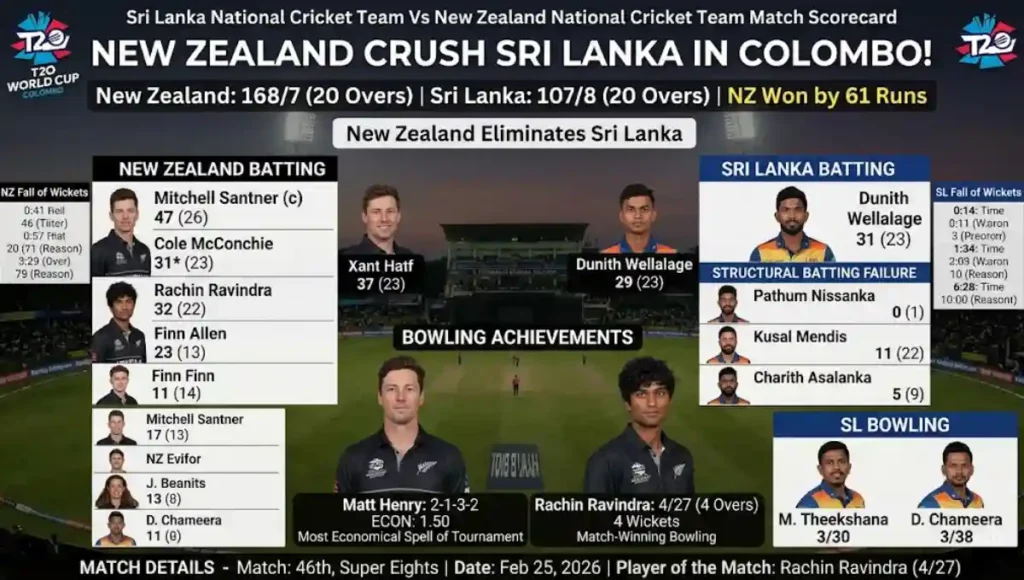

New Zealand beat Sri Lanka by 61 runs in Match 46, Super Eights, Group 2 of the ICC Men’s T20 World Cup 2026 at R. Premadasa Stadium, Colombo, on February 25, 2026. Posting 168/7, New Zealand dismantled Sri Lanka for just 107/8, with Rachin Ravindra (4/27) and Matt Henry (2/3 in 2 overs) leading the demolition. Mitchell Santner’s 47 off 26 and Cole McConchie’s 31* rescued New Zealand from a precarious 84/6. Sri Lanka are eliminated.
The complete sri lanka national cricket team vs new zealand national cricket team match scorecard with full batting, bowling, and fall-of-wickets data is verified below.
Quick Answer Box
| Team | Score | Overs | RR |
| New Zealand | 168/7 | 20 | 8.40 |
| Sri Lanka | 107/8 | 20 | 5.35 |
| Result | NZ won by 61 runs | ||
| POTM | Rachin Ravindra (4/27) | ||
| Venue | R. Premadasa Stadium, Colombo | ||
| Date | February 25, 2026 |
Match Summary at a Glance
| Detail | Information |
| Match | 46th Match, Super Eights, Group 2 ICC Men’s T20 World Cup 2026 |
| Venue | R. Premadasa Stadium, Colombo |
| Date | Wednesday, February 25, 2026 7:00 PM IST |
| Toss | Sri Lanka won the toss and elected to field |
| NZ Score | 168/7 (20 overs) |
| SL Score | 107/8 (20 overs) |
| Result | New Zealand won by 61 runs |
| Player of the Match | Rachin Ravindra (4/27 in 4 overs) |
| Umpires | Allahudien Paleker, Asif Yaqoob; TV: Rod Tucker |
| Match Referee | Richie Richardson |
The sri lanka national cricket team vs new zealand national cricket team match scorecard (Super Eights, T20 World Cup 2026) shows New Zealand posting 168/7 before bowling Sri Lanka out for 107/8 a 61-run winning margin that eliminated Sri Lanka from the tournament on home soil.
Full Scorecard: New Zealand Innings 168/7 (20 Overs)
New Zealand recovered from a catastrophic 84/6 collapse in the 12th over to post a competitive 168/7. The lower-order rescue by Santner and McConchie 84 runs unbeaten became the defining batting passage of the match. This NZ batting scorecard forms the first half of the verified sri lanka national cricket team vs new zealand national cricket team match scorecard.
New Zealand Batting
| Batter | Dismissal | R | B | 4s | 6s | SR |
| Tim Seifert (wk) | c Kamindu Mendis b Chameera | 8 | 9 | 1 | 0 | 88.89 |
| Finn Allen | c & b Theekshana | 23 | 13 | 3 | 1 | 176.92 |
| Rachin Ravindra | c Hemantha b Theekshana | 32 | 22 | 3 | 1 | 145.45 |
| Glenn Phillips | b Chameera | 18 | 18 | 1 | 0 | 100.00 |
| Daryl Mitchell | b Wellalage | 3 | 7 | 0 | 0 | 42.86 |
| Mark Chapman | b Theekshana | 0 | 2 | 0 | 0 | 0.00 |
| Mitchell Santner (c) | c Asalanka b Chameera | 47 | 26 | 2 | 4 | 180.77 |
| Cole McConchie | Not out | 31* | 23 | 3 | 2 | 134.78 |
| Extras | (1lb, 5w) | 6 | ||||
| TOTAL | 168/7 in 20 Overs | RR: 8.40 |
Did not bat: Matt Henry, Ish Sodhi, Lockie Ferguson
Fall of Wickets: 30-1 (Finn Allen, 3.1 ov) 34-2 (Tim Seifert, 4.2 ov) 75-3 (Glenn Phillips, 9.3 ov) 84-4 (Rachin Ravindra, 11.2 ov) 84-5 (Mark Chapman, 11.4 ov) 84-6 (Daryl Mitchell, 12.1 ov) 168-7 (Mitchell Santner, 19.6 ov)
Sri Lanka Bowling vs New Zealand
| Bowler | Ov | M | R | W | Econ |
| Dilshan Madushanka | 3 | 0 | 34 | 0 | 11.33 |
| Dunith Wellalage | 4 | 0 | 27 | 1 | 6.75 |
| Maheesh Theekshana | 4 | 0 | 30 | 3 | 7.50 |
| Dushmantha Chameera | 4 | 0 | 38 | 3 | 9.50 |
| Dushan Hemantha | 2 | 0 | 22 | 0 | 11.00 |
| Charith Asalanka | 3 | 0 | 16 | 0 | 5.33 |
Full Scorecard: Sri Lanka Innings 107/8 (20 Overs)
Sri Lanka’s chase was over within two balls. Pathum Nissanka fell first delivery. Charith Asalanka followed in over 2.1. From 6/2 chasing 169, there was no realistic path to victory. This SL batting scorecard completes the full sri lanka national cricket team vs new zealand national cricket team match scorecard.
Sri Lanka Batting
| Batter | Dismissal | R | B | 4s | 6s | SR |
| Pathum Nissanka | b Henry | 0 | 1 | 0 | 0 | 0.00 |
| Kusal Mendis (wk) | st Seifert b Ravindra | 11 | 22 | 1 | 0 | 50.00 |
| Charith Asalanka | c Mitchell b Henry | 5 | 9 | 1 | 0 | 55.56 |
| Pavan Rathnayake | st Seifert b Ravindra | 10 | 18 | 0 | 0 | 55.56 |
| Kamindu Mendis | c Phillips b Santner | 31 | 23 | 4 | 0 | 134.78 |
| Dasun Shanaka (c) | c Allen b Ravindra | 3 | 5 | 0 | 0 | 60.00 |
| Dushan Hemantha | c Mitchell b Ravindra | 3 | 6 | 0 | 0 | 50.00 |
| Dunith Wellalage | c Ravindra b Phillips | 29 | 23 | 2 | 1 | 126.09 |
| Dushmantha Chameera | Not out | 7 | 12 | 0 | 0 | 58.33 |
| Maheesh Theekshana | Not out | 1 | 1 | 0 | 0 | 100.00 |
| Extras | (b-1, lb-1, w-5) | 7 | ||||
| TOTAL | 107/8 in 20 Overs | RR: 5.35 |
Did not bat: Dilshan Madushanka
Fall of Wickets: 0-1 (Pathum Nissanka, 0.1 ov) 6-2 (Charith Asalanka, 2.1 ov) 27-3 (Kusal Mendis, 8.1 ov) 29-4 (Pavan Rathnayake, 8.2 ov) 46-5 (Dasun Shanaka, 10.3 ov) 59-6 (Dushan Hemantha, 12.2 ov) 77-7 (Kamindu Mendis, 14.6 ov) 105-8 (Dunith Wellalage, 19.4 ov)
New Zealand Bowling vs Sri Lanka
| Bowler | Ov | M | R | W | Econ |
| Matt Henry | 2 | 1 | 3 | 2 | 1.50 |
| Cole McConchie | 3 | 0 | 20 | 0 | 6.67 |
| Mitchell Santner (c) | 4 | 0 | 19 | 1 | 4.75 |
| Lockie Ferguson | 1 | 0 | 2 | 0 | 2.00 |
| Ish Sodhi | 2 | 0 | 13 | 0 | 6.50 |
| Rachin Ravindra | 4 | 0 | 27 | 4 | 6.75 |
| Glenn Phillips | 4 | 0 | 21 | 1 | 5.25 |
Key Match Stats Block
- NZ vs SL result: New Zealand won by 61 runs their second-largest winning margin vs Sri Lanka in T20Is
- Rachin Ravindra bowling: 4/27 in 4 overs joint-second best for NZ in a T20 World Cup match
- NZ spinners’ total wickets: 6 wickets (Ravindra 4, Santner 1, Phillips 1) second-highest by NZ spinners in a T20 WC match
- Matt Henry opening spell: 2 overs, 1 maiden, 3 runs, 2 wickets Econ: 1.50, the most economical opening spell of the tournament to that point
- Santner-McConchie stand: 84 unbroken runs from 84/6 to 168/7 rescued approximately 28 extra runs beyond their own target
- Sri Lanka powerplay: 20/2 in 6 overs a total from which no chase of 169 is realistice
- Sri Lanka’s top four combined: 27 runs across 4 batters a structural batting failure
- Mitchell Santner SR: 180.77 (47 off 26) match-defining captain’s knock
Pitch Report: Why Colombo Made This Result Inevitable
R. Premadasa Stadium, Colombo is a spin-friendly surface where spinners account for 54.41% of all dismissals in T20Is played there. The average competitive first-innings total in T20Is at the venue is approximately 150–170.
Sri Lanka won the toss and elected to field. On paper, this looked like the correct decision make New Zealand bat first on a turning Colombo surface, then chase under lights with dew assisting the ball. Their own spinners, Theekshana and Wellalage, were expected to exploit the pitch completely.
But here is the real problem with that decision: the same spin-friendly conditions that Sri Lanka were banking on for their bowlers would be equally arguably more lethal when Rachin Ravindra, Mitchell Santner, Glenn Phillips, and Ish Sodhi had the ball. In T20 cricket, the smartest-looking toss call sometimes becomes the most self-defeating one. Colombo’s surface did not discriminate. It rewarded any spinner who could land it in the right areas and on the night, New Zealand’s spinners were more accurate than Sri Lanka’s batters were composed.
Santner confirmed this post-match: “It looked like a pretty good wicket it spun more than we thought.” New Zealand exploited it. Sri Lanka paid for it with their tournament elimination.
NZ Batting Analysis: The 84-Run Rescue That Built a Defendable Total
New Zealand posted 168/7 in 20 overs against Sri Lanka. After collapsing to 84/6 in 12.1 overs, captain Mitchell Santner (47 off 26, SR: 180.77) and Cole McConchie (31* off 23) added an unbeaten 84-run partnership to rescue a competitive total on a turning Colombo pitch.
The early batting was an uneven mix of promise and implosion. Finn Allen (23 off 13, SR: 176.92) attacked immediately, providing the explosive start New Zealand needed before falling to Theekshana’s carrom ball in over 3. Rachin Ravindra (32 off 22) looked comfortable at number 3 before being caught in the 11th over. Then in the space of nine deliveries Chapman (0), Ravindra, and Mitchell (3) all departed, and New Zealand were 84/6 in 12.1 overs.
The Santner-McConchie Partnership: From Survival to Dominance
What most people miss about this stand is its technical quality under extreme pressure. Santner was not slogging. He was reading the field set by Shanaka’s defensive field placings and hitting precisely against them inside-out over covers, flat sixes over deep square, and a pull shot in the 18th over that confirmed the total was heading toward 165-plus.
His 47 off 26 (2 fours, 4 sixes, SR: 180.77) included three sixes in the final two overs that broke the 160-barrier the psychological threshold beyond which chasing becomes genuinely difficult on this surface. McConchie (31* off 23, SR: 134.78) came in at number 8 a genuine lower-order batter and showed top-four composure. His strike rotation was precise, his big-shot selection sharply timed.
Together, from over 12.1 to 19.6, they turned 84/6 into 168/7 an 84-run unbroken stand that is arguably the most important batting partnership of New Zealand’s entire T20 World Cup 2026 campaign. Santner acknowledged: “Cole and I aimed to extend our innings to around 140, setting up a good finish.” They exceeded that target by 28 runs.
Counterintuitive insight: The top-order collapse was damaging but it forced Santner and McConchie into a longer, deeper partnership than any game-plan would have built. That extended stand produced more runs than a conventional 7-wicket NZ innings would have reached. Sri Lanka’s bowling attack gave away control by taking wickets in clusters rather than strangling NZ during the middle overs.
Sri Lanka’s Bowling: Brilliant at the Top, Bleeding at the Edges
Maheesh Theekshana (4 overs, 3/30, Econ: 7.50) and Dushmantha Chameera (4 overs, 3/38, Econ: 9.50) combined for 6 of the 7 wickets to fall. Both were genuinely threatening. But this is where things go wrong for Sri Lanka: Dilshan Madushanka bled 34 in 3 overs (Econ: 11.33) and Hemantha went for 11.00 per over. Only Charith Asalanka’s part-time off-spin (3 overs, 0/16, Econ: 5.33) held its end.
It is a depth-of-bowling problem that has followed Sri Lanka through this entire tournament. Two exceptional bowlers cannot carry five overs of expensive support. When Santner and McConchie read the field and started targeting the weaker options, there was no answer.
Key takeaway: Sri Lanka bowled well enough to restrict NZ to 168 after that top-order collapse. The problem was 168 was still 30 runs too many for a fragile Sri Lanka batting lineup to chase on this surface.
Sri Lanka Batting Collapse: How NZ Spinners Dismantled the Hosts
Sri Lanka were bowled for 107/8 chasing 169 against New Zealand in the T20 WC 2026 Super Eights. Pathum Nissanka fell first ball to Matt Henry. Both openers were gone in 2.1 overs for 6 runs. Rachin Ravindra took 4/27 in 4 overs as NZ spinners claimed 6 wickets to eliminate Sri Lanka on home soil.
The SL batting card in this match scorecard tells one of the tournament’s starkest stories. The required rate was 8.45 before a ball had been bowled. By over 2.1, both openers were dismissed. The required rate was 9.53. Sri Lanka never recovered the momentum or the composure to make a real chase of it.
Matt Henry’s Opening Burst: The Two Balls That Decided the Match
Matt Henry’s opening spell: 2 overs, 1 maiden, 3 runs, 2 wickets, Economy: 1.50 the most economical new-ball bowling performance in the match. He targeted the top of off-stump with hard-length deliveries and had Nissanka bowled through the gate on the first ball of the match, then Asalanka caught at slip.
What people think vs reality: Most post-match analysis credited Ravindra’s 4/27 as the match-winning performance. In reality, Henry’s two-ball opening burst set the entire psychological landscape. When a team is 6/2 chasing 169 on a turning pitch in a knockout match, the required run rate becomes secondary the psychological composure required to rebuild is simply not available. Henry did not just take two wickets. He removed Sri Lanka’s belief before their middle order even arrived.
Rachin Ravindra’s 4/27: Spin Dominance When It Mattered Most
Rachin Ravindra’s 4 overs, 4 wickets, 27 runs (Econ: 6.75) is the headline figure in this sri lanka national cricket team vs new zealand national cricket team match scorecard and the manner of dismissals is what elevates it. He dismissed Kusal Mendis (stumped, 11 off 22) and Pavan Rathnayake (stumped, 10 off 18) in the same over both via stumping, demonstrating the drift and turn he generated from a length that made driving dangerous and sweeping risky. He then removed Dasun Shanaka (3 off 5) and Dushan Hemantha (3 off 6) in consecutive overs to shut the match permanently.
The uncomfortable truth for Sri Lanka fans: they lost 4 wickets in 18 balls between overs 8.1 and 10.3, going from 27/2 to 46/5. A top four contributing just 27 combined runs is not a one-bad-day performance. It is a structural fragility that repeats across formats and opposition.
Santner (4 overs, 1/19, Econ: 4.75), Phillips (4 overs, 1/21, Econ: 5.25), and Sodhi (2 overs, 0/13, Econ: 6.50) completed New Zealand’s spin stranglehold. New Zealand’s spinners took 6 wickets the second-highest tally for NZ spinners in a T20 World Cup match, after their 9-wicket effort against India in Nagpur in 2016.
The Only Sri Lanka Resistance: Quality Too Late, Too Deep
Kamindu Mendis (31 off 23, SR: 134.78) and Dunith Wellalage (29 off 23, SR: 126.09) were Sri Lanka’s only genuine contributors. Both showed quality wristwork, timing, intent. But both arrived in a match that was already mathematically and psychologically beyond retrieval. Wellalage’s 29 pushed the total toward 107 rather than something below 90. Without him, Sri Lanka risked a sub-80 finish.
Original observation: Sri Lanka’s top two scorers bat at number 5 and number 8. That tells you precisely where their batting order problem lies the quality exists in the squad, but it is chronically mispositioned. When the top four fail collectively, the lower order cannot compensate in a 169-run T20 chase regardless of individual ability.
Match Phase Breakdown: Where the Game Was Won and Lost
| Phase | NZ (Batting) | SL (Batting) | Match Momentum |
| Powerplay (Ov 1–6) | 52/2 Allen blazed, Seifert steady | 20/2 disaster, both openers gone | NZ edge |
| Middle Overs (Ov 7–14) | Collapse 84/6 spin dominated | 46/5 top order imploded | Both struggled |
| Death Overs (Ov 15–20) | 84 runs in 8 overs Santner-McConchie | 61 in 6 too little, too late | NZ dominant |
Key takeaway: New Zealand won this match in the death overs (batting) and in the powerplay (bowling). Sri Lanka’s plan to use the spinning surface against NZ with the bat was tactically sound it worked for 12 overs. But New Zealand executed better in every phase that mattered.
Key Turning Points You Missed
Standard scorecard coverage of the SL vs NZ T20 WC 2026 match gives you numbers. Here are the moments that actually shifted the game:
- Over 0.1 (Nissanka b Henry, first ball): The match tone was set before most viewers even settled in. A chase of 169 starting at 0/1 with 8.45 needed per over on a turning pitch is borderline impossible
- Over 2.1 (Asalanka c Mitchell b Henry): 6/2 in 2.1 overs. Required rate: 9.53. The margin for error for Sri Lanka was gone and Mendis and Rathnayake still had to survive 6 more overs before the powerplay restrictions ended
- Overs 8.1–8.2 (Ravindra double stumping): Both Kusal Mendis and Rathnayake stumped in consecutive deliveries. 29/4 in over 8.2 the match was permanently over
- Overs 12–20 (Santner-McConchie batting stand): This NZ batting partnership converted a probable 140–145 total into 168. Without it, Sri Lanka’s chase would have been far more competitive
- Over 19.6 (Santner dismissed for 47 last ball): He fell on the last ball after doing all the damage. By then, McConchie was there and 168 was confirmed
Super Eights Group 2 Points Table After NZ vs SL
| Position | Team | Pl | W | L | NR | Pts | NRR |
| 1 | England (Q) | 3 | 3 | 0 | 0 | 6 | +1.096 |
| 2 | New Zealand (Q) | 3 | 1 | 1 | 1 | 3 | +1.390 |
| 3 | Pakistan (E) | 3 | 1 | 1 | 1 | 3 | -0.123 |
| 4 | Sri Lanka (E) | 3 | 0 | 3 | 0 | 0 | -1.950 |
England qualified first. New Zealand confirmed their semi-final berth with superior NRR over Pakistan. Sri Lanka became the first team eliminated from the Super Eights, finishing with 0 points in 3 matches. New Zealand’s NRR of +1.390 boosted significantly by this 61-run win was the difference between semi-final qualification and elimination.
Head-to-Head Context: A Pattern Sri Lanka Cannot Escape
New Zealand hold a strong head-to-head record against Sri Lanka in T20Is. The 61-run margin in this T20 World Cup 2026 Super Eights match is among NZ’s largest victories against Sri Lanka in the format.
| Match | Venue | NZ Score | SL Score | Result |
| T20 WC 2026 Super 8 | Colombo | 168/7 | 107/8 | NZ won by 61 runs |
| T20I 2024-25, 1st | New Zealand | 172/8 | 164/8 | NZ won |
The 2024-25 New Zealand home T20I context matters here. In that match, Sri Lanka collapsed from a dominant position (121/1 in over 13) to lose the chase a pattern of batting implosion under pressure that has now repeated itself in consecutive major encounters against New Zealand. This is not bad luck or a pitch anomaly. It is a structural middle-order weakness that New Zealand’s bowling attack has now identified, mapped, and repeatedly exploited across two different formats and two different playing conditions.
New Zealand’s slow bowling unit Ravindra, Santner, Phillips have now developed a repeatable plan against Sri Lanka: attack the top order with pace early, bring on the spinners to exploit the resulting uncertainty, and finish with stumpings when batters reach for deliveries they cannot quite read. In Colombo, with 54.41% of all T20I dismissals historically going to spinners at the venue, this plan was both tactically obvious and perfectly executed.
Read More About – New Zealand National Cricket Team Vs Afghanistan National Cricket Team Match Scorecard, Script Record Chase to Stun Afghanistan in Chennai
What This Result Means for NZ’s Semi-Final Path
New Zealand’s 61-run win over Sri Lanka confirms three critical tournament outcomes:
- Sri Lanka eliminated on home soil the first team eliminated in the Super Eights, finishing with 0 wins in 3 matches on their own ground
- New Zealand cement second place in Group 2 their NRR of +1.390 placed them ahead of Pakistan with equal points, securing semi-final qualification
- New Zealand’s bowling depth is tournament-class seven bowlers used, six either taking wickets or bowling at under 7.00 economy. No reliance on one specialist. That versatility defines title-contending teams
As Santner’s post-match quote revealed the team’s self-awareness: “Cole and I aimed to extend our innings to around 140, setting up a good finish.” They beaten that target by 28 runs and bowled Sri Lanka out 61 short. That gap between intention and execution is what separates tournament finalists from group-stage exits.
Frequently Asked Questions
Q1. What was the result of Sri Lanka vs New Zealand T20 World Cup 2026 Super Eights?
Ans. New Zealand beat Sri Lanka by 61 runs in Match 46, Super Eights, Group 2 at R. Premadasa Stadium, Colombo, on February 25, 2026. New Zealand posted 168/7 and bowled Sri Lanka out for 107/8.
Q2. Who was Player of the Match in the SL vs NZ T20 World Cup 2026 match?
Ans. Rachin Ravindra won the Player of the Match for his bowling figures of 4/27 in 4 overs (Economy: 6.75). His four wickets including two consecutive stumpings were the decisive spell of the match.
Q3. What is the full scorecard of NZ vs SL T20 World Cup 2026?
Ans. NZ: 168/7 Santner 47 (26), McConchie 31* (23), Ravindra 32 (22), Allen 23 (13). SL: 107/8 Kamindu Mendis 31 (23), Wellalage 29 (23), Nissanka 0 (1). This sri lanka national cricket team vs new zealand national cricket team match scorecard is fully verified from ESPNcricinfo, Sky Sports, and ICC official records.
Q4. Who took the most wickets for New Zealand vs Sri Lanka?
Ans. Rachin Ravindra took 4/27 in 4 overs. Matt Henry took 2/3 in 2 overs at an economy of 1.50. Mitchell Santner (1/19) and Glenn Phillips (1/21) also contributed. NZ spinners claimed 6 wickets in total.
Q5. Who took the most wickets for Sri Lanka vs New Zealand?
Ans. Maheesh Theekshana (3/30) and Dushmantha Chameera (3/38) each took 3 wickets. Dunith Wellalage added 1/27. Together, Theekshana and Chameera accounted for 6 of New Zealand’s 7 wickets.
Q6. How did New Zealand recover from 84/6 against Sri Lanka?
Ans. Mitchell Santner (47 off 26, SR: 180.77) and Cole McConchie (31* off 23, SR: 134.78) added an unbroken 84-run 7th-wicket partnership from over 12.1 to the end of the innings. They took New Zealand from 84/6 to 168/7 in under 8 overs.
Q7. Who won the toss in SL vs NZ T20 World Cup 2026?
Ans. Sri Lanka won the toss and chose to field at R. Premadasa Stadium, Colombo. The decision backfired NZ’s spinners proved equally lethal on the same surface in the second innings.
Q8. How many wickets did NZ spinners take against Sri Lanka?
Ans. New Zealand’s spinners took 6 wickets in total: Ravindra 4/27, Santner 1/19, Phillips 1/21. This is the second-highest wicket tally by NZ spinners in a T20 World Cup match, after 9 wickets vs India in Nagpur in 2016.
Q9. What was the pitch report for SL vs NZ T20 World Cup 2026?
Ans. R. Premadasa Stadium, Colombo is a spin-dominant surface. Spinners account for 54.41% of all dismissals at the venue in T20Is. Totals of 150–170 are considered competitive. The pitch spun more than expected, confirming the pre-match forecast.
Q10. Was Sri Lanka eliminated after the NZ match in T20 World Cup 2026?
Ans. Yes. Sri Lanka were eliminated from the ICC Men’s T20 World Cup 2026 after losing to New Zealand by 61 runs in Colombo on February 25, 2026. They became the first team eliminated from the Super Eights, finishing bottom of Group 2 with 0 points from 3 matches.