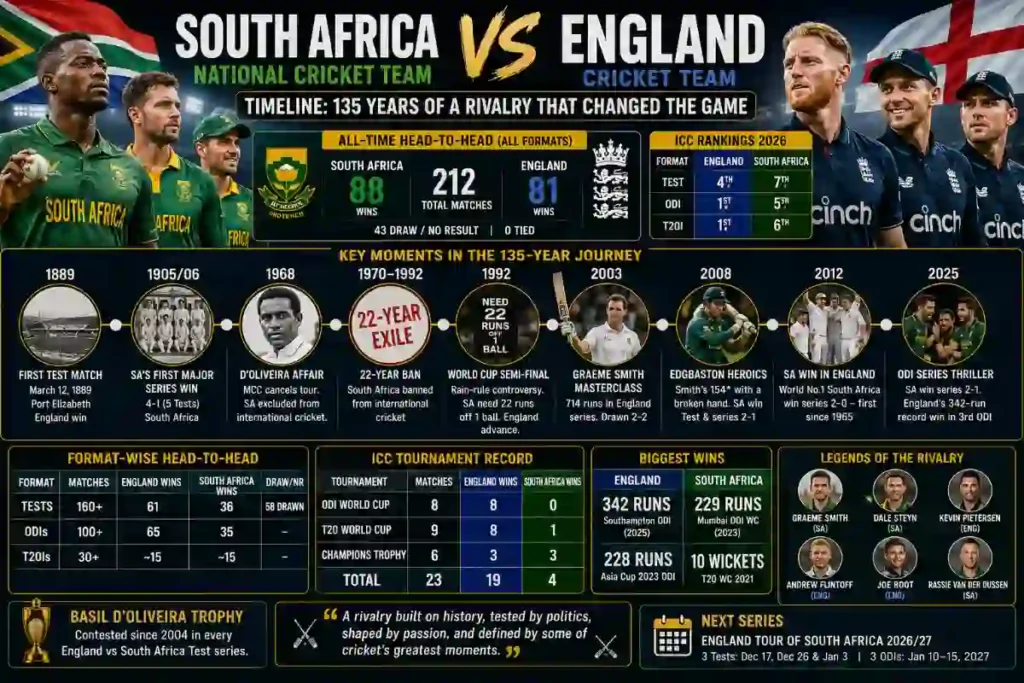

The south africa national cricket team vs england cricket team timeline spans over 135 years from the first Test match in 1889 to the explosive 2025 ODI series. It covers England’s early dominance, South Africa’s rapid rise, a 22-year international exile caused by the apartheid-era D’Oliveira affair (1970–1992), and a fiercely competitive modern era defined by Bazball aggression, elite pace bowling, and results that swing violently in either direction. No bilateral cricket rivalry has been more shaped by politics, more contested across eras, or more unpredictable in its outcomes.
One line you need to understand about this rivalry: It is not driven by talent alone. It is driven by history, politics, and two nations that have never truly settled who is better.
South Africa vs England Cricket Timeline (Quick Chronological Overview)
This is the fastest way to scan 135 years of rivalry. Every fan researching the south africa national cricket team vs england cricket team timeline needs this reference point first.
| Year | Key Event | Result/Impact |
| 1889 | First ever Test match Port Elizabeth | England win |
| 1905/06 | SA’s first major series win 4-1 (5 Tests) | South Africa |
| 1909/10 | SA win at home again, 3-2 | South Africa |
| 1935–1960 | Contested series, rising SA competitiveness | Mixed |
| 1965 | Last pre-ban Test series | South Africa (1-0) |
| 1968 | D’Oliveira Affair political crisis | Turning point |
| 1970–1992 | 22-year international exile for SA | Apartheid ban |
| 1992 | World Cup semi-final rain-rule scandal | England advance |
| 1994 | First post-readmission Test series | Drawn 1-1 |
| 2003 | Graeme Smith scores 714 runs in England | Drawn 2-2 |
| 2004 | Basil D’Oliveira Trophy introduced | Milestone |
| 2004/05 | Michael Vaughan’s England wins Trophy 2-1 | England |
| 2008 | Smith bats with broken hand at Edgbaston | South Africa (2-1) |
| 2012 | SA world No.1 first England series win since 1965 | South Africa (2-0) |
| 2019/20 | England win in SA’s backyard | England (3-1) |
| 2022 | Bazball era launches England win Trophy | England (2-1) |
| 2023 | ICC World Cup SA beat England by 229 runs | South Africa |
| 2025 | SA tour England most volatile ODI series ever | SA (ODI 2-1) |
| 2026/27 | England tour SA Tests from Dec 17 | Upcoming |
Era Comparison: Who Dominated When?
| Era | Dominant Team | One-Line Takeaway |
| 1889–1935 | England | Superior county depth SA on matting wickets |
| 1935–1965 | Contested | SA pace attack developing fast |
| 1970–1992 | No cricket | 22-year apartheid exile |
| 1992–2002 | England (slight edge) | SA rebuilding from scratch |
| 2003–2015 | South Africa | Smith era, world No. 1, Steyn-Morkel-Philander dominance |
| 2015–2021 | England (slight edge) | Root captaincy, SA in transition |
| 2022–2025 | Contested | Bazball vs pace explosive, unpredictable |
Post-1992 rivalry trend: Balanced. South Africa strong at home. England evolving aggressively with Bazball. No team has held a sustained edge for more than a decade since readmission.
The Early Dominance Era (1889–1935)
England dominated South Africa in the early Test era from 1889 to the 1930s, winning consistently due to a superior county cricket system, greater player depth, and South Africa’s reliance on matting wickets that disadvantaged home development.
The south africa national cricket team vs england cricket team timeline begins on March 12, 1889, at St George’s Park, Port Elizabeth South Africa’s very first Test match. England won comprehensively. For the next two decades, England were simply the superior side, winning every series on South African soil.
What Most People Miss About This Era
South Africa were not just technically inferior they were playing on a different surface entirely. Matting wickets at home produced completely different bounce and spin behaviour compared to English grass pitches. England’s county cricketers, exposed to varied conditions across the county circuit, adapted to surfaces far faster than South Africa’s domestic players could.
South Africa’s First Major Upset (1905/06)
Here is the counterintuitive truth about this rivalry’s opening chapter: England’s early dominance was concealing a rapid South African evolution.
By 1905/06, South Africa beat England 4-1 in a five-Test series on home soil their first major series win, which genuinely shocked the cricket world. They followed it with a 3-2 series win in 1909/10. The Proteas were accelerating in development, their margins improving with every campaign.
Then history intervened and it had nothing to do with cricket.
The Affair That Split the Rivalry: Basil D’Oliveira (1968)
The Basil D’Oliveira affair refers to the 1968 political crisis triggered when England selected mixed-race South African Basil D’Oliveira for their tour of South Africa. The apartheid government refused to accept the squad, the MCC cancelled the tour, and South Africa was subsequently excluded from international cricket for 22 years.
Any serious study of the south africa national cricket team vs england cricket team timeline must confront this chapter directly. It is not background context it is the story.
What the D’Oliveira Affair Actually Was
Basil D’Oliveira was a Cape Coloured South African who, because of apartheid, was legally barred from playing professional cricket in his own country. He emigrated to England, qualified as an English citizen, and earned Test selection through performances that any selector could not ignore.
In 1968, after scoring a match-saving 158 at The Oval against Australia, he was named in England’s touring squad for South Africa. The response from South Africa’s apartheid government was immediate: no squad containing a non-white player would be accepted. The MCC cancelled the tour. The ICC and international cricket community followed with a full sporting boycott that lasted 22 years.
What makes this counterintuitive: The D’Oliveira affair did not simply exile South Africa from cricket. It exiled them from an entire era of global sporting evolution the rise of West Indian pace bowling as the dominant Test force, the birth and growth of limited-overs cricket, the development of helmets, modern fitness science, and sports psychology. When South Africa walked back into international cricket in 1992, they were stepping into a sport that had reinvented itself twice without them.
22 Years of Silence: The True Cost
The last England-South Africa Test before the ban was in 1965, when South Africa won 1-0. The next competitive meeting was at the 1992 World Cup in Australia a gap of 27 years.
That gap is not just statistical. It is generational. A full cohort of South African cricketers who might have defined this rivalry at the highest level were permanently denied their opportunity. England, meanwhile, developed an entire era without the team that had historically challenged them most, which may partly explain England’s structural vulnerability against quality away pace bowling that became visible in the 1980s and 1990s.
Readmission and the Broken Rain Rule (1992–2003)
South Africa returned to international cricket at the 1992 World Cup in Australia. Their semi-final against England ended when a rain-rule calculation left South Africa needing an impossible 22 runs off 1 ball. England progressed. The rule was acknowledged as broken even by England’s own players at the time.
The 1992 World Cup Semi-Final Controversy
South Africa’s first competitive match against England in 27 years came at Melbourne in the 1992 World Cup group stage. England won by 3 wickets off the final ball a genuine thriller. But it was the semi-final at Sydney that wrote itself into cricket’s darkest chapters.
South Africa needed 22 runs off 13 balls when rain stopped play. The rain-rule of that era a primitive predecessor to Duckworth-Lewis recalculated the target on resumption: 22 runs off 1 ball. Mathematically impossible. England went through.
What people think: South Africa were unlucky.
What reality shows: The rule was structurally broken not a close call, not marginal. Even England’s players at the time described it as unfair. This moment planted the seeds of a “choking” narrative that would be lazily applied to South Africa for decades ignoring that their first major knockout exit was caused not by failure of nerve, but by a broken administrative system.
The 1994 Comeback Test Series
South Africa’s return to Test cricket against England in 1994 was drawn 1-1 cautious, exploratory cricket from two teams feeling each other out across a 27-year absence. But South Africa had made their statement: they were back, they were competitive, and they were not settling for less.
Graeme Smith Arrives (2003)
The 2003 series marked the arrival of one of cricket’s most important figures in the south africa national cricket team vs england cricket team timeline. A 22-year-old Graeme Smith on debut as Test captain scored 714 runs in a single series in England, including two double centuries. This remains the highest aggregate by any South African captain in a single Test series.
South Africa should have won that series. They drew 2-2. But Smith had placed a marker that would define the next decade of this rivalry’s competitive balance.
The Trophy That Carries History: Basil D’Oliveira Era (2004–2022)
The Basil D’Oliveira Trophy has been contested since 2004 in every England vs South Africa Test series. It is named after the cricketer whose selection in 1968 triggered South Africa’s 22-year exile making it one of the most symbolically significant bilateral trophies in world cricket.
From 2004 onwards, every Test series between these two nations has been played for the Basil D’Oliveira Trophy. The naming is deliberate. It is cricket’s formal reckoning with its political past an acknowledgment that the man whose selection caused a 22-year exile now has his name on the prize both nations fight for.
England Win the First Trophy: Michael Vaughan’s Series (2004/05)
England, under Michael Vaughan and with Andrew Flintoff at his all-round peak, won the first contested Basil D’Oliveira Trophy in South Africa 2-1. It was South Africa’s first home series loss in years and confirmed that England were building genuine away game strength.
Smith’s Edgbaston Masterclass (2008)
In the context of the full south africa national cricket team vs england cricket team timeline, this is the single most iconic individual moment.
Needing 281 to win at Edgbaston and secure the Basil D’Oliveira Trophy, South Africa’s captain Graeme Smith walked out to bat with a broken hand. He scored an unbeaten 154. South Africa won by 5 wickets. South Africa won the series 2-1.
Bold opinion that most analysts avoid: This was one of the five greatest captain’s innings in Test cricket history not because of the runs alone, but because of what surrounded them. A 27-year-old, batting injured in England, winning the trophy named after the man whose exclusion had caused his nation’s 22-year exile, barely 16 years after readmission. The symbolism was overwhelming and cricket barely acknowledged it.
South Africa’s Peak: World No. 1 and the 2012 Series Win
By 2012, South Africa arrived in England as the No. 1 ranked Test team in the world. They had not won a Test series in England since 1965 a 47-year drought. That ended with a 2-0 series win featuring Hashim Amla, Dale Steyn, and Vernon Philander at the height of their powers.
Honest assessment: That 2012 South Africa Test unit was arguably the most complete Test team assembled by any nation in the 2010s. England, even on home turf, had no structural answer to Steyn’s reverse swing or Philander’s metronomic accuracy. The series was not close in quality, even if the scoreline does not fully reflect it.
England’s 2019/20 Comeback
England reversed the narrative in South Africa’s backyard winning the Basil D’Oliveira Trophy 3-1 in 2019/20. Winning 3-1 in conditions that traditionally favour South African bowlers confirmed that Joe Root’s England had built genuine away-game credentials.
Modern Era: Bazball Meets Pace and Power (2022–2025)
The modern era of the South Africa vs England rivalry, from 2022 to 2025, is defined by England’s Bazball philosophy aggressive, high-risk Test cricket under Ben Stokes meeting South Africa’s world-class pace attack. Results have been unpredictable and extreme in both directions.
England’s 2022 Win: The Bazball Declaration
England won the 2022 Basil D’Oliveira Trophy 2-1, but not through conventional methods. Ben Stokes and Brendon McCullum had just launched the “Bazball” approach attacking, counterintuitive Test cricket that challenged every opponent’s preparation. Against South Africa’s pace battery, it worked. Barely.
The insight that most coverage misses: England did not win in 2022 because they had superior players. They won because Bazball created a psychological environment that South Africa’s batters had not been structurally prepared for. It was tactical disruption dressed up as bravery.
The 2023 World Cup Demolition
The 2023 ICC ODI World Cup delivered the harshest single-match reality check in this rivalry’s modern chapter. South Africa beat England by 229 runs in Mumbai England’s heaviest-ever ODI defeat. England batted first, posted below par, and were dismantled by South Africa’s pace attack in swing-friendly conditions.
This result matters beyond the scoreline. It exposed a structural vulnerability in England’s Bazball-influenced ODI identity aggressive batting against early swing is not a philosophy, it is a liability. England’s post-2019 ODI rebuild has not yet found its answer.
The 2025 ODI Series: Cricket’s Most Volatile 48 Hours
The south africa national cricket team vs england cricket team timeline has never produced a short series this extreme. Three matches. Three wildly different stories.
- 1st ODI, Headingley: South Africa won by 7 wickets clinical, comfortable
- 2nd ODI, Lord’s: South Africa posted 330/8. England fell 5 runs short at 325/9 a last-ball thriller. Series sealed 2-0 to South Africa
- 3rd ODI, Rose Bowl, Southampton: England posted 414/5. South Africa bowled out for 72. England won by 342 runs their largest ODI victory in history, beating the previous record by exactly 100 runs
South Africa won the ODI series 2-1. The T20I series that followed was equally split South Africa won the first T20I by 14 runs (DLS), England won the second by 146 runs.
This is the rivalry’s DNA. Those who try to read South Africa vs England in straight lines form, rankings, momentum always get it wrong. The swings are enormous, the reversals are sudden, and the form guides become irrelevant within 48 hours. That is not a quirk. That is the defining characteristic of this contest.
Most Important Matches in the South Africa vs England Rivalry
These are the matches that changed the trajectory of the full south africa national cricket team vs england cricket team timeline:
- 1889 Port Elizabeth: First ever Test England establish early authority
- 1905/06 SA home series: South Africa’s first series win signals a power shift
- 1968 D’Oliveira exclusion: Not a match, but cricket’s most consequential moment
- 1992 Sydney semi-final: Broken rain rule eliminates South Africa “choking” myth is born
- 2003 England series: Smith’s 714 runs announce a generational leader
- 2008 Edgbaston Test: Smith’s broken-hand 154 arguably cricket’s most symbolic innings
- 2012 England series: World No.1 SA wins first series in England since 1965
- 2023 Mumbai, World Cup: 229-run demolition exposes England’s ODI structure
- 2025 Rose Bowl: 342-run victory largest margin in this rivalry’s history
Head-to-Head Records Across All Formats
| Format | Total Matches | England Wins | South Africa Wins | Drawn/NR |
| Tests | 160+ | 61 | 36 | 58 drawn |
| ODIs | 100+ | 65 | 35 | — |
| T20Is | 30+ | ~15 | ~15 | Split |
The critical context: England’s lead across formats is significantly distorted by the pre-1992 period when South Africa could not play. In the post-readmission era (1994–2025), the series record is far more balanced South Africa have won multiple Basil D’Oliveira Trophy series in England, and consistently dominated at home.
Post-1992 reality check: This is not England’s rivalry to own. It is cricket’s most genuinely contested bilateral series in the post-modern era.
Read More About – Pakistan National Cricket Team vs India National Cricket Team Standings 2026: The Complete Rivalry Guide
Why This Rivalry Still Matters Today
The south africa national cricket team vs england cricket team timeline is not a history lesson. It is a live, evolving argument between two philosophies of cricket.
- England are redefining what Test cricket looks like aggressive intent, high-risk batting, and a dismissal of defensive strategy
- South Africa are producing elite pace bowlers at a consistent rate Rabada, Nortje, Jansen who challenge every Bazball instinct
- The clash is between philosophy and execution: England’s attacking mindset versus South Africa’s ability to dismantle it with disciplined, fast bowling
England tour South Africa in 2026/27 three Tests from December 17, 2026 at The Wanderers, Johannesburg, followed by Tests at Centurion (December 26) and The Wanderers again (January 3, 2027). Three ODIs follow at Paarl and Bloemfontein (January 10-15, 2027). The Basil D’Oliveira Trophy is the prize.
Given the 2025 volatility, expect nothing predictable.
Two Original Observations This Rivalry Demands
First: This is the only major bilateral cricket rivalry where the defining moment was a political decision, not a match result. The D’Oliveira affair is not background it is the reason this rivalry looks the way it does today. Every time England and South Africa play for the Basil D’Oliveira Trophy, they are re-enacting a question cricket refused to answer in 1968: does sport have a moral obligation to resist political injustice?Second: South Africa’s “choking” label is one of cricket’s most intellectually dishonest narratives. Their biggest knockout exits were caused by a broken rain rule in 1992 and extraordinary pressure in isolated ICC moments. Their actual bilateral Test record against England from 2003 to 2022 four series, multiple Trophy wins, the world No.1 rank is the record of a team that dominated this rivalry during the sport’s most competitive era. The data disagrees with the narrative. The narrative has been lazy.