
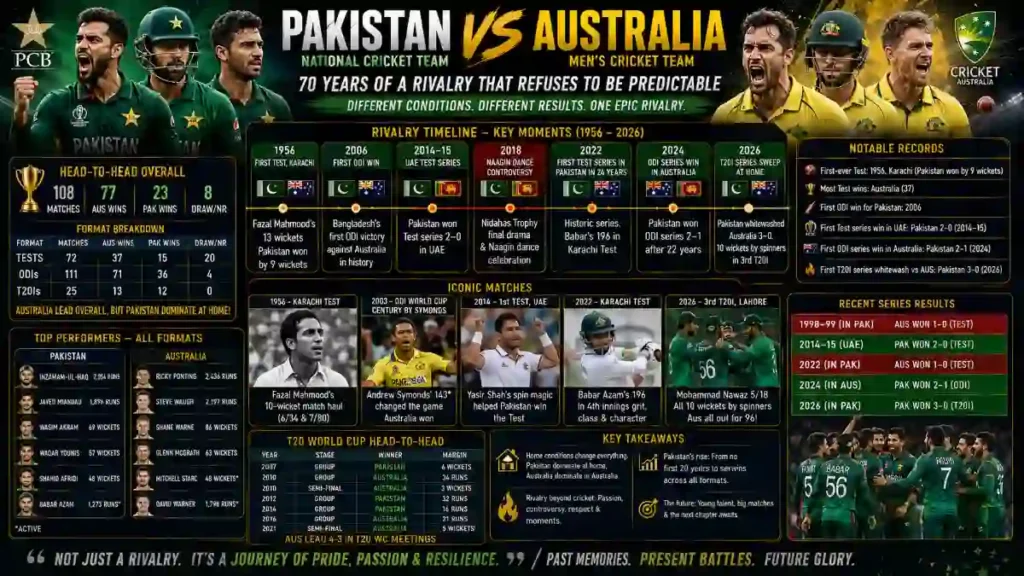

The pakistan national cricket team vs australian men’s cricket team timeline spans seven decades, beginning in October 1956 when a 25-year-old Fazal Mahmood single-handedly dismantled Australia at Karachi and running all the way to Pakistan’s historic 3-0 T20I sweep over Australia in early 2026. This is not a rivalry of equals on paper. But on the pitch, across subcontinental dust and Australian green-tops, the gap narrows in ways statistics alone will never capture.
What makes this rivalry fascinating is one buried truth: conditions matter more than talent in Pakistan vs Australia cricket. Flip the venue, and the dominant team almost always changes. That dynamic has been running for 70 years and shows no sign of stopping.
Pakistan vs Australia Timeline: Quick View (1956–2026)
| Year | Event | Winner |
| 1956 | First-ever Test, Karachi | Pakistan (9 wickets) |
| 1959–60 | Australia tour, first bilateral series | Australia 2-0 |
| 1979–80 | Pakistan home series | Pakistan 1-0 |
| 1982–83 | Pakistan home series | Pakistan 3-0 |
| 1988–89 | Pakistan home series, Imran’s peak era | Draw |
| 1998–99 | Last Australia tour to Pakistan pre-2022 | Australia 1-0 |
| 2002 | Pakistan’s last ODI series win in Australia (pre-2024) | Pakistan 2-1 |
| 2014–15 | Pakistan beat Australia in UAE Tests | Pakistan 2-0 |
| 2022 | Australia’s first Test tour to Pakistan in 24 years | Australia 1-0 |
| 2024 | Pakistan ODI series win in Australia | Pakistan 2-1 |
| 2026 | Pakistan T20I sweep at home | Pakistan 3-0 |
The 1956 Beginning: Where It All Started
The pakistan national cricket team vs australian men’s cricket team timeline begins at the National Stadium in Karachi on October 11, 1956 and Pakistan’s first message to Australia was delivered at pace.
Fazal Mahmood took 6 for 34 in the first innings and 7 for 80 in the second. Australia were bowled out for 80 and 187. Pakistan chased down 69 to win by 9 wickets. A side that had only been playing Test cricket since 1952 had beaten one of the world’s elite teams in their very first encounter.
Why the 1956 Test Still Matters
What most analysts miss: That first Test was played on a matting wicket Pakistan’s home conditions at the time. Fazal Mahmood’s late swing and cut movement on matting was virtually unplayable for Australian batters trained on pace-friendly turf. This set the blueprint: Pakistan on home conditions is a completely different team.
The 1956 match also established an identity that Pakistan cricket would carry for decades aggressive, conditions-aware, and tactically imaginative in ways that raw pace firepower alone cannot produce.
The 1960s–1980s: Home Ground Is Everything
In this phase of the pakistan national cricket team vs australian men’s cricket team timeline, a clear pattern emerged: whoever played at home almost always won.
Australia won 2-0 in 1959-60 on their own turf. Pakistan won 1-0 at home in 1979-80. Pakistan won 3-0 at home in 1982-83. Australia dominated the series played in Australia. When the venue shifted to the subcontinent, Australia struggled significantly.
The Imran Khan Era (1982–1989): Pakistan’s Tactical Masterclass
Imran Khan’s captaincy turned Pakistan from a talented side into a psychologically dangerous one.
In the 1982-83 Pakistan home series, Pakistan won 3-0 their largest-ever series victory over Australia. Imran understood that Australia’s strength was not just technical; it was built on the confidence of playing in familiar conditions and the pressure they applied mentally through that confidence. Neutralize the conditions, neutralize the confidence.
By the late 1980s, Pakistan under Imran had become near-impossible to beat at home. The 1988-89 series in Pakistan ended in a draw which, against an Australian side that had previously dominated, felt like a result Pakistan had earned.
Bold opinion: Imran Khan remains the most tactically intelligent captain in Pakistan’s history specifically because he understood opponent psychology as well as he understood cricket. That combination is rare.
Head-to-Head Records: The Full Picture
The overall pakistan national cricket team vs australian men’s cricket team timeline shows Australia leading across all formats, but the margin shifts dramatically based on venue.
Tests
| Metric | Result |
| Total series played | 72 |
| Australia series wins | 37 |
| Pakistan series wins | 15 |
| Drawn series | 20 |
| Highest team total | Pakistan 580/9d |
| Australia highest | Australia 575 |
ODIs
| Metric | Result |
| Total matches | 111 |
| Australia wins | 71 |
| Pakistan wins | 36 |
| Tied/NR | 4 |
T20I World Cup Head-to-Head
| Year | Winner | Margin |
| 2007 | Pakistan | 6 wickets |
| 2010 (SF) | Australia | 3 wickets |
| 2010 (GS) | Australia | 34 runs |
| 2012 | Pakistan | 32 runs |
| 2014 | Pakistan | 16 runs |
| 2016 | Australia | 21 runs |
| 2021 (SF) | Australia | 5 wickets |
Australia lead the T20 World Cup head-to-head 4-3. The knockout-match record is the most psychologically weighted part of this entire rivalry.
The 1990s–2000s: Australia’s Golden Generation Takes Over
The mid-1990s to mid-2000s represent Australia’s most dominant phase in the pakistan national cricket team vs australian men’s cricket team timeline driven by an extraordinary generation of players.
Pakistan were whitewashed 3-0 in Australia in 1999-2000, 2002-03, and 2004-05. Shane Warne’s leg-spin was the instrument of destruction. His ability to deceive Pakistan’s middle-order batters drawing them forward with the wrong one, then turning the standard leg-break past the outside edge made him virtually unplayable in Australian conditions.
The 2003 World Cup: When Symonds Broke Pakistan
The 2003 World Cup encounter between the two sides is a masterclass in how momentum shifts can define a generation.
Australia were 86 for 4. Pakistan appeared in control. Andrew Symonds, relatively uncapped at the time, walked in and made 143 off 125 balls. Pakistan lost the psychological grip on the game and never recovered. The final score was Australia 310, Pakistan 228. What people think: Australia dominated from the start. Reality: Pakistan were in control for nearly half the innings.
What Most People Miss About This Era
The 1990s whitewashes were not just about Australian talent. They were about Pakistan’s instability. Player disputes, selection controversies, and tour-by-tour leadership changes made it impossible for Pakistan to build a consistent game plan across a series. Australia, under Taylor and then Steve Waugh, were relentlessly organised. That organisational discipline not just Warne was the real differentiator.
The 2010s: The UAE Fortress and Pakistan’s Smart Adaptation
When security concerns forced Pakistan to play home matches in the UAE, the pakistan national cricket team vs australian men’s cricket team timeline entered its most strategically interesting phase.
Pakistan recreated subcontinental conditions in Abu Dhabi and Dubai dry, turning pitches built for Yasir Shah’s leg-spin. Australia toured the UAE in 2014-15 and lost the Test series 2-0. It was Australia’s first Test series loss to Pakistan since 1995.
Yasir Shah’s UAE Masterclass
Yasir Shah became the dominant force in this series. He bowled on pitches that Australian batters had never practiced on, against a bowling style they rarely faced at the home level. The tactical preparation was exceptional. Pakistan didn’t beat Australia in the UAE because they were more talented; they beat them because they engineered conditions that made Australian experience and strength irrelevant.
This is the counterintuitive truth at the heart of this rivalry: Pakistan’s greatest victories are almost never won through superior talent. They are won through superior conditions management.
2022: The Test Series That Changed Everything
The Australia tour of Pakistan in 2022 was the most significant series in this rivalry in two decades not because of the final result, but because of what happened in the second Test at Karachi.
Australia had not toured Pakistan for Tests since 1998-99 a gap of 24 years.
Match-by-Match Breakdown
First Test, Rawalpindi: Both sides posted enormous totals on a flat pitch. Pakistan 476/4 declared, Australia 459, Pakistan 252/0 declared. The match ended in a draw. The pitch was criticized for being lifeless, but the cricket was absorbing.
Second Test, Karachi The Turning Point of the Entire Rivalry
Australia posted 556/9 declared. Pakistan collapsed for 148 in reply. Following on, facing a deficit of 408 runs, Babar Azam made 196 in the fourth innings one of the most technically complete innings in modern Test batting. Pakistan survived 171.4 overs and finished on 443/7, 63 runs short of the target.
It was the second-most overs survived in a fourth innings in Test cricket history. Pakistan didn’t win. But they proved they could grind out a Test match against the best bowling attack in the world.
Third Test, Lahore: Australia won by 115 runs. Mitchell Starc’s pace attack was decisive. Series result: Australia 1-0.
Why 2022 Reframed the Rivalry
What most analysts get wrong: The 2022 series is remembered as an Australian series win. That is accurate. But the more significant outcome was what it revealed about Pakistan’s Test identity. Babar’s 196 changed perceptions around Pakistan’s ability to survive pressure situations in modern Test cricket a criticism that had stuck to the team for years.
2024: Pakistan Finally Win an ODI Series in Australia
For the first time since 2002, Pakistan won an ODI series on Australian soil in 2024.
- 1st ODI (Melbourne): Australia won by 2 wickets
- 2nd ODI (Adelaide): Pakistan won by 9 wickets
- 3rd ODI (Perth): Pakistan won by 8 wickets
Pakistan’s 2-1 series win was comprehensive in the final two matches. The bowling attack was aggressive and smart in Perth conditions, and the batting finally found its rhythm in Australian conditions. This was Pakistan’s first ODI series win in Australia in 22 years and ended one of the more stubborn statistics in the rivalry’s history.
2026: Pakistan’s T20I Sweep History Made in Three Nights
In January 2026, Pakistan completed the most dominant home series victory in this rivalry’s T20I history defeating Australia 3-0 and setting a record in the process.
The third T20I at Lahore told the complete story: Pakistan 207/6, Australia dismissed for 96. Pakistan won by 111 runs Australia’s heaviest-ever defeat in T20Is. Pakistan’s spinners took all 10 wickets in that Australian innings, the first time in history any team achieved this in a T20I innings.
Mohammad Nawaz took 5 for 18 in that decider. Babar Azam made 58 from 36 balls in the same match.
The 2026 Reversal: What It Really Means
The counterintuitive insight here is striking: Just months before this 2026 home sweep, Australia had beaten Pakistan 3-0 in a T20I series in Australia. The complete reversal 3-0 in both directions, home and away confirms something that the entire pakistan national cricket team vs australian men’s cricket team timeline has been building toward for seven decades:
Neither team is definitively superior. Venue is the real variable.
Pakistan vs Australia: Iconic Bowling Performances
The greatest individual bowling moments in the rivalry demonstrate how conditions and execution combine to produce unforgettable cricket.
- Fazal Mahmood, 13 wickets, Karachi 1956 Created the rivalry
- Waqar Younis, multiple spells, 1989-99 Defined Pakistan’s pace era in home conditions
- Yasir Shah, UAE 2014-15 Destroyed Australia’s batting in the series
- Mohammad Nawaz, 5/18, Lahore 2026 Australia’s heaviest T20I defeat
Pakistan vs Australia: Why This Rivalry Matters Beyond Numbers
The broader pakistan national cricket team vs australian men’s cricket team timeline is a case study in how bilateral Test rivalries survive political disruption, security concerns, and 24-year gaps in bilateral contact.
Most rivalries fade when the teams stop playing regularly. This one did not. The 2022 Test series, played after two decades of absence, produced cricket of genuine quality and emotional depth. That speaks to something real: when these two sides meet, regardless of the surface or format, the competitive intensity is authentic.
Australia holds the overall statistical lead. But Pakistan has won the moments that mattered on their terms. The 1956 debut. The 1982-83 home sweep. The UAE Tests in 2014. The Karachi fourth innings in 2022. The 2024 ODI series win in Australia. The 2026 T20I sweep.
Read More About – New Zealand National Cricket Team vs England Cricket Team 2026: Complete Series Guide, Squad Analysis, Head-to-Head & Prediction
That is not a rivalry being dominated. That is a rivalry being contested across seven decades.