
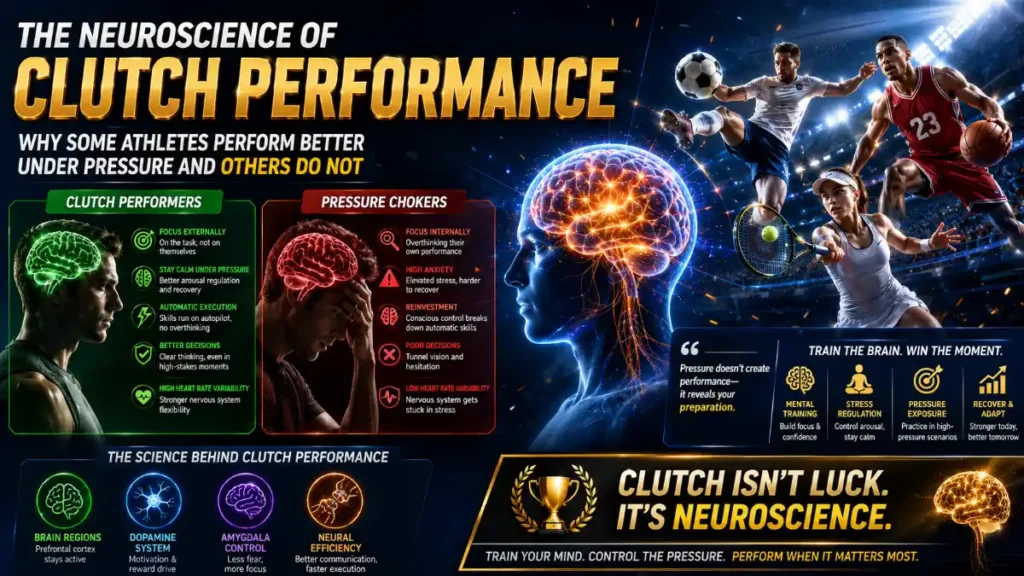

Sport has always sorted athletes into two categories that every coach, scout, and serious fan recognises: those who perform better when the stakes are highest, and those whose performance degrades precisely when it matters most. The language used to describe this distinction — “clutch player,” “big game performer,” “choker” — is informal, but the phenomenon it describes is real and measurable. What decades of sports psychology and cognitive neuroscience have established is that clutch performance is not a fixed personality attribute distributed randomly across athletic populations. It is a set of specific neurological and psychological mechanisms that vary between individuals for identifiable reasons, that are amenable to training interventions, and that coaches and sports organisations can actively develop rather than simply hope they are selecting for.
The Neurological Basis of Performance Under Pressure
What Pressure Does to the Athletic Brain
The experience of high-stakes athletic competition produces a neurological state that is fundamentally different from the state of practice or low-stakes performance. The presence of significant consequences — a match-defining penalty, a championship final, a selection trial — activates the threat response system, releasing cortisol and adrenaline that alter cognition, attention, and motor execution in ways that can either enhance or impair performance depending on how the athlete interprets and responds to the physiological state.
The arousal-performance relationship in sport is not linear. Research on what psychologists call the “Yerkes-Dodson curve” demonstrates that performance increases with arousal up to an optimal level, beyond which additional arousal produces performance degradation. The location of the optimal arousal level varies by task complexity: simple, well-trained motor skills — a free throw, a penalty kick — can be performed effectively at higher arousal levels than complex tactical decision-making tasks, where excess arousal narrows attentional focus in ways that exclude the peripheral information that good decision-making requires.
The mechanism of choking under pressure — the phenomenon where a well-trained athlete performs significantly below their established capability in high-stakes situations — involves a specific neurological process that sports scientists call “reinvestment.” An athlete who has automated a skill through thousands of hours of practice executes it through implicit, procedural memory systems that operate outside conscious awareness. Under pressure, anxiety about performance causes the athlete to consciously attend to the execution of the skill — to try to control the movement that has become automatic — which transfers control back to explicit, declarative memory systems that are slower, less efficient, and far more prone to breakdown. The technical execution that was smooth and automatic becomes effortful and uncertain precisely because conscious attention has been directed toward it.
The research on what prevents reinvestment is directly relevant to how clutch athletes differ from those who choke. Athletes who maintain performance under pressure are those whose attentional control under threat activation keeps focus external rather than internal — directed toward the task, the opponent, or the target rather than toward their own execution. Developing this attentional control is a trainable skill, and the training approaches that produce it most reliably are those that create pressure conditions in practice that approximate the neurological state of competition rather than allowing athletes to practice exclusively in low-threat environments where reinvestment never occurs.
The study of decision-making under pressure extends beyond sport into any domain where consequential choices must be made rapidly with incomplete information. Research on how humans manage risk and uncertainty under time pressure has been developed extensively in the context of digital interactive environments, where millisecond response patterns can be studied at scale. A desiplay instant win casino games platform provides a studied environment for exactly this kind of rapid decision-making: in games like crash formats, players must decide when to exit a rising multiplier before it resets, combining real-time probability assessment with risk tolerance calibration under the mild pressure of an expiring opportunity. Research using these environments has contributed to understanding how experienced decision-makers differ from novices in their ability to maintain calibrated judgment under time pressure — findings that sports scientists have applied to understanding how experienced athletes maintain decision quality under competitive pressure that overwhelms less experienced performers.
The Role of Autonomic Nervous System Regulation
The physiological dimension of clutch performance is as important as the cognitive one, and the athletes who perform best under pressure have typically developed superior autonomic nervous system regulation — the ability to modulate their physiological arousal state rather than being subject to it passively.
Heart rate variability, the variation in time between consecutive heartbeats, has emerged as one of the most reliable physiological indicators of an athlete’s capacity for pressure performance. High resting heart rate variability indicates a nervous system that can switch efficiently between sympathetic (arousal) and parasympathetic (recovery) states, which is the neurological foundation of arousal regulation under pressure. Athletes with low heart rate variability tend to remain in an elevated arousal state longer after a threat activation, which increases the window during which reinvestment and decision-making impairment can occur.
Training interventions that improve heart rate variability — slow, controlled breathing exercises, cold exposure protocols, and specific meditation practices — have demonstrated measurable improvements in pressure performance in controlled athletic studies. The mechanism is not relaxation in a general sense: these practices do not make athletes calmer in competition, which would reduce the arousal that performance benefits from at optimal levels. They improve the precision of arousal regulation, allowing athletes to reach and maintain optimal arousal states rather than overshooting into the hyperarousal that degrades performance.
What Coaches and Sports Organisations Can Do With This Knowledge
Pressure Training as a Systematic Practice
The most important applied implication of the neuroscience of clutch performance is that pressure must be present in training at sufficient intensity to produce the neurological state that competition creates, or the athlete’s pressure performance will remain entirely untrained regardless of the technical and physical quality of their practice. This seems obvious, but the default structure of most athletic training is explicitly designed to minimise pressure: athletes practice in low-threat environments, coaches focus on technical correction rather than execution under stress, and the only exposure to high-pressure execution comes in actual competition, where the cost of failure is highest and the opportunity for learning from failure is lowest.
The training approaches that most effectively develop clutch performance capability share a common design principle: they make the consequences of performance in training meaningful enough to activate the neurological state of competition while keeping the actual stakes low enough that failure is a learning opportunity rather than a career-defining outcome. Competitions within practice, public performance of skills in front of coaches and teammates, and adversarial drills where one team’s success directly creates another’s failure all create partial approximations of competitive pressure that are sufficient to train the attentional and arousal regulation systems that clutch performance depends on.
The characteristics of pressure training protocols that produce the strongest transfer to competitive performance are:
- Consequence specificity — the consequences of performance within the training activity must be immediate, visible, and meaningful to the athlete rather than abstract or disconnected from their performance motivation
- Repeated exposure across varying arousal levels — the most effective pressure training moves athletes through a range of arousal states rather than maintaining constant high arousal, developing the regulation capability rather than simply habituating to a single pressure level
- Post-performance cognitive reflection — structured review of attentional focus and physiological state during pressure training, which builds the metacognitive awareness that athletes need to regulate their state in competition rather than simply reacting to it
The numbered priorities for sports organisations building pressure performance development into their training systems are as follows:
- Assess individual athlete arousal regulation profiles before designing pressure training, because athletes whose performance degrades under pressure do so for different reasons — some choke through reinvestment, some through attentional narrowing, some through arousal dysregulation — and the appropriate training intervention differs by mechanism
- Build consequence structures into practice sessions that create meaningful stakes without the irreversibility of competition outcomes, using points systems, public performance contexts, and competitive formats that activate threat responses at practice intensity
- Integrate heart rate variability monitoring into athlete development programmes, using it as a training variable rather than simply a health monitoring tool, and designing recovery and arousal regulation protocols based on individual athlete profiles rather than generic recommendations
- Develop coach education in pressure facilitation — most coaches are expert in technical skill development but have not been trained in the specific practices that develop pressure performance capability, and the gap between what coaches know about skill development and what they know about pressure development is a systematic weakness in most athletic development programmes
Conclusion: Clutch Is Developed, Not Discovered
The scout who is looking for the clutch player in the selection pool is solving the wrong problem. The coach who is developing clutch capability in the athlete pool is solving the right one. The neuroscience of pressure performance has established clearly enough that the mechanisms underlying clutch performance are trainable — that autonomic regulation can be improved, that attentional control under threat can be developed, and that the reinvestment tendency that produces choking can be directly countered through specific practice designs. The athletic organisations that treat pressure performance as a developmental capability rather than a selection criterion will systematically produce higher proportions of athletes who perform at their best when it matters most. The ones that continue to select for it without developing it will continue to be surprised by the performance variance that competition produces in their athletes — and to attribute to character what is actually a training gap.