
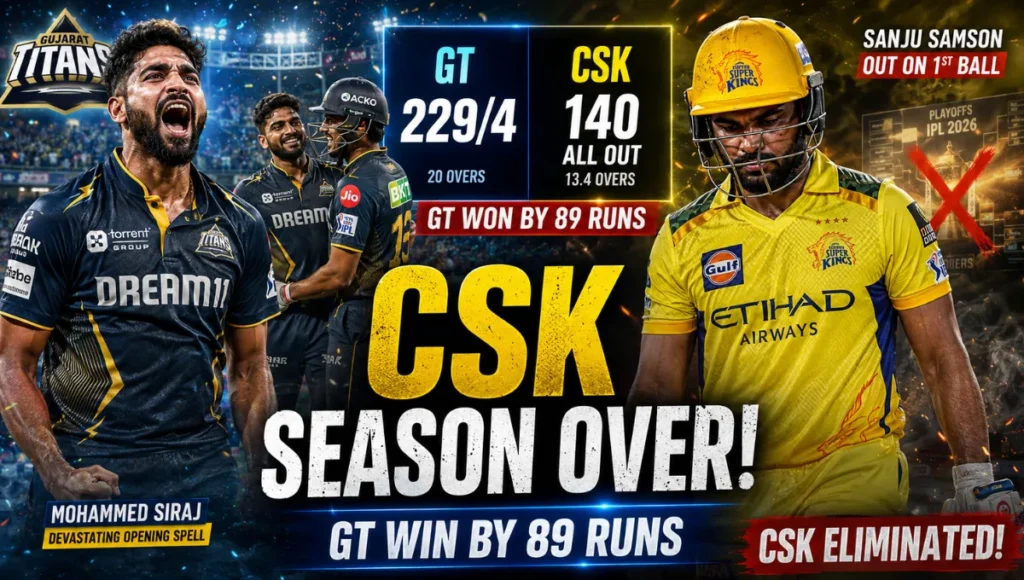

Sanju Samson was out off the very first ball of Chennai Super Kings‘ chase. By the time Mohammed Siraj had finished his opening spell, CSK’s season was already, for all practical purposes, over.
Gujarat Titans posted 229/4. Chennai Super Kings were bowled out for 140 in 13.4 overs. The 89-run margin was GT’s biggest-ever win by runs in IPL history and it eliminated CSK from the IPL 2026 playoff race in the same moment.
This Gujarat Titans vs Chennai Super Kings match scorecard covers the full 66th Match at Ahmedabad. But the number that matters most isn’t 229 or 140. It’s the fact that this result ended a season, not just a match.
Match in 30 Seconds
| Detail | Match information |
|---|---|
| Match | 66th Match, Indian Premier League 2026 |
| Venue | Narendra Modi Stadium, Ahmedabad |
| Date | 21 May 2026 |
| Toss | Chennai Super Kings won the toss and elected to field first |
| Gujarat Titans score | 229/4 in 20 overs |
| Chennai Super Kings score | 140 all out in 13.4 overs |
| Result | Gujarat Titans won by 89 runs |
| Player of the Match | Mohammed Siraj — 3/26 |
| Season impact | GT confirmed a top-two finish; CSK were eliminated from the playoff race |
The one-line story: Shubman Gill and Sai Sudharsan built a total CSK could never realistically chase, and Siraj’s opening burst turned “difficult” into “impossible” inside two overs.
What people think is that 230 in a modern IPL innings is always at least theoretically gettable, given how often totals in that range get chased down.
The reality here was blunter: CSK needed to be near-perfect from ball one, and they lost their captain-in-waiting tactic and two batters inside three overs instead.
Gujarat Titans vs Chennai Super Kings Match Scorecard
Gujarat Titans innings: 229/4 in 20 overs
| Batter | Runs | Balls | 4s | 6s | Strike rate |
|---|---|---|---|---|---|
| Shubman Gill (c) | 64 | 37 | 7 | 3 | 172.97 |
| B Sai Sudharsan | 84 | 53 | 7 | 4 | 158.49 |
| Total | 229/4 | 20 overs |
CSK bowling figures
| Bowler | Overs | Runs | Wickets | Economy |
|---|---|---|---|---|
| Spencer Johnson | 4 | 47 | 1 | 11.75 |
| Mukesh Choudhary | 4 | 36 | 1 | 9.00 |
Chennai Super Kings innings: 140 all out in 13.4 overs
| Batter | Runs | Balls | 4s | 6s | Strike rate | Dismissal |
|---|---|---|---|---|---|---|
| Sanju Samson (wk) | 0 | 1 | 0 | 0 | 0.00 | c Buttler b Siraj |
| Matthew Short | 24 | 14 | 3 | 1 | 171.42 | c Prasidh Krishna b Rabada |
| Ruturaj Gaikwad (c) | 16 | 7 | 1 | 2 | 228.57 | b Siraj |
| Urvil Patel | 0 | 2 | 0 | 0 | 0.00 | c Prasidh Krishna b Siraj |
| Kartik Sharma | 19 | 15 | 3 | 0 | 126.66 | run out (Gill) |
| Dewald Brevis | 8 | 10 | 0 | 0 | 80.00 | c Holder b Rashid Khan |
| Shivam Dube | 47 | 17 | 4 | 4 | 276.47 | c Gill b Rashid Khan |
| Anshul Kamboj | 19 | 8 | 1 | 2 | 237.50 | c Holder b Rashid Khan |
| Noor Ahmad | 1 | 5 | 0 | 0 | 20.00 | c & b Rabada |
| Mukesh Choudhary | 2 | 2 | 0 | 0 | 100.00 | not out |
| Spencer Johnson | 0 | 1 | 0 | 0 | 0.00 | c Buttler b Rabada |
| Extras | 4 | — | — | — | — | 4 wides |
| Total | 140 | 13.4 overs |
Fall of wickets: 0/1 (Samson, 0.1), 29/2 (Gaikwad, 2.2), 29/3 (Urvil Patel, 2.4), 51/4 (Short, 5.1), 63/5 (Kartik Sharma, 7.0), 116/6 (Dube, 10.3), 136/7 (Kamboj, 12.1), 138/8 (Brevis, 12.4), 140/9 (Noor Ahmad, 13.3), 140/10 (Johnson, 13.4).
GT bowling figures
| Bowler | Overs | Runs | Wickets | Economy |
|---|---|---|---|---|
| Mohammed Siraj | 3 | 26 | 3 | 8.66 |
| Kagiso Rabada | 3.4 | 32 | 3 | 8.72 |
| Arshad Khan | 2 | 24 | 0 | 12.00 |
| Jason Holder | 2 | 27 | 0 | 13.50 |
| Rashid Khan | 2 | 18 | 3 | 9.00 |
| Prasidh Krishna | 1 | 13 | 0 | 13.00 |
Highlights and Key Moments
1. Gill and Sudharsan built a total that punished any hesitation
Shubman Gill’s 64 off 37 and Sai Sudharsan’s 84 off 53 gave GT a platform that never allowed CSK’s bowlers to settle. Gill’s most productive shot, the slog sweep, brought him 12 runs, while Sudharsan’s off-drive alone contributed 22 runs at an 82% control rate.
What most people miss: a 229 total built on top-order runs, rather than late-innings fireworks, is often harder to defend against psychologically for the chasing side. There is no single over of carnage to point to and dismiss as an aberration the pressure was applied steadily across the full 20 overs, which is exactly what made the chase feel insurmountable from ball one.
2. Samson’s golden duck and Gaikwad’s gamble both failed in the same over
Sanju Samson, playing despite a finger injury, was out off the very first ball of the chase. Ruturaj Gaikwad responded by promoting himself to No. 3 in an attempt to stabilise the innings immediately.
That gamble did not work. Gaikwad fell for 16 off 7, and Urvil Patel followed for a golden duck two balls later. CSK were 29 for 3 inside three overs.
Counterintuitive point: promoting your best available batter up the order after an early wicket is usually the correct percentage decision in T20 cricket. Here, it still failed not because the tactic was wrong, but because Siraj’s bowling was simply too well-directed for any reactive adjustment to work. Sometimes the right decision still loses to the better ball.
3. Siraj’s three wickets in two overs ended the contest
Mohammed Siraj bowled three overs, took three wickets, and conceded 26 runs. He dismissed Samson, Gaikwad and Urvil Patel effectively CSK’s entire recognised top three inside his first two overs of the innings.
This is where things go wrong for a chasing side facing 230: losing your top three before the fourth over removes any margin for a controlled build-up. CSK’s middle and lower order were forced to attack from the very first ball they faced, with no platform and an asking rate already climbing past 12 an over.
4. Dube’s counterattack briefly flickered, then the innings fully collapsed
Shivam Dube played the only genuinely positive innings of CSK’s chase, striking 47 off just 17 balls with four fours and four sixes. For a few overs, his hitting created a small window of hope.
Once Dube fell in the 10.3rd over, CSK’s last four wickets went down for just four runs. The innings was all out in 13.4 overs.
Bold opinion: Dube’s cameo, however brilliant in isolation, actually illustrates CSK’s deeper problem rather than solving it. A genuinely competitive chase needs sustained partnerships, not a single batter’s fireworks surrounded by collapse. Relying on one player to manufacture hope from a lost position is not a chase plan it’s damage control mistaken for a comeback.
Player Performance Breakdown
Mohammed Siraj: 3/26: the spell that decided the match
Siraj’s post-match comments revealed the method behind his figures: he prioritised building pressure in the powerplay above all else, trusting that wickets would follow from sustained accuracy rather than searching for magic deliveries. Against Samson specifically, he deliberately bowled fuller and wider, having noticed the same plan work when the two sides met earlier in the season.
Original observation: Siraj explicitly described his partnership with Rabada as a shared plan “if Rabada gets wickets because of the pressure I create, that’s our bowling partnership.” That is a rare, explicit articulation of how modern fast-bowling pairs think about collective impact rather than individual glory, and it is exactly the mindset that turned three separate bowlers into one unified demolition.
Sai Sudharsan and Shubman Gill the platform that decided everything
Gill’s 64 and Sudharsan’s 84 anchored GT’s innings without needing an explosive finish from the middle order. Their opening stand set a tone that, by Gaikwad’s own admission, CSK’s bowlers “didn’t execute well” against in the powerplay.
Practical lesson for batting captains: a controlled, high-scoring opening stand can be more valuable than a late slog-over explosion, because it removes the chasing side’s ability to point to one bad over as the turning point. GT’s total felt inevitable well before the final five overs even began.
Kagiso Rabada and Rashid Khan completing the bowling sweep
Rabada finished with 3/32, while Rashid Khan claimed 3/18 from his two overs. Between them and Siraj, GT’s three leading bowlers took exactly three wickets each a rare, clean statistical symmetry that reflects genuinely even contribution rather than one standout spell carrying the attack.
What people think vs reality: fans often assume a dominant bowling performance needs one bowler with headline figures like 5/20. Here, no single bowler took more than three wickets, yet the collective effect was still a complete demolition proof that consistency spread across an attack can be just as devastating as one spectacular individual spell.
Shivam Dube a lone counterattack in a lost cause
Dube’s 47 off 17 balls, striking at 276.47, was CSK’s best individual batting performance of the match by a wide margin. He hit four fours and four sixes in a genuinely destructive cameo.
Common mistake in analysis: treating Dube’s innings as evidence CSK were “competitive” for a period. In reality, his runs came while CSK were already chasing an asking rate near 14 an over the kind of situation where boundary-hitting reflects individual quality far more than genuine match-winning potential.
Analysis: Why CSK’s Season Ended Here
A total built to punish exactly this kind of chase
What people think: any target below 250 in a high-scoring IPL season carries a real chance for the chasing side.
Reality: 230 against a bowling attack executing its plans as precisely as GT’s did here required a near-flawless start. CSK’s actual start a first-ball wicket, a failed tactical gamble, and 29/3 inside three overs made the target’s raw size almost irrelevant. The match was decided by execution in the first three overs, not by the total itself.
CSK’s structural season-long problem, not just one bad night
Ruturaj Gaikwad was candid in his post-match reflection, describing a “tough season” that began with a hat-trick of losses and was repeatedly disrupted by injuries to key players including Jamie Overton and an all-rounder the squad had been counting on. He pointed out that CSK were “always playing a batter short or a bowler short” in their final matches of the campaign.
Bold opinion: this defeat should not be read purely as a bad night against a red-hot GT side. It was the accumulation of a season where CSK fielded an inexperienced, injury-hit squad against the toughest competition in franchise cricket and a 65-plus-average GT top order was always going to be the harshest possible opponent to face that exposure against.
GT’s record-breaking margin in context
This was GT’s biggest win by runs in IPL history, surpassing their own 82-run win over Sunrisers Hyderabad and 77-run win over Rajasthan Royals both also achieved during IPL 2026. All three of GT’s biggest-ever victory margins by runs came within the same season.
Practical takeaway for team analysis: a franchise recording its three biggest-ever wins within one season is not a coincidence of scheduling. It reflects a bowling attack and top-order batting pairing that had found a genuinely repeatable, high-ceiling formula one CSK, in a rebuilding year, had no realistic answer for.
Records, Points Table Impact and Format Guardrail
Points table after this match
| Team | Matches | Won | Lost | Points | NRR | Position |
|---|---|---|---|---|---|---|
| RCB | 14 | 9 | 5 | 18 | +0.783 | 1st |
| GT | 14 | 9 | 5 | 18 | +0.695 | 2nd |
| SRH | 14 | 9 | 5 | 18 | +0.524 | 3rd |
| CSK | 14 | 6 | 8 | 12 | -0.345 | 8th (eliminated) |
Record-book context
| Record | Detail |
|---|---|
| GT’s biggest win by runs | 89 runs vs CSK, Ahmedabad, 2026 — ahead of 82 runs vs SRH and 77 runs vs RR, both also 2026 |
| CSK’s biggest defeat margin (by runs) in IPL history | 89 runs vs GT, Ahmedabad, 2026 |
| Bowling symmetry | Siraj, Rabada and Rashid Khan each took exactly 3 wickets |
| Season outcome | GT confirmed a top-two finish; CSK were mathematically eliminated from the playoffs |
Format and fixture guardrail
| Fixture | Correct context |
|---|---|
| GT vs CSK, 66th Match, IPL 2026 (this article) | The elimination match — this article’s core scorecard |
| CSK vs GT, 37th Match, IPL 2026 | An earlier meeting between the same two teams in the same season; different result and context |
| CSK vs GT, 2023 (Punjab Kings archive) | A completely different season and squad composition |
Do not present the 37th Match or the 2023 fixture’s figures as part of this 66th Match scorecard. Each belongs to a separate point in the two franchises’ history.