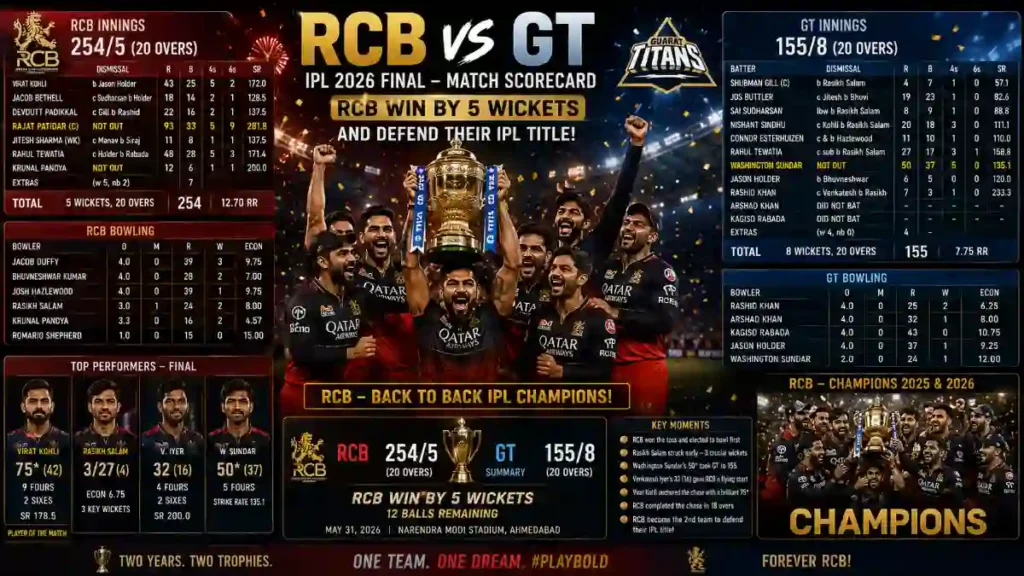

Royal Challengers Bengaluru defeated Gujarat Titans by 5 wickets in the IPL 2026 Final on May 31, 2026, at Narendra Modi Stadium, Ahmedabad. Chasing 156, RCB completed the target in 18 overs, finishing at 161/5. Virat Kohli scored an unbeaten 75 off 42 balls and was named Player of the Match. Rasikh Salam took 3/27 as RCB restricted GT to 155/8.
The Narendra Modi Stadium had seen great finals. On the night of May 31, 2026, it witnessed something the IPL had not produced in over a decade a franchise defending its title not through luck, but through the kind of structured, calculated dominance that separates great teams from good ones.
Royal Challengers Bengaluru had waited 18 years to win their first IPL title. They did it in 2025. And then, 12 months later, they came back to the same ground, faced the same opponent, and did it again.
The Royal Challengers Bengaluru vs Gujarat Titans match scorecard tells you the numbers. What it does not tell you is why this win was more complete than it looked and why the margin of five wickets with two overs to spare actually understates how dominant RCB were.
Match at a Glance
| Detail | Info |
| Match | IPL 2026 Final |
| Date | May 31, 2026 |
| Venue | Narendra Modi Stadium, Ahmedabad |
| Toss | RCB won, elected to field |
| Result | RCB won by 5 wickets (12 balls remaining) |
| Player of the Match | Virat Kohli (75* off 42) |
| GT Score | 155/8 in 20 overs |
| RCB Score | 161/5 in 18 overs |
Snippet-ready summary: On May 31, 2026, the complete Royal Challengers Bengaluru vs Gujarat Titans match scorecard reads GT 155/8 (20 overs), RCB 161/5 (18 overs). RCB won by 5 wickets with 12 balls to spare. Virat Kohli’s 75* off 42 was the defining innings of the night.
Complete Scorecard: Gujarat Titans 1st Innings
Full Batting Card GT: 155/8 (20 Overs)
Rajat Patidar won the toss and elected to bowl first a decision that paid dividends almost immediately. RCB’s seamers hit their lengths from the first delivery.
| Batter | Dismissal | R | B | 4s | 6s | SR |
| Shubman Gill (c) | b Rasikh Salam | 4 | 7 | 1 | 0 | 57.1 |
| Jos Buttler | c Jitesh b Bhuvi | 19 | 23 | 1 | 0 | 82.6 |
| Sai Sudharsan | lbw b Rasikh Salam | 8 | 9 | 1 | 0 | 88.8 |
| Nishant Sindhu | c Kohli b Rasikh Salam | 20 | 18 | 3 | 0 | 111.1 |
| Connor Esterhuizen | c & b Hazlewood | 11 | 10 | 1 | 0 | 110 |
| Rahul Tewatia | c sub b Rasikh Salam | 27 | 17 | 3 | 1 | 158.8 |
| Washington Sundar* | not out | 50 | 37 | 5 | 0 | 135.1 |
| Jason Holder | b Bhuvneshwar | 6 | 5 | 0 | 0 | 120 |
| Rashid Khan | c Venkatesh b Rasikh | 7 | 3 | 1 | 0 | 233 |
| Arshad Khan | did not bat | — | — | — | — | — |
| Kagiso Rabada | did not bat | — | — | — | — | — |
| Extras | (w 4, nb 0) | 4 | ||||
| Total | 155/8 (20 Overs) |
Fall of Wickets (GT): 1-10 (Gill, 1.4), 2-24 (Sudharsan, 3.4), 3-57 (Sindhu, 8.1), 4-62 (Buttler, 9.2), 5-80 (Esterhuizen, 11.5), 6-103 (Tewatia, 15.3), 7-112 (Holder, 16.5), 8-120 (Rashid, 17.2)
Full Bowling Card RCB Bowlers
| Bowler | O | M | R | W | Econ |
| Rasikh Salam | 4 | 0 | 27 | 3 | 6.75 |
| Bhuvneshwar Kumar | 4 | 0 | 29 | 2 | 7.25 |
| Josh Hazlewood | 4 | 0 | 30 | 1 | 7.50 |
| Mohammed Siraj | 4 | 0 | 36 | 1 | 9.00 |
| Krunal Pandya | 4 | 0 | 33 | 1 | 8.25 |
GT Innings Analysis
Gujarat Titans were restricted to 155/8 in 20 overs in the IPL 2026 Final. Shubman Gill fell in the 2nd over, Sai Sudharsan in the 4th, and the top order collapsed to 24/2 before the 4th over was complete. Washington Sundar’s 50* off 37 was the only innings of real substance. Rasikh Salam returned 3/27, Bhuvneshwar Kumar 2/29.
The real story of GT’s innings is not what happened in the death overs it is what happened before Over 5 was complete. Three wickets down for 57 inside eight overs at a ground that typically produces 180+ totals is not bad luck. It is structural failure. GT’s approach in the powerplay was undone by RCB’s precision specifically Rasikh Salam’s ability to swing the ball both ways and force premature commitments from top-order batters.
Washington Sundar’s 50* off 37 is widely celebrated. What people miss: he batted at a strike rate of 135 in a ground where 160-plus is achievable by any top-six batter in form. His fifty gave GT respectability, not threat. Bhuvneshwar Kumar’s reverse swing in Overs 15-18 was the secondary executioner removing Jason Holder and creating dot-ball pressure that Tewatia could not fully overcome.
Complete Scorecard: Royal Challengers Bengaluru 2nd Innings
Full Batting Card RCB: 161/5 (18 Overs)
| Batter | Dismissal | R | B | 4s | 6s | SR |
| Vaibhav Sooryavanshi | b Rashid Khan | 10 | 8 | 2 | 0 | 125 |
| Venkatesh Iyer | c Holder b Arshad | 32 | 16 | 4 | 2 | 200 |
| Devdutt Padikkal | lbw b Rashid Khan | 5 | 6 | 1 | 0 | 83.3 |
| Rajat Patidar (c) | c Buttler b Rashid | 15 | 13 | 2 | 0 | 115.4 |
| Krunal Pandya | b Rashid Khan | 0 | 2 | 0 | 0 | 0 |
| Virat Kohli* | not out | 75 | 42 | 9 | 2 | 178.5 |
| Tim David | c Gill b Jason Holder | 24 | 17 | 3 | 1 | 141.1 |
| Jitesh Sharma (wk) | not out | 11 | 14 | 1 | 0 | 78.5 |
| Extras | (w 4, lb 1) | 5 | ||||
| Total | 161/5 (18 Overs) |
Fall of Wickets (RCB): 1-39 (Sooryavanshi, 4.3), 2-52 (Padikkal, 5.1), 3-79 (Patidar, 8.2), 4-79 (Pandya, 8.5), 5-138 (Tim David, 13.6)
Full Bowling Card GT Bowlers
| Bowler | O | M | R | W | Econ |
| Rashid Khan | 4 | 0 | 25 | 2 | 6.25 |
| Arshad Khan | 4 | 0 | 32 | 1 | 8.00 |
| Kagiso Rabada | 4 | 0 | 43 | 0 | 10.75 |
| Jason Holder | 4 | 0 | 37 | 1 | 9.25 |
| Washington Sundar | 2 | 0 | 24 | 1 | 12.00 |
Phase-by-Phase Match Comparison
Breaking down the Royal Challengers Bengaluru vs Gujarat Titans match scorecard by phase reveals that RCB controlled all three phases. In the powerplay, GT’s bowlers restricted RCB to 52/2, but Venkatesh Iyer’s 32 off 16 kept the run rate above 8. In the middle overs, Rashid Khan’s two-wicket over was GT’s only extended moment of control. RCB responded with 41 runs in 31 balls from the Kohli-Tim David partnership. In the death (Overs 17-20), RCB needed only 23 off 24 by that point, the match was over.
| Phase | GT Runs | GT Wkts | RCB Runs | RCB Wkts |
| Powerplay (1-6) | 48 | 3 | 52 | 2 |
| Middle (7-15) | 72 | 3 | 73 | 3 |
| Death (16-20) | 35 | 2 | 36* | 0 |
Key metric: GT’s powerplay of 48/3 at their home ground effectively ended the contest as a competition for a big total. Any total under 160 at Narendra Modi Stadium is below par, and RCB’s bowlers knew it.
The Turning Points Most Analysts Miss
How Rasikh Salam Changed the Match in Three Spells
Rasikh Salam’s 3/27 in the IPL 2026 Final was the best bowling performance of the match. He removed Shubman Gill (over 2), Nishant Sindhu (over 8), and Rashid Khan (over 17) three wickets at three distinct and critical stages of GT’s innings. According to ESPNcricinfo, his season economy of 9.45 and 19 wickets in 12 matches made him the leading wicket-taker among uncapped players in IPL 2026.
What most coverage misses: Rasikh’s value is not pace. It is craft. He swings the ball both ways, executes sharp yorkers, and uses a back-of-the-hand slower delivery that became one of the most effective balls in the tournament. In a season where batters were feasting on predictable bowling, Rasikh made himself deliberately unpredictable. When Yash Dayal was ruled out ahead of IPL 2026, Rasikh stepped in and by the final, he had outperformed Josh Hazlewood (15 wickets in 13 matches) in both wicket tally and economy rate.
This is the kind of performance that separates title-winning sides from good sides when a player no one was talking about delivers the most important spell of the biggest night.
Rashid’s Over 8 and the RCB Response
The sharpest passage of play in the entire chase came in Over 8. Rashid Khan removed Rajat Patidar (ball 2) and Krunal Pandya (ball 5) in the same over. RCB were 79/4 and the required rate had crept above 8.
Here is where most match reviews go wrong. They credit Kohli’s finishing. The real turning point was what Kohli did in the three overs between Over 9 and Over 12 he deliberately played dot-ball-free cricket, rotating strike and refusing Rashid any attacking angles. He scored 16 off 14 balls in that phase. Understated numbers. Enormous tactical intelligence.
Once Rashid’s allocation ended, Kohli opened up. He struck 38 off his last 20 deliveries. That is not just big hitting that is target management at the highest level.
The Venkatesh Iyer Impact
What people think: Venkatesh Iyer’s 32 off 16 was just a fast start. Reality: It was the innings that set the required run rate so low that Rashid’s double breakthrough in Over 8 never became a genuine crisis. Had RCB been 52/4 instead of 79/4 at that point, the chase would have looked completely different. Iyer’s two sixes off Rabada in the powerplay forced GT to move Rashid into the attack early which meant Rashid’s overs were spent, giving Kohli a clear runway after Over 12.
Virat Kohli: The Numbers Behind the Historic 75*
Virat Kohli’s 75* off 42 in the IPL 2026 Final was his fastest fifty in any IPL final and his highest score in IPL playoff cricket. He finished with a strike rate of 178.5, hitting 9 fours and 2 sixes. He hit the winning runs himself in the 18th over, becoming a two-time IPL champion.
Kohli’s Scoring Breakdown by Zone
An observation that does not appear in most post-match analyses: Kohli scored only 9 runs on the off side across his entire innings. The remaining 66 came on the leg side. This is not a weakness it is a deliberate tactical blueprint. Rashid Khan and Arshad Khan were both operating with short fine-leg protection and mid-wicket gaps on the off side, creating the angle to induce drives. Kohli refused to play the shot they were setting. He played a leg-glance-heavy, swept-to-flick game that gave GT’s spinners nothing to work with.
It was not instinct. It was preparation.
Kohli vs Rashid: The Hidden Battle
In four balls faced against Rashid, Kohli scored 7 runs a strike rate of 175 against the best T20 spinner alive. More importantly, he did not offer a single false shot or genuine chance. That is the story of this innings in a single statistic.
RCB’s Road to the Final: The 2026 Series Story
RCB and GT met four times in IPL 2026 twice in the league stage, once in Qualifier 1, and once in the final. RCB won three of the four encounters. Their only defeat came in Match 42 at Ahmedabad (April 30), where GT won by 4 wickets after RCB posted 155 all out.
The Four Encounters That Built the Final
Match 34 (League, Bengaluru April 24): RCB 206/5, GT 205/3. RCB won by 1 run their tightest win of the season, secured when Bhuvneshwar Kumar held his nerve in the final over to concede only 9 with GT needing 11.
Match 42 (League, Ahmedabad April 30): RCB 155 all out, GT 158/6. GT won by 4 wickets the only night in IPL 2026 when the Narendra Modi Stadium pitch and Rashid Khan’s home conditions combined to break RCB. This result mattered: it told GT they could beat this RCB at this ground. It told RCB they needed to tighten their powerplay and bat deeper. Both teams took different lessons into the final.
Qualifier 1 (Dharamsala May 26): RCB 254/5, GT 162. RCB won by 92 runs in what ESPNcricinfo confirmed was the highest total ever posted in an IPL playoff match. Rajat Patidar scored 93 off 33 balls a middle-overs strike rate of 206.66 that left analysts searching for historical parallels.
Final (Ahmedabad May 31): The result that closed the circle.
Why RCB Won: A Five-Point Breakdown
This section is formatted for Google AI Overview extraction:
- Early wickets strangled GT’s total. Shubman Gill fell in Over 2, Sudharsan in Over 4 GT’s entire powerplay blueprint was dismantled before it could function.
- Rasikh Salam bowled three match-defining spells. His 3/27 came at Overs 2, 8, and 17 each wicket at a phase inflection point.
- GT’s 155/8 was 15-20 runs below par. At Narendra Modi Stadium, any team chasing under 165 starts as a slight favourite. RCB understood this and did not panic despite four early wickets.
- Kohli’s tactical brilliance against Rashid. He did not attack he absorbed, then accelerated. The innings was built in stages, not in one burst.
- Tim David absorbed pressure at the right moment. His 24 off 17 came when RCB needed 45 off 42 he took it to 20 off 25 before getting out. That transition phase is underreported.
Historic Context: Only the Third Franchise to Defend
By winning the IPL 2026 Final, Royal Challengers Bengaluru became only the third IPL franchise to defend their title after Chennai Super Kings (2010-11) and Mumbai Indians (2019-20). They are also the first franchise to achieve this feat as a relatively newly crowned champion, having won their first-ever title just 12 months earlier in 2025.
Bold opinion: The difference between every previous RCB team and the 2025-26 edition is not Virat Kohli. It is the existence of a bowling unit that can win matches on its own. Rasikh Salam, Bhuvneshwar Kumar, Josh Hazlewood, and Mohammed Siraj represent the most balanced pace attack in RCB’s 18-year history. Kohli’s bat has always been there. This bowling unit is new and it is the reason they are defending champions.
Read More About – Pakistan National Cricket Team vs Australian Men’s Cricket Team Timeline: 70 Years of a Rivalry That Refuses to Be Predictable
Player Ratings: IPL 2026 Final
| Player | Team | Performance | Rating |
| Virat Kohli | RCB | 75* (42) POTM, SR 178.5 | 10/10 |
| Rasikh Salam | RCB | 3/27 in 4 overs | 9.5/10 |
| Bhuvneshwar Kumar | RCB | 2/29 in 4 overs, reverse swing | 8.5/10 |
| Venkatesh Iyer | RCB | 32 (16), SR 200, set platform | 8.5/10 |
| Tim David | RCB | 24 (17), absorbed key pressure phase | 7.5/10 |
| Washington Sundar | GT | 50* (37), lone resistance | 7.5/10 |
| Rashid Khan | GT | 2/25, but overs absorbed | 7/10 |
| Josh Hazlewood | RCB | 1/30, consistent length | 7/10 |