
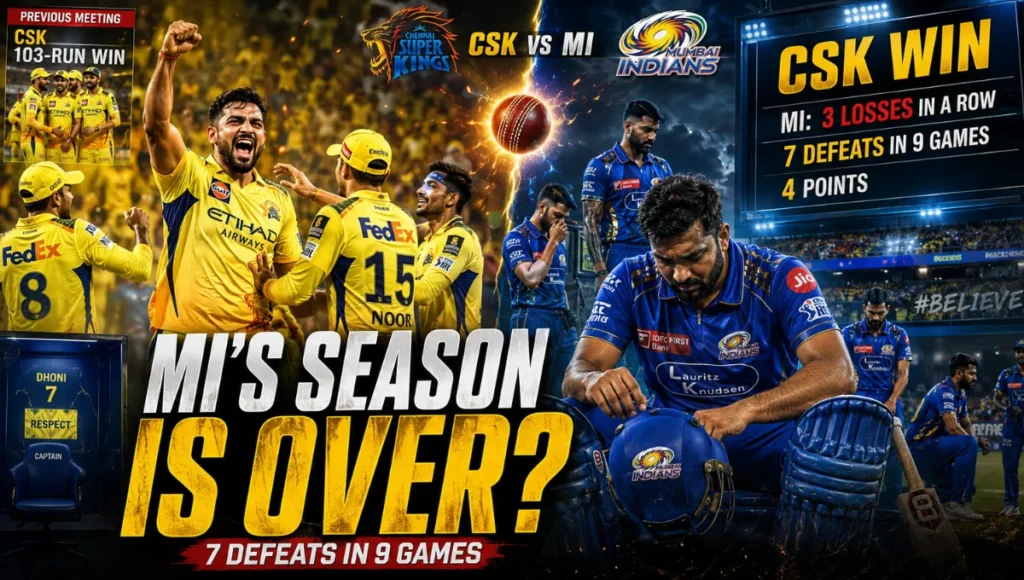

Mumbai Indians have lost three matches in a row. Seven defeats in nine games. Just four points on the board, and their season effectively hanging by a thread.
Chennai Super Kings, playing without MS Dhoni, just beat them again completing a season double for only the third time in the history of this fixture. This Chennai Super Kings vs Mumbai Indians match scorecard covers the 44th Match of IPL 2026 in full. But to understand why this result mattered so much, you need the whole season’s story, starting with a 103-run demolition a few weeks earlier.
Match in 30 Seconds
| Detail | Match information |
|---|---|
| Match | 44th Match, Indian Premier League 2026 |
| Venue | MA Chidambaram Stadium, Chennai |
| Date | 2 May 2026 |
| Toss | Mumbai Indians won the toss and elected to bat |
| Mumbai Indians score | 159/7 in 20 overs |
| Chennai Super Kings score | 160/2 in 18.1 overs |
| Result | Chennai Super Kings won by 8 wickets |
| Player of the Match | Ruturaj Gaikwad — 67 (48) |
| Season significance | CSK’s third-ever league double over MI in IPL history |
The one-line story: Ruturaj Gaikwad’s calm 67 and Kartik Sharma’s maiden IPL fifty guided Chennai Super Kings to a controlled 8-wicket chase, completing a season double over Mumbai Indians and deepening MI’s season-long collapse.
What people think is that a struggling team’s defeat is usually a single bad performance that can be quickly fixed.
Mumbai Indians captain Hardik Pandya’s own post-match words suggest something more structural: “not the season, I feel, not just the night… they played better, they bowled better, they fielded better, and they batted better.”
The Season’s First Blow: The 33rd Match
Before this 44th Match, Chennai Super Kings had already beaten Mumbai Indians once this season, at Wankhede Stadium and it wasn’t close.
Samson’s century and MI’s collapse to 11/3
CSK posted 207/6, built around Sanju Samson’s unbeaten 101 off 54 balls, including 10 fours and 6 sixes.
In reply, Mumbai Indians’ innings fell apart almost immediately: they lost Danish Malewar for a duck in the first over, Quinton de Kock for 7 in the second, and Naman Dhir for a duck in the third, sliding to 11/3.
What most people miss: a target of 208 already asks a lot of a chasing side. Losing three top-order wickets before the third over is not simply a bad start it’s the kind of collapse that makes the rest of the chase almost irrelevant, regardless of how the middle order responds afterward.
MI never recovered, eventually bowled out for just 104. Akeal Hosein took 4/17 from his four overs, the standout bowling figures of the match.
CSK’s biggest-ever win against MI by runs
The 103-run margin stands as Chennai Super Kings’ biggest-ever win against Mumbai Indians by runs in IPL history a genuinely significant record within one of the league’s most storied rivalries.
Bold opinion: a result this lopsided against a five-time IPL champion should have been treated as a major alarm bell for Mumbai Indians’ season at the time. In hindsight, given how the rest of their campaign unfolded, it was exactly that an early, unmistakable sign of the structural problems that would resurface again in the second meeting.
Chennai Super Kings vs Mumbai Indians Match Scorecard: The 44th Match
Mumbai Indians’ innings: 159/7 in 20 overs
Mumbai Indians were unable to build the momentum they needed after the 10-over mark, with Hardik Pandya later admitting the team had been “looking to get around 180, 190” but fell well short of that mark.
CSK bowling figures
| Bowler | Notable contribution |
|---|---|
| Anshul Kamboj | Bowled with composure, reading the pitch like a batsman reads a bowler, according to his captain |
| Noor Ahmad | Found rhythm and made key adjustments since the third game of the season |
Chennai Super Kings’ innings: 160/2 in 18.1 overs
| Batter | Runs | Balls | Dismissal |
|---|---|---|---|
| Sanju Samson | — | — | dismissed early to Bumrah after a reprieve |
| Urvil Patel | — | — | bowled off Ghazanfar after a brisk cameo |
| Ruturaj Gaikwad (c) | 67 | 48 | not out |
| Kartik Sharma | 50 | 39 | not out |
| Total | 160/2 | 18.1 overs |
MI bowling figures
| Bowler | Overs | Runs | Wickets | Economy |
|---|---|---|---|---|
| Krish Bhagat | 2 | 22 | 0 | 11.00 |
| Trent Boult | 3 | 33 | 0 | 11.00 |
Read Also:- New Zealand National Cricket Team Vs Bangladesh National Cricket Team Match Scorecard
Highlights and Key Moments
1. Gaikwad and Kartik Sharma’s calm, controlled chase
Chasing 160, CSK lost Samson early to Jasprit Bumrah, right after he’d survived an early reprieve. Urvil Patel then played a brisk cameo before dragging one back onto his stumps off Allah Ghazanfar. That brought Kartik Sharma to the crease, and from there, the chase never looked in doubt.
Counterintuitive point: a chase built around two batters simply rotating strike and punishing loose deliveries, without ever needing to force the pace, is often less exciting to watch than a boundary-filled slog.
But Gaikwad’s own explanation afterward made the approach clear: “we were chasing 20 to 30 runs less” than a genuinely testing target, so the team’s actual job was simply “getting through the first couple of overs” and ensuring one recognised batter stayed till the end.
2. The tactical decision behind Kartik’s promotion
Gaikwad explained CSK’s specific selection logic in picking Kartik Sharma over Akeal Hosein for this match: “we thought, how to get that extra batter at number eight and, if needed, extra bowler as well, and a bit of left-hander, batting down the order as well.” Kartik, promoted to No. 4, delivered a maiden IPL fifty that Gaikwad specifically praised for its shot selection: “he’s not someone who’s, who goes wild slogging… he picks and chooses his bowlers.”
This is where things go wrong for a struggling batting order, and right for a well-managed one: a specific, explained team-balance decision not just a generic “next man up” substitution produced exactly the kind of composed innings CSK needed. At 20 years and 6 days old, Kartik became the second-youngest CSK batter ever to score an IPL fifty, behind only Ayush Mhatre.
3. MI’s stalled momentum after 10 overs
Hardik Pandya was candid about exactly where Mumbai Indians’ innings went wrong: “we could not get the momentum post 10 overs, could not get the finish as well.” He explained that CSK’s bowlers made it difficult to simply “go straightaway and kind of play shots,” forcing MI into “calculative cricket” rather than the aggressive finish their total needed.
Bold opinion: Pandya’s specific phrase “even their batters, after getting set, they could not really take on the bowlers” is a genuinely revealing admission. It suggests MI’s problem in this match wasn’t a lack of individual quality, but a bowling unit disciplined enough to prevent set batters from ever finding the freedom to accelerate.
Player Performance Breakdown
Ruturaj Gaikwad a captain rebuilding form in real time
Gaikwad’s 67 off 48 was his second successive half-century, and he was open about the personal journey behind it: “it’s just that T20 cricket, one of those days where you hit a good shot, straight into the hands… I knew I was in a good frame of mind, thanks to my wife as well, my teammates as well, my management as well.” He specifically credited finishing the game as something that had been “lacking a bit for a long time.”
Original observation: Gaikwad’s honesty about needing support from people around him to maintain a positive frame of mind is a genuinely useful, human data point often missing from purely statistical analysis. A captain’s returning form isn’t just about technical adjustments it’s frequently about the surrounding environment restoring confidence that poor recent results had eroded.
Kartik Sharma a maiden fifty with real composure
Kartik’s unbeaten 50 off 39 balls, his first IPL half-century, came with a simple message from his captain beforehand: “Rutu bhayya just told me to play the game that I know. Nothing else.”
He celebrated with a pre-planned gesture, later explaining: “I had planned beforehand that if I scored runs today, I would celebrate like that.”
Practical lesson for young players stepping into a settled batting order: Kartik’s own admission that he didn’t overthink his specific method (“this I don’t know”) reflects the value of simple, uncomplicated instructions for a player under pressure in only his first innings at a new position clarity, not complexity, produced the composed innings CSK needed.
Sanju Samson: the individual highlight of the season series
Samson’s unbeaten 101 off 54 balls in the 33rd Match remains the standout individual batting performance across CSK’s two wins over Mumbai Indians this season, combining control with genuine six-hitting power.
What people think vs reality: an early-season century can sometimes be dismissed as a form blip once a player’s overall season numbers are assessed months later. In the specific context of CSK’s rivalry with MI this year, Samson’s innings should be remembered as the individual moment that set the tone for an entire season series CSK would go on to sweep.
Hardik Pandya an honest diagnosis of MI’s season
Pandya’s post-match comments went beyond a single match’s excuses, directly acknowledging a season-wide pattern: “yeah, they played better, they bowled better, they fielded better, and they batted better.”
When asked whether MI should have bowled more aggressively, his response was blunt: “I don’t know what aggressive we would have been. I think we would have had to throw some fireballs to get them out.”
Common mistake in analysis: dismissing a captain’s honest post-match admission as simply “good sportsmanship” rather than genuine diagnostic value. Pandya’s specific, unprompted acknowledgment that CSK were better across every discipline is a far more useful signal of MI’s season-long struggles than any external analysis could provide.
Analysis: Why Mumbai Indians’ Season Is Unraveling
A pattern, not a single bad night
What people think: a single 8-wicket defeat, even against a rival, is usually explainable by one bad session or one costly individual error.
Reality: this defeat extended MI’s losing streak to three matches and their overall record to seven losses in nine games, leaving them with just four points. Hardik Pandya’s own assessment “not the season, I feel, not just the night” is a captain explicitly rejecting the idea that this was an isolated bad performance.
CSK’s rare league double, in historical context
This win completed only the third league double CSK have achieved over MI in IPL history, following seasons in 2014 and 2023. Since 2020, CSK now lead the head-to-head 9-4 across 13 matches, having won six of their last seven encounters against MI dating back to 2023.
Bold opinion: a rivalry this storied rarely produces a clean sweep in either direction across a full season. The fact that CSK managed it for a third time, specifically during a season when Mumbai Indians are also playing without some key figures and searching for consistency, suggests this particular head-to-head has genuinely shifted in CSK’s favour over the medium term, not just this specific year.
What this means for both teams’ playoff hopes
This win lifted Chennai Super Kings to sixth on the points table, giving them hope of “a late surge,” in the words of match commentary.
For Mumbai Indians, the situation is genuinely dire: just four points from nine games leaves them needing something extraordinary from the remainder of the season to stay in playoff contention.
Practical takeaway for reading a mid-season collapse: a team requiring “something extraordinary” this deep into a season, as commentary described Mumbai Indians’ situation, should be analyzed as facing a structural, multi-match problem exactly the kind of pattern Hardik Pandya’s own comments confirmed, rather than hoping a single changed selection or tactical tweak will reverse the trend.
Read Also:- England Cricket Team Vs India National Cricket Team Stats
Records, Season Context and Format Guardrail
Records from the season’s two meetings
| Record | Detail |
|---|---|
| CSK’s biggest win vs MI by runs | 103 runs, 33rd Match, IPL 2026 |
| CSK’s league doubles over MI | Third time in IPL history, after 2014 and 2023 |
| Head-to-head since 2020 | CSK lead 9-4 across 13 matches |
| CSK’s recent dominance | Won 6 of the last 7 meetings vs MI since 2023 |
| Youngest CSK batters to score an IPL fifty | Ayush Mhatre (17y 291d), then Kartik Sharma (20y 6d) |
| Ruturaj Gaikwad’s career record vs MI | 380 runs in 11 innings, average 47.5, strike rate 150.2, four fifties |
Format and fixture guardrail
| Fixture | Correct context |
|---|---|
| CSK vs MI, 44th Match, IPL 2026 (this article) | The double-completing match — this article’s core scorecard |
| MI vs CSK, 33rd Match, IPL 2026 (this article) | The season’s first meeting — Samson’s century, CSK’s biggest-ever win by runs |
| MI vs CSK, 2021 (Punjab Kings archive) | A completely different, unrelated season |
| CSK vs MI, 2025 (Mumbai Indians/Delhi Capitals archives) | A different season entirely, hosted on unrelated franchise domains |
Do not present the 2021 or 2025 fixtures’ figures as part of this 2026 season analysis. Each belongs to a separate point in the two franchises’ history.
Frequently Asked Questions
Ans. Yes. Chennai Super Kings won both meetings against Mumbai Indians in IPL 2026 — by 103 runs in the 33rd Match and by 8 wickets in the 44th Match — completing their third-ever league double over MI in IPL history.
Ans. Mumbai Indians scored 159/7. Chennai Super Kings chased it down at 160/2 in 18.1 overs, led by Ruturaj Gaikwad’s unbeaten 67 and Kartik Sharma’s maiden IPL fifty of 50, winning by 8 wickets.
Ans. Ruturaj Gaikwad was Player of the Match for his unbeaten 67 off 48 balls, his second successive half-century.
Ans. CSK’s biggest win against MI came in the 33rd Match, a 103-run victory built on Sanju Samson’s unbeaten century of 101 off 54 balls — CSK’s biggest-ever win against MI by runs in IPL history.
Ans. Captain Hardik Pandya described it as a season-wide issue rather than a single bad match, with MI losing seven of nine games and struggling with bowling, batting, and fielding execution across multiple fixtures.