
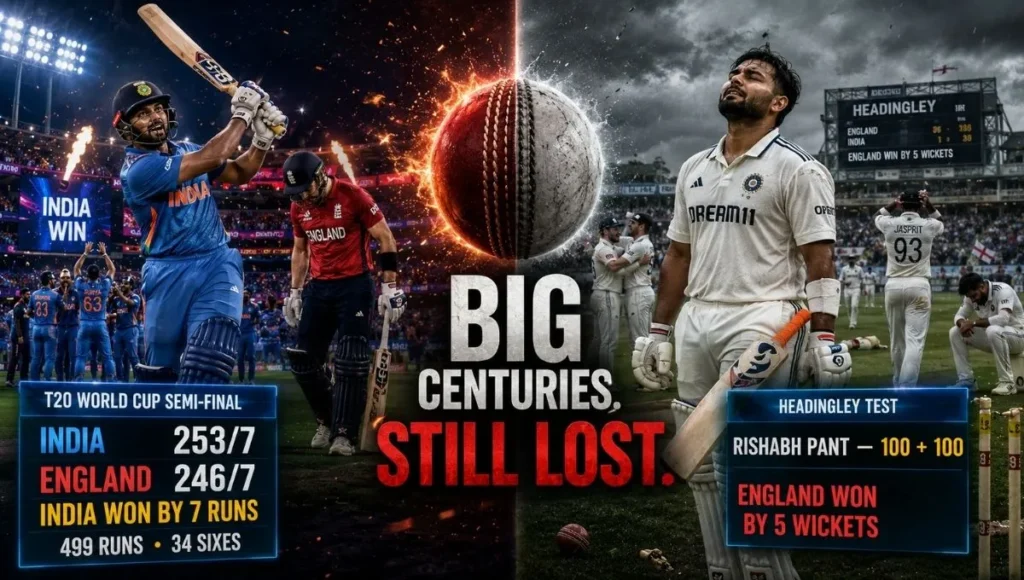

Two matches. Two formats. Two games where the team with the bigger individual centuries still lost.
In March, India and England combined for 499 runs in a single T20 World Cup semi-final the most ever scored in a men’s T20 World Cup match and India survived by exactly seven. Months later, at Headingley, Rishabh Pant scored twin centuries in the same Test match, and India still lost by five wickets.
This is the complete England Cricket Team vs India National Cricket Team stats breakdown for 2026 both matches, both formats, and the numbers that made each one remarkable.
The 2026 Stats Hub at a Glance
| Match | Format | Date | Venue | Result |
|---|---|---|---|---|
| 2nd Semi-Final, ICC Men’s T20 World Cup 2026 | T20I | 5 March 2026 | Wankhede Stadium, Mumbai | India won by 7 runs |
| 1st Test, India tour of England 2026 | Test | Multi-day | Headingley, Leeds | England won by 5 wickets |
The one-sentence 2026 story: India edged England in cricket’s most explosive format by the smallest possible margin, then lost to them in cricket’s longest format despite two centuries from the same batter in the same match.
T20 World Cup 2026 Semi-Final Stats
India’s innings: 253/7 in 20 overs
India were put in to bat and posted 253/7, the highest total ever recorded in a T20 World Cup knockout match. Sanju Samson led the way with 89 off 42 balls, supported by Shivam Dube’s 43 off 25 and Ishan Kishan’s 39 off 18.
England bowling: Will Jacks 2/20, Adil Rashid 2/41.
England’s innings: 246/7 in 20 overs
Chasing 254, England fell agonisingly short at 246/7, conceding over 250 in a T20 international for the first time in the process of building their chase. Jacob Bethell’s stunning 105 off 48 balls his maiden T20I century took England to the brink of what would have been the second-highest successful T20I run-chase in history. Will Jacks added 35 off 20 and Jos Buttler 25 off 17.
India bowling: Hardik Pandya 2/38, Jasprit Bumrah 1/33.
The record: 499 combined runs
The two teams scored 499 runs between them across the 40 overs the most in the history of men’s T20 World Cup cricket. India’s 253/7 stood as the highest total ever posted in a T20 World Cup knockout match at the time.
Highlights and Key Moments From the Semi-Final
1. Samson’s 89 builds an imposing total
Sanju Samson’s 89 off 42 balls gave India the platform for their record knockout total. Combined with Shivam Dube and Ishan Kishan’s cameos, India reached 253/7 after being put in to bat by England captain Harry Brook.
What most people miss: a semi-final total this large usually looks unassailable on paper. The fact that England came within seven runs of chasing it down retrospectively makes Samson’s innings look less like overwhelming dominance and more like exactly enough a distinction that matters when judging how “big” a total truly was.
2. Bethell’s stunning century almost completes the impossible
Jacob Bethell’s 105 off 48 balls was his maiden T20I century, arriving in the biggest possible match context. His innings took England to the cusp of the second-highest successful T20I run-chase in history, a genuinely remarkable achievement in a losing effort.
Counterintuitive point: England’s captain Harry Brook held his hands up over a costly fielding error after the match a reminder that a match decided by seven runs often comes down to one specific, identifiable moment rather than an overall performance gap between the two sides.
Bethell’s brilliance nearly overcame that single mistake; it simply wasn’t quite enough.
3. The over that decided the match
Jofra Archer hit three late sixes for England in the closing overs, dragging the chase agonisingly close, before timely wickets from Hardik Pandya, Jasprit Bumrah, and Axar Patel in the run-up to the death overs proved decisive.
Bold opinion: in a 499-run match, it’s tempting to credit only the batters. The specific value of India’s bowling attack here was less about economy Bumrah went for 33 in his four overs and entirely about wicket-taking at the exact moments that mattered, preventing Bethell from ever getting the support partnership he needed in the closing overs.
Read Also:- Sunrisers Hyderabad Vs Kolkata Knight Riders Match Scorecard
1st Test, India Tour of England 2026: Leeds Stats
India’s twin-century second innings
India’s first innings of 471 was built on Yashasvi Jaiswal’s 101 and Shubman Gill’s 147. England responded with 465, driven by Ollie Pope’s 106 and Harry Brook’s 99. In India’s second innings, KL Rahul made 137 and Rishabh Pant scored 118, taking India to 364 all out and setting England a target of 373.
India bowling in England’s first innings: Jasprit Bumrah 5/83, Prasidh Krishna 3/128.
England’s fourth-innings chase of 373
England’s second innings saw Ben Duckett make 149 and Zak Crawley 65, with Joe Root finishing unbeaten on 53 and Jamie Smith unbeaten on 44, as England reached 373/5 to win by 5 wickets.
England bowling across India’s two innings: Josh Tongue took 4 wickets in the first innings and 3 in the second; Brydon Carse took 1 and 3 respectively; Ben Stokes took 4 and 1.
Player Performance Breakdown Across Both Matches
Rishabh Pant’s twin centuries in a losing cause
Pant scored 134 in India’s first innings and 118 in the second two centuries in the same Test match and still finished on the losing side as England chased down 373.
Original observation: scoring twin centuries in a losing Test is one of the rarest outcomes in the format. It reflects an individual performance so far ahead of the team result that it becomes almost a separate story in its own right Pant’s batting effectively won India two entire innings’ worth of the contest, while the bowling and fielding around him lost the other two.
Sanju Samson and Jacob Bethell: the semi-final’s defining duel
Samson’s 89 built India’s platform; Bethell’s 105 nearly dismantled it entirely. Neither innings alone decided the match it was the seven-run gap between them that made this the highest-combined-scoring match in men’s T20 World Cup history.
Practical lesson for reading close matches: when a match is decided by single-digit margins, crediting only the winning side’s best performer misses half the story. Bethell’s innings deserves to be remembered on its own terms, not simply as “not quite enough.”
Jasprit Bumrah’s five-wicket haul that wasn’t enough
Bumrah took 5/83 in England’s first innings at Leeds a genuine standout bowling performance yet India still lost the match. In the semi-final months later, his figures were a more modest 1/33, but his wicket came at a moment his captain needed it most.
What people think vs reality: a five-wicket haul is often treated as an automatic match-defining performance. Here, it wasn’t enough to prevent an eventual defeat, because a Test match’s result depends on all four innings, not just one bowling spell in the first.
Analysis: Reading Stats Across Two Different Formats
Why totals mean different things in T20Is and Tests
What people think: a “big total” of 250-plus in a T20I and a “big total” of 470-plus in a Test both represent similarly dominant positions for the team that posted them.
Reality: India’s 253/7 in the semi-final came within seven runs of being chased down inside 20 overs. India’s 471 in the first innings of the Leeds Test came close to representing a match-winning lead England managed only 465 in reply but that lead evaporated entirely once England’s bowlers dismantled India’s fourth-innings target-setting effort and their own batters chased successfully.
Both examples show that a “big total” in isolation guarantees nothing without matching bowling and fielding execution across the full match.
The common thread: England’s fourth-innings composure
In the semi-final, England’s chase came agonisingly close in the format’s final “innings.” In the Test, England’s actual fourth innings chasing 373 was completed successfully. Across both formats, England’s batting in the chasing/finishing position was genuinely strong throughout this head-to-head, even though the results split one win apiece.
Bold opinion: rather than reading these two results as contradictory (“India won the T20, England won the Test, so who’s really better?”), the more useful stats-based conclusion is that England’s batting order, across both formats, performs its best cricket specifically when chasing a target a pattern any opposition captain should account for when setting a total against them.
Read Also:- India Women’s National Cricket Team Vs England Women’s National Cricket Team Match Scorecard
Historical Context and Format Guardrail
The broader head-to-head
England and India have played a long and extensive head-to-head across Tests, ODIs, and T20Is spanning decades. The two 2026 matches covered in this article represent two of the most statistically remarkable recent additions to that history the highest-scoring T20 World Cup match ever played, and a Test defined by two centuries from a single losing-side batter.
Format guardrail
| Source | Correct use |
|---|---|
| This article’s two 2026 matches | The T20 World Cup semi-final and the Leeds Test — this article’s core statistical content |
| Cricinfo/Wikipedia all-time head-to-head pages | Aggregate historical data across all formats and decades, not specific to 2026 |
| India tour of England 2025 stats hub | A completely different year’s series; must not be blended with 2026 figures |
Do not present all-time head-to-head win counts or 2025 series statistics as if they describe either of the two specific 2026 matches covered here. Each data source serves a different, clearly separate purpose.
Frequently Asked Questions
Ans. India won by 7 runs. India scored 253/7, and England finished on 246/7 at Wankhede Stadium, Mumbai, with India advancing to the final.
Ans. The India vs England 2026 semi-final produced 499 combined runs, the most ever scored in a men’s T20 World Cup match.
Ans. Rishabh Pant scored twin centuries for India — 134 in the first innings and 118 in the second — but India still lost the Test by 5 wickets as England chased down 373.
Ans. England won by 5 wickets, chasing down a target of 373 built on Ben Duckett’s 149 and contributions from Joe Root and Jamie Smith, despite India leading for large parts of the match.
Ans. Very close. Bethell scored 105 off 48 balls, and England finished just 7 runs short of India’s 253/7, in what would have been the second-highest successful T20I run-chase in history.