
New Zealand were bowled out for a stunning 91 in their own backyard, then ten days earlier had smashed South Africa’s unbeaten World Cup run with the fastest century in men’s T20 World Cup history, This rivalry keeps flipping on its head within the same fortnight. Here’s every scorecard, every collapse, and the tactical detail that explains why these two teams can’t seem to play a predictable match against each other.
Match Snapshot: Two Fixtures, Two Opposite Stories
New Zealand and South Africa met twice in quick succession in 2026, First in the T20 World Cup semi-final at Eden Gardens, Kolkata, where New Zealand demolished an unbeaten South African side, and then in a bilateral T20I series just ten days later at Mount Maunganui, where South Africa returned the favor with a shock win. Both results were so extreme that they read like different teams entirely.
| Match | Venue | Result |
|---|---|---|
| T20 World Cup 2026, Semi-Final 1 | Eden Gardens, Kolkata | New Zealand won by 9 wickets |
| 1st T20I, bilateral series | Bay Oval, Mount Maunganui | South Africa won by 7 wickets |
But here’s the real problem with judging either team off a single result: both matches were decided by extreme, almost freakish individual performances rather than sustained team form and that’s the exact nuance most scorecards flatten into a simple win-loss line.
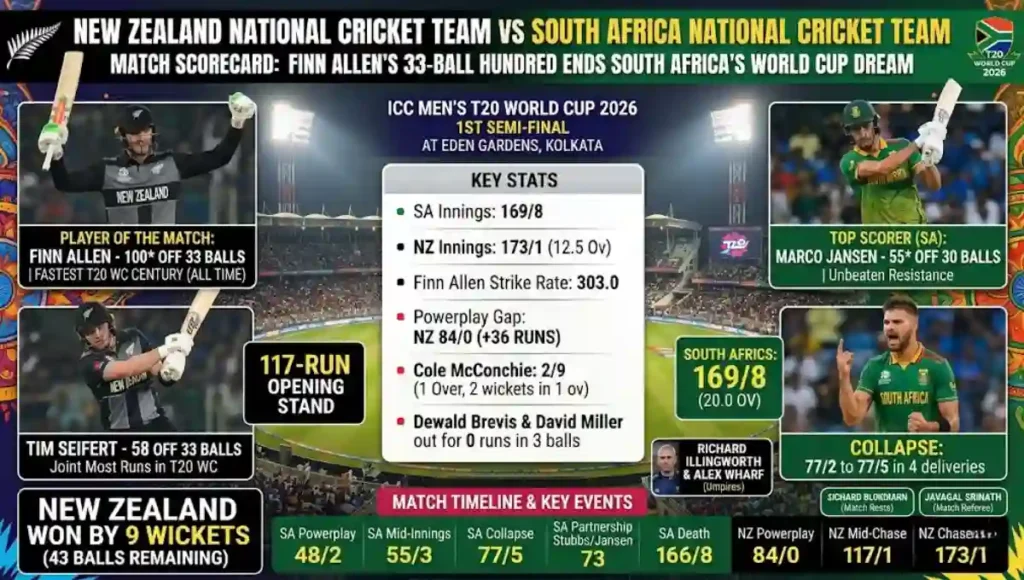
Full Scorecard: T20 World Cup Semi-Final, Kolkata New Zealand Win by 9 Wickets
South Africa were restricted to 169/8 despite entering the match unbeaten through the tournament, before New Zealand chased it down in just 12.5 overs, powered by the fastest century in men’s T20 World Cup history.
South Africa Innings: 169/8 (20 overs)
| Batter | Runs | Balls | Notes |
|---|---|---|---|
| Marco Jansen | 55 (not out) | 30 | Led a late fightback after a middle-order collapse |
| Dewald Brevis | 34 | — | Provided the innings’ early momentum |
Bowling New Zealand: Rachin Ravindra 2/29 and Zak McConchie 2/9 were the standout wicket-takers, breaking South Africa’s middle order at a crucial stage.
New Zealand Innings: 173/1 (12.5 overs)
| Batter | Runs | Balls | 4s | 6s | SR |
|---|---|---|---|---|---|
| Finn Allen | 100 (not out) | 33 | 8 | 9 | 303.03 |
| Tim Seifert | 58 | — | — | — | — |
| Rachin Ravindra | 13 (not out) | — | — | — | — |
Read Also:- India National Under-19 Cricket Team Vs Sri Lanka National Under-19 Cricket Team Match Scorecard
Bowling South Africa: Kagiso Rabada 1/28 was South Africa’s only wicket-taker in a chase that never allowed them to build any pressure.
The Turning Point Nobody Talks About
Most recaps credit Finn Allen’s century as a standalone heroic act, but that misses the actual mechanical failure by South Africa. Their bowling attack had no answer once Allen and Seifert cleared the ball over a “slower-than-usual” Eden Gardens surface a pitch South Africa themselves had exploited to bowl teams out cheaply all tournament. What most people miss is that South Africa’s own tactical success throughout the group stage, built on slow, low tracks, became the exact platform Allen used to play the innings of his career, since low bounce actually suits committed power-hitting more than variable bounce does.
If you’re assessing any T20 chase on a slow surface, don’t assume it favors the bowling side automatically. Check whether the batting side has power-hitters who target length rather than bounce Allen’s 33-ball hundred proves slow pitches can be more dangerous in the wrong hands.
Performance Breakdown: Why Finn Allen’s Century Was Different From a Normal Blitz
A 33-ball century sounds like blind slogging, but Allen’s knock had genuine method. He targeted specific bowlers in specific overs going after Rabada’s variations early rather than waiting, which meant South Africa’s captain Aiden Markram never got a settling period to adjust his bowling plans. What people think: record-breaking hundreds are pure luck and timing. What actually happened: Allen and Seifert’s 173-run stand meant New Zealand never lost the momentum of the powerplay, turning what should have been a tense semi-final chase into a one-sided rout inside 13 overs.
What you should do with this insight: when previewing New Zealand’s top order, track Finn Allen’s strike rate in the first six overs specifically. If he’s above 150 in the powerplay, New Zealand’s chase is almost always over before the middle overs even begin.
What Fans Think vs What Actually Happened
- Fans think: South Africa’s unbeaten run through the group stage made them the outright favorites entering the semi-final.
- Reality: South Africa had already shown vulnerability against Afghanistan earlier in the tournament, and Eden Gardens’ conditions neutralized their biggest strength disciplined, low-scoring containment bowling.
- Fans think: Marco Jansen’s unbeaten 55 was a genuine positive sign for South Africa.
- Reality: his innings came in a lost cause after South Africa were already reduced to a low total with wickets in hand unused it inflated the final score without changing the outcome.
Full Scorecard: 1st T20I, Mount Maunganui South Africa Win by 7 Wickets
New Zealand were bowled out for a shocking 91 in just 14.3 overs on home soil, before South Africa chased down the target with ease, taking a 1-0 lead in the five-match bilateral series.
New Zealand Innings: 91 all out (14.3 overs)
| Batter | Dismissal | Runs | Balls | 4s | 6s | SR |
|---|---|---|---|---|---|---|
| Devon Conway | c de Zorzi | 0 | 6 | 0 | 0 | 0.00 |
| Tom Latham | lbw b Coetzee | 12 | 6 | 1 | 0 | 200.00 |
| Tim Robinson | c Linde b Coetzee | 5 | 10 | 1 | 0 | 50.00 |
| Nick Kelly | b Baartman | 0 | 3 | 0 | 0 | 0.00 |
| Bevon Jacobs | run out | 15 | 19 | 2 | 0 | 78.94 |
| Mitchell Santner (c) | b Mokoena | 18 | 12 | 2 | 1 | 150.00 |
| James Neesham | c wk b Mokoena | 26 | 21 | 2 | 1 | 123.80 |
| Zak Foulkes | c Esterhuizen | 3 | 5 | 0 | 0 | 60.00 |
| Kyle Jamieson | b Maharaj | 3 | 5 | 0 | 0 | 60.00 |
| Cole McConchie | not out | 0 | 3 | 0 | 0 | 0.00 |
Extras: 6 | Total: 91 all out (14.3 overs, RR 6.27)
Fall of wickets: 1-2 (Conway), 2-14 (Latham), 3-20 (Robinson), 4-21 (Kelly), 5-36 (Jacobs), 6-54 (Santner), 7-80 (Neesham), 8-83 (Foulkes), 9-86 (Jamieson), 10-91 (McConchie).
Bowling South Africa: Gerald Coetzee 3-0-14-2, Nqabayomzi Mokoena 3.3-0-26-3, Ottniel Baartman 3-0-22-1, Keshav Maharaj 4-0-25-1, Dewald Forrester 1-0-4-0.
South Africa Innings: 93/3 (16.4 overs)
| Batter | Dismissal | Runs | Balls | Notes |
|---|---|---|---|---|
| Tony de Zorzi | caught | 7 | — | Fell early to Foulkes |
| Clyde Esterhuizen | not out | 45 | 48 | Anchored the chase from start to finish |
| Rubin Hermann | caught wk | 10 | — | Part of a historic sibling pairing with Jordan Hermann |
| Jason Smith | stumped | 10 | — | Dismissed by sharp glovework from Latham |
| Dewald Forrester | not out | 16 | — | Finished the chase alongside Esterhuizen |
Bowling New Zealand: Kyle Jamieson 3.4-0-28-1, Zak Foulkes 2-0-8-1, Ben Sears 3-0-16-0, Mitchell Santner 4-0-8-1, Cole McConchie 4-0-24-0.
This Is Where Things Go Wrong: New Zealand’s Powerplay Collapse
Most recaps simply say “New Zealand collapsed” and move on, but the real story is in the powerplay numbers specifically. New Zealand lost five wickets inside the mandatory six overs, meaning half their batting order was gone before South Africa’s debutant legspinner Nqabayomzi Mokoena had even bowled a single delivery. What most people miss is that this collapse came just ten days after New Zealand’s dominant World Cup semi-final win, proving that even a team playing with total confidence can completely fall apart against fresh bowling variety and unfamiliar personnel in a low-stakes bilateral opener.
If you’re studying team form transitions between tournaments and bilateral series, don’t assume momentum carries over automatically. New Zealand’s collapse here shows that changed conditions (Mount Maunganui’s seam-friendly pitch versus Eden Gardens’ slow track) and unfamiliar opposition bowlers can erase tournament momentum within days.
Read Also:- Rajasthan Royals Vs Gujarat Titans Match Scorecard
Counterintuitive Take: South Africa’s Debutants Deserve More Credit Than the Result Suggests
Conventional wisdom would say South Africa’s win was inevitable revenge after the World Cup semi-final loss. The bolder, more accurate read: this win was built almost entirely on debutant legspinner Mokoena claiming his first three international wickets and Gerald Coetzee returning from injury to strike twice in his opening three overs meaning South Africa’s depth, not their established stars, decided this match. If you’re tracking South Africa’s rebuilding phase after the World Cup, watch Mokoena’s economy rate across the rest of the series specifically. A 19-year-old taking 3/26 on debut against a full-strength New Zealand top order is a genuinely rare statistical outlier worth monitoring closely.
Tactical Decisions That Decided Both Matches
New Zealand’s semi-final success came from an aggressive, no-fear approach in the powerplay chase, while their T20I defeat came from the exact opposite problem no application against unfamiliar bowling variety in tricky home conditions. South Africa’s pattern was the mirror image: disciplined bowling execution won them the bilateral opener, while a lack of depth in their middle order cost them the semi-final once their top order failed to build a substantial total.
What both team managements should actually do: New Zealand needs genuine top-order coaching on early powerplay shot selection against unfamiliar spin, since Conway, Latham, and Kelly were all dismissed cheaply against bowlers they’d never faced before. South Africa should fast-track Mokoena into their next global tournament squad debut performances against elite opposition rarely happen by accident.
Series and Match Summary Table
| Metric | New Zealand | South Africa |
|---|---|---|
| T20 World Cup semi-final result | Won by 9 wickets | Lost, unbeaten run ended |
| Bilateral T20I opener result | Lost, bowled out for 91 | Won by 7 wickets, series lead 1-0 |
| Standout individual performance | Finn Allen, 100* off 33 balls | Nqabayomzi Mokoena, 3/26 on debut |
| Key bowling impact | Rachin Ravindra 2/29 (semi-final) | Gerald Coetzee 2/14 (T20I opener) |