
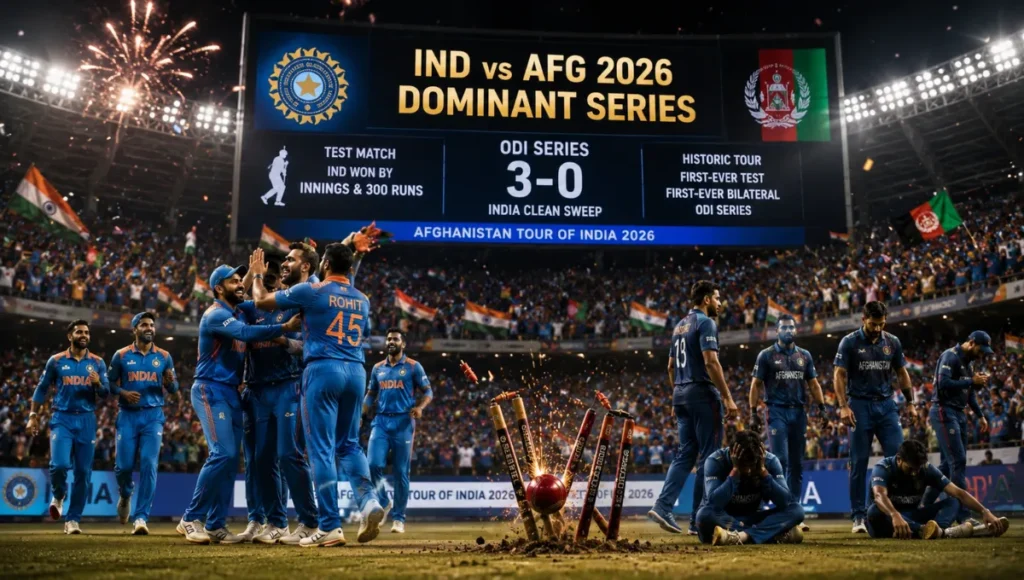

Afghanistan arrived in India in June 2026 for their first-ever Test against the hosts and their first-ever bilateral ODI series against them. They left having lost every single match, including a Test defeat by an innings and 300 runs.
But here’s the real problem: most coverage of the India vs Afghanistan national cricket team timeline gives you a results list, but never explains how completely one-sided this historic tour actually was.
The Afghanistan cricket team toured India from June 6 to June 20, 2026, playing one Test and three One Day Internationals across four venues. India won every match the Test by an innings and 300 runs, and the ODI series 3-0.
What most people miss is that this wasn’t just another bilateral series. It was the first time India and Afghanistan had ever played a bilateral ODI series against each other, and Afghanistan’s first-ever Test against India since making their format debut in 2018.
Series Summary at a Glance
| Detail | Information |
|---|---|
| Tour dates | June 6-20, 2026 |
| Format | 1 Test, 3 ODIs |
| Venues | New Chandigarh, Dharamshala, Lucknow, Chennai |
| Test result | India won by an innings and 300 runs |
| ODI series result | India won 3-0 |
| Historic significance | First-ever bilateral ODI series between the two nations |
| Player of the Test | Shubman Gill (126) and Manav Suthar (7 wickets) |
This is where things go wrong for anyone expecting a competitive contest based on Afghanistan’s growing reputation in white-ball cricket: their bowling and batting both fell apart completely once Test and ODI conditions in India tested their depth beyond T20 cricket.
Why This Tour Made History
Afghanistan had played India in white-ball formats before, but never in a bilateral ODI series, and their Test history against India stretched back only to 2018 with just isolated fixtures. This tour changed that structurally, giving Afghanistan a genuine multi-format bilateral engagement against one of the sport’s biggest teams for the first time.
Common mistake fans make when reading this framing: assuming “historic” automatically means “competitive.” Reality: history and competitiveness are separate things this tour was historically significant precisely because it exposed the gap between Afghanistan’s white-ball reputation and their depth in longer formats, rather than narrowing it.
The Only Test: Full Breakdown (June 6-10, New Chandigarh)
Played at the Maharaja Yadavindra Singh International Cricket Stadium, this Test turned into a complete demolition inside four days.
India’s First Innings (564/8 declared in 127 overs)
| Batter | Runs | Balls |
|---|---|---|
| Shubman Gill | 126 | 177 |
India batted deep into the match, posting 564 for 8 declared, with Shubman Gill’s 126 anchoring the innings. Mohammad Saleem was Afghanistan’s most successful bowler, taking 6 for 140 across 27 overs, but the workload took a visible toll on Afghanistan’s bowling unit heading into their reply.
Afghanistan’s First Innings (152 all out in 58.4 overs)
| Batter | Runs | Balls |
|---|---|---|
| Rahmat Shah | 60 | 135 |
Rahmat Shah’s patient 60 was the lone bright spot as Afghanistan collapsed to 152 all out, conceding a first-innings deficit of 412 runs. Debutant left-arm spinner Manav Suthar picked up a stunning 6 for 33 in just 22 overs, announcing himself in style on his first Test appearance.
Afghanistan’s Second Innings (112 all out in 35.5 overs, following on)
| Batter | Runs | Balls |
|---|---|---|
| Sediqullah Atal | 42 | 80 |
Read Also:- Icc T20 World Cup 2024: Full Schedule, Highlights & Key Moments
Forced to follow on, Afghanistan folded even faster in their second attempt, bowled out for just 112. Washington Sundar took 4 for 36 in 11 overs, sealing India’s win by an innings and 300 runs.
Turning point of the Test: Manav Suthar’s 6-wicket debut haul in Afghanistan’s first innings is the single moment that turned a big total into an insurmountable one once Afghanistan conceded a 412-run deficit, the follow-on and the innings defeat became a formality.
1st ODI: Dharamshala A Nail-Biter (June 13-14)
This is where things go wrong for anyone assuming the ODI series would mirror the Test’s one-sidedness. The opener was a genuine low-scoring thriller.
Afghanistan Batting Innings (194 all out in 24.5 overs)
Afghanistan were bowled out cheaply, but the low total set up a tighter chase than most fans expected given the Test result.
India’s Chase (195/3 in 22.5 overs, won by 7 wickets)
India chased down the target in under 23 overs, completing the win comfortably despite the modest target requiring some careful navigation of Afghanistan’s spin-heavy attack.
What people think vs reality: most fans assume a 3-0 ODI sweep means every match was a routine formality. Reality: this opener finished in just 22.5 overs of India’s innings against a total of only 194 a match that was closer in tempo and required more discipline from India’s top order than the eventual scoreline suggests, since Afghanistan’s spinners created early pressure before India’s chase settled.
2nd ODI: Lucknow Total Domination (June 17)
By the second match, India shifted gears completely, delivering their most emphatic performance of the series.
India Batting Innings (402 in 49.5 overs)
India posted a massive 402, their highest total of the series, batting through almost all 50 overs to set an imposing target.
Afghanistan’s Chase (232 all out in 44.3 overs, lost by 170 runs)
Afghanistan’s chase never had any realistic chance against a target of this size, and they were bowled out for 232, losing by 170 runs.
This match is the clearest evidence of the gap between the two sides in the 50-over format India’s batting depth allowed them to bat first and pile on runs at a rate Afghanistan’s bowling attack, already stretched thin after the Test, simply couldn’t contain.
3rd ODI: Chennai The Series Sweep (June 20)
The final match confirmed the series result with India completing a clean sweep in front of their home crowd.
Afghanistan Batting Innings (218 all out in 44.2 overs)
Afghanistan posted a modest 218, unable to build the kind of total needed to challenge India’s in-form batting lineup.
India’s Chase (224/1 in 28.4 overs, won by 9 wickets)
India cruised to the target inside 29 overs, losing only a single wicket, sealing a 9-wicket win and a 3-0 series sweep.
Turning point of the series: If one passage of play defines this entire tour, it’s Manav Suthar’s Test debut spell it set the tone for a series where India’s depth (in both batting and bowling) consistently outmatched Afghanistan across every format and every venue, regardless of who India fielded.
Player Performance Breakdown
| Player | Format | Performance | Impact |
|---|---|---|---|
| Shubman Gill | Test | 126 in the 1st innings | Set up India’s declaration total of 564/8 |
| Manav Suthar | Test | 7 wickets across the match (6/33 and more) | Man of the Match on debut, decided the Test |
| Mohammad Saleem | Test | 6/140 | Afghanistan’s lone standout bowling effort |
| Rahmat Shah | Test | 73 runs across both innings | Afghanistan’s most consistent batter of the series |
| Washington Sundar | Test | 4/36 in the second innings | Sealed the innings victory |
Read Also:- India Vs West Indies T20 2026: Full Scorecard, Highlights & Turning Points
Manav Suthar’s Test debut deserves more attention than a single stat line gives it taking 7 wickets in your first-ever Test match, against an opponent that had shown genuine promise in white-ball cricket, is the kind of performance that should be remembered as the defining individual moment of this entire tour, not just a footnote inside a bigger scoreline.
What People Think vs What Actually Happened
Most fans assumed Afghanistan’s rising reputation in white-ball cricket, built on strong performances in T20 World Cups and ODI World Cups, would translate into a competitive series against India in home conditions.
Reality: Afghanistan lost the Test by an innings and 300 runs and the ODI series 3-0, with only the first ODI offering genuine competitive tension. The common mistake fans and pundits make is assuming T20 pedigree transfers directly to Test and 50-over cricket this tour proved that Afghanistan’s depth in longer formats still lags significantly behind their white-ball strike bowling reputation.
Key Takeaways for Fans
- Manav Suthar’s 7-wicket Test debut is a genuine breakout performance that should be tracked closely in India’s future spin-bowling selections
- Afghanistan’s batting fragility in Tests (152 and 112 in their two innings) shows a clear gap between their T20 form and longer-format technique
- The first ODI’s tight finish (195/3 in 22.5 overs chasing 194) is proof that Afghanistan’s white-ball bowling attack still has genuine bite, even in a series they lost 3-0
- India’s 402 in the second ODI is a reminder of their batting depth advantage very few teams can consistently post totals of that scale against any opponent
- This tour’s historic framing (first bilateral ODI series, first Test since 2018) matters more for Afghanistan’s cricketing development than for the immediate results, which were heavily one-sided