
England were 35 for 3, chasing a modest-looking 165. Their top order was gone. Shaheen Shah Afridi had a new ball doing exactly what it was designed to do, and Pakistan’s fielders were closing in for the kill.
Then Harry Brook decided the match belonged to him.
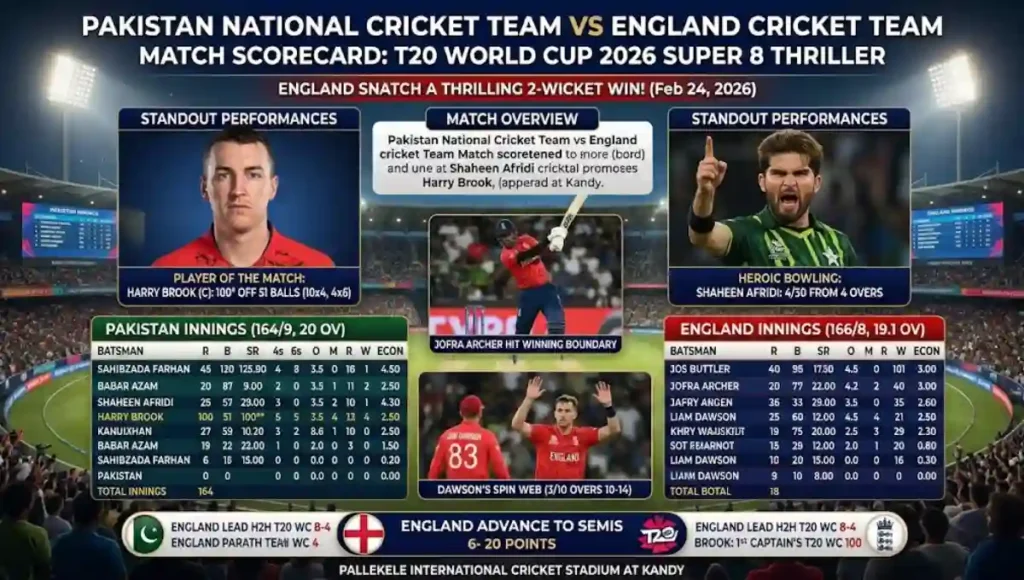
He scored 100 off 51 balls. England somehow finished on 166/8 in 19.1 overs, winning by two wickets. Pakistan had done almost everything right and still lost.
This Pakistan National Cricket Team vs England Cricket Team match scorecard covers the full result from the ICC Men’s T20 World Cup 2026 Super Eights match at Pallekele. It also explains something no raw scorecard tells you: how a team can collapse to 35/3 and still win, and how a team can bowl brilliantly for 12 overs and still lose.
Match in 30 Seconds
| Detail | Match information |
|---|---|
| Match | England vs Pakistan, 45th Match, Super Eights Group 2 |
| Tournament | ICC Men’s T20 World Cup 2026 |
| Venue | Pallekele Cricket Stadium, Pallekele |
| Toss | Pakistan won the toss and elected to bat |
| Pakistan score | 164/9 in 20 overs |
| England score | 166/8 in 19.1 overs |
| Result | England won by 2 wickets |
| Key match phase | England slipped to 35/3 before Harry Brook’s century turned the chase |
The one-line story: Shaheen Shah Afridi’s new-ball spell gave Pakistan control of the match, but Harry Brook’s 100 off 51 balls dragged England through a chase they were losing for more than half the innings.
What people think is that 164 is a below-par T20 total that any decent batting side chases comfortably. The reality is sharper. England needed a near-flawless individual innings just to survive their own top-order collapse. Without Brook, this was Pakistan’s match to close out.
Pakistan National Cricket Team vs England Cricket Team Match Scorecard
Pakistan innings: 164/9 in 20 overs
| Batter | Runs | Balls | 4s | 6s | Strike rate | Dismissal |
|---|---|---|---|---|---|---|
| Sahibzada Farhan | 63 | 45 | 7 | 2 | 140.00 | lbw b Overton |
| Saim Ayub | 7 | 7 | 1 | 0 | 100.00 | c Bethell b Archer |
| Salman Ali Agha (c) | 5 | 6 | 1 | 0 | 83.33 | c Overton b Dawson |
| Babar Azam | 25 | 24 | 2 | 0 | 104.17 | b Overton |
| Fakhar Zaman | 25 | 16 | 2 | 2 | 156.25 | c Dawson b Rashid |
| Shadab Khan | 23 | 11 | 4 | 0 | 209.09 | run out (Bethell) |
| Usman Khan (wk) | 8 | 5 | 0 | 1 | 160.00 | c Overton b Dawson |
| Mohammad Nawaz | 0 | 1 | 0 | 0 | 0.00 | lbw b Dawson |
| Shaheen Shah Afridi | 2 | 3 | 0 | 0 | 66.67 | c Curran b Archer |
| Salman Mirza* | 2 | 3 | 0 | 0 | 66.67 | not out |
| Extras | 4 | — | — | — | — | 1 nb, 3 w |
| Total | 164/9 | 20 overs |
Fall of wickets: 14/1 (2.1), 27/2 (3.3), 73/3 (10.5), 122/4 (15.4), 132/5 (16.3), 146/6 (17.4), 146/7 (17.5), 149/8 (18.3), 164/9 (19.6).
England bowling figures
| Bowler | Overs | Runs | Wickets | Economy |
|---|---|---|---|---|
| Jofra Archer | 4 | 32 | 2 | 8.00 |
| Jamie Overton | 3 | 26 | 2 | 8.66 |
| Liam Dawson | 4 | 24 | 3 | 6.00 |
| Sam Curran | 3 | 24 | 0 | 8.00 |
| Adil Rashid | 4 | 31 | 1 | 7.75 |
| Will Jacks | 2 | 27 | 0 | 13.50 |
England innings: 166/8 in 19.1 overs
| Batter | Runs | Balls | 4s | 6s | Strike rate | Dismissal |
|---|---|---|---|---|---|---|
| Phil Salt | 0 | 1 | 0 | 0 | 0.00 | c Usman b Shaheen |
| Jos Buttler (wk) | 2 | 3 | 0 | 0 | 66.67 | c Usman b Shaheen |
| Harry Brook (c) | 100 | 51 | 10 | 4 | 196.08 | b Shaheen |
| Jacob Bethell | 8 | 10 | 1 | 0 | 80.00 | c Farhan b Shaheen |
| Tom Banton | 2 | 6 | 0 | 0 | 33.33 | c Usman b Usman Tariq |
| Sam Curran | 16 | 15 | 1 | 0 | 106.67 | c Nawaz b Usman Tariq |
| Will Jacks | 28 | 23 | 1 | 2 | 121.74 | b Nawaz |
| Jamie Overton | 0 | 3 | 0 | 0 | 0.00 | st Usman b Nawaz |
| Liam Dawson* | 1 | 1 | 0 | 0 | 100.00 | not out |
| Jofra Archer* | 5 | 2 | 1 | 0 | 250.00 | not out |
| Extras | 4 | — | — | — | — | 1 lb, 3 w |
| Total | 166/8 | 19.1 overs |
Fall of wickets: 0/1 (0.1), 17/2 (2.3), 35/3 (4.5), 58/4 (7.1), 103/5 (11.5), 155/6 (16.6), 160/7 (18.1), 161/8 (18.5).
Pakistan bowling figures
| Bowler | Overs | Runs | Wickets | Economy |
|---|---|---|---|---|
| Shaheen Shah Afridi | 4 | 30 | 4 | 7.50 |
| Salman Mirza | 3.1 | 26 | 0 | 8.21 |
| Saim Ayub | 2 | 21 | 0 | 10.50 |
| Mohammad Nawaz | 3 | 26 | 2 | 8.66 |
| Shadab Khan | 3 | 31 | 0 | 10.33 |
| Usman Tariq | 4 | 31 | 2 | 7.75 |
Read Also:- Lucknow Super Giants vs Punjab Kings Match Scorecard
Highlights and Key Moments
1. Farhan and Babar gave Pakistan a total worth defending
Sahibzada Farhan’s 63 off 45 was Pakistan’s platform innings. He struck seven fours and two sixes and batted through the top order’s collapse around him. Babar Azam added a steady 25 off 24, and Fakhar Zaman’s 25 off 16 gave the innings late thrust.
What most people miss: Farhan’s innings looks unremarkable at 140 strike rate in a T20 World Cup, but it was the glue that held Pakistan’s innings together after two early wickets. Without it, 164 becomes 130.
2. Shaheen’s new-ball spell put England at 35/3
Shaheen Shah Afridi opened the bowling and immediately dismissed Phil Salt for a golden duck. Two balls later, Jos Buttler fell for 2. By the time Jacob Bethell was gone in the fifth over, England were 35 for 3, and Shaheen was on his way to 4/30.
This is the passage of play competitors bury in a fall-of-wickets column. It deserves more attention than that. England’s most explosive top three were removed inside five overs against a total of only 165. At that point, Pakistan were clear favourites.
Common mistake: judging Shaheen’s figures purely by his 7.50 economy. In a chase this small, three early wickets matter more than any economy rate they force every remaining batter to rebuild from behind.
3. Brook turned rescue into a run-a-ball century
Harry Brook walked in with England already two down. He ended up dismantling Pakistan’s bowling attack almost single-handedly, striking 10 fours and 4 sixes in a 51-ball hundred.
His innings had three distinct phases:
- Rescue (0–35): Brook played carefully alongside the collapsing top order, absorbing pressure rather than adding to it.
- Rebuild (35–103): After Bethell’s dismissal, Brook found the boundary more often, using the pace of Pakistan’s bowlers against them.
- Finish (103–155): He accelerated hard, targeting Shadab Khan and Usman Tariq, and took the game away from Pakistan almost entirely on his own.
Counterintuitive idea: most match reports will call this “Brook’s rescue act.” The more accurate description is that Brook did not rescue the innings passively he took over the captaincy of the chase in every sense, dictating tempo from the fourth over onward.
4. Pakistan’s spinners nearly completed the comeback
After Brook departed for 100, bowled by Shaheen in his second spell, England were 155/6. Mohammad Nawaz then removed Will Jacks and Jamie Overton in the same over, reducing England to 161/8.
Pakistan needed one more wicket. They did not get it. Liam Dawson and Jofra Archer saw England home with two wickets to spare, in 19.1 overs.
This is where things go wrong for a bowling side: taking eight wickets and still losing usually means the tail was allowed too much freedom in the closing overs, or a bowling change came one over too late. Pakistan’s spin attack created two genuine chances in the death overs but could not force the ninth wicket.
Player Performance Breakdown
Harry Brook: 100 off 51: the innings that won the match
Brook’s century is one of the most complete chase-defining innings possible in T20 cricket: he walked in with his team two down, absorbed the initial pressure, then delivered boundaries at a rate of nearly one every three balls.
| Brook’s phase | Approach | Effect |
|---|---|---|
| Early (2 down) | Controlled strike rotation | Prevented a third quick wicket |
| Middle | Aggressive boundary hitting | Rebuilt the required rate from over 9 to under 7 |
| Late | All-out attack | Effectively decided the match before the final over |
Read Also:- Pakistan Super League Standings 2026: Final Table, Turning Points & Full Breakdown
Original observation: Brook’s century is often going to be remembered as a “captain’s innings,” but the real skill was restraint in the first ten balls. Batters who try to counter-attack immediately after 35/3 usually become 35/4. Brook waited, then attacked.
Shaheen Shah Afridi 4/30: four wickets that nearly won it anyway
Shaheen’s spell produced two separate wicket clusters: the powerplay strikes that removed Salt and Buttler, and the later breakthrough that ended Brook’s innings.
Bold opinion: Man of the Match debates in a losing effort are rare, but Shaheen’s spell was genuinely good enough to win most T20 games. Pakistan’s defeat here says more about their death-over execution than about any flaw in his bowling.
Sahibzada Farhan and Babar Azam: Pakistan’s foundation
Farhan’s 63 and Babar’s 25 combined to give Pakistan a total that was competitive rather than commanding. Their partnership-building approach, while not explosive by modern T20 standards, meant Pakistan had enough runs on the board for their bowlers to create real pressure.
Practical lesson: in conditions where new-ball bowling dominates, a platform score built through controlled batting can be just as valuable as an all-out aggressive total provided the bowling attack can capitalise on it.
Mohammad Nawaz and Usman Tariq the late squeeze that fell short
Nawaz’s 2/26 and Usman Tariq’s 2/31 together accounted for four of England’s eight wickets, including the crucial dismissals of Jacks and Overton in the same over at 160/7 and 161/8.
They did everything asked of them except finish the job.
The lesson for death-over bowling units: two wickets in the same over should be followed by an even more aggressive field and a bowling change built around removing the least experienced batter first Pakistan’s setup after 161/8 allowed Dawson and Archer to see out the remaining overs.
Analysis: Why Pakistan Lost After Reducing England to 35/3
164 was competitive, not safe
What people think: any total below 170 in a T20 World Cup match is an easy chase.
Reality: England needed their captain to play one of the best individual chase innings of the tournament just to get home. Pakistan’s total, combined with Shaheen’s new-ball spell, created genuine pressure. The result margin two wickets reflects how close this actually was.
Pakistan’s missed closing opportunity
At 35/3, Pakistan had control. At 161/8, they still had a real chance. The gap between those two moments is where the match was lost.
- Pakistan did not maintain the same bowling intensity through the middle overs that they showed in the powerplay.
- Brook was allowed to settle into a rhythm between overs 5 and 12 without a change of pace or a fresh short-ball plan.
- The two wickets in the 18th over came too late to change the bowling sequence for the death overs.
Common mistake teams make in this exact situation: treating a strong start as a guarantee rather than a platform that still needs a closing plan. Pakistan bowled brilliantly in patches but did not sustain the pressure long enough to finish the win they had built.
England’s recovery blueprint
England’s chase offers a clear, reusable lesson: when three early wickets fall, do not panic and do not rush the recovery. Brook’s approach survive the first ten balls, then attack in controlled bursts is the model any batting side chasing from a similar position should study.
Records, Format Clarity and Tournament Impact
Match significance
England’s two-wicket win kept them alive in the Super Eights race, while Pakistan’s near-miss built on Shaheen’s four-wicket spell highlighted a recurring pattern in their bowling: strong new-ball performances undermined by an inability to close out tight middle-to-death-over finishes.
Format and fixture guardrail
| Fixture | Format / competition | Correct use |
|---|---|---|
| England vs Pakistan, T20 World Cup 2026, Super Eights | Senior men’s T20 international | This article’s core match |
| Pakistan vs England, Multan, 2024–25 | Senior men’s Test match | Separate historical article only — different format entirely |
| Pakistan vs England Test head-to-head | All-time Test records | Reference table only, never blended into the T20 scorecard |
| Pakistan Under-19 vs England Under-19 | Under-19 tournament fixture | Entirely separate age-group competition; must not be cited as senior-team context |
For example, in the Multan Test, Pakistan made 556 and 220, while England replied with 823 for 7 declared and won by an innings and 47 runs. These figures belong to a five-day Test match and must never appear alongside this T20 World Cup scorecard.