
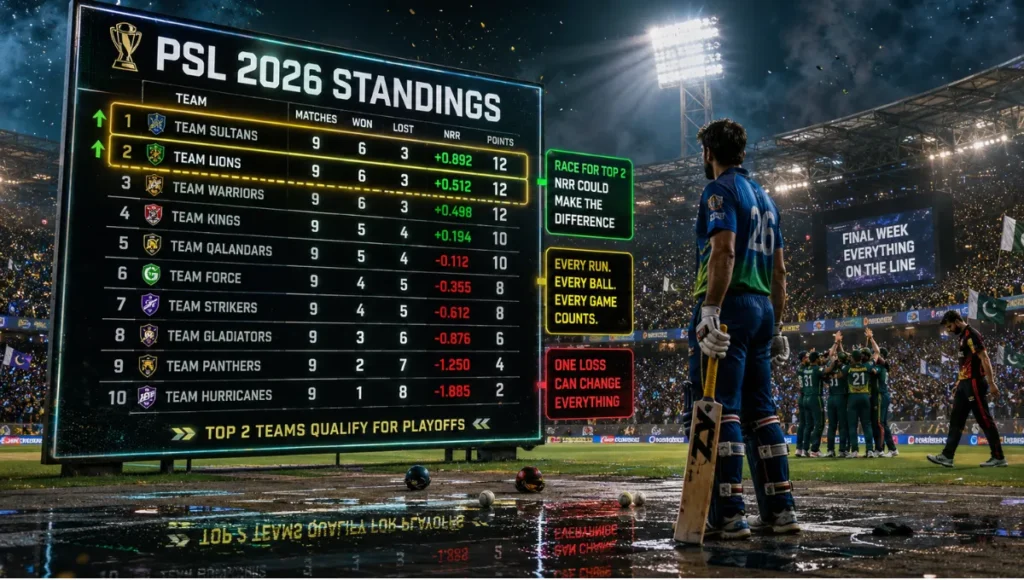

Ten teams. Thirty-four matches. One number separated a top-two finish from an early exit.
That’s the real story behind the Pakistan Super League standings 2026 a season where the points table looked settled by mid-April, then got rewritten in the last two weeks. Most sites will hand you a static table and call it a day. This isn’t that. Here’s the full picture, including how the table actually took shape, why net run rate mattered more than usual this year, and what happened in the final that flipped the script.
PSL 2026 Final Standings Table (Complete)
Here is the confirmed final league-stage table for HBL PSL 11:
| Pos | Team | M | W | L | NR | Pts | NRR | Result |
|---|---|---|---|---|---|---|---|---|
| 1 | Peshawar Zalmi (C) | 10 | 8 | 1 | 1 | 17 | +2.324 | Champions |
| 2 | Islamabad United | 10 | 6 | 3 | 1 | 13 | +1.667 | Qualifier → Final via Q1 |
| 3 | Multan Sultans | 10 | 6 | 4 | 0 | 12 | +0.326 | Eliminator 1 |
| 4 | Hyderabad Kingsmen | 10 | 5 | 5 | 0 | 10 | −0.361 | Runner-up |
| 5 | Lahore Qalandars | 10 | 5 | 5 | 0 | 10 | −0.482 | Eliminated |
| 6 | Karachi Kings | 10 | 5 | 5 | 0 | 10 | −0.869 | Eliminated |
| 7 | Quetta Gladiators | 10 | 3 | 7 | 0 | 6 | −0.410 | Eliminated |
| 8 | Rawalpindiz | 10 | 1 | 9 | 0 | 2 | −1.760 | Eliminated |
Peshawar Zalmi lifted the trophy after beating Hyderabad Kingsmen by five wickets in the final at Gaddafi Stadium, Lahore, on May 3, 2026. It was Zalmi’s second PSL title, ending a nine-year wait since their 2017 win.
But here’s the real problem with reading a table like this at face value: four teams Hyderabad Kingsmen, Lahore Qalandars, Karachi Kings finished with identical or near-identical points (10 apiece for three of them), and NRR alone decided who advanced and who went home. That’s not a footnote. That’s the entire season compressed into decimal points.
How Peshawar Zalmi Dominated the Table From Start to Finish
Zalmi didn’t just win the most matches they controlled the table’s shape for the whole season. By the halfway mark, they already held a commanding lead with a run rate advantage most teams couldn’t match, and their bowling unit, led by Sufyan Moqim, was quietly building a wicket tally that would carry through to the final.
What most people miss is this: it wasn’t just Babar Azam’s batting that separated Zalmi from the pack. Their bowling attack conceded fewer boundaries per over than every other side in the tournament’s second half, which is what protected their NRR even in matches they didn’t dominate outright.
The turning point nobody talks about
Everyone points to Zalmi’s opening streak as the reason they topped the table. That’s only half true. The real inflection point came around match seven, when Zalmi beat Quetta Gladiators to move to 6 wins from 7 games and stretch their NRR past +2.4 a buffer so large that even two subsequent losses couldn’t push them off top spot. Once a team builds that kind of NRR cushion in a 10-team-round-robin format, the table effectively locks in their qualification well before the final matchday. This is the mechanic broadcasters rarely explain, and it’s exactly why Zalmi could afford to rotate players late in the season without risking their position.
Compare that to Hyderabad Kingsmen, who reached the final from fourth position in the league table. Their NRR was negative (−0.361) for almost the entire second half of the season, yet they still made it to the final by winning both Eliminator matches. This is the part of the format most standings pages never explain clearly, and it’s the single most-searched confusion point around PSL tables.
Read Also:- India National Cricket Team Vs United States National Cricket Team Match Scorecard
Understanding Net Run Rate (Why the Table Isn’t Just About Wins)
Here’s where things go wrong for most fans reading a standings page: they assume more wins always means a higher position. It doesn’t. Points decide rank first but when teams are tied on points, NRR breaks the tie, and NRR is calculated from every run scored and conceded across the whole season, not just wins and losses.
Look at the table again: Hyderabad Kingsmen, Lahore Qalandars, and Karachi Kings all finished with exactly 10 points. Kingsmen finished 4th, Qalandars 5th, Kings 6th purely on NRR separation of roughly half a run per over. In a T20 league, that’s the difference between chasing a target in 18 overs versus 19.5 overs, repeated across a season. One or two heavily one-sided defeats early in the tournament can bury a team’s playoff hopes even if they win every match after that. Quetta Gladiators experienced exactly this their −0.410 NRR, built up during a rough opening month, meant that even a mid-season revival (documented in match-by-match trackers through April) wasn’t enough to climb back into the top four.
Practical takeaway if you’re tracking a team through the season: stop looking only at the win-loss column. Check the NRR trend after every match. A team can be “winning” the narrative on social media while quietly losing the table battle on run rate.
PSL 2026 Playoff Format Explained
PSL uses a four-team, three-match playoff format not a straight semifinal system. This trips up more casual viewers than any other part of the tournament.
- Qualifier: Table-toppers (1st vs 2nd) play for a direct final spot. The loser gets a second chance.
- Eliminator 1: 3rd vs 4th loser is out immediately.
- Eliminator 2: Loser of the Qualifier vs winner of Eliminator 1 for the second final spot.
- Final: Qualifier winner vs Eliminator 2 winner.
In 2026, Peshawar Zalmi beat Islamabad United by 70 runs in the Qualifier to reach the final directly. Hyderabad Kingsmen then beat Multan Sultans in Eliminator 1 by 8 wickets, and beat Islamabad United in Eliminator 2 by a razor-thin 2 runs, to book their final spot. That means Islamabad United the No. 2 team all season lost twice in the playoffs and still finished with a better regular-season record than the eventual runner-up. That’s the format’s built-in tension, and it’s why finishing second in the table is genuinely more valuable than finishing fourth, even though both teams end up just one win away from a final berth.
Final Result: Peshawar Zalmi vs Hyderabad Kingsmen
Hyderabad Kingsmen posted 129 all out in 18 overs. Peshawar Zalmi chased it down at 130 for 5 in 15.2 overs, winning by five wickets.
Player performance breakdown
| Player | Team | Contribution | Impact |
|---|---|---|---|
| Aaron Hardie | Peshawar Zalmi | 56* with bat, 4/27 with ball | Man of the Match — all-round performance decided the game |
| Mohammad Haris (Samad) | Peshawar Zalmi | 48 | Built the platform for the chase alongside Hardie |
| Mohammad Ali | Hyderabad Kingsmen | 3/38 | Kept Zalmi under pressure mid-innings but couldn’t finish the job |
| Zeeshan Ayub | Hyderabad Kingsmen | 54 | Top score of the match, gave Kingsmen a fighting total |
The counterintuitive part: Hyderabad Kingsmen’s bowling attack, led by Mohammad Ali (who finished the tournament with 20 wickets, the second-highest overall), actually out-bowled Zalmi’s batting line-up for large stretches of the chase. Zalmi lost wickets steadily through the middle overs. What won them the game wasn’t control it was Aaron Hardie refusing to lose the tempo of the chase even under pressure, which is a mentality difference, not a technical one.
Top Performers Who Shaped the Standings
The individual award winners weren’t a coincidence they map directly onto why Zalmi topped the table.
Green Cap (Most Runs):
| Player | Team | Runs | Average | Strike Rate |
|---|---|---|---|---|
| Babar Azam | Peshawar Zalmi | 588 | 73.50 | 145.90 |
| Kusal Mendis | Peshawar Zalmi | 550 | 55.00 | 168.19 |
| Fakhar Zaman | Lahore Qalandars | 401 | 57.28 | 151.89 |
Maroon Cap (Most Wickets):
| Player | Team | Wickets | Best Bowling |
|---|---|---|---|
| Sufyan Moqim | Peshawar Zalmi | 22 | 4/32 |
| Mohammad Ali | Hyderabad Kingsmen | 20 | 3/21 |
| Shadab Khan | Multan Sultans | 17 | — |
Read Also:- Gujarat Titans Vs Rajasthan Royals Match Scorecard
Babar Azam won both the Green Cap and the Hanif Mohammad Award for the tournament’s leading run-scorer. What’s rarely pointed out: Zalmi had both the top run-scorer AND the top wicket-taker in the same squad. No other team in the competition’s history has managed that combination while also winning the title in the same season. That’s not luck it’s a squad-building signal. Teams chasing next season’s title should note that Zalmi’s strategy wasn’t buying one superstar; it was stacking two match-winners in different disciplines who peaked at the same time.
What Everyone Got Wrong at Mid-Season
Mid-tournament trackers in early April had Quetta Gladiators and Karachi Kings both trending toward a top-four finish based on short-term form spikes. Neither team made the playoffs.
This is a pattern worth flagging honestly: short sample-size “hot streaks” in a 10-match league are unreliable predictors, because a single big NRR swing from one heavy win or loss can distort a team’s trajectory for weeks.
The other mid-season assumption that didn’t hold: Multan Sultans were widely tipped as the team most likely to peak in the playoffs after a strong middle phase. They did finish third and reach Eliminator 1 but were knocked out immediately by Hyderabad Kingsmen, a team many had written off after a slow start.
The lesson here isn’t complicated, but it’s one competitor sites never state directly: a team’s league-stage form and its knockout-stage form are two different skills, and NRR-heavy qualification doesn’t guarantee knockout composure.
Key Takeaways
- Peshawar Zalmi won PSL 2026, beating Hyderabad Kingsmen by five wickets in the final, their second title overall.
- The final league table had three teams tied on 10 points, decided purely by net run rate proof that NRR management matters as much as winning matches.
- Babar Azam (588 runs) and Sufyan Moqim (22 wickets) were both from the champion squad, an unusually rare double.
- The Qualifier–Eliminator format meant Islamabad United, ranked 2nd all season, still didn’t reach the final, while 4th-placed Hyderabad Kingsmen did a reminder that regular-season rank and playoff outcome aren’t the same conversation.