
India had six different wicket-taking bowlers. Pakistan had one batter who crossed 40.
That single contrast tells you why the India vs Pakistan match did not become the close rivalry contest many fans expected. India made 175/7. Pakistan were bowled out for 114 in 18 overs. The margin was 61 runs, but the bigger story was player balance: India had a match-winner in every phase; Pakistan had brief individual moments without a complete team performance.
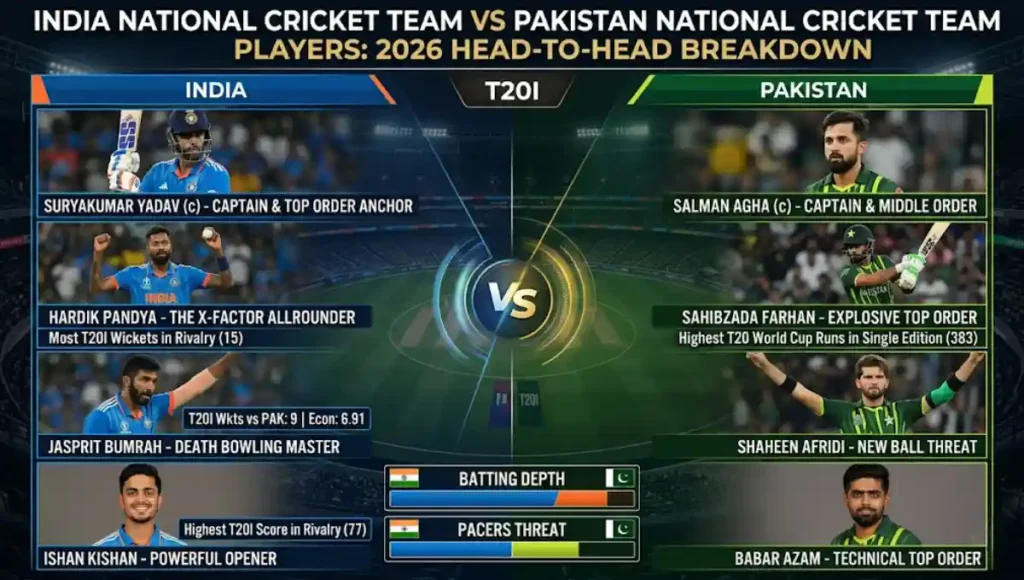
This guide covers the verified India National Cricket Team vs Pakistan National Cricket Team players from the ICC Men’s T20 World Cup 2026 Group A match in Colombo: the playing XIs, bench players, key performers, scorecard context, and the decisions that shaped the game.
Who Played in India vs Pakistan? Quick Answer
India playing XI
| Player | Role in this match | Key contribution |
|---|---|---|
| Abhishek Sharma | Opening batter | 0 off 4 |
| Ishan Kishan (wk) | Opening batter / wicketkeeper | 77 off 40; top scorer |
| Tilak Varma | Top-order batter / part-time bowler | 25 off 24; 1/11 |
| Suryakumar Yadav (c) | Captain / top-order batter | 32 off 29 |
| Hardik Pandya | Seam-bowling all-rounder | 2/16; 0 off 1 |
| Shivam Dube | Batting all-rounder | 27 off 17 |
| Rinku Singh | Finisher | 11* off 4 |
| Axar Patel | Spin-bowling all-rounder | 2/29 |
| Kuldeep Yadav | Left-arm wrist-spinner | 1/14 |
| Varun Chakaravarthy | Mystery spinner | 2/17 |
| Jasprit Bumrah | Fast bowler | 2/17 |
Pakistan playing XI
| Player | Role in this match | Key contribution |
|---|---|---|
| Saim Ayub | Opening batter / spin-bowling all-rounder | 6 off 2; 3/25 |
| Sahibzada Farhan | Opening batter | 0 off 4 |
| Salman Agha (c) | Captain / batting all-rounder | 4 off 4; 1/10 |
| Babar Azam | Top-order batter | 5 off 7 |
| Usman Khan (wk) | Wicketkeeper-batter | 44 off 34; top scorer |
| Shadab Khan | Leg-spin all-rounder | 14 off 15 |
| Mohammad Nawaz | Spin-bowling all-rounder | 4 off 5 |
| Faheem Ashraf | Seam-bowling all-rounder | 10 off 14 |
| Shaheen Afridi | Left-arm fast bowler | 1/31; 23* off 19 |
| Abrar Ahmed | Leg-spinner | 0/38 |
| Usman Tariq | Mystery spinner | 1/24 |
Bench players: who did not play
| Team | Available squad members not in the XI |
|---|---|
| India | Sanju Samson, Arshdeep Singh, Mohammed Siraj, Washington Sundar |
| Pakistan | Fakhar Zaman, Naseem Shah, Salman Mirza, Khawaja Nafay |
This distinction matters. Searchers often treat a “squad” list as a playing-XI list. It is not. The names in the first two tables played this match; the bench lists were available but did not take the field.
India vs Pakistan Match in 30 Seconds
| Detail | Match information |
|---|---|
| Match | India vs Pakistan, 27th Match, Group A |
| Tournament | ICC Men’s T20 World Cup 2026 |
| Venue | R Premadasa Stadium, Colombo |
| Date | 15 February 2026 |
| Toss | Pakistan won the toss and chose to bowl |
| India score | 175/7 in 20 overs |
| Pakistan score | 114 all out in 18 overs |
| Result | India won by 61 runs |
| Player of the Match | Ishan Kishan — 77 off 40 balls |
The one-line story: Ishan Kishan gave India a powerplay platform, but India’s real winning advantage was the ability to take Pakistan wickets through Hardik, Bumrah, Axar, Varun, Kuldeep and Tilak rather than relying on one bowler to carry the innings.
What people think is that India won because they made 175. The reality is that 175 was a good, not extraordinary, total. It became dominant because Pakistan fell to 13/3 in two overs and could never build a partnership that matched India’s 87-run Kishan–Tilak stand.
India National Cricket Team vs Pakistan National Cricket Team Players Performance Table
India: who made the difference
| Player | Performance | Impact on match |
|---|---|---|
| Ishan Kishan | 77 off 40; 10 fours, 3 sixes | Created the innings base; India reached 88 before his wicket |
| Suryakumar Yadav | 32 off 29 | Held the middle order after Kishan fell |
| Shivam Dube | 27 off 17 | Added late pace when India lost wickets |
| Rinku Singh | 11* off 4 | Finished the innings with a boundary and a six |
| Hardik Pandya | 2/16 | Removed Farhan and Usman Tariq; started and ended Pakistan’s innings |
| Jasprit Bumrah | 2/17 | Removed Saim and Salman in the opening two overs |
| Axar Patel | 2/29 | Bowled Babar and stumped Usman Khan; broke Pakistan’s only meaningful recovery |
| Varun Chakaravarthy | 2/17 | Removed Faheem and Abrar in a double-wicket phase |
| Kuldeep Yadav | 1/14 | Dismissed Nawaz and maintained middle-over pressure |
| Tilak Varma | 1/11 | Dismissed Shadab; showed India’s sixth bowling option |
Pakistan: strong moments, but no complete innings
| Player | Performance | What it meant |
|---|---|---|
| Saim Ayub | 3/25 in 4 overs | Pakistan’s best bowler; removed Kishan, Tilak and Hardik |
| Usman Khan | 44 off 34 | Only Pakistan batter to pass 23; gave a brief recovery window |
| Shaheen Afridi | 1/31; 23* off 19 | Took Axar late and added tail-end runs, but could not repair the top-order collapse |
| Salman Agha | 1/10 in 2 overs | Efficient short spell, but limited wicket impact |
| Usman Tariq | 1/24 in 4 overs | Controlled his spell and removed Suryakumar |
Read Also:- South Africa National Cricket Team Vs New Zealand National Cricket Team
Highlights and Key Moments
1. Kishan made the match uncomfortable before Pakistan’s spinners settled
Ishan Kishan scored 77 off 40 balls, hitting 10 fours and 3 sixes. India lost Abhishek Sharma for a duck in the first over, so Kishan’s innings was not a luxury. It was the recovery and the attack combined.
He and Tilak Varma added 87 for the second wicket. That partnership moved India from 1/1 to 88/2 and ensured Pakistan could not bowl defensively through the middle overs.
What most people miss: Kishan’s value is not just his strike rate of 192.50. He faced 40 balls. In a match where India finished 175/7, that means he absorbed almost exactly one-third of the innings while still scoring at nearly two runs a ball. That is a rare combination of volume and aggression.
2. Saim Ayub’s 3/25 stopped India from reaching 190
Saim Ayub dismissed Kishan, Tilak and Hardik.
Those wickets came at a critical time: India went from 88/2 to 126/4, losing their two set or high-impact batters in the middle phase.
Counterintuitive point: Pakistan’s bowling did not fail completely. Saim’s spell was good enough to create a route back into the game. But a strong individual spell only matters if the batting lineup can use the lower target it creates. Pakistan’s batting did not.
3. Pakistan lost the match at 13/3, not 114 all out
Pakistan’s chase began badly:
- Sahibzada Farhan: 0/1 at 0.4 overs.
- Saim Ayub: 6/2 at 1.2 overs.
- Salman Agha: 13/3 at 1.6 overs.
This was the decisive phase. Bumrah removed Saim and Salman, while Hardik dismissed Farhan. Pakistan’s top three were gone before the third over, and Babar Azam had to rebuild with the required rate already rising.
This is where things go wrong: a batting side chasing 176 cannot have three separate batters play “survival” innings after an early collapse. Pakistan needed a 50-run partnership by the eighth over. They got a 39-run stand between Babar and Usman, but it consumed too much time and ended at 34/4.
4. India’s six-bowler wicket web gave Pakistan no release over
Every main India bowler took at least one wicket:
| India bowler | Wickets | Game-state contribution |
|---|---|---|
| Hardik Pandya | 2 | First wicket and last wicket |
| Jasprit Bumrah | 2 | Destroyed the top order early |
| Axar Patel | 2 | Removed Babar and Usman Khan |
| Varun Chakaravarthy | 2 | Late double strike |
| Kuldeep Yadav | 1 | Removed Nawaz during recovery attempt |
| Tilak Varma | 1 | Removed Shadab and confirmed depth |
This is why Pakistan never found a phase to attack. When a batting side knows the next bowler is also a wicket option, it cannot simply wait for one weak over. India’s attack was not built around one superstar spell. It was built around six different threats.
Player Performance Breakdown
Ishan Kishan 77 off 40: the innings that made 175 feel bigger
Kishan was Player of the Match because he solved India’s hardest problem: losing an opener inside the first over without losing momentum.
His 77 had three jobs:
- Reset the innings after Abhishek’s duck.
- Keep Pakistan’s spinners from dictating the middle overs.
- Leave enough balls for Dube and Rinku to finish around 175.
Original observation: The dangerous part of Kishan’s innings was not the sixes. It was that Pakistan never got a defensive phase against him. A batter who scores 77 off 40 does not let bowlers hide behind dot balls, and that forced Pakistan to chase wickets instead of manage the innings.
Saim Ayub 3/25: Pakistan’s best player in defeat
Saim’s spell deserves better than being buried in a 61-run loss. He dismissed India’s top scorer, a stabilising left-hander, and an all-rounder off consecutive match phases.
But he also illustrates Pakistan’s central problem. Their best bowler was their opening batter, and he made 6 off 2 before Bumrah removed him. Pakistan asked one player to influence both disciplines, and he succeeded with the ball but had no support with the bat.
Hardik, Bumrah, Axar and Varun India’s wicket web
Hardik’s 2/16, Bumrah’s 2/17, Axar’s 2/29 and Varun’s 2/17 were the core of India’s attack. But the deeper point is sequence:
- Hardik gave India the first wicket.
- Bumrah removed two top-order players.
- Axar dismissed Babar and ended Usman Khan’s resistance.
- Varun took the lower-order double blow.
Bold opinion: India’s biggest strength in this match was not their marquee pace attack. It was that the bowling unit could take a wicket even when Bumrah was not bowling. That is the difference between a good T20 side and a tournament-winning one.
Usman Khan 44 off 34: resistance without a partner
Usman Khan made 44 off 34 balls with six fours and a six. He was Pakistan’s only batter to pass 23.
His innings kept Pakistan from being bowled out for 80. But a 129.41 strike rate is not enough in a 176 chase when the top order has already collapsed. He needed one other batter to score at 140-plus alongside him. That never happened.
Shaheen Afridi late runs, but too much left to do
Shaheen scored 23 not out off 19 after taking 1/31. He fought until the end, but this was a classic case of tail-end resistance arriving after the match’s structure had already collapsed.
The lesson is not that Shaheen should have batted faster. It is that Pakistan cannot rely on a No. 9 to be their second-highest scorer in a T20 chase.
Analysis: Why India’s Player Balance Beat Pakistan’s
175 was a pressure total, not a safe total
India’s 175/7 was not flawless. They lost five wickets for 49 runs after reaching 126/3, and Saim Ayub’s spell prevented a 190-plus finish.
But 175 became a pressure total when India’s first three bowlers reduced Pakistan to 13/3. The chasing side had to rebuild, accelerate, and preserve wickets at the same time. That is a three-part task few teams can complete against a bowling unit with six wicket-takers.
India had six wicket-taking options
This was the tactical mismatch:
| Team | Wicket-taking depth | Result |
|---|---|---|
| India | Six bowlers took a wicket | Pakistan had no safe phase to attack |
| Pakistan | Saim took 3; Shaheen, Salman and Usman took 1 each | India still had batting resources and reached 175 |
Read Also:- India National Cricket Team Vs England Cricket Team Players
What people think: India won because their best players performed.
Reality: India won because even their sixth bowling option, Tilak Varma, took a wicket. That is not a normal luxury. It means the captain can keep attacking regardless of matchups or over allocation.
Pakistan had one bowling phase but no batting reset
Saim Ayub gave Pakistan a genuine chance with 3/25. Usman Tariq’s 1/24 and Salman Agha’s 1/10 also offered control. But Pakistan’s batting response had no equivalent phase of excellence.
After 13/3, Pakistan needed either:
- A 60-run partnership by the 10th over, or
- One batter to score 70-plus at a strike rate above 145.
They achieved neither. The result was not caused by one bad shot or one bad over. It was a failure to rebuild the chase with a defined plan.
Squad Clarity: 2026 World Cup vs 2025 Asia Cup
Search results may show different India and Pakistan player lists because they refer to different events. Keep them separate.
| Search result / event | Correct interpretation |
|---|---|
| ICC Men’s T20 World Cup 2026, Group A, Match 27 | This article’s current playing XIs and scorecard |
| Asia Cup 2025 final squad page | A separate earlier final; not this World Cup XI |
| Asia Cup 2025 group-match Playing XI | Different match, team balance and selection point |
| Champions Trophy 2025 scorecard | Different tournament and ODI format |
| India–Pakistan rivalry page | Evergreen historical context, not a current player list |