
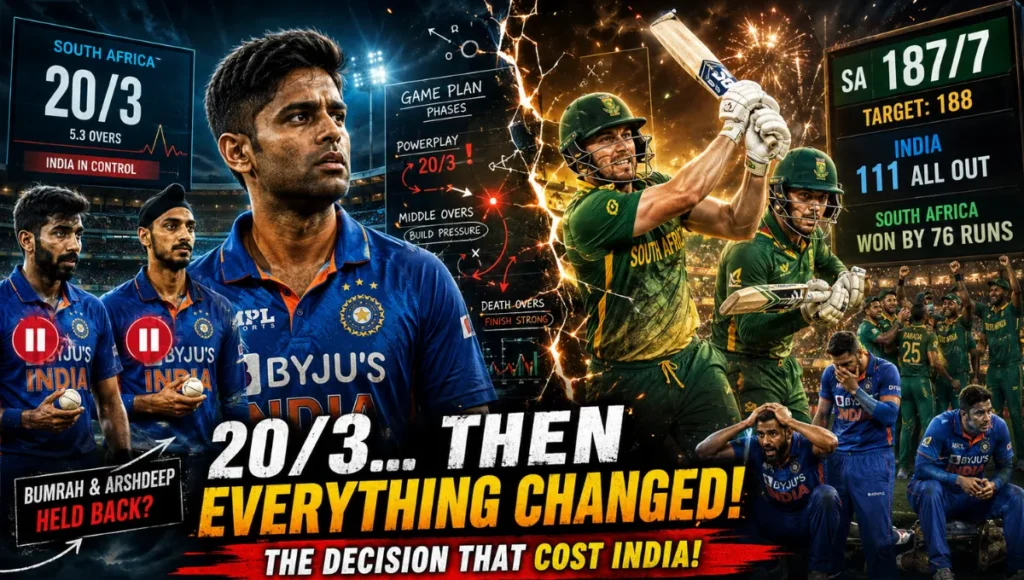

South Africa were 20 for 3. India had the game exactly where they wanted it.
Then Suryakumar Yadav held back Jasprit Bumrah and Arshdeep Singh his two best bowlers during the exact window South Africa needed to rebuild.
David Miller and Dewald Brevis walked in, built a partnership nobody saw coming, and South Africa finished at 187/7. India collapsed to 111 all out, losing by 76 runs. Here’s the real problem most match reports skip: this wasn’t a bowling failure. It was a decision-making failure at the exact moment the game was still India’s to control.
The Context Behind This Rivalry
India and South Africa have built one of modern cricket’s most competitive rivalries, sharpened further by their meeting in the 2024 T20 World Cup final. That final still shapes how every subsequent encounter between these two sides gets covered every match now carries the weight of “unfinished business.”
What most people miss is that this rivalry isn’t just about talent anymore. It’s about tactical maturity. South Africa spent years being labeled cricket’s “chokers” in big tournaments. That label has quietly disappeared, replaced by a team that now out-thinks opponents in pressure moments exactly what happened against India in February 2026.
The Complete India vs South Africa Head-to-Head
Most fans assume India comfortably dominates this rivalry across every format. That’s only partly true it depends heavily on which competition you’re measuring.
| Format/Competition | Matches | India Wins | South Africa Wins | No Result/Tie |
|---|---|---|---|---|
| T20I (overall) | 35 | 21 | 13 | 1 |
| T20 World Cup | 7 | 5 | 2 | 0 |
| Test (2025-26 series) | 2 | 0 | 2 | 0 |
What most people miss: South Africa’s T20 World Cup record against India has been improving, not stagnant. They won in 2022, then again in the 2026 Super Eight meaning South Africa has beaten India in two of the last three World Cup meetings. That trend gets buried under the “India dominates overall” headline stat.
Why the Test Series Result Matters More Than People Realize
South Africa toured India in November 2025 and won the two-Test series 2-0, a result Wisden described as leaving India’s home reputation “in tatters”. That’s a strong statement about a team that rarely loses Test series at home. It’s also the first real signal three months before the World Cup that South Africa’s bowling attack could trouble India’s batting lineup under pressure.
November-December 2025: South Africa’s Tour of India
South Africa’s full tour ran from November 14 to December 19, 2025, covering Tests, ODIs, and T20Is.
Test Series: A Reputation In Tatters
| Match | Dates | Venue | Result |
|---|---|---|---|
| 1st Test | Nov 14-18 | Eden Gardens, Kolkata | South Africa won |
| 2nd Test | Nov 22-26 | Barsapara Stadium, Guwahati | South Africa won |
South Africa swept the series 2-0. What people don’t realize: this happened under a new Indian Test captain, Shubman Gill, adding extra scrutiny to a result that already stung.
ODI and T20I Series Results
| Series | Matches | Venue Highlights | Dates |
|---|---|---|---|
| ODI (3 matches) | Ranchi, Raipur, Visakhapatnam | Full white-ball tour | Nov 30 – Dec 6 |
| T20I (5 matches) | Cuttack, Chandigarh, Dharamsala, Lucknow, Ahmedabad | Final leg of tour | Dec 9-19 |
Read Also:- India National Cricket Team Vs Netherlands National Cricket Team Matches
This is where things go wrong for most analysis they treat the Test series loss as isolated. It wasn’t. It was the first data point in a pattern that repeated itself two months later in the World Cup.
The Overlooked Connection
Almost every competitor page reports these series results as separate news items. Nobody links the Test series defeat to the World Cup performance months later. But look closely the same core weakness (India’s batting struggling against disciplined, high-pace bowling) showed up in both events. That’s not a coincidence. It’s a pattern that deserved far more attention before the World Cup even began.
The T20 World Cup 2026 Super Eight Shock
India and South Africa met again on February 22, 2026, at the Narendra Modi Stadium in Ahmedabad, in their first Super Eight match of Group 1. This was billed as a rematch of the 2024 T20 World Cup final.
The Turning Point
South Africa’s innings started disastrously they slipped to 20/3 early on. Most viewers assumed India had the match under control at this point. But here’s what most people miss: Suryakumar Yadav chose to hold back Bumrah and Arshdeep Singh during this exact window, rather than pressing the advantage.
David Miller and Tristan Stubbs later joined by Dewald Brevis in the recovery phase built the partnership that changed everything. South Africa finished at 187/7, with Miller scoring 63 off 35 balls and Stubbs adding an unbeaten 44 off 24.
Phase-By-Phase Breakdown
| Phase | South Africa’s Innings | Bowling Context |
|---|---|---|
| Early collapse | 20/3 | India’s frontline seamers not yet deployed |
| Recovery | Miller-Stubbs/Brevis partnership builds | Bumrah, Arshdeep held back |
| Death overs | Total pushed to 187/7 | Marco Jansen 4/22, Keshav Maharaj 3/24 with the ball later |
| India’s chase | 111 all out in 18.5 overs | Collapsed against Rabada and Jansen |
India’s reply never recovered. Abhishek Sharma struggled badly against Kagiso Rabada, and Tilak Varma’s dismissal against Marco Jansen triggered a broader batting collapse. Shivam Dube top-scored with 42, and Bumrah picked up 3/15 in a losing effort, but the damage was already done.
Why This Loss Wasn’t Just About Bowling
The common assumption is that India lost because Varun Chakravarthy (4-0-47) and Shivam Dube (2-0-32) had expensive bowling spells. That’s only half the story. The deeper issue was tactical delaying the introduction of India’s best bowlers at 20/3 gave South Africa’s middle order exactly the platform it needed to recover. Bowling figures reflect a decision made overs earlier.
The Batting Collapse Nobody Fully Explained
India’s chase fell apart in a way that goes beyond “South Africa bowled well.” Abhishek Sharma’s technical struggles against Rabada’s pace weren’t a one-off they mirrored issues visible in the earlier Test series against South African quicks. Tilak Varma’s dismissal against Marco Jansen came from an aggressive shot at a moment that called for patience, a mistake that triggered the wider collapse. Individually, these look like separate errors. Together, they reveal a batting lineup that hasn’t adjusted its approach against disciplined pace attacks since November.
Why India’s Captaincy Decisions Are Under Fire
What people think vs reality: fans often blame individual bowlers after a heavy defeat. Reality Suryakumar Yadav’s field settings and bowling changes at the 20/3 stage are the more defensible target for criticism, since that’s the moment the entire match trajectory shifted.
My bold take here: holding back your two best bowlers when the opposition is three wickets down inside the Powerplay is not a conservative decision it’s a passive one, and passive decisions lose knockout-stage cricket matches. India had South Africa cornered and let them out.
A Second Bold Observation
There’s a broader pattern worth naming directly: India’s captains have repeatedly shown reluctance to attack with their best bowlers immediately after early wickets, preferring to “save” them for later overs. This conservative philosophy might work in bilateral series against weaker batting lineups. It does not work against South Africa’s middle order, which has proven twice now that it thrives on exactly this kind of breathing room.
What India Must Fix Before Facing Zimbabwe and West Indies
India’s Net Run Rate dropped to -3.8 after this defeat, adding real pressure heading into matches against Zimbabwe and West Indies, especially given Chennai’s spin-friendly conditions on the schedule. What should a fan or analyst actually do with this information?
- Track India’s bowling changes in the first six overs of the next match the same passive pattern must not repeat
- Watch Abhishek Sharma’s technique against high pace specifically, since Rabada exposed a clear weakness
- Expect a batting order reshuffle if Tilak Varma’s shot selection issues continue into Chennai
- Follow India’s Net Run Rate recovery closely, since -3.8 puts real pressure on the remaining group fixtures
For South Africa, the takeaway is different: their middle-order recovery ability, now proven twice against India in T20 World Cups, is becoming a genuine trend rather than a one-off. Any team preparing to face South Africa in a knockout match should expect exactly this scenario an early stumble followed by a calculated, patient rebuild through the middle overs.
Read Also:- New Zealand National Cricket Team Vs India National Cricket Team Timeline
The Bigger Picture For India’s Campaign
This defeat doesn’t eliminate India, but it changes the math for their remaining Super Eight fixtures. A -3.8 Net Run Rate means India likely needs a dominant win margin against either Zimbabwe or West Indies to stay in strong qualification position. Fans and analysts should watch the toss decision and opening bowling changes closely in both upcoming matches those two factors, more than individual batting form, will determine whether India corrects the tactical pattern that cost them against South Africa.