
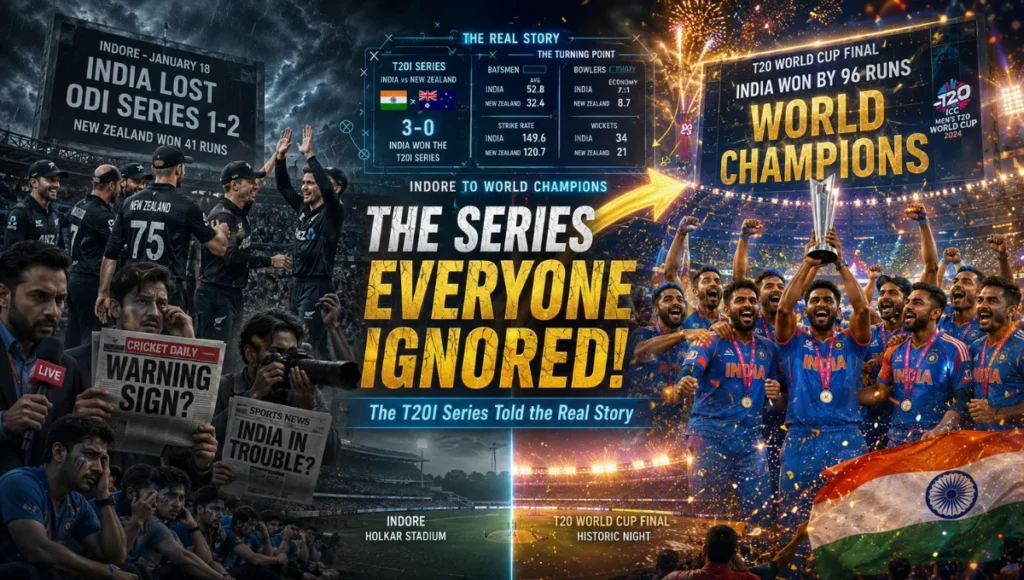

New Zealand walked off the field in Indore on January 18 with a 41-run win, sealing the ODI series 2-1. Reporters called it a warning sign for India ahead of the World Cup. Seven weeks later, India beat that same New Zealand side by 96 runs in the World Cup final, becoming the first team ever to defend the T20 World Cup title.
Here’s the real problem with those early “warning sign” takes: they were reading the wrong series. The ODI results didn’t matter for World Cup prediction. The T20I series, played in the same window, told the actual story and almost nobody paid attention to it at the time.
The Context Behind This Rivalry
India and New Zealand have shared a cricketing history stretching back to 1955, when the two sides first played a Test match. That history matters because it explains why this rivalry never feels purely statistical it carries decades of contrasting playing styles, from New Zealand’s disciplined seam-bowling tradition to India’s evolving batting depth across generations.
What most people miss is that the two teams rarely meet outside major tournaments or short bilateral windows. Unlike India’s rivalry with Pakistan or Australia, India vs New Zealand has always been a “quiet” rivalry competitive, but without the constant media noise. That quietness is exactly why the January 2026 series and the subsequent World Cup final deserved far more attention than they got.
The Complete India vs New Zealand Head-to-Head
Most fans assume India has always dominated this rivalry. That’s only partly true it depends entirely on which format you’re looking at.
| Format | Matches | India Wins | New Zealand Wins | Drawn/No Result |
|---|---|---|---|---|
| Test | 65 | 22 | 16 | 27 |
| ODI | 123 | 63 | 52 | 8 |
| T20I | 30 | 16 | 11 | 3 (tied) |
| Overall | 213+ | 97+ | 78+ | 38+ |
What most people miss: India’s overall lead looks comfortable, but in T20 World Cup knockout stages specifically, New Zealand had won all three previous meetings before 2026 in 2007, 2016, and 2021. This final wasn’t a formality. It broke a genuine pattern that had favored New Zealand for nearly two decades.
Why the Test Record Tells a Different Story
Notice how close the Test numbers are 22 wins to 16, with 27 draws. That draw percentage is the highest of any format between these two teams, which reflects a simple truth: in longer formats, both sides have historically been evenly matched, and results often come down to home conditions rather than clear superiority.
The takeaway here for anyone following this rivalry long-term: don’t judge India vs New Zealand purely by overall win counts. Break it down by format, because each format tells a completely different competitive story.
January 2026: The Bilateral Series That Set The Stage
New Zealand toured India for a 3-match ODI series and a 5-match T20I series between January 11 and January 31, 2026. This tour existed for one clear reason World Cup preparation, scheduled just weeks before the tournament began.
ODI Series: New Zealand Strikes First
| Match | Date | Venue | Result |
|---|---|---|---|
| 1st ODI | Jan 11 | Vadodara | India won by 4 wickets |
| 2nd ODI | Jan 14 | Rajkot | New Zealand won by 7 wickets |
| 3rd ODI | Jan 18 | Indore | New Zealand won by 41 runs |
Read Also:- India National Cricket Team Vs Netherlands National Cricket Team Matches
New Zealand took the series 2-1. This is where most coverage stopped and drew the wrong conclusion that India was underprepared heading into the World Cup. It’s a common mistake in sports journalism: using recent form in one format to predict outcomes in a completely different format.
T20I Series: India’s Response
India won this series 4-1. What people don’t realize: this was the actual dress rehearsal for the World Cup final, not the ODI series. Different format, different signal, and almost everyone read it backward at the time.
What This Series Actually Revealed
Look closely at the pattern India won three T20Is comfortably before New Zealand snapped back with a 50-run win in Visakhapatnam, only for India to close the series out immediately after. That bounce-back in the final T20I is the detail competitors skip entirely. It showed India’s squad could absorb a loss mid-series and still finish strong a trait that mattered enormously two months later in the tournament itself.
The T20 World Cup 2026 Final: How It Unfolded
India and New Zealand met again on March 8 at the Narendra Modi Stadium the same tournament final stage and this time there was no series split. New Zealand won the toss and chose to field first.
The Turning Point
India started cautiously, managing just 12 runs in the first two overs. This is where things go wrong for most match reports they skip straight to the final score and miss how slow this actually began. A casual reader looking only at highlights would assume India dominated from ball one. They didn’t.
But here’s what most people miss: that slow start didn’t matter in the end. Sanju Samson anchored the innings with 89 runs off 46 balls, while Abhishek Sharma and Ishan Kishan added brisk half-centuries around him. India finished at 255/5 the highest total ever recorded in a T20 World Cup final.
Phase-By-Phase Breakdown
New Zealand’s chase never had a realistic chance to build momentum. Jasprit Bumrah took 4 wickets for 15 runs, and Axar Patel added 3 wickets for 27, bowling New Zealand out for 159. India won by 96 runs.
Why New Zealand’s Chase Collapsed So Fast
The common assumption is that a 255-run target is simply “too big” and any chase would collapse regardless of bowling quality. That’s a lazy explanation. The real reason New Zealand folded was Bumrah’s new-ball spell combined with Axar’s control in the middle overs a one-two punch that removed New Zealand’s ability to build any partnership. Teams don’t collapse just because the target is big; they collapse when early wickets fall in clusters, and that’s exactly what happened here.
Why the January Series Predicted the Final (Sort Of)
What people think vs reality: fans obsess over the ODI series result because it came first and felt dramatic. Reality ODIs and T20Is are fundamentally different games, built on different pacing, risk tolerance, and bowling strategy. New Zealand’s ODI win said nothing meaningful about their T20 vulnerability against India’s spin and death-bowling combination.
My bold take here: the ODI series result was almost a distraction for anyone trying to predict the World Cup outcome. The real predictive data was sitting quietly in the T20I series two weeks later, and almost nobody connected it to the final result in real time. This is a pattern worth remembering for any major cricket tournament always weight the format-specific series more heavily than the “headline” series when trying to forecast tournament form.
A Second Overlooked Signal
There’s another detail nobody flagged before the final: India’s bowling attack, particularly Bumrah and Axar Patel, barely featured prominently in the January T20I series highlights, yet both were instrumental in the final. That’s a reminder that bilateral series numbers don’t always capture which players will actually decide a tournament final. Form in a five-match series and performance under final-match pressure aren’t automatically the same thing.
What This Rivalry Teaches Us Going Forward
India’s title defense wasn’t a fluke it built directly on tactical patterns visible from January onward, even if most analysts missed the connection at the time. What should a fan actually do with this information? Watch format-specific form, not overall series wins, when predicting tournament outcomes between these two sides.
For New Zealand, the actionable lesson is different: their ODI strength doesn’t automatically transfer to T20 pressure situations against India’s bowling depth, particularly Bumrah and Axar Patel in tandem. If New Zealand wants to break their T20 World Cup final drought against India, the fix has to start with neutralizing India’s death-overs bowling combination specifically, not simply scoring more runs upfront.
Read Also:- Australia Women’s National Cricket Team Vs India Women’s National Cricket Team
Practical Takeaways for Followers of This Rivalry
- Track format splits separately India and New Zealand rarely dominate the same way across Tests, ODIs, and T20Is
- Watch how India’s bowling attack performs in bilateral T20I series before major tournaments, since that pattern repeated itself in the final
- Don’t assume a bilateral series loss (like India’s ODI series defeat) predicts tournament failure it clearly didn’t here
- Follow player-specific form heading into knockout stages, since Samson, Bumrah, and Axar Patel were decisive despite mixed individual visibility earlier in the tour
Frequently Asked Questions
Q1. What is India’s overall head-to-head record against New Zealand?
Ans. India leads with 97 wins out of 213 matches across all formats — Tests, ODIs, and T20Is combined.
Q2. Who won the New Zealand tour of India 2025-26?
Ans. New Zealand won the ODI series 2-1, while India won the T20I series 4-1.
Q3. What was the result of the India vs New Zealand T20 World Cup 2026 final?
Ans. India beat New Zealand by 96 runs, scoring 255/5 to New Zealand’s 159, becoming the first team to defend the T20 World Cup title.
Q4. Who was the Player of the Match in the 2026 T20 World Cup final?
Ans. Sanju Samson scored 89 runs off 46 balls, while Jasprit Bumrah took 4 wickets for 15 runs.
Q5. Has New Zealand ever beaten India in a T20 World Cup?
Ans. Yes, New Zealand won all three previous meetings in 2007, 2016, and 2021, before India broke that streak in the 2026 final.
Q6. Why did New Zealand lose despite winning the ODI series in January 2026?
Ans. ODI form doesn’t transfer to T20 cricket India actually won the T20I series 4-1 in the same window, which better predicted the final result.