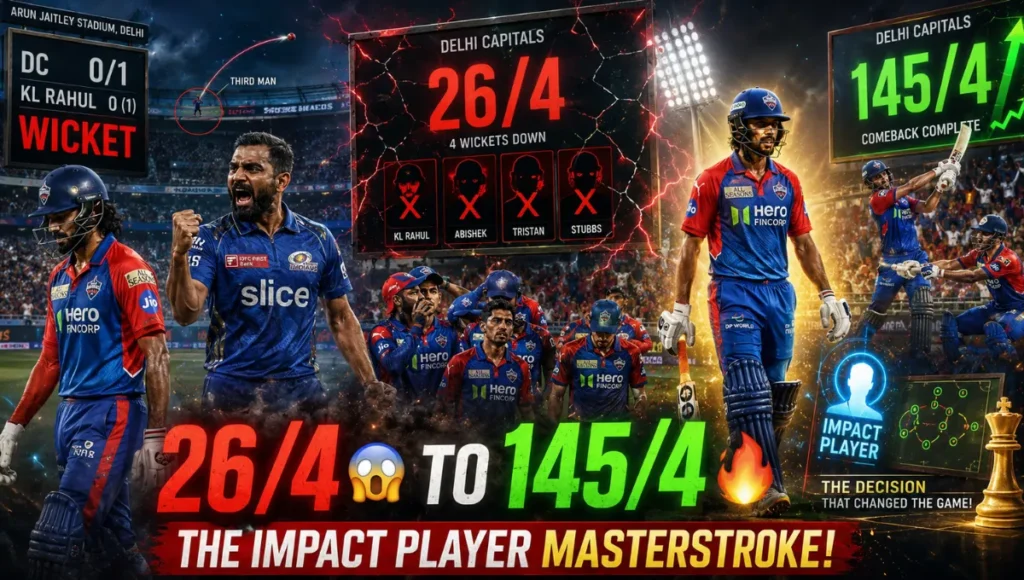

KL Rahul, opening for his new team, faced exactly one ball. He sliced a lofted drive off Mohammed Shami straight to third man and walked off without scoring.
Three overs later, Delhi Capitals were 26/4. Their season opener looked over before it began.
Here’s the real problem most scorecard pages skip: they show you 33/4 became 145/4 and call it a “comeback.” What most people miss is that this recovery happened because of one specific batting decision sending in an Impact Player at exactly the right psychological moment.
The Context Behind This Match
Both franchises walked into IPL 2026 Match 5 carrying unfinished business from the previous season, since neither team had made the playoffs the year before. That shared pressure made this early-season clash at Ekana far more consequential than a typical fifth-round fixture usually is.
What most people miss is that both KL Rahul and Rishabh Pant switched teams before this season, meaning this match doubled as their first competitive meeting against former franchises. That subplot added genuine emotional weight to a game that already carried playoff-positioning stakes this early in the tournament.
Match Result At A Glance
Delhi Capitals beat Lucknow Super Giants by 6 wickets in Match 5 of IPL 2026 at Ekana Cricket Stadium, Lucknow, on April 1, 2026.
| Team | Score | Overs |
|---|---|---|
| Lucknow Super Giants | 141/10 | 18.4 |
| Delhi Capitals | 145/4 | 17.1 |
What people think vs reality: fans assume a 6-wicket win with 17 balls to spare means a comfortable, routine chase. Reality Delhi were 33/4 inside the Powerplay, effectively needing a miracle recovery just to stay competitive.
LSG’s Innings: A Middle-Order Rescue
LSG, put in to bat first, lost Rishabh Pant early to a run-out at the non-striker’s end while opening the innings. Aiden Markram, Ayush Badoni, and Nicholas Pooran all fell in quick succession, leaving LSG struggling at 65/4.
LSG Batting Scorecard
| Batter | Runs | Balls | Dismissal |
|---|---|---|---|
| Mitchell Marsh | 35 | 28 | Fell inside 10 overs |
| Abdul Samad | 36 | 25 | Top scorer, rescued innings |
| LSG Total | 141/10 | 18.4 overs | Bowled out |
Read Also:- South Africa National Cricket Team Vs India National Cricket Team Matches
What most people miss: LSG’s total of 141 looked genuinely under-par on this surface, yet Marsh and Samad’s late resistance made it just enough to create real pressure on Delhi’s chase.
Why LSG’s Middle Order Collapsed So Fast
This is where things go wrong for most scorecard breakdowns they list four wickets falling without explaining the pattern. Pant’s run-out set off a chain reaction, since it removed the team’s designated aggressor before he could settle. Markram, Badoni, and Pooran then all fell attempting to force the tempo back in LSG’s favor, rather than rebuilding steadily. That aggressive instinct, understandable after losing an anchor early, is exactly what let Delhi’s bowlers dictate terms through the middle overs.
DC’s Bowling Effort
| Bowler | Overs | Wickets | Runs | Economy |
|---|---|---|---|---|
| Mohammed Shami | 4.0 | 1 | 28 | 7.00 |
| Prince Yadav | 3.0 | 2 | 20 | 6.67 |
| Mohsin Khan | 4.0 | 1 | 19 | 4.75 |
Lungi Ngidi and T Natarajan were credited with three-wicket hauls in the broader match breakdown, with Kuldeep Yadav and Axar Patel tightening the screws in the middle overs. This is where things go wrong for most recaps they credit the bowling attack generically without noting that Delhi’s spin duo specifically strangled LSG’s middle overs, forcing risky shots that led to the collapse.
DC’s Chase: The 33/4 Turning Point
Delhi’s reply started disastrously. KL Rahul was dismissed off the very first ball, caught behind off Shami. Nitish Rana, Pathum Nissanka, and captain Axar Patel followed in quick succession, and Delhi were reduced to 26/4 inside five overs.
DC Batting Collapse and Recovery
| Batter | Runs | Balls | Role |
|---|---|---|---|
| KL Rahul | 0 | 1 | Dismissed first ball |
| Nitish Rana | 15 | 17 | Fell early in Powerplay |
| Pathum Nissanka | 1 | 5 | Part of the collapse |
| Axar Patel | 0 | 1 | Captain dismissed cheaply |
| Sameer Rizvi | 70* | 47 | Match-winning Impact Player innings |
| Tristan Stubbs | 39* | 32 | Anchored the recovery |
The Turning Point: Rizvi’s Impact Player Entry
This is where things go wrong for most match reports they mention Sameer Rizvi’s 70 as a great innings and move on. What they miss: Rizvi entered as an Impact Player substitution, a tactical decision that changed the entire complexion of the chase.
My bold take here: Delhi’s team management deserves more credit than Rizvi himself for this win. Bringing him in at exactly the moment the top order collapsed, rather than persisting with a set batting order, is what actually turned 26/4 into a winning position.
The 119-Run Partnership That Won The Match
Rizvi and Stubbs added an unbeaten 119 runs for the fifth wicket, absorbing pressure before taking on LSG’s bowlers once set. Rizvi finished unbeaten on 70 off 47 balls with 5 fours and 4 sixes, while Stubbs stayed unbeaten on 39 off 32 balls. Delhi completed the chase in 17.1 overs, winning by 6 wickets.
A Second Bold Observation
There’s a pattern worth naming directly: this match had two completely separate storylines within one scorecard. LSG’s innings was a standard middle-order rescue story. Delhi’s chase was a genuine collapse-to-recovery arc, more dramatic than the final margin suggests. Judging this match purely by “Delhi won by 6 wickets” massively understates how close this game actually was at the halfway point of the chase.
Why The Partnership Worked Tactically
Rizvi and Stubbs didn’t just survive they split roles deliberately. Stubbs anchored, rotating strike and avoiding risk against LSG’s spin, while Rizvi targeted specific bowlers he judged as weaker links in the death overs. That division of labor, rather than both batters trying to accelerate simultaneously, is a common mistake many partnerships make under pressure. Avoiding it here is exactly why the stand grew to 119 unbroken runs.
Fall Of Wickets: The Full Picture
| Team | Wicket | Score | Over |
|---|---|---|---|
| DC | KL Rahul | 0/1 | 0.1 |
| DC | Nitish Rana | 21/2 | 3.3 |
| DC | Pathum Nissanka | 25/3 | 4.2 |
| DC | Axar Patel | 26/4 | 4.3 |
Read Also:- India National Cricket Team Vs Zimbabwe National Cricket Team Matches
What most people miss: after the fourth wicket fell at just 26 runs, Delhi didn’t lose another wicket for the rest of the innings. That’s not luck that’s Rizvi and Stubbs completely shutting down LSG’s bowling momentum through disciplined batting.
What Both Teams Should Actually Fix Next
This match exposed genuine tactical lessons for both franchises heading into their next fixtures. What should analysts and fans actually track going forward?
- Watch LSG’s middle-order sequencing closely, since losing Pant, Markram, Badoni, and Pooran in quick succession suggests a batting order vulnerable to early pace and spin pressure
- Track Delhi’s top-four fragility in upcoming matches, since 26/4 inside five overs is a pattern that better bowling attacks will exploit again
- Follow Sameer Rizvi’s Impact Player role specifically, since this innings could cement him as Delhi’s designated middle-overs rescuer for the rest of the season
- Note LSG’s bowling combination in future death-overs situations, since their inability to close out a 145-run chase with early wickets in hand reflects a tactical gap
- Compare Rahul’s dismissal pattern against pace bowlers in coming matches, since a first-ball duck against his former team invites early scrutiny
For Delhi Capitals, the practical decision is clear: build the batting strategy around flexible Impact Player substitutions rather than a fixed top-order, since this exact approach salvaged an otherwise lost match.
The Bigger Picture For Both Franchises
Beyond this single result, the match reveals a deeper roster-construction question both teams need to answer. LSG’s top order looks stacked with aggressive intent but lacks a genuine anchor once an early wicket falls. Delhi’s top four, despite marquee names, has now shown fragility against quality pace in the Powerplay. Whichever franchise fixes this specific weakness first will hold a real structural advantage as the season progresses.