
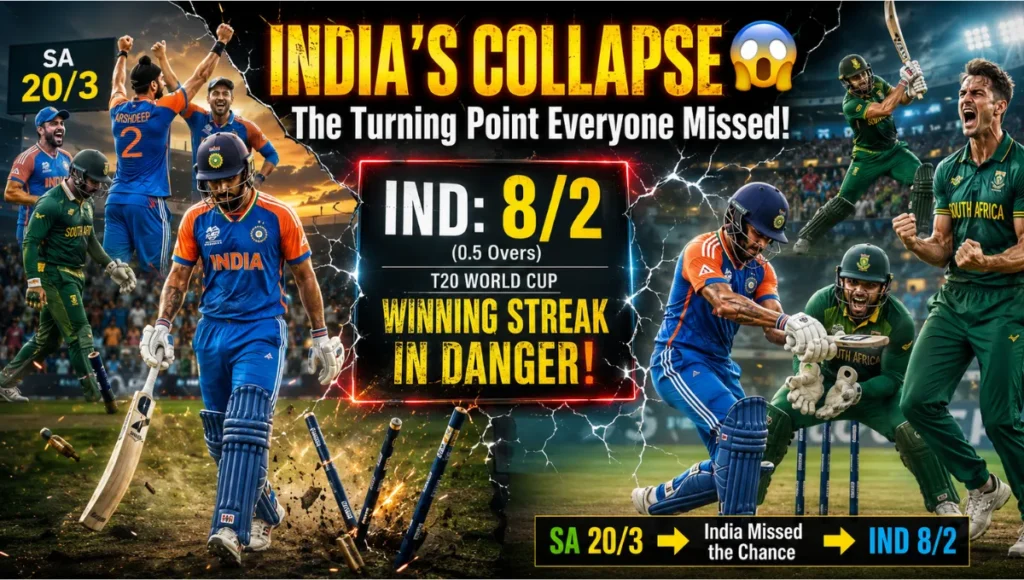

Ishan Kishan fell on the fourth ball of the innings, caught trying to play against Aiden Markram’s offspin. One ball later, in Marco Jansen’s very first over, Tilak Varma was caught behind.
Two wickets down in under five balls. India’s 12-match T20 World Cup winning streak, stretching back to their 2024 title win, was already in serious trouble before the Powerplay even finished.
Here’s the real problem most match reports skip: this collapse wasn’t really about Kishan and Varma’s individual dismissals. It was about what happened four overs earlier, when South Africa themselves were 20/3 and India let them escape.
The Context Behind This Rivalry
South Africa and India walked into this Super Eight clash both unbeaten, both in red-hot form, and both painfully familiar with each other after their dramatic 2024 T20 World Cup final meeting. Commentators openly called this “the final before the final” in the build-up, given how evenly matched both squads looked on paper.
What most people miss is that South Africa arrived with a specific tactical edge a dominant win over New Zealand in their toughest group match had already shown their bowling attack could handle high-pressure, high-quality batting lineups. That form signal got buried under India’s more heavily covered 12-match winning streak narrative.
The Complete South Africa vs India Head-to-Head
Most fans assume India comfortably dominates this rivalry because of their recent T20 success. That’s only partly true the full picture across formats tells a much more competitive story.
| Format/Competition | Matches | India Wins | South Africa Wins | No Result/Tie |
|---|---|---|---|---|
| ODI (all-time) | 87 | 35 | 49 | 3 |
| ICC World Cup (all formats) | 6+ | 3 | 3 | 0 |
| T20 World Cup (recent record) | 14 | 12 (before this loss) | 1 | 1 |
Read Also:- India National Cricket Team Vs West Indies Cricket Team Players
What most people miss: South Africa actually holds the historical ODI advantage, 49 wins to India’s 35. The narrative of “India dominates South Africa” is a T20-era perception that doesn’t hold up once you look at the full 87-match ODI record.
Why the World Cup Record Tells a Balanced Story
In ICC World Cup meetings across formats, India and South Africa are dead level at 3-3. That balance matters it means neither team can claim a psychological edge heading into any major tournament clash, including this Super Eight showdown.
The T20 World Cup 2026 Super Eight Shock
India and South Africa met on February 22, 2026, at the Narendra Modi Stadium in Ahmedabad. South Africa won the toss and chose to bat first.
South Africa’s Innings: The 20/3 Turning Point
South Africa’s innings started shakily. They slipped to 41/3 by the end of the Powerplay, with David Miller on 18 and Dewald Brevis on just 4. This is where things go wrong for most casual analysis commentators moved straight past this stumble, assuming India had the game fully under control.
But here’s what most people miss: India didn’t press this advantage aggressively enough with their premium bowlers during this exact window. Miller and Brevis steadied the innings, and by the time Tristan Stubbs joined the middle order, South Africa had built enough platform to accelerate hard in the closing overs.
Phase-By-Phase Breakdown: South Africa’s Innings
| Phase | Score | Key Detail |
|---|---|---|
| Powerplay (1-6 overs) | 41/3 | Mandatory Powerplay, Miller 18*, Brevis 4* |
| Middle overs | Recovery phase | Miller-Brevis partnership rebuilds innings |
| Death overs | Total pushed to 187/7 | Stubbs’ late acceleration seals a strong total |
Miller finished with 63 off 35 balls and was named Player of the Match, while Brevis contributed 45 off 29. Stubbs then added an unbeaten 44 off just 24 balls in the closing overs, pushing South Africa to a competitive 187/7.
India’s Chase: The Opening Collapse
India’s reply began disastrously. Ishan Kishan fell for just 4 balls faced, dismissed by Markram’s offspin after trying to play against the turn. Tilak Varma followed one ball into Marco Jansen’s spell, caught behind without troubling the scorers. Abhishek Sharma, already under scrutiny for early tournament struggles, added 15 off 12 balls before falling in the fifth over.
Shivam Dube’s 42 off 37 balls was the only real resistance in the middle order, while Marco Jansen and Keshav Maharaj kept the pressure relentless throughout. India were eventually bowled out for 111 in 18.5 overs, with the innings ending at 105/8 requiring 83 runs from just 12 balls at the point the game was effectively decided. India lost by 76 runs.
Phase-By-Phase Breakdown: India’s Chase
| Phase | India’s Chase | Bowling Context |
|---|---|---|
| Overs 1-1 | 2 wickets down in 5 balls | Kishan and Varma dismissed almost immediately |
| Powerplay | Continued pressure | Abhishek Sharma falls in over 5 |
| Middle overs | Dube’s 42 provides brief resistance | Jansen and Maharaj apply constant pressure |
| Final overs | All out for 111 in 18.5 overs | Chase effectively over well before the end |
Why South Africa’s Recovery Wasn’t Just Aggression
What people think vs reality: most reports frame Miller and Brevis’s partnership as simply “aggressive counter-attacking batting.” That’s technically true, but it skips the more important half of the story aggression alone doesn’t work against a well-set bowling attack unless the bowling side eases pressure first.
My bold take here: South Africa didn’t out-bat India during that recovery phase. India out-thought themselves. Holding back frontline bowling pressure at 41/3 inside the Powerplay, rather than immediately trying to finish South Africa off, is what actually created the opening for Miller and Brevis to settle in and eventually accelerate.
A Second Bold Observation
There’s a pattern worth naming directly across recent India matches: the team’s bowling changes after early wickets have repeatedly favored caution over aggression. That conservative philosophy might work against weaker batting line-ups. It clearly did not work against South Africa’s middle order, which has now punished this same passivity in a genuinely high-stakes encounter.
The Batting Collapse Nobody Fully Explained
India’s chase fell apart in a way that goes beyond “South Africa bowled well.” Losing two wickets in the first five balls isn’t just misfortune it reflects a batting lineup that walked out without a clear plan against spin (Markram) and pace (Jansen) working in tandem from ball one. Abhishek Sharma’s continued struggles this tournament, visible again here, suggest a technical issue that opposition bowlers have identified and are now targeting deliberately.
Read Also:- India National Cricket Team Vs England Cricket Team Timeline
What India Must Fix Before Their Next Match
India’s crushing defeat leaves them needing to win their remaining Super Eight fixtures to stay in semifinal contention. What should a fan or analyst actually do with this information?
- Track India’s bowling changes in the first six overs of the next match the same passive pattern at 41/3 must not repeat
- Watch Abhishek Sharma’s form closely, since his early-tournament struggles resurfaced again in this match
- Expect a batting order reshuffle if the top three continue to struggle against combined spin-pace opening threats
- Follow India’s net run rate recovery in upcoming matches, since this 76-run margin puts real mathematical pressure on qualification
For South Africa, the takeaway is different: their middle-order recovery ability, proven decisively in this match, confirms they can be trusted to rebuild from early collapses without panicking, making them a genuinely dangerous knockout-stage opponent.
The Bigger Picture For India’s Campaign
This defeat doesn’t eliminate India, but it changes the math for their remaining Super Eight fixtures significantly. A 76-run margin means India likely needs dominant wins in their remaining games to repair net run rate and stay in strong qualification position. Fans and analysts should watch the toss decision and opening bowling changes closely in India’s next matches those two factors, more than individual batting form alone, will determine whether India corrects the tactical pattern that cost them here.