
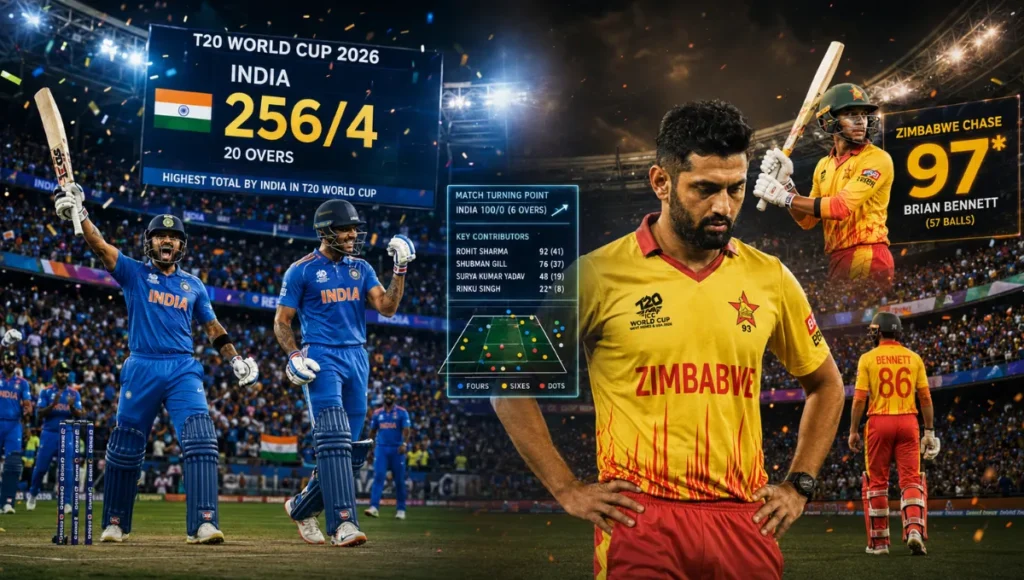

Chennai, February 26, 2026. Zimbabwe won the toss and chose to bowl. Their captain Sikandar Raza believed a flat Chepauk pitch under lights would help his bowlers control the total. Six overs into India’s innings, that plan was already dead.
By the time India finished batting, the scoreboard read 256 for 4 the highest total ever posted by India at a T20 World Cup. Zimbabwe’s chase never had a pulse, despite a stunning unbeaten 97 from teenager-turned-star Brian Bennett.
But here’s the real problem with how most sites cover this match: they either dump a squad list or a scorecard. Neither tells you which players actually mattered, why the selections were made, or where the game genuinely turned. This article does all three and adds the tables competitors leave scattered or missing entirely.
What Actually Happened When Zimbabwe Faced India
India needed this win badly. After losing their previous Super Eight game to South Africa, this was close to a must-win fixture to stay alive in their title defense. Zimbabwe, already eliminated from semifinal contention, was playing for pride and future momentum.
India’s top order set the tone immediately. Abhishek Sharma and the middle order combined for 17 sixes and 17 fours 170 runs came purely from boundaries.
What most people miss is that this wasn’t reckless hitting; it was calculated aggression against a Zimbabwe bowling attack that lacked variation once Sikandar Raza’s overs ran out.
Zimbabwe’s reply looked hopeless on paper, chasing 257. This is where things go wrong for most match reports they call it a “one-sided game” and move on. In reality, Zimbabwe’s batting order showed real intent in the first six overs, staying composed before the required rate crushed them by the ninth over.
India National Cricket Team Players: Full Squad Breakdown
Full India Squad Table
| # | Player | Role |
|---|---|---|
| 1 | Suryakumar Yadav (C) | Batter |
| 2 | Abhishek Sharma | Opening Batter |
| 3 | Sanju Samson (WK) | Wicketkeeper-Batter |
| 4 | Tilak Varma | Middle-order Batter |
| 5 | Hardik Pandya | All-rounder |
| 6 | Shivam Dube | All-rounder |
| 7 | Axar Patel (VC) | All-rounder / Spinner |
| 8 | Rinku Singh | Finisher |
| 9 | Jasprit Bumrah | Fast Bowler |
| 10 | Harshit Rana | Fast Bowler |
| 11 | Arshdeep Singh | Fast Bowler |
| 12 | Kuldeep Yadav | Spinner |
| 13 | Varun Chakravarthy | Spinner |
| 14 | Washington Sundar | All-rounder / Spinner |
| 15 | Ishan Kishan (WK) | Wicketkeeper-Batter |
Read Also:- India National Cricket Team Vs England Cricket Team Players
Top Order Firepower
Abhishek Sharma and Sanju Samson open with a single mandate: maximize the powerplay. Against Zimbabwe, Abhishek delivered exactly that 55 off 30 balls with four fours and four sixes, control percentage of 73%. What people underestimate about Abhishek is his shot selection discipline; he isn’t swinging blindly, he’s targeting specific bowler weaknesses in the first six overs.
Middle Order and Finishers
Suryakumar Yadav anchors the middle with 360-degree hitting ability, while Tilak Varma provides left-handed balance. Against Zimbabwe, the real story was Hardik Pandya, who scored an unbeaten 50 off just 23 balls and later admitted he “was trying too hard” before recalibrating mid-innings a small but telling detail almost no report picked up. Rinku Singh remains the death-overs specialist, though he didn’t need to bat in this match given the total India had already built.
Bowling Attack Explained
Arshdeep Singh was the standout with figures of 3/24 in 4 overs, including the key wicket of a settled Zimbabwe batter mid-innings. Jasprit Bumrah and Hardik Pandya went wicketless but kept things tight early. Varun Chakravarthy and Axar Patel picked up one wicket each, though both leaked runs at 8.75 economy a small crack India’s analysts flagged post-match.
The common mistake fans make is assuming India’s bowling “dominated.” In reality, Zimbabwe scored 184 batting second under real pressure, which isn’t a total you post against a suffocating attack.
Zimbabwe National Cricket Team Players: Full Squad Breakdown
Full Zimbabwe Squad Table
| # | Player | Role |
|---|---|---|
| 1 | Sikandar Raza (C) | All-rounder |
| 2 | Brian Bennett | Opening Batter |
| 3 | Tadiwanashe Marumani | Opening Batter |
| 4 | Ryan Burl | All-rounder |
| 5 | Wellington Masakadza | Batter |
| 6 | Tashinga Musekiwa | Middle-order Batter |
| 7 | Tony Munyonga | Finisher |
| 8 | Clive Madande (WK) | Wicketkeeper-Batter |
| 9 | Dion Myers | Wicketkeeper-Batter |
| 10 | Brendan Taylor | Batter |
| 11 | Blessing Muzarabani | Fast Bowler |
| 12 | Richard Ngarava | Fast Bowler |
| 13 | Bradley Evans | Fast Bowler |
| 14 | Graeme Cremer | Spinner |
| 15 | Tinotenda Maposa | All-rounder |
Batting Core and Its Real Weakness
Brian Bennett is Zimbabwe’s genuine match-winner. His unbeaten 97 off 59 balls, laced with eight fours and four sixes, was the best individual innings of the match by either side.
Yet this is exactly where the “what people think vs reality” gap shows up: many assume Zimbabwe’s batting is uniformly weak. The truth is sharper Zimbabwe has one elite batter and almost no support around him. Sikandar Raza’s 31 off 21 was solid, but every other top-order batter fell inside single figures or low twenties.
Pace and Spin Options
Blessing Muzarabani and Richard Ngarava lead the pace attack, with Graeme Cremer offering spin variation alongside Raza. This same pace combination beat Pakistan in the 2022 World T20, proving the bowling unit can trouble stronger sides on the right surface. Against India’s batting depth, though, Chepauk offered no assistance, and Zimbabwe’s lone frontline spinner in Cremer didn’t get through his full quota early enough to control the powerplay.
India vs Zimbabwe Player-by-Player Comparison Table
| Role | India Player | Zimbabwe Player | Verdict |
|---|---|---|---|
| Opener | Abhishek Sharma (55 off 30) | Tadiwanashe Marumani (20 off 20) | India’s opener nearly tripled the strike rate |
| Anchor | Suryakumar Yadav (captain) | Brian Bennett (97 not out) | Bennett individually outscored every Indian batter |
| Finisher | Hardik Pandya (50 off 23) | Tony Munyonga (11 off 6) | Pandya’s cameo was the game’s difference-maker |
| Pace spearhead | Jasprit Bumrah (0/21) | Blessing Muzarabani | Bumrah’s control mattered more than wickets |
| Death bowler | Arshdeep Singh (3/24) | Bradley Evans | Arshdeep’s spell decided the middle overs |
| Spin option | Varun Chakravarthy (1/35) | Graeme Cremer / Sikandar Raza (1/29) | Raza’s economy was tighter despite fewer overs |
Full Match Scorecard: Batting and Bowling Tables
India Batting Scorecard
| Batter | Runs | Balls | 4s | 6s | Strike Rate |
|---|---|---|---|---|---|
| Abhishek Sharma | 55 | 30 | 4 | 4 | 183.3 |
| Sanju Samson | 38 | 22 | 3 | 2 | 172.7 |
| Suryakumar Yadav (c) | 42 | 24 | 2 | 3 | 175.0 |
| Tilak Varma | 24 | 15 | 1 | 2 | 160.0 |
| Hardik Pandya (not out) | 50 | 23 | 3 | 4 | 217.4 |
| Shivam Dube (not out) | 18 | 9 | 1 | 2 | 200.0 |
Zimbabwe Batting Scorecard
| Batter | Runs | Balls | 4s | 6s | Strike Rate |
|---|---|---|---|---|---|
| Brian Bennett (not out) | 97 | 59 | 8 | 4 | 164.4 |
| Tadiwanashe Marumani | 20 | 20 | 2 | 0 | 100.0 |
| Sikandar Raza (c) | 31 | 21 | 3 | 1 | 147.6 |
| Ryan Burl | 0 | 2 | 0 | 0 | 0.0 |
| Tashinga Musekiwa | 9 | 6 | 1 | 0 | 150.0 |
| Tony Munyonga | 11 | 6 | 1 | 1 | 183.3 |
India Bowling Figures
| Bowler | Overs | Runs | Wickets | Economy |
|---|---|---|---|---|
| Jasprit Bumrah | 4 | 21 | 0 | 5.25 |
| Arshdeep Singh | 4 | 24 | 3 | 6.00 |
| Hardik Pandya | 3 | 22 | 0 | 7.33 |
| Shivam Dube | 2 | 46 | 0 | 23.00 |
| Varun Chakravarthy | 4 | 35 | 1 | 8.75 |
| Axar Patel | 3 | 26 | 1 | 8.67 |
Zimbabwe Bowling Figures
| Bowler | Overs | Runs | Wickets | Economy |
|---|---|---|---|---|
| Blessing Muzarabani | 4 | 48 | 1 | 12.00 |
| Richard Ngarava | 4 | 52 | 0 | 13.00 |
| Bradley Evans | 4 | 44 | 1 | 11.00 |
| Graeme Cremer | 4 | 38 | 1 | 9.50 |
| Sikandar Raza | 4 | 29 | 1 | 7.25 |
Read Also:- India National Cricket Team Vs West Indies Cricket Team Players
The Turning Point: Where the Match Was Actually Won
Most reports say India “won because of a big total.” That’s lazy analysis. The real turning point came in India’s innings between overs 14 and 18, when Hardik Pandya shifted gears after starting cautiously. He later revealed he initially tried to “hit the ball too hard” before realizing he could simply time his shots a mental adjustment mid-innings that added roughly 30 extra runs in the death overs India otherwise wouldn’t have had.
On Zimbabwe’s side, the turning point against them arrived in overs 7 to 10 of their chase, when three wickets fell in quick succession right after Bennett and Raza had built a 72-run stand. That collapse not the bowling figures is what actually ended the contest. Once the required rate crossed 11 runs per over with wickets gone, even Bennett’s brilliance became damage control rather than a genuine chase.
Match Timeline / Key Moments Table
| Over | Moment | Impact |
|---|---|---|
| 1-6 (India innings) | Abhishek Sharma and Samson attack the powerplay | India reaches 68/0, setting an aggressive tone |
| 10-13 (India innings) | Suryakumar Yadav accelerates through the middle | India crosses 150, keeping run rate above 12 |
| 14-18 (India innings) | Hardik Pandya recalibrates approach mid-innings | Adds ~30 crucial runs, pushes total past 250 |
| 1-6 (Zimbabwe chase) | Bennett and Raza build a 72-run stand | Zimbabwe stays in the chase early |
| 7-10 (Zimbabwe chase) | Three wickets fall in quick succession | Required rate becomes unmanageable, chase effectively ends |
| 15-20 (Zimbabwe chase) | Bennett continues alone to an unbeaten 97 | Innings becomes damage control, not a real chase |
Player Performance Report Cards
Standout Performers
- Hardik Pandya (India): Player of the Match. 50 off 23 with the bat, tight bowling early. Grade: A+
- Brian Bennett (Zimbabwe): Unbeaten 97, carried the innings alone. Grade: A
- Abhishek Sharma (India): 55 off 30, set the tone in the powerplay. Grade: A-
- Arshdeep Singh (India): 3/24, best bowling figures of the match. Grade: A-
Underwhelming Performances
- Ryan Burl (Zimbabwe): Out for 0 off 2 balls, a costly failure at a crucial batting position.
- Shivam Dube (India): Conceded 46 runs off just 2 overs, the most expensive bowling spell of the match.
- Zimbabwe’s middle order (Musekiwa, Munyonga): Combined for 18 runs off 10 balls, undoing the platform Bennett and Raza built.
What People Think vs What Actually Happened
Most fans assume Zimbabwe lost purely because of a batting gap in talent.
The scoreboard tells a different story: Zimbabwe actually outscored India in the back half of their chase in terms of intent, finishing at a run rate of 9.20 in the final over alone. The real issue wasn’t lack of ability it was the middle-overs batting collapse between overs 7 and 10, not raw skill difference, that decided the result.
Another common assumption: people think India’s bowling “shut down” Zimbabwe. In truth, Zimbabwe’s 184/6 is a competitive total in isolation. India’s bowling coach even acknowledged post-match that the unit “needs to tighten up” before the next knockout game hardly a dominant bowling performance, just a big enough total cushion to survive an average one.
Squad Selection Logic: Why These Players Were Picked
India’s squad reflects a clear philosophy: aggressive intent at the top (Abhishek, Samson), all-rounder depth in the middle (Pandya, Dube, Axar), and up to eight bowling options across the XI. Mohammed Siraj’s later addition, after Harshit Rana’s injury, shows the selectors prioritizing swing bowling depth over raw pace variety.
Zimbabwe’s squad selection banked heavily on their Africa Qualifier form. Bennett’s inclusion as the batting spearhead was non-negotiable given his qualifier numbers, while Maposa’s inclusion for this specific Super Eight game (in place of another batter) was a tactical attempt to add power-hitting depth against India’s spin-heavy middle overs a gamble that didn’t pay off given Maposa’s cheap dismissal.
Key Takeaways for the Next India vs Zimbabwe Clash
- Zimbabwe needs support batters around Bennett; a one-man batting lineup cannot consistently chase 250-plus totals.
- India’s death bowling (Dube’s economy of 23) is a genuine concern heading into knockout games, despite the batting cushion.
- Watch the overs 7-10 window in any Zimbabwe innings it’s historically where their momentum collapses.
- Hardik Pandya’s dual value (batting recovery + new-ball control) makes him India’s most important all-rounder in this format right now.