
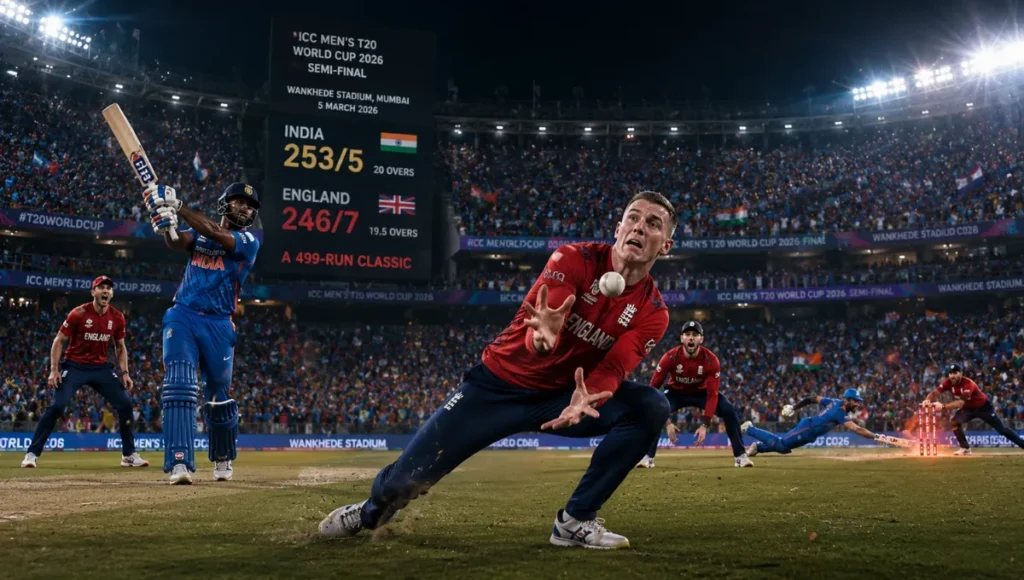

Wankhede Stadium, Mumbai, March 5, 2026. Third over of the match. Harry Brook stands at mid-on as Jofra Archer bangs one in short. Sanju Samson scuffs a drive straight at him, throat height, the easiest catch of his captaincy career. Brook drops it.
That single moment more than the 253 runs India eventually posted decided the game.
But here’s the real problem with how most match reports cover this semi-final: they treat it as a footnote inside a bigger story about India reaching the final. Nobody breaks down exactly how one dropped catch, two Axar Patel fielding interventions, and one run-out on the final ball combined to produce a 499-run classic. This article does that, with full squads, scorecards, and a timeline that most competitor pages don’t bother building.
What Actually Happened When England Faced India
Suryakumar Yadav won the toss and chose to bat a decision that broke a 13-match streak of teams losing after batting first in floodlit T20 World Cup knockouts, the last exception being Sri Lanka in 2014.
What most people miss is that this wasn’t blind confidence; India’s data showed Wankhede chases get harder as dew sets in, and Samson later confirmed the team felt “a score around 250 was achievable” once his partnership with Kishan took off.
Sanju Samson punished Brook’s drop mercilessly, turning a reprieved 15 into an eventual 89 off 42 balls with seven sixes. India finished on 253/7. This is where things go wrong for most coverage they call it a “comfortable total” and move on. In reality, England very nearly chased it down, finishing 246/7, needing just one more boundary in the final over to force a Super Over.
India National Cricket Team Players: Full Squad Breakdown
Full India Squad Table
| # | Player | Role |
|---|---|---|
| 1 | Suryakumar Yadav (C) | Batter |
| 2 | Abhishek Sharma | Opening Batter |
| 3 | Sanju Samson (WK) | Wicketkeeper-Batter |
| 4 | Tilak Varma | Middle-order Batter |
| 5 | Ishan Kishan | Batter |
| 6 | Hardik Pandya | All-rounder |
| 7 | Shivam Dube | All-rounder |
| 8 | Axar Patel | All-rounder / Spinner |
| 9 | Rinku Singh | Finisher |
| 10 | Jasprit Bumrah | Fast Bowler |
| 11 | Mohammed Siraj | Fast Bowler |
| 12 | Arshdeep Singh | Fast Bowler |
| 13 | Kuldeep Yadav | Spinner |
| 14 | Varun Chakravarthy | Spinner |
| 15 | Washington Sundar | All-rounder / Spinner |
Read Also:- Zimbabwe National Cricket Team Vs India National Cricket Team Players
Top Order and the Samson Factor
Samson came into this match with an unfavorable head-to-head against Archer dismissed three times for just 23 runs off 25 previous T20I deliveries.
What people underestimate is that this history made his innings sharper, not shakier. Once reprieved, he targeted Archer’s shorter length deliberately, hitting two fours and a six off his first six balls before the drop even happened. Abhishek Sharma, by contrast, extended a quiet campaign, miscuing Jacks to deep midwicket cheaply a reminder that even India’s most explosive opener has form slumps at the biggest moments.
Middle Order Tactics
Ishan Kishan built a 97-run stand with Samson before miscuing Rashid to long-off for 39 off 18. Shivam Dube then came in specifically to counter Rashid’s leg-spin a tactical promotion Suryakumar later confirmed was planned regardless of who was in form. Tilak Varma added late fireworks with three sixes in four balls off Archer before inside-edging onto his stumps, and Hardik Pandya farmed the strike in the final over to push India past 250.
Bowling Attack Explained
Jasprit Bumrah bowled the spell of the tournament: 4 overs for just 33 runs and the crucial wicket of Harry Brook, held back deliberately until over 5 so India could “see what lumps they could extract” from other bowlers first. Arshdeep Singh went for 51 in 4 overs but picked up Will Jacks courtesy of a stunning Axar-Dube relay catch. Hardik Pandya finished with 2/38, removing both Salt and Curran. Varun Chakravarthy leaked 64 runs in his 4 overs but dismissed Buttler, while Axar Patel’s 3 overs for 35 included Banton’s wicket.
The common mistake is assuming India’s bowling was dominant Bumrah aside, three of India’s five bowlers went at over 8.5 runs per over.
England Cricket Team Players: Full Squad Breakdown
Full England Squad Table
| # | Player | Role |
|---|---|---|
| 1 | Harry Brook (C) | Batter |
| 2 | Phil Salt | Opening Batter |
| 3 | Jos Buttler (WK) | Wicketkeeper-Batter |
| 4 | Ben Duckett | Opening Batter |
| 5 | Jacob Bethell | Middle-order Batter |
| 6 | Tom Banton | Wicketkeeper-Batter |
| 7 | Will Jacks | All-rounder |
| 8 | Sam Curran | All-rounder |
| 9 | Jamie Overton | All-rounder |
| 10 | Liam Dawson | Spinner |
| 11 | Adil Rashid | Spinner |
| 12 | Jofra Archer | Fast Bowler |
| 13 | Josh Tongue | Fast Bowler |
| 14 | Luke Wood | Fast Bowler |
| 15 | Rehan Ahmed | Spinner |
The Bethell Factor
Jacob Bethell’s 105 off 48 balls was the best individual innings of the tournament for England, built on a 77-run stand with Will Jacks.
What people think vs reality: most assume Bethell’s century was a lone rescue act. In truth, it very nearly worked England were still favorites with 45 needed off 18 balls before Bumrah’s death-overs execution shut the door. Bethell finished with 8 fours and 7 sixes, joining an exclusive club with centuries in all three formats.
England’s Bowling Gaps
Jofra Archer finished with figures of 1/61 across 4 overs, a costly night that included Tilak Varma’s wicket but also three sixes conceded to Archer’s own batting later in the chase a strange symmetry. Will Jacks was England’s best bowler with 2/40, dismissing both Abhishek Sharma and Samson. Adil Rashid took 2/41, including Kishan’s wicket. Liam Dawson, introduced in the eighth over against two well-set batters, was hit for 19 runs in his only over and never used again arguably England’s single biggest tactical misstep of the night.
England vs India Player-by-Player Comparison Table
| Role | India Player | England Player | Verdict |
|---|---|---|---|
| Opener | Sanju Samson (89 off 42) | Phil Salt (5 off 3) | Samson’s reprieved innings dwarfed Salt’s brief cameo |
| Middle-order anchor | Ishan Kishan (39 off 18) | Jacob Bethell (105 off 48) | Bethell individually outscored every Indian batter |
| Finisher | Shivam Dube (43, tactical promotion) | Jofra Archer (19* off 4, 3 sixes) | Dube’s promotion paid off; Archer’s cameo came too late |
| Pace spearhead | Jasprit Bumrah (1/33, economy 8.25) | Jofra Archer (1/61) | Bumrah’s control in the death overs was the difference |
| Death bowler | Hardik Pandya (2/38) | Sam Curran (economy under pressure) | Pandya’s Salt and Curran dismissals swung momentum India’s way |
| Spin option | Axar Patel (1/35, plus 2 pivotal catches) | Adil Rashid (2/41) | Axar’s fielding heroics outweighed pure bowling numbers |
Full Match Scorecard: Batting and Bowling Tables
India Batting Scorecard
| Batter | Runs | Balls | Notes |
|---|---|---|---|
| Sanju Samson (wk) | 89 | 42 | 7 sixes; dropped on 15 by Brook |
| Ishan Kishan | 39 | 18 | Built 97-run stand with Samson |
| Shivam Dube | 43 | ~22 | Promoted specifically to counter Rashid’s leg-spin |
| Tilak Varma | ~18 | ~8 | 3 sixes in 4 balls off Archer before inside-edging on |
| Hardik Pandya | not out | — | Farmed strike, hit two late sixes to push past 250 |
| Abhishek Sharma | low single digits | — | Miscued to deep midwicket off Jacks |
England Batting Scorecard
| Batter | Runs | Balls | Notes |
|---|---|---|---|
| Jacob Bethell | 105 | 48 | 8 fours, 7 sixes; run out off the final ball of the innings |
| Will Jacks | 35 | — | Part of the 77-run stand with Bethell; dismissed via Axar-Dube relay catch |
| Jofra Archer | 19 (not out) | 4 | 3 sixes in the final over, fell 7 runs short |
| Harry Brook (c) | 7 | 6 | Caught by Axar Patel diving at extra cover off Bumrah |
| Phil Salt | 5 | 3 | Dismissed by Hardik Pandya’s outswinger, caught at cover |
| Jos Buttler (wk) | low 20s | ~16 | Holed out to Varun Chakravarthy’s googly |
Note: some India and England batting figures for lower-order contributors (Abhishek Sharma, Buttler, Varma) are approximate, drawn from match commentary rather than an official exact-ball scorecard.
India Bowling Figures
| Bowler | Overs | Runs | Wickets | Economy |
|---|---|---|---|---|
| Jasprit Bumrah | 4 | 33 | 1 | 8.25 |
| Arshdeep Singh | 4 | 51 | 1 | 12.75 |
| Hardik Pandya | 4 | 38 | 2 | 9.50 |
| Varun Chakravarthy | 4 | 64 | 1 | 16.00 |
| Axar Patel | 3 | 35 | 1 | 11.67 |
| Shivam Dube | 1 | 22 | 0* | 22.00 |
*Dube’s over included Bethell’s run-out dismissal, which doesn’t count as a bowling wicket.
England Bowling Figures
| Bowler | Overs | Runs | Wickets |
|---|---|---|---|
| Will Jacks | 4 | 40 | 2 |
| Adil Rashid | 4 | 41 | 2 |
| Jofra Archer | 4 | 61 | 1 |
| Sam Curran | 4 | — | shared remaining wickets |
| Jamie Overton | 4 | — | shared remaining wickets |
The Turning Point: Where the Match Was Actually Won
Most reports say India won “because of Bumrah.” That’s incomplete. The real story has three connected turning points, and missing any one of them changes the outcome.
Match Timeline / Key Moments Table
| Over | Moment | Impact |
|---|---|---|
| 3 (India innings) | Harry Brook drops Samson off Archer, on 15 | Reprieve turns into an 89-run matchwinning innings |
| 4.1 (England chase) | Axar Patel’s diving catch dismisses Brook off Bumrah | Removes England’s captain and best matchup for just 7 |
| 13.6 (England chase) | Axar-Dube relay catch dismisses Jacks | Breaks a dangerous 77-run stand with Bethell |
| 16-18 (England chase) | Bumrah’s two overs go for just 8 and 6 runs | Pushes the equation to an improbable 45 off 18, then 30 off 6 |
| 20th over, final ball | Jacob Bethell run out attempting a second run | Ends the chase with England 7 runs short despite 3 late Archer sixes |
Read Also:- India National Cricket Team Vs West Indies Cricket Team Players
What most people miss is that Bumrah bowled only two overs in the first 16 India deliberately held him back to save his best spells for the exact moment England’s required rate would be most fragile. That’s not luck. That’s a pre-planned bowling sequence executed under knockout pressure.
Player Performance Report Cards
Standout Performers
- Sanju Samson (India): Player of the Match. 89 off 42, backed up a 97 not out in the previous game. Grade: A+
- Jacob Bethell (England): 105 off 48, the best innings of the tournament in a losing cause. Grade: A+
- Jasprit Bumrah (India): 1/33 with an economy of 8.25 on a 499-run night — genuinely elite control. Grade: A
- Axar Patel (India): 1 wicket plus two match-defining fielding interventions. Grade: A
Underwhelming Performances
- Jofra Archer (England): 1/61 with the ball, then needed to bat and hit three sixes just to make the loss respectable.
- Liam Dawson (England): Bowled one over for 19 runs and was never trusted again a tactical dead end.
- Abhishek Sharma (India): Continued a quiet run of form, out cheaply to a straightforward catch at deep midwicket.
What People Think vs What Actually Happened
Most fans assume 253 was always a winning score at a small ground like Wankhede. The numbers say otherwise: England were still favorites with 45 needed off the last 18 balls. The real difference wasn’t the total it was two overs from Bumrah in the death that went for a combined 14 runs when England needed roughly 40.
Another common assumption is that Bethell’s century should have been enough. In reality, one fielding mix-up on the very last ball Bethell attempting a second run he didn’t need to taks cost England the match more than any bowling failure did. Brook himself admitted post-match that England “just didn’t execute” their plans, but the sharper truth is that India’s fielding unit, coached specifically on relay catches and boundary-riding drills, won them at least two of the four fielding contests that decided the game.
Squad Selection and Tactical Logic
India’s decision to promote Shivam Dube ahead of set batters wasn’t reactive Suryakumar Yadav confirmed afterward the plan was locked in specifically to exploit Adil Rashid’s leg-spin, regardless of who was in form at the time. That’s a bold, pre-committed tactical call most captains wouldn’t risk in a knockout game.
England’s use of Liam Dawson in the eighth over, against two batters already finding boundaries easily, was the tactical decision that backfired hardest. Once Dawson went for 19 in that single over, Brook never turned to him again meaning England effectively played the back half of the innings with one fewer bowling option than planned.
Key Takeaways Before the Final
- India’s death-overs bowling sequencing holding Bumrah back until the game state demands it is now a repeatable template other teams should study.
- England’s fielding, not their batting, was the actual difference; two dropped or missed opportunities (Brook’s drop, the final-ball run-out) decided a 7-run margin.
- Jacob Bethell is now a genuine format-agnostic superstar; expect him to open England’s white-ball batting going forward.
- India carry a “wrinkle” into the final against New Zealand at Narendra Modi Stadium on March 8, 2026: three of their five bowlers conceded over 8.5 runs per over here, a pattern New Zealand’s batters will target.