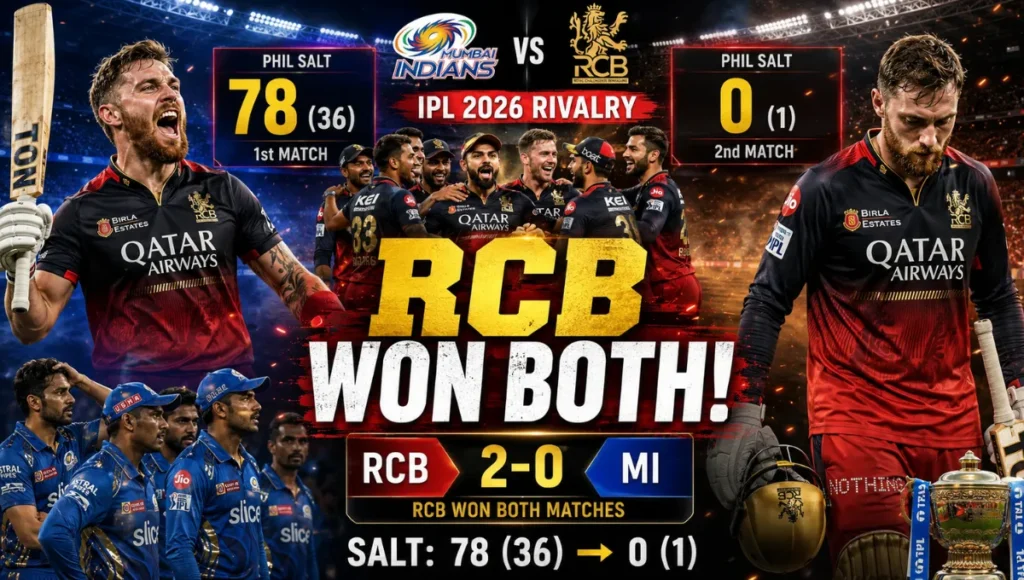

Phil Salt scored 78 off 36 balls to win the first match. In the rematch, he was out for a golden duck inside two balls. Somehow, RCB won both games anyway.
That single contrast tells you almost everything about this season’s Mumbai Indians vs Royal Challengers Bengaluru rivalry: RCB found a way to win twice, even when their own match-winner from the first meeting completely disappeared in the second. This is the full head-to-head both scorecards, the key numbers, and the real story behind why RCB have had the better of Mumbai Indians in IPL 2026.
MI vs RCB IPL 2026 Head-to-Head at a Glance
| Match | Venue | Result | Margin | Top Performer |
|---|---|---|---|---|
| 20th Match | Wankhede Stadium, Mumbai | RCB won | 18 runs | Phil Salt — 78 (36) |
| 54th Match | Wankhede Stadium, Mumbai | RCB won | 12 runs | Virat Kohli — 67 (42) |
The one-sentence season story: RCB beat Mumbai Indians twice in IPL 2026 first through Phil Salt’s explosive innings, then through a Kohli-Patidar partnership that survived a furious Hardik Pandya counterattack.
What people think is that RCB’s second win, by a smaller margin, must mean Mumbai Indians were genuinely closing the gap.
The reality, once you look at the actual passages of play, is more specific: MI’s chase was competitive only because of one extraordinary counterattacking cameo late in the innings not because their overall approach against RCB had fundamentally improved.
Match-by-Match Scorecards and Stats
20th Match: RCB win by 18 runs
| Team | Score | Overs |
|---|---|---|
| Royal Challengers Bengaluru | 240/4 | 20 |
| Mumbai Indians | 222/5 | 20 |
Phil Salt’s 78 off 36 balls set up RCB’s total of 240/4. Sherfane Rutherford’s 71 off 31 kept Mumbai Indians in the chase, but RCB’s bowlers, led by Suyash Sharma (2/47) and Krunal Pandya (1/26), held on for an 18-run win at Wankhede Stadium.
54th Match: RCB win by 12 runs
Toss: Mumbai Indians won the toss and elected to field.
RCB innings: 221/5 in 20 overs
| Batter | Runs | Balls | 4s | 6s | Strike rate | Dismissal |
|---|---|---|---|---|---|---|
| Phil Salt | 4 | 2 | 1 | 0 | 200.00 | b Boult |
| Virat Kohli | 67 | 42 | 8 | 2 | 159.52 | c Dhir b Pandya |
| Devdutt Padikkal | 37 | 22 | 2 | 3 | 168.18 | c Jacks b Puthur |
| Rajat Patidar (c) | 64 | 32 | 5 | 4 | 200.00 | c Rickelton b Boult |
| Liam Livingstone | 0 | 2 | 0 | 0 | 0.00 | c Bumrah b Pandya |
| Jitesh Sharma (wk) | 40 | 19 | 2 | 4 | 210.53 | not out |
| Tim David | 1 | 1 | 0 | 0 | 100.00 | not out |
| Extras | 8 | — | — | — | — | 1 lb, 7 w |
| Total | 221/5 | 20 overs |
Fall of wickets: 4/1 (Salt, 0.2), 95/2 (Padikkal, 8.6), 143/3 (Kohli, 14.1), 144/4 (Livingstone, 14.3), 213/5 (Patidar, 18.6).
MI bowling: Trent Boult 2/57 (4 overs), Hardik Pandya 2/45 (4 overs), Puthur 1/10 (1 over), Deepak Chahar 0/29, Jasprit Bumrah 0/29, Will Jacks 0/10, Mitchell Santner 0/40.
MI innings: 209/9 in 20 overs
| Batter | Runs | Balls | 4s | 6s | Strike rate | Dismissal |
|---|---|---|---|---|---|---|
| Rohit Sharma | 17 | 9 | 2 | 1 | 188.89 | b Dayal |
| Ryan Rickelton (wk) | 17 | 10 | 4 | 0 | 170.00 | lbw b Hazlewood |
| Will Jacks | 22 | 18 | 2 | 1 | 122.22 | c Kohli b Pandya |
| Suryakumar Yadav | 28 | 26 | 5 | 0 | 107.69 | c Livingstone b Dayal |
| Tilak Varma | 56 | 29 | 4 | 4 | 193.10 | c Salt b Bhuvneshwar |
| Hardik Pandya (c) | 42 | 15 | 3 | 4 | 280.00 | c Livingstone b Hazlewood |
| Naman Dhir | 11 | 6 | 1 | 1 | 183.33 | c Dayal b Pandya |
| Mitchell Santner | 8 | 4 | 0 | 1 | 200.00 | c David b Pandya |
| Deepak Chahar | 0 | 1 | 0 | 0 | 0.00 | c David b Pandya |
| Trent Boult | 1 | 1 | 0 | 0 | 100.00 | not out |
| Jasprit Bumrah | 0 | 1 | 0 | 0 | 0.00 | not out |
| Extras | 7 | — | — | — | — | 1 lb, 6 w |
| Total | 209/9 | 20 overs |
Read Also:- Gujarat Titans Vs Chennai Super Kings Match Scorecard
Fall of wickets: 21/1 (Rohit, 1.4), 38/2 (Rickelton, 3.4), 79/3 (Jacks, 9.4), 99/4 (Suryakumar, 11.6), 188/5 (Tilak, 17.4), 194/6 (Hardik, 18.1), 203/7 (Santner, 19.1), 203/8 (Chahar, 19.2), 209/9 (Dhir, 19.5).
RCB bowling: Bhuvneshwar Kumar 1/48 (4 overs), Yash Dayal 2/46 (4 overs), Josh Hazlewood 2/37 (4 overs), Suyash Sharma 0/32 (4 overs), Krunal Pandya 4/45 (4 overs).
Highlights and Key Moments
1. Salt’s blistering 78 set up the first win
In the 20th Match, Phil Salt’s 78 off 36 balls gave RCB the platform to post 240/4. Sherfane Rutherford’s counterattacking 71 off 31 for Mumbai Indians made the chase competitive, but RCB’s total, and Suyash Sharma’s two wickets, were enough to close it out by 18 runs.
What most people miss: Salt’s role across this rivalry is not that of a consistent accumulator it is boom-or-bust by design. That is exactly what happened next.
2. Kohli and Patidar powered a 221 defence in the rematch
In the 54th Match, Salt fell for a two-ball duck, bowled by Trent Boult in the very first over. RCB’s total instead came from Virat Kohli’s 67 off 42 and Rajat Patidar’s 64 off 32, who added 48 runs together between overs 9 and 14 before both fell in quick succession.
Counterintuitive point: losing your most explosive opener for almost nothing usually derails a T20 total. Here, RCB’s middle order simply absorbed the loss and rebuilt without panic proof that a genuinely deep batting order can treat an early setback as a minor disruption rather than a crisis.
3. Hardik Pandya’s near-miss all-round effort
Hardik Pandya’s 42 off just 15 balls, at a strike rate of 280, was the standout individual batting performance of the second match. He struck three fours and four sixes in a counterattack that briefly threatened to complete an improbable chase.
This is where things go wrong for a chasing side, even with a brilliant cameo: Pandya’s innings came too late, starting only once MI were already 194 for 5 with limited overs left. A destructive finish from one batter cannot fully compensate for a chase that needed acceleration much earlier MI’s middle overs, where Suryakumar Yadav managed only 28 off 26, had already conceded too much ground.
4. Why the second match was so much closer
The margin shrank from 18 runs to 12, but the reason was not that MI’s overall batting improved it was that Hardik Pandya, batting as captain, personally manufactured 42 runs from almost nothing in the space of 15 balls. Remove that one cameo, and MI’s total would have been closer to 167, turning a 12-run defeat into a far heavier one.
Bold opinion: a shrinking win margin between two matches does not automatically mean the losing team is closing the gap. Sometimes it just means one individual player produced a better cameo the second time around the underlying tactical picture, in this case, barely changed at all.
Player Performance Breakdown
Phil Salt: from match-winner to first-ball duck
Salt’s two performances against Mumbai Indians this season sit at opposite extremes: 78 off 36 in the first meeting, then 4 off 2 in the second, dismissed by Trent Boult inside the very first over.
Original observation: Salt’s value to RCB is not measured by consistency it is measured by ceiling. When he connects, as he did in the first match, he can win a game almost single-handedly inside the powerplay. When he doesn’t, as in the second match, RCB’s deeper batting order has repeatedly shown it can absorb the loss without the innings collapsing. That balance of high risk and high team-level insurance is precisely why RCB can afford an explosive, inconsistent opener.
Virat Kohli and Rajat Patidar RCB’s repeatable middle-overs engine
In the second match, Kohli’s 67 and Patidar’s 64 came in the same middle-overs window, both dismissed within two balls of each other at 143 and 144. Despite losing both set batters in quick succession, RCB still finished with 221, thanks to Jitesh Sharma’s unbeaten 40 off 19 at the death.
Practical lesson for batting depth: a team that can lose its top three inside 15 overs and still post 220-plus has a genuine structural advantage over one that depends on a single long innings. RCB’s total in the second match survived exactly the kind of double-blow that would have capped most sides below 190.
Hardik Pandya a losing effort that still stood out
Pandya’s 42 off 15 in the second match, combined with his role as MI captain, made him the game’s most eye-catching individual performer despite finishing on the losing side. He also contributed with the ball in the first match’s tighter margin conversation, showing his all-round value across the rivalry.
What people think vs reality: fans often remember only the winning side’s standout performer. Here, the most talked-about individual cameo of the entire head-to-head belonged to the losing captain a reminder that Player of the Match–calibre form doesn’t always align with the final scoreline.
Krunal Pandya and Suyash Sharma RCB’s bowling difference-makers
Krunal Pandya took 4/45 in the second match, the difference-maker that turned MI’s chase from genuinely threatening into a comfortable defence. In the first match, Suyash Sharma’s 2/47 provided the key breakthroughs that slowed Mumbai’s chase at a crucial stage.
Common mistake in analysis: judging spin-bowling performances purely on economy rate. Krunal’s 45 runs conceded looks expensive in isolation, but his four wickets, taken across the middle and death overs, directly dismantled MI’s lower-middle order recovery attempt.
Analysis: Why RCB Have the Upper Hand This Season
A batting-first template that travels
Across both matches, RCB’s totals were built on top-order or middle-order explosions rather than late-innings fireworks alone: Salt’s 78 in the first game, and the Kohli-Patidar stand in the second. This is a template that does not depend on a single phase of the innings working perfectly it simply requires one recognised batter to have a big day, and RCB’s depth covers the rest.
Bold opinion: RCB’s real advantage over Mumbai Indians this season is not raw firepower MI have similarly explosive players in Rohit Sharma, Suryakumar Yadav, and Hardik Pandya. The advantage is structural: RCB’s batting order has repeatedly shown it can lose a genuine match-winner early (Salt for a duck in the second game) and still post a match-winning total, while MI’s chases have depended on one big individual moment arriving late enough to threaten but not quite complete the job.
Read Also:- Royal Challengers Bengaluru Vs Gujarat Titans Stats
MI’s bowling struggled to find consistent wicket-taking outside the pace attack
Across the second match, MI’s spin and part-time options Santner, Jacks, Chahar combined for zero wickets in nine overs, conceding 79 runs. Only the pace trio of Boult, Pandya, and Puthur found breakthroughs.
Practical takeaway for MI’s team management: a bowling unit this reliant on pace to take wickets becomes predictable and exploitable, especially once a set batter has survived the new ball. RCB’s middle order, built around players comfortable against pace, may specifically benefit from this pattern more than most opponents would.
What a shrinking margin actually tells you
The move from an 18-run win to a 12-run win looks, on the surface, like Mumbai Indians closing a gap.
The phase-by-phase data tells a more precise story: MI’s top order (Rohit, Rickelton, Jacks, Suryakumar) combined for just 84 runs off 63 balls in the second match barely different from their overall output in the first meeting. The entire six-run improvement in competitiveness came from one individual’s counterattack, not a genuine team-wide upgrade.
This is where things go wrong for surface-level analysis: treating win margin alone as a proxy for “how close the teams are” ignores exactly which phase of the game produced the improvement. A true closing of the gap would show up in the top order’s numbers, not just a captain’s individual cameo in the closing overs.
Rivalry History and Format Guardrail
The broader IPL rivalry
Mumbai Indians and Royal Challengers Bengaluru have met many times across IPL history, with an extensive all-time head-to-head record spanning multiple seasons and formats of both franchises. This season’s two meetings both won by RCB sit within that longer rivalry rather than replacing it.
Format and fixture guardrail
| Fixture | Correct context |
|---|---|
| MI vs RCB, 20th Match, IPL 2026 | First 2026 meeting — this article’s opening scorecard |
| RCB vs MI, 54th Match, IPL 2026 | Second 2026 meeting — this article’s detailed scorecard |
| RCB vs MI, 2020 (Punjab Kings archive) | A completely different season and squad composition |
| Cricinfo all-time head-to-head records | Aggregate historical data across all IPL seasons, not specific to 2026 |
Do not present the 2020 fixture’s figures or the all-time head-to-head win count as if they describe this season’s results. Each belongs to a different point in the two franchises’ shared IPL history.