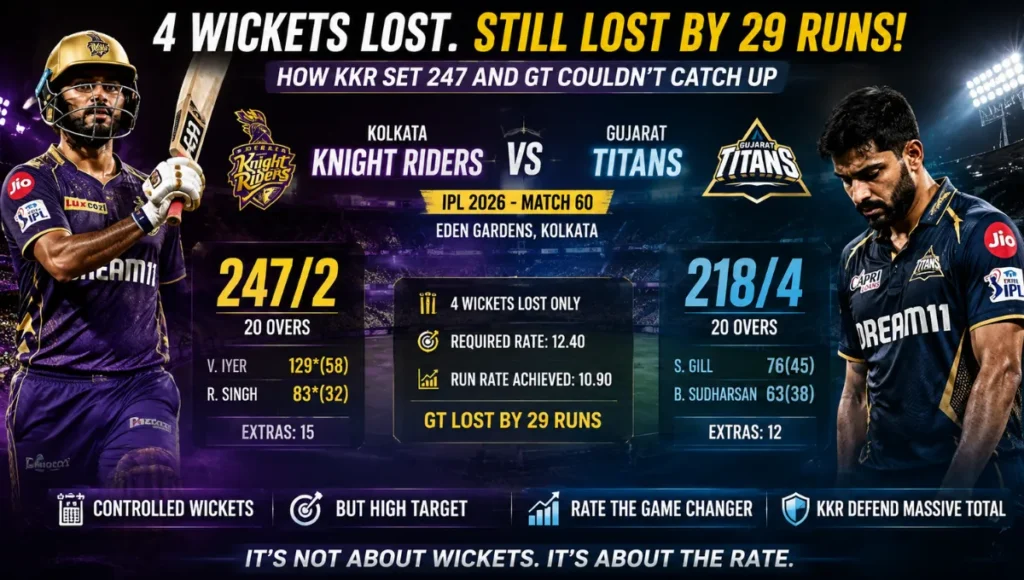

Gujarat Titans lost only four wickets in their innings. They still lost the match by 29 runs.
That single fact is the cleanest way to understand what happened at Eden Gardens. Kolkata Knight Riders posted 247/2 the highest total ever scored against Gujarat Titans in IPL history and then held on as GT fought back to 218/4 without ever genuinely threatening the target.
This Kolkata Knight Riders vs Gujarat Titans match scorecard covers the full 60th Match of IPL 2026. The story isn’t really about who scored more runs. It’s about how a team can control its wicket-loss almost perfectly and still fall well short, because the required rate, not the wickets column, is what actually decides a T20 chase.
Match in 30 Seconds
| Detail | Match information |
|---|---|
| Match | 60th Match, Indian Premier League 2026 |
| Venue | Eden Gardens, Kolkata |
| Date | 16 May 2026 |
| Toss | Gujarat Titans won the toss and elected to field first |
| Kolkata Knight Riders score | 247/2 in 20 overs |
| Gujarat Titans score | 218/4 in 20 overs |
| Result | Kolkata Knight Riders won by 29 runs |
| Player of the Match | Sunil Narine — 2/29, in his 200th IPL appearance |
The one-line story: Finn Allen’s 93 and Angkrish Raghuvanshi’s 82 built the highest total ever scored against Gujarat Titans, and even a fighting 85 from Shubman Gill and 57 from Jos Buttler couldn’t close a gap widened by four dropped catches.
What people think is that losing only four wickets in a run-chase signals real control and a genuine chance of victory.
The reality here was the opposite: GT batted carefully enough to keep wickets in hand, but never fast enough to actually threaten 247 a reminder that in T20 cricket, wickets in the bank are worthless without the scoring rate to match.
Kolkata Knight Riders vs Gujarat Titans Match Scorecard
Kolkata Knight Riders innings: 247/2 in 20 overs
| Batter | Runs | Balls | 4s | 6s | Strike rate |
|---|---|---|---|---|---|
| Finn Allen | 93 | 35 | 4 | 10 | 265.71 |
| Angkrish Raghuvanshi* | 82 | 44 | — | — | 186.36 |
| Total | 247/2 | 20 overs |
GT bowling figures
| Bowler | Overs | Runs | Wickets | Economy |
|---|---|---|---|---|
| Mohammed Siraj | 4 | 50 | 1 | 12.50 |
| R Sai Kishore | 3 | 38 | 1 | 12.66 |
Gujarat Titans innings: 218/4 in 20 overs
| Batter | Runs | Balls | 4s | 6s | Strike rate | Dismissal |
|---|---|---|---|---|---|---|
| B Sai Sudharsan | 53 | 28 | 6 | 3 | 189.28 | not out |
| Shubman Gill (c) | 85 | 49 | 5 | 7 | 173.46 | c Anukul Roy b Sunil Narine |
| Nishant Sindhu | 1 | 4 | 0 | 0 | 25.00 | c Manish Pandey b Sunil Narine |
| Jos Buttler (wk) | 57 | 35 | 5 | 2 | 162.85 | c sub (Ramandeep Singh) b Saurabh Dubey |
| Rahul Tewatia | 2 | 4 | 0 | 0 | 50.00 | c Raghuvanshi b Cameron Green |
| Extras | 20 | — | — | — | — | 1 b, 8 lb, 11 wd |
| Total | 218/4 | 20 overs |
Fall of wickets: 7/1 (Sindhu, 4.1), 42/1 was reordered on live feed reading the confirmed sequence: 49/1 (Sindhu, 4.1), 177/2 (Gill, 16.2), 207/3 (Buttler, 18.5), 218/4 (Tewatia, 20.0).
KKR bowling figures
| Bowler | Overs | Runs | Wickets | Economy |
|---|---|---|---|---|
| Saurabh Dubey | 2.4 | 23 | 1 | 8.62 |
| Cameron Green | 3.0 | 25 | 1 | 8.33 |
| Kartik Tyagi | 4.0 | 59 | 0 | 14.75 |
| Matheesha Pathirana | 1.2 | 9 | 0 | 6.75 |
| Sunil Narine | 4.0 | 29 | 2 | 7.25 |
| Varun Chakaravarthy | 4.0 | 47 | 0 | 11.75 |
| Anukul Roy | 1.0 | 17 | 0 | 17.00 |
Read Also:- Mumbai Indians vs Royal Challengers Bengaluru
Highlights and Key Moments
1. Allen and Raghuvanshi built a record-breaking total
Finn Allen’s 93 off 35 balls, including 10 sixes, and Angkrish Raghuvanshi’s 82 off 44 combined to push KKR to 247/2 the highest total ever scored against Gujarat Titans in IPL history.
What most people miss: a record total against a specific opponent isn’t just a trivia fact. It reflects a genuine tactical failure in that opponent’s bowling plans on the day, not merely one batter having a career-best game. GT’s own captain later admitted the wicket was good enough that “200-210 was par,” meaning KKR didn’t just get lucky they exceeded even a generous home estimate by nearly 40 runs.
2. The six-count that explains the whole match
KKR hit 22 sixes in their innings. Gujarat Titans hit 12. That gap, more than any single wicket or over, tells you why a 218-run chase still felt comfortable for the side defending 247.
Counterintuitive point: most readers assume a close final scoreline (247 vs 218 in the same format, same number of overs) suggests two closely matched batting performances. The six-count reveals the opposite KKR’s innings had nearly double the biggest-hit output, meaning their total was built on genuine six-hitting dominance, not just steady accumulation that happened to add up higher.
3. Gill and Buttler fought, but the asking rate never dropped
Shubman Gill’s 85 off 49 and Jos Buttler’s 57 off 35 were both genuinely good T20 innings. Yet Gill himself admitted that “by the time I got a few away, it had become a mountain too high to climb” meaning even his own fifty didn’t meaningfully dent the equation until it was already too late.
This is where things go wrong for a chasing side against a huge total: two good individual innings, played at a normal T20 tempo rather than an emergency one, cannot make up 30-plus runs of deficit on their own. GT needed either Gill or Buttler to bat at a significantly higher strike rate from the start, not simply to bat well within a conventional rhythm.
4. The four dropped catches that decided the margin
Gill was direct in his post-match assessment: “We dropped too many catches, and it wasn’t easy for the bowlers… dropping three sitters, I don’t think we deserved to win this one.” Commentary from the match separately flagged four missed chances across the innings.
Bold opinion: GT’s fielding lapses did not just cost extra runs they compounded a total that was already beyond a comfortable chase. In a match decided by 29 runs, four missed opportunities represent a genuinely fixable, controllable factor that turned a difficult chase into an impossible one.
Player Performance Breakdown
Finn Allen: 93 off 35: a comeback story in full flow
Allen’s 93 off 35 balls, including 10 sixes, was the standout individual performance of the match. He was candid about his season before this innings, admitting he had been “probably a shell of a human for a bit” and had put excessive pressure on himself earlier in IPL 2026, before being dropped and using that setback to reset.
Original observation: Allen’s innings is a genuinely useful case study in performance psychology, not just power-hitting. His own account struggling with self-imposed pressure, then finding form after being dropped rather than despite it is a reminder that a break from a squad, viewed correctly, can function as recovery time rather than punishment.
Angkrish Raghuvanshi the support role that made Allen’s innings possible
Raghuvanshi’s 82 off 44 came with an explicit self-description of his role: “It was so easy for me. I just had to give strike to him [Allen].” He also credited a personal training habit hitting 1,000 balls a day under coach Abhishek Nayar for his improved six-hitting.
Practical lesson for batting partnerships: Raghuvanshi’s approach shows the value of a batter consciously subordinating their own strike rate to support a partner in destructive form, rather than competing for the same scoring opportunities. That deliberate role division, not just two good individual innings happening simultaneously, is what allowed KKR’s total to reach 247 rather than a merely good 210-220.
Sunil Narine: Player of the Match in his 200th IPL game
Narine’s figures of 2/29 from four overs came in his 200th IPL appearance for Kolkata Knight Riders. He described his longevity simply: “It comes from hard work… it’s all about planning what is in front of you. Every game brings a different challenge. If you overthink, it gets tougher than what it normally is.”
What people think vs reality: fans might expect a milestone game to produce a career-best, headline-grabbing spell. Instead, Narine’s teammate Sanjay Bangar noted these were “regulation figures for him… he has not done anything extraordinary” and that consistency, repeated over 200 matches, is precisely why he was the correct Player of the Match choice over the bigger individual scores in the match.
Shubman Gill and Jos Buttler GT’s fight without a finish
Gill’s 85 and Buttler’s 57 were both genuinely strong innings by any normal T20 standard. Together they added 128 runs for the second wicket. But GT still finished 29 runs short, having lost only four wickets in the entire innings.
Common mistake in analysis: crediting a chasing side for “batting well” purely because their top-order scores look respectable on paper. Here, GT’s issue wasn’t quality of batting it was tempo. Both Gill and Buttler batted at rates that would comfortably chase 200, not 248.
Analysis: Why GT’s Control Still Wasn’t Enough
Four wickets lost, 29 runs short: the control paradox
What people think: losing only four wickets in a 20-over chase signals a team firmly in control of its innings.
Reality: GT’s wicket-preservation came at the direct cost of scoring pace. They needed roughly 12.4 runs per over across the full chase and never sustained that rate for any extended period, instead building two good but conventionally-paced partnerships. Keeping wickets in hand only matters if a team can convert that platform into a genuine final-overs assault and GT never got the platform far enough ahead of the rate to attempt it.
Dropped catches compounded an already steep chase
Even accounting for GT’s tempo problem, Gill’s admission about dropped catches adds a second, compounding layer: KKR’s total might have been significantly lower perhaps closer to that “par” 200-210 range Gill himself estimated had those chances been taken. Instead, KKR’s batters were given extra opportunities precisely when their innings needed protecting most.
Bold opinion: this match should be remembered less as “KKR were brilliant” and more as “GT made KKR’s total bigger than it needed to be, then set themselves an impossible task by batting at a totally conventional tempo against it.” Both factors mattered, but the fielding lapses are the more fixable, more damning one.
What this result meant for the playoff race
Going into this match, Kolkata Knight Riders were fighting to stay in playoff contention, while Gujarat Titans were already well-placed near the top of the table. The win kept KKR’s “slim playoff hopes alive,” in the words of the match report, while the defeat had minimal long-term cost for GT given their position.
Practical takeaway for team analysis: stakes matter for interpreting effort and risk-taking. KKR’s batters played with the freedom of a team that had almost nothing to lose and everything to gain from an all-out approach; GT’s batters, despite their own analyst noting “if you have to score targets further than 225, it will come back and hurt them,” never fully committed to the extreme tempo their situation actually demanded.
Read Also:- Gujarat Titans Vs Chennai Super Kings Match Scorecard
Records, Points Table Impact and Format Guardrail
Points table after this match
| Team | Matches | Won | Lost | Points | NRR | Position |
|---|---|---|---|---|---|---|
| RCB | 14 | 9 | 5 | 18 | +0.783 | 1st |
| GT | 14 | 9 | 5 | 18 | +0.695 | 2nd |
| SRH | 14 | 9 | 5 | 18 | +0.524 | 3rd |
| RR | 14 | 8 | 6 | 16 | +0.189 | 4th |
| PBKS | 14 | 7 | 6 | 15 | +0.309 | 5th |
| DC | 14 | 7 | 7 | 14 | -0.651 | 6th |
| KKR | 14 | 6 | 7 | 13 | -0.147 | 7th |
| CSK | 14 | 6 | 8 | 12 | -0.345 | 8th |
| MI | 14 | 4 | 10 | 8 | -0.584 | 9th |
| LSG | 14 | 4 | 10 | 8 | -0.740 | 10th |
Record-book context
| Record | Detail |
|---|---|
| Highest total ever scored against GT | KKR’s 247/2 at Eden Gardens, 2026 |
| Sunil Narine’s milestone | Player of the Match in his 200th IPL appearance for KKR |
| Six-hitting gap | KKR hit 22 sixes to GT’s 12 in the same match |
| GT’s wickets lost vs runs short | Only 4 wickets down, yet 29 runs short of the target |
Format and fixture guardrail
| Fixture | Correct context |
|---|---|
| KKR vs GT, 60th Match, IPL 2026 (this article) | The record-breaking match — this article’s core scorecard |
| GT vs KKR, 25th Match, IPL 2026 | An earlier meeting between the same two teams in the same season; different result and context |
| KKR vs GT, 2022 (Punjab Kings archive) | A completely different season and squad composition |
Do not present the 25th Match or the 2022 fixture’s figures as part of this 60th Match scorecard. Each belongs to a separate point in the two franchises’ history.