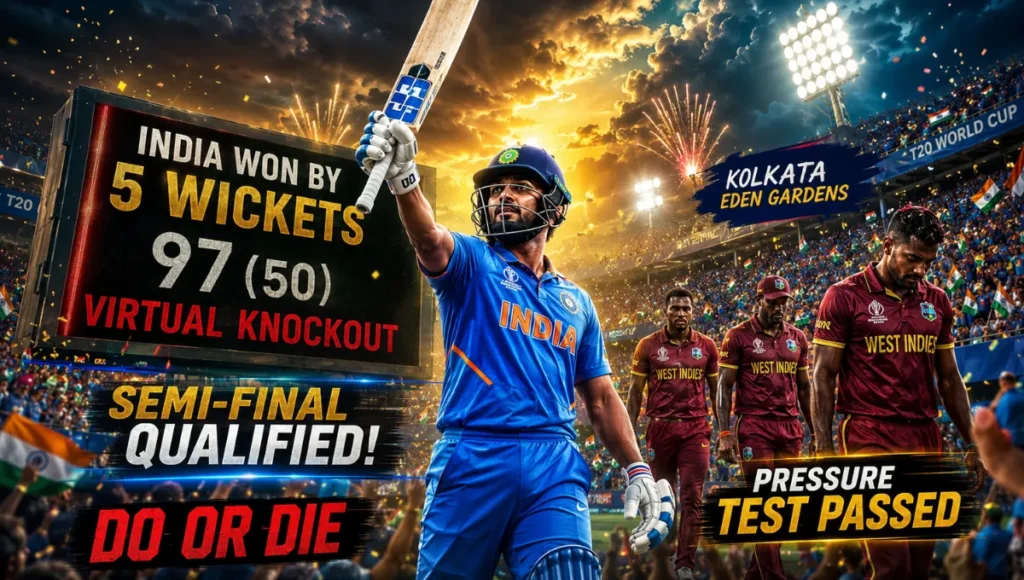

Sanju Samson walked out in Kolkata knowing exactly what was at stake. A virtual knockout. Win, and India reaches the semi-final. Lose, and their title defense ends right there.
He finished with 97 off 50 balls, and India won by 5 wickets. Most match reports call this “India power past West Indies” and move on.
Here’s the real problem with that framing: it treats a virtual knockout match like a routine group game. What actually happened in Kolkata was a pressure test that revealed exactly how India handles must-win situations differently from dead-rubber fixtures and that distinction matters far more than the final scoreline suggests.
The Context Behind This Rivalry
India and West Indies don’t play each other with the same frequency as India’s fixtures against Australia, England, or Pakistan. That scheduling gap actually makes every meeting between these two sides more consequential than it might initially appear, since fans and analysts have fewer recent data points to draw conclusions from.
What most people miss is that this relative scarcity of matches changes how both teams approach each other tactically. Neither side can rely heavily on recent scouting patterns, which is partly why the 2026 Super Eight clash in Kolkata unfolded as such a genuinely tense contest rather than a predictable script.
The Complete India vs West Indies Head-to-Head
Most fans assume this rivalry is comfortably one-sided because India has been the stronger cricketing nation for over a decade. That’s only partly accurate the picture shifts depending on format and era.
| Format | India’s Recent Form | Notable Context |
|---|---|---|
| T20I | Strong, especially in tournament settings | India beat WI in the 2026 T20 WC Super Eight |
| ODI | Competitive historically | Upcoming 3-match series in Oct 2026 |
| Test | Long rivalry dating back decades | Not part of the current bilateral window |
Read Also:- India National Under-19 Cricket Team Schedule
What most people miss: this fixture doesn’t get the same tournament frequency as India-Australia or India-England. That means every meeting bilateral or ICC event carries more weight per match, since there’s less recent data to draw from between series.
Why Format Frequency Skews Perception
Because India and West Indies rarely clash in Test cricket in the current cycle, most modern fans only know this rivalry through white-ball cricket. That’s a meaningfully different rivalry than the one older cricket followers remember from decades of Test battles. Judging this fixture purely by recent T20I and ODI form, without acknowledging that shift, leads to an incomplete picture of how competitive these two sides really are.
The 2026 T20 World Cup: A Virtual Knockout
India faced West Indies in their third Super Eight match of Group 1 at Eden Gardens, Kolkata, on March 1, 2026. This wasn’t a routine fixture. It was framed explicitly as a “winner takes all” contest, since both teams needed the win to stay alive for the semi-final.
The Turning Point
Sanju Samson anchored India’s innings with 97 runs off just 50 balls, alongside a strong showing from Abhishek Sharma. This is where things go wrong for most casual analysis they treat a near-century in a virtual knockout as just another good batting performance. It wasn’t. Samson built the entire chase-defining platform under the exact kind of pressure that has broken other Indian batters in the past.
Why This Win Mattered More Than a Normal Group Match
What people think vs reality: fans assume a 5-wicket win margin suggests a comfortable game. Reality in a virtual knockout, a 5-wicket win with overs to spare reflects controlled chasing under elimination pressure, not just superior talent. India’s composure in exactly this situation is what separated them from West Indies on the day.
My bold take here: India’s biggest strength in ICC tournaments isn’t raw batting depth. It’s specifically how calmly they chase in must-win, single-elimination-style situations. That composure showed up again in Kolkata, and it’s a repeatable pattern worth tracking in future tournaments.
A Closer Look At The Chase Dynamics
Winning by 5 wickets in a virtual knockout doesn’t happen by accident. It requires a top-order batter to absorb early pressure without panicking, which is exactly what Samson’s 97 off 50 balls represents. Compare that to how many chases in similar high-stakes matches collapse the moment an early wicket falls India avoided that trap entirely, and Abhishek Sharma’s supporting role alongside Samson meant the required run rate never spiraled out of control.
Why West Indies Struggle In These High-Pressure Meetings
West Indies possess genuine T20 power-hitting talent, yet they’ve struggled to convert that talent into wins against India specifically in virtual knockout scenarios. The common assumption is that West Indies simply lack the bowling depth to defend totals against India’s top order. That’s only half the explanation.
The sharper reality: West Indies’ batting approach in these must-win games tends to rely on explosive starts rather than measured innings-building the opposite of what Samson demonstrated for India in Kolkata. When that explosive start doesn’t materialize, West Indies have historically struggled to recover, and that pattern repeated itself in this Super Eight match.
The Common Mistake West Indies Keep Repeating
Teams built around power-hitting often assume aggression is always the right approach, regardless of match situation. West Indies’ batting template in this Super Eight clash reflected exactly that mindset high-risk shot selection from the start, rather than adapting to the specific pressure of a knockout scenario. Until West Indies build in a genuine “anchor” role similar to what Samson provided for India, they’ll keep losing tight, high-stakes matches even when their raw hitting talent matches or exceeds the opposition’s.
The Upcoming West Indies Tour of India, 2026-27
Beyond the World Cup meeting, India and West Indies are set for a full bilateral series later in 2026. West Indies will tour India from September 27 to October 17, 2026, for a three-match ODI series followed by a five-match T20I series.
ODI Series Schedule
| Match | Date | Venue |
|---|---|---|
| 1st ODI | September 27, 2026 | Thiruvananthapuram |
| 2nd ODI | September 30, 2026 | Guwahati |
| 3rd ODI | October 3, 2026 | New Chandigarh |
T20I Series Schedule
| Match | Date | Venue |
|---|---|---|
| 1st T20I | October 6, 2026 | Lucknow |
| 2nd T20I | October 9, 2026 | Ranchi |
| 3rd T20I | October 11, 2026 | Indore |
| 4th T20I | October 14, 2026 | Hyderabad |
| 5th T20I | October 17, 2026 | Bengaluru |
Read Also:- India National Cricket Team Vs Zimbabwe National Cricket Team Matches
What most people miss: this tour arrives roughly seven months after the World Cup Super Eight meeting, giving both teams a rare chance to settle the bilateral scoreline right after a high-stakes tournament clash. That timing makes this series unusually meaningful compared to a typical standalone bilateral tour.
Why This Series Deserves More Attention Than A Standard Tour
Most previews will treat this as a routine home series for India. That undersells it. West Indies will arrive looking to prove their World Cup exit wasn’t reflective of their true form, while India will be defending home turf fresh off a title defense. Expect team compositions on both sides to be shaped directly by lessons learned in Kolkata.
What This Series Could Reveal About Both Teams’ Progress
A bilateral series played just months after a tense tournament exit often functions as an unofficial referendum on whether a team has actually addressed its weaknesses. If West Indies show up in October with a more disciplined top-order approach fewer high-risk shots in the opening overs that would suggest genuine tactical growth since Kolkata. If they repeat the same explosive, high-variance batting template, it signals the lesson from the World Cup hasn’t been absorbed at all.
What Fans Should Actually Track Going Forward
India’s composure in virtual knockout situations is now a proven pattern, not a one-off. What should a fan or analyst actually do with this information heading into the October series?
- Watch whether Sanju Samson retains his middle-order anchor role in the bilateral T20I series, since his Kolkata innings may shift team batting strategy
- Track West Indies’ approach in the early ODIs a more patient batting style would signal they’ve addressed the issue exposed in the World Cup
- Follow the T20I series closely for player rotation, since India often uses bilateral series after major tournaments to test bench strength
- Note venue-specific patterns, since Lucknow, Ranchi, and Indore haven’t hosted this fixture recently, adding an unknown conditions factor
- Compare West Indies’ shot selection data between the World Cup Super Eight match and the October ODIs to measure actual tactical adjustment
For West Indies specifically, the actionable priority is clear: build batting depth that doesn’t rely purely on explosive starts, since that approach failed them in the one match that mattered most in 2026. For India, the priority is different use this bilateral series to test whether their World Cup-winning formula, especially Samson’s role, can be replicated consistently outside knockout pressure.