
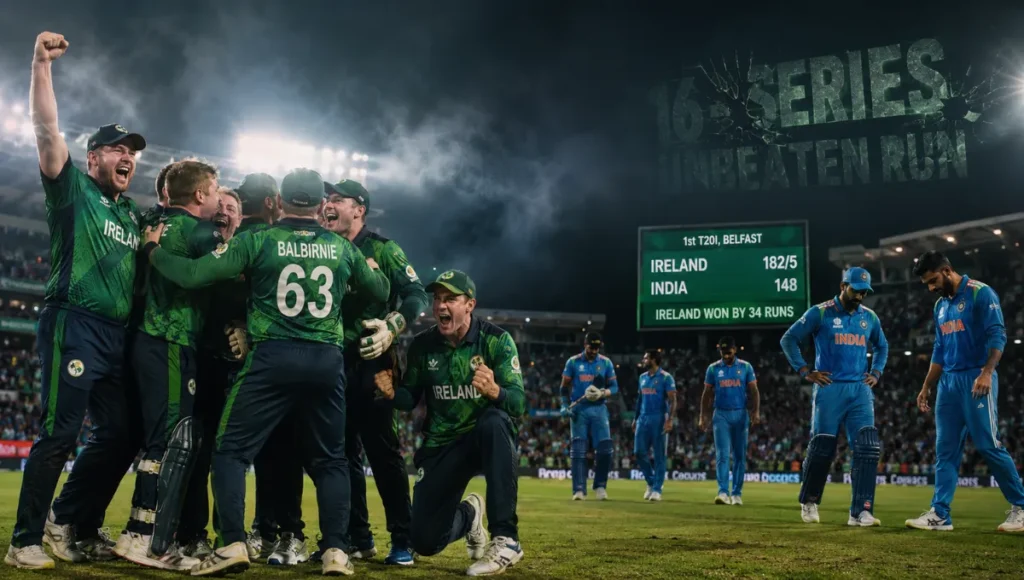

India had played Ireland 12 times across international cricket before this match. They had never lost. Not once.
Then, missing five of their first-choice players through injury, Ireland beat the reigning back-to-back T20 World Champions by 34 runs. Two days later, they did it again by a single run to complete a 2-0 series sweep.
This Ireland Cricket Team vs India National Cricket Team match scorecard covers the 1st T20I in Belfast in full detail. But the real story is bigger than one scorecard it is how a team playing without several regulars ended India’s 16-series unbeaten run in the format.
Match in 30 Seconds
| Detail | Match information |
|---|---|
| Match | 1st T20I, India tour of Ireland 2026 |
| Venue | Civil Service Cricket Club, Belfast |
| Date | 26 June 2026 |
| Toss | India won the toss and elected to field first |
| Ireland score | 182/9 in 20 overs |
| India score | 148 all out in 18.5 overs |
| Result | Ireland won by 34 runs |
| Player of the Match | Matt Hollard — 3/28 on T20I debut |
| Historic context | Ireland’s first-ever win over India in international cricket, in their 12th attempt |
The one-line story: Two debutant seamers, Jai Moondra and Matt Hollard, combined for five wickets to dismantle India’s chase after Lorcan Tucker’s fifty rescued Ireland from 51/4 to a defendable 182.
What people think is that a shock result like this must have been a fluke a good day for the underdog that will not repeat.
The reality arrived two days later: Ireland won the decider too, by just one run, to complete a full series sweep. This was not luck. It was a team that read the conditions better across two matches in a row.
Ireland Cricket Team vs India National Cricket Team Match Scorecard
Ireland innings: 182/9 in 20 overs
| Batter | Runs | Balls | 4s | 6s | Dismissal |
|---|---|---|---|---|---|
| Lorcan Tucker (c) | 50 | 36 | 5 | 2 | — |
| Gareth Delany | 49 | 32 | 3 | 3 | — |
| Total | 182/9 | 20 overs |
Ireland slipped to 51/4 before Tucker and Delany rebuilt the innings. Tucker’s captaincy debut fifty and Delany’s 49 off 32 his most productive shot a slog for 12 runs including two sixes powered Ireland from crisis to a genuinely competitive total.
India bowling figures
| Bowler | Overs | Runs | Wickets | Economy |
|---|---|---|---|---|
| Harshit Rana | 4 | 24 | 3 | 6.00 |
| Arshdeep Singh | 4 | 28 | 2 | 7.00 |
India innings: 148 all out in 18.5 overs
| Batter | Runs | Balls | 4s | 6s | Dismissal |
|---|---|---|---|---|---|
| Abhishek Sharma | 49 | 20 | — | — | caught |
| SV Samson | 5 | 4 | — | — | bowled |
| Ishan Kishan | 1 | 5 | — | — | caught (wk) |
| SS Iyer | 3 | 7 | — | — | caught |
| NT Tilak Varma | 19 | 21 | — | — | caught |
| Washington Sundar | 9 | 12 | — | — | caught |
| Shivam Dube | 25 | 14 | — | — | caught |
| AR Patel | 15 | 16 | — | — | caught |
| Harshit Rana | 8 | 9 | — | 1 | caught |
| Arshdeep Singh | 2 | 4 | — | — | caught |
| Prasidh Krishna | 1 | 2 | — | — | not out |
| Extras | 11 | — | — | — | 3 lb, 7 w, 1 nb |
| Total | 148 | 18.5 overs |
Partnership contributions by wicket: 1st 16 (Samson/Abhishek), 2nd 29 (Kishan/Abhishek), 3rd 15 (Iyer/Abhishek), 4th 20 (Abhishek/Tilak), 5th 10 (Washington/Tilak), 6th 10 (Dube/Washington), 7th 35 (Axar/Dube), 8th 2 (Axar/Rana), 9th 10 (Arshdeep/Rana), 10th 1 (Prasidh/Arshdeep).
Ireland bowling figures
| Bowler | Overs | Runs | Wickets | Economy |
|---|---|---|---|---|
| Matthew Humphreys | 3.5 | 38 | 3 | 9.91 |
| Jai Moondra | 4.0 | 25 | 2 | 6.25 |
| L McCarthy | 3.0 | 29 | 1 | 9.66 |
| Matt Hollard | 4.0 | 28 | 3 | 7.00 |
| HT Tector | 3.0 | 22 | 0 | 7.33 |
| Gareth Delany | 1.0 | 3 | 1 | 3.00 |
How Rare Was This Result?
12 attempts, one historic breakthrough
Before this match, India had faced Ireland 12 times across all international formats nine T20Is and three ODIs without ever losing. Ireland became the 11th team to beat India in international cricket, and only the eighth Full Member side to do so, leaving just Australia, New Zealand, and Sri Lanka as opponents India has never lost to.
Original observation: the scale of this result is easy to understate because Ireland are not traditionally viewed as a top-tier T20 side. But beating a two-time reigning T20 World Champion, even a understrength one, in a bilateral series is a genuinely rare achievement rarer, in context, than most single-match shocks make it appear.
Ending a 16-series unbeaten run
India’s run of 16 consecutive T20I series unbeaten ended with this result the longest such streak by any Full Member side, surpassing Pakistan’s 11-series run between 2016 and 2018. The last time India had lost a bilateral T20I series before this was in January 2024.
Bold opinion: a 16-series unbeaten run is the kind of statistic that can create complacency in team selection and squad rotation. India traveled to Ireland without five first-choice players Ireland were missing key players too, but the gap in squad depth clearly mattered less than expected.
Highlights and Key Moments
1. Ireland’s recovery from 51/4 set the tone
Ireland lost early wickets and slipped to 51 for 4, facing an Indian bowling attack that, in Tucker’s own words, “bowled really good lengths” and made scoring difficult “ it nearly felt like a Test match at one stage.”
Tucker and Delany then rebuilt through a partnership that changed the complexion of the innings, taking Ireland from crisis to 182/9.
What most people miss: a total of 182 against a side capable of chasing 200-plus totals “for fun,” as the ESPN report put it, still looked short before the match. The recovery mattered less for the raw total and more because it gave Ireland’s bowlers something to defend at all.
2. India’s flying powerplay start hid a deeper problem
Abhishek Sharma helped India race to 68 at the end of the powerplay, despite losing three wickets a fast, promising opening phase that suggested a comfortable chase.
Shreyas Iyer later admitted: “I thought 140 would have been an amazing score considering the start that we got to chase.”
Counterintuitive point: a fast powerplay with wickets falling is a warning sign, not just a positive. India’s counterattacking approach produced quick runs but also handed Ireland wickets in hand and once the required rate stabilised, Ireland’s middle-overs bowlers had license to attack rather than simply contain.
3. The debutants who changed the match
Jai Moondra and Matt Hollard, both playing their first T20I, combined for five wickets in their eight overs. Hollard removed key middle-order batters to finish with 3/28 and claimed the Player of the Match award, while Moondra took 2/25, including the wickets of Sanju Samson and Shivam Dube.
This is where things go wrong for a favourite: facing bowlers with no track record removes the ability to prepare through video analysis or past data. India’s batters could not rely on scouting reports against two debutants who simply executed disciplined lines under pressure.
Player Performance Breakdown
Lorcan Tucker: 50 off 36: a captain’s fifty under pressure
Tucker’s fifty, struck in his first match as Ireland’s T20I captain, was the platform for everything that followed. He described it as “pretty special,” while noting that “we scrapped through the game” and that his side found it “challenging to hit good shots” against India’s tight opening bowling.
Practical lesson: Tucker’s innings shows the value of a captain leading a recovery rather than delegating it. Choosing to absorb pressure personally, rather than relying on a lower-order rescue, gave Ireland’s innings both stability and belief.
Matt Hollard: Player of the Match on T20I debut
Hollard’s 3/28 came in his very first international match, against the reigning T20 World Champions. He described the moment vividly: “I never expected this… to have a debut against India, it’s honestly a dream come true.”
Original observation: debut performances against elite opposition often get remembered as one-off fairy tales. Hollard’s follow-up two days later, in a series-clinching win, is what turns this from a nice story into a genuine emergence the kind of result a young bowler builds a career on rather than looks back on as a peak.
Jai Moondra: the debutant who kept striking
Moondra took 2/25 in the 1st T20I, including the crucial wicket of Sanju Samson. He would go on to take a career-defining role in the 2nd T20I as well, eventually being named Player of the Series after just two international appearances.
Counterintuitive idea: most Player of the Series awards go to established internationals with big individual scores. Moondra won his based on control and repeatability across two matches proof that consistency, not spectacle, can be the deciding factor in a short series.
Abhishek Sharma: India’s lone bright spot
Abhishek Sharma’s 49 off 20 balls was India’s most positive contribution with the bat, giving them the fast powerplay platform that briefly suggested a comfortable chase.
What people think vs reality: a fifty-adjacent score at a strike rate above 240 looks like a matchwinning innings in isolation. In context, it was undermined by the batters around him nobody else in India’s top six passed 25, meaning Abhishek’s aggression could not be converted into a genuine chase because of a lack of support through the middle overs.
Analysis: Why India Lost the Series
A batting collapse pattern, not a one-off
India lost their middle order cheaply in the 1st T20I five wickets fell for just 46 runs after the powerplay ended.
In the 2nd T20I, the pattern repeated in even starker form: Sanju Samson and Abhishek Sharma both fell for golden ducks in the very first over of the chase.
Bold opinion: this was not bad luck across two matches. It was a structural batting problem a top order built for explosive starts with no clear plan for recovering when the plan failed early, twice in a row, against the same opposition.
Iyer’s difficult start as captain
Shreyas Iyer lost his first match in charge of India’s T20I side, becoming only the second Indian captain to lose each of his first two matches as captain, after Rishabh Pant.
He was honest in his post-match reflection: “It’s still definitely not a great series, honestly speaking, but kudos to them, the way they played.”
Practical lesson for leadership analysis: a captain’s first series should not be judged purely on results, especially against a well-drilled underdog on home soil. But Iyer himself flagged a specific, fixable issue “converting singles into twos” showing self-awareness that matters more, long-term, than the scoreline of two matches in Belfast.
The 2nd T20I decider: 1 run, and a series sealed
India’s chase in the decider began disastrously: both openers fell for golden ducks in the first over. Tilak Varma anchored a recovery, reaching a fighting fifty with support from Axar Patel, before Harshit Rana’s late boundaries brought the equation down to 8 needed off the final two balls.
Rana holed out off the penultimate delivery. India needed 6 off the last ball; Prince Yadav struck it for six but it was one run short of what was required, and Ireland won by exactly 1 run.
This is where things go wrong at the death: a target that comes down to “6 off the last ball” is often decided by the specific delivery a bowler chooses under maximum pressure. Harry Tector, entrusted with defending the final over, “rode his luck a little” according to the match report but the composure to simply execute a full toss into a catchable position, rather than panic, won Ireland the match and the series.
Records, Context and What This Means Going Forward
Historic markers from this result
| Record | Detail |
|---|---|
| Ireland’s first-ever win over India | Achieved in their 12th attempt across formats |
| Ireland’s rank among India’s international conquerors | 11th team overall, 8th Full Member side |
| India’s unbeaten streak ended | 16 consecutive T20I series unbeaten, a record among Full Members |
| Last previous series loss for India | A 1-1 drawn series in South Africa, December 2023 |
| Shreyas Iyer’s captaincy start | Lost each of his first two matches in charge, joining Rishabh Pant as the only Indian captains to do so |
| Lowest fall-of-4th-wicket recovery to beat India | Ireland’s 51/4 recovery, surpassing New Zealand’s previous mark of 61/4 (Nagpur, 2016) |
What this means going forward
India’s tour continued to England for a 5-match T20I series immediately after this defeat, giving Iyer’s side a quick chance to respond against sterner opposition. For Ireland, the result was described by captain Lorcan Tucker as a moment that will put Irish cricket “front page news,” with the team hoping the achievement inspires the next generation of players who watched the series unfold.