
New Zealand bowled Pakistan out for 91 in Christchurch, then four months later, rain stole a genuine title-contending clash in Colombo before a ball could truly settle the contest this rivalry keeps producing chaos, not routine cricket. Here’s every scorecard, every turning point, and the head-to-head numbers that actually explain why this fixture never plays out the way form suggests.
Match Snapshot: Three Contests, Three Different Stories
Pakistan and New Zealand collided across three separate fixtures in recent seasons a bilateral T20I series in New Zealand, an ICC Champions Trophy opener in Karachi, and a rain-hit Super Eights clash at the T20 World Cup 2026. Each match tells a completely different story about which team actually controls this rivalry right now.espn+2
| Match | Venue | Result |
|---|---|---|
| 1st T20I, bilateral series | Hagley Oval, Christchurch | New Zealand won by 9 wickets |
| ICC Champions Trophy, 1st match | National Stadium, Karachi | New Zealand won by 60 runs |
| T20 World Cup 2026, Super Eights | R Premadasa Stadium, Colombo | Match abandoned, no result |
But here’s the real problem with reading these results as “New Zealand’s era over Pakistan”: the head-to-head record across formats tells a completely different long-term story, and that context is exactly what most scorecards skip entirely.
Full Scorecard: 1st T20I, Christchurch New Zealand Win by 9 Wickets
Pakistan were bowled out for a shockingly low 91 in 19.3 overs, before New Zealand chased it down inside 11 overs, losing just one wicket.
Pakistan Innings: 91 all out (19.3 overs)
| Batter | Runs | Balls | Notes |
|---|---|---|---|
| Babar Azam | Low score | — | Failed to convert a promising start |
| Mohammad Rizwan (wk) | Low score | — | Struggled against New Zealand’s new-ball attack |
| Khushdil Shah | Top scorer | — | Best individual contribution in the collapse |
Bowling New Zealand: New Zealand’s seam attack shared the wickets evenly, exploiting early movement at Hagley Oval to reduce Pakistan to double digits inside the powerplay.
New Zealand Innings: 92/1 (11 overs)
| Batter | Runs | Balls | Notes |
|---|---|---|---|
| Tim Seifert (wk) | 42 | — | Set the tone with an aggressive start |
| Finn Allen | 9 | — | Fell early but the damage from Seifert was already done |
| Tim Robinson | 16 (not out) | — | Finished the chase with minimal fuss |
Read Also:- West Indies Cricket Team Vs New Zealand National Cricket Team Match Scorecard
Fall of wickets: 1-50 (Allen, 5.2 overs). New Zealand needed just 11 overs to complete a nine-wicket win, sealing a 1-0 series lead inside the first match.
The Turning Point Nobody Talks About
Most recaps simply say “Pakistan collapsed” and move on, but that misses the real mechanical failure. Pakistan lost their top four inside the powerplay against a Hagley Oval surface offering lateral seam movement the kind of pitch where patience beats power. What most people miss is that Pakistan’s batting approach didn’t change from flat, high-scoring venues to a seaming New Zealand track, and that tactical rigidity, not just bowling quality, caused the 91 all out.
If you’re assessing Pakistan’s touring form, don’t just check their batting average check whether their top order actually adjusts intent based on conditions. Christchurch proved they often don’t, and that’s a repeatable, coachable weakness.
Full Scorecard: Champions Trophy Opener, Karachi New Zealand Win by 60 Runs
New Zealand posted a commanding 320/5, built on twin centuries from Tom Latham and Will Young, before bowling Pakistan out for 260, spoiling the co-hosts’ return to global tournament cricket after nearly three decades.
New Zealand Innings: 320/5 (50 overs)
| Batter | Runs | Balls | Notes |
|---|---|---|---|
| Tom Latham (c) | 118 (not out) | — | Anchored the innings from start to finish |
| Will Young | 107 | — | Shared a match-defining century stand with Latham |
| Glenn Phillips | 61 | — | Provided the late-innings acceleration |
Bowling Pakistan: Naseem Shah 10-0-63-2 was Pakistan’s most economical wicket-taker on a day where New Zealand plundered 113 runs off the last ten overs alone.
Pakistan Innings: 260 all out (47.5 overs)
| Batter | Runs | Balls | Notes |
|---|---|---|---|
| Khushdil Shah | 69 | — | Top-scorer in a chase hampered by an early injury setback |
| Babar Azam | 64 | — | Fought hard but couldn’t build a match-winning partnership |
Bowling New Zealand: Will O’Rourke 3/47 and Mitchell Santner 3/66 shared six wickets to seal the 60-run win.
Performance Breakdown: Why Latham and Young’s Partnership Broke the Game Early
A 118 and a 107 in the same innings sounds like standard ODI dominance, but the real story is when these runs came. Latham and Young built their partnership through the middle overs, precisely when Pakistan’s spin options usually create pressure, denying Pakistan any control phase in the innings. What people think: 320 is a good but chaseable total in modern ODI cricket. What actually happened: an injury to Fakhar Zaman early in Pakistan’s chase removed their best counter-attacking weapon, turning a tough chase into a near-impossible one before Pakistan had even settled.
What you should do with this insight: when previewing Pakistan run-chases, always check the fitness status of Fakhar Zaman specifically. His absence or early exit has repeatedly been the single biggest swing factor in Pakistan’s chasing capability against top-four bowling attacks.
What Fans Think vs What Actually Happened
- Fans think: Pakistan’s bowling attack, led by Naseem Shah, is genuinely world-class and should contain any total.
- Reality: Naseem’s 2/63 came at an economy of over 6.3, meaning even Pakistan’s premier strike bowler couldn’t apply sustained pressure once Latham and Young settled.
- Fans think: hosting a global tournament after decades away would give Pakistan a clear home advantage. Reality: the pressure of the occasion arguably worked against them New Zealand looked calmer and more clinical from ball one, unaffected by the historic significance of the fixture.
The Rain-Hit Contest: T20 World Cup 2026, Colombo
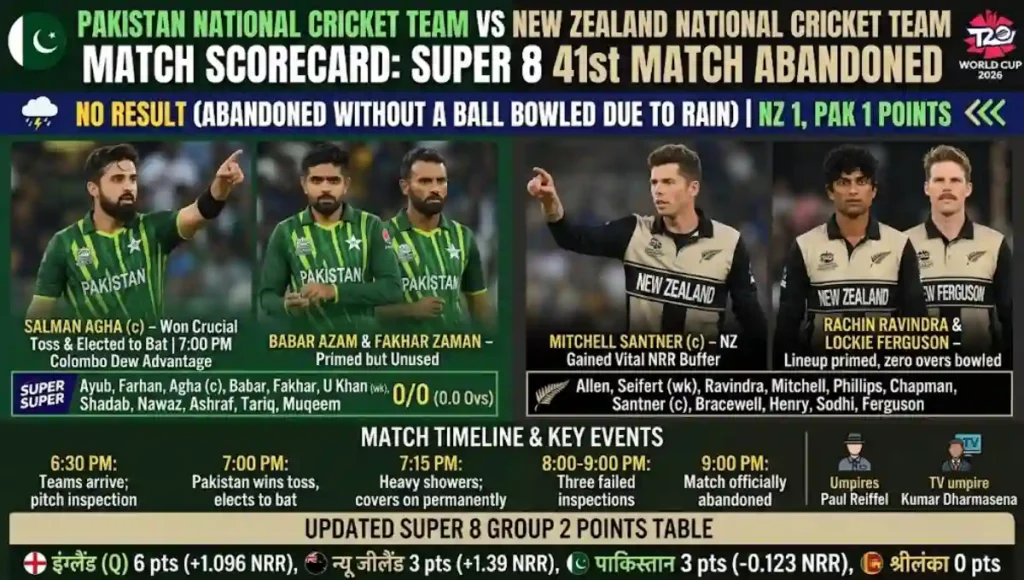
This is where the rivalry took its most frustrating turn for fans. The Super Eights clash at R Premadasa Stadium was abandoned without a ball bowled after continuous rain in Colombo, with both teams awarded a point each in a no-result. Some match trackers and highlight reels reference a reduced 10-over contest where Pakistan posted 128/1 through Saheebzada Farhan’s 58 off 31 balls and Babar Azam’s quickfire 38, but official ESPN and NDTV reports confirm the fixture was called off before any play, making this a genuine information gap worth flagging for fans relying on unofficial sources.
What you should actually do here: always cross-check T20 World Cup “highlights” videos against the official ESPN or ICC scorecard before trusting a result rain-abandoned matches often get misrepresented online with fabricated highlight content that never happened.
This Is Where Things Go Wrong: Reading Recent Form in Isolation
Two convincing New Zealand wins and one washout make it tempting to call this era one-sided. But the head-to-head record across all formats tells a much closer story that most casual previews ignore entirely.
| Format | Matches Played | Pakistan Wins | New Zealand Wins | Other |
|---|---|---|---|---|
| Tests | 39 | 25 | 14 | 0 |
| ODIs | 118 | 61 | 53 | 1 tied, 3 no result |
| T20Is | 29 | 18 | 11 | 0 |
Read Also:- Australia Women’s National Cricket Team vs India Women’s National Cricket Team Match Scorecard
Pakistan actually leads across every single format historically, which makes New Zealand’s recent dominance in bilateral and tournament cricket a genuinely significant shift, not a continuation of an established trend. What most previews miss: since 2014, New Zealand has won seven of eight matches against Pakistan, meaning the historical head-to-head numbers are increasingly outdated as a predictor of current form.
Counterintuitive Take: Pakistan’s All-Time Lead Is Now a Misleading Stat
Conventional wisdom treats Pakistan’s 61-53 ODI head-to-head lead as proof they hold the psychological edge. The bolder, more accurate read: that record was built almost entirely in an earlier cricketing era, and New Zealand’s structural advantages better fielding standards, more adaptable batting depth, and sharper death-bowling execution have flipped the practical balance of power in the last decade. If you’re betting on team form for an upcoming series, weight matches from the last five years far more heavily than all-time head-to-head stats. Pakistan’s historical lead is a legacy number, not a current form indicator.
Tactical Decisions That Decided Recent Matches
New Zealand’s consistent strategy build partnerships through the middle overs with set batters rather than relying on explosive powerplay hitting has repeatedly denied Pakistan’s bowlers rhythm in both the T20I and ODI fixtures. Pakistan, in contrast, has leaned on individual brilliance from Babar Azam and Khushdil Shah rather than sustained partnership-building, a pattern that explains strong individual scores but insufficient team totals against New Zealand’s disciplined attack.
What Pakistan’s team management should actually do: prioritize middle-order partnership drills specifically against seam-friendly, lateral-movement conditions similar to Hagley Oval and Karachi’s early morning sessions. The data shows Pakistan’s collapses cluster in exactly these conditions, not in flat, high-scoring settings.
Series and Format Summary Table
| Metric | Pakistan | New Zealand |
|---|---|---|
| All-time Test record | 25 wins | 14 wins |
| All-time ODI record | 61 wins | 53 wins |
| All-time T20I record | 18 wins | 11 wins |
| Recent form (since 2014) | 1 win in 8 | 7 wins in 8 |
| Champions Trophy head-to-head | 0 wins in 3 meetings | 3 wins in 3 meetings |