
South Africa had never lost a T20 World Cup match to New Zealand. Five meetings, five wins.
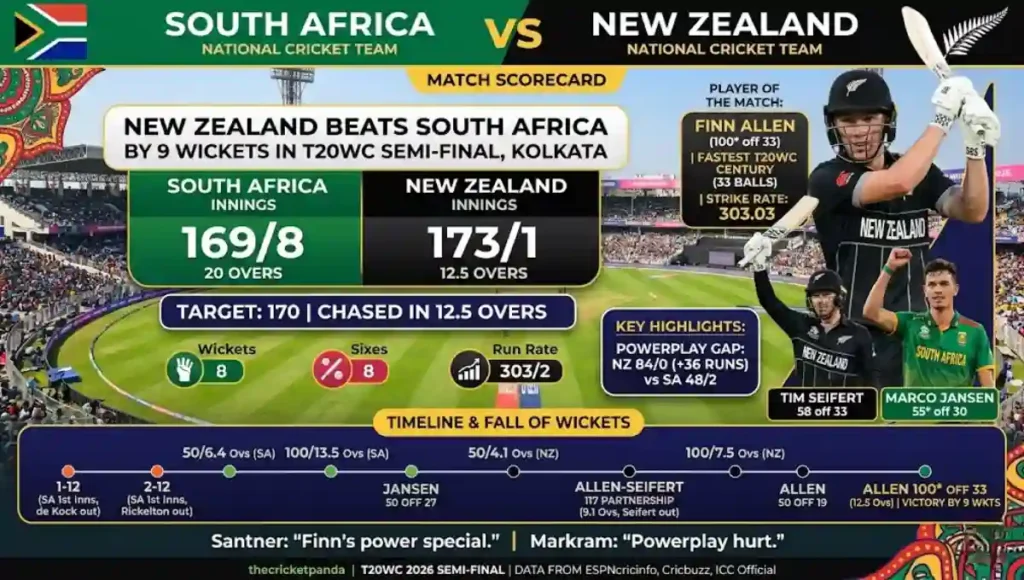
Then, in the biggest match of their tournament, they lost by 9 wickets and Finn Allen scored the fastest century in T20 World Cup history to make sure everyone remembered it.
But here’s the real problem competitors keep missing: this collapse didn’t come out of nowhere. It followed a pattern South Africa had shown signs of all tournament explosive potential undone by two or three costly overs. This is the complete scorecard breakdown of how a perfect head-to-head record turned into a record-breaking defeat.
Match Snapshot: Eden Gardens Semi-Final
| Team | Score | Overs | Result |
|---|---|---|---|
| South Africa | 169/8 | 20.0 | Lost |
| New Zealand | 173/1 | 12.5 | Won by 9 wickets |
New Zealand won the toss and chose to field first at Eden Gardens, Kolkata, on March 4, 2026. The decision paid off in a way even New Zealand’s own camp likely didn’t expect.
South Africa’s Innings: 12/2 to a Fighting 169/8
The Two-Ball Collapse That Set the Tone
South Africa’s innings was over as a genuine threat before it had properly begun. Cole McConchie dismissed Quinton de Kock and Ryan Rickelton in successive deliveries, leaving South Africa at 12 for 2 within the first two overs.
What most people miss about this specific moment is how little time it gave South Africa to recalibrate. Two of their most destructive top-order batters went for single-digit scores, on the same over, against a bowler who wasn’t even their primary threat on paper. That’s not just early pressure it’s the kind of shock that forces every remaining batter into pure survival mode rather than the fearless approach that had carried South Africa unbeaten through the tournament.
Aiden Markram and Dewald Brevis did the only sensible thing available: they rebuilt, adding 43 runs together before Rachin Ravindra broke the stand by removing Markram in the eighth over. That partnership was necessary, but it also cost South Africa the tempo they needed on a ground where 170 was always going to be a below-par score against a confident chasing side.
Jansen’s Lone Rescue: 55* Off 30 Balls
If not for one man, this total would have looked far worse. Marco Jansen finished unbeaten on 55 off 30 balls, hitting two fours and five sixes, dragging South Africa from a middling position to a total that at least offered some pressure.
Here’s the counterintuitive part: a total rescued almost entirely by one lower-order batter often looks more respectable on the scorecard than it actually is in match terms. South Africa reached 169/8, which sounds competitive on paper but the shape of that innings (an early collapse, a rebuilding stand, then one big individual innings) meant they never built the kind of scoreboard pressure a genuinely dominant total creates. Matt Henry struck twice in the final over, removing Corbin Bosch and Kagiso Rabada, ensuring South Africa’s tail couldn’t add the extra 10-15 runs that might have changed the complexion of the chase.
What South Africa needed to do differently here: protect Jansen’s strike rate earlier by rotating him up the order once the top order had fallen, rather than letting him arrive to bat only after the innings was already compromised.
Read Also:- Rajasthan Royals Vs Gujarat Titans Match Scorecard
New Zealand’s Chase: Finn Allen Rewrites History
Seifert-Allen’s 117-Run Stand in the Powerplay
New Zealand’s approach to chasing 170 was the exact opposite of South Africa’s damage-control batting. Tim Seifert and Finn Allen put on 117 runs for the first wicket, with New Zealand racing to 84 runs without loss inside the powerplay.cricketworld+1
The over-by-over milestones tell the real story: New Zealand reached 50 in just 4.1 overs, and 100 in 7.5 overs. Seifert reached his own fifty off 28 balls, striking with four sixes and six fours, before falling for 58 off 33 but by then the match had already tilted decisively.
What people think: “New Zealand just got lucky with two batters having a good day.”
What actually happened: New Zealand’s entire chase strategy was built around denying South Africa’s bowlers any early rhythm, exactly the opposite of how South Africa themselves collapsed. While South Africa’s top order got two dismissals in two balls, New Zealand’s top order never let a single bowler settle into any kind of pattern for the first 12 overs of the innings.
100 Off 33 Balls: Breaking Gayle’s Decade-Old Record
Finn Allen reached fifty off just 19 balls hitting six fours and three sixes along the way before accelerating even further. He brought up his hundred in 33 balls, hitting a boundary to seal both his century and the match in the same shot.
That innings broke Chris Gayle’s 47-ball century record from the 2016 T20 World Cup by a staggering 14 balls not a marginal improvement, but a complete rewriting of what’s considered possible in a knockout match.
Here’s a bold, logical opinion: Allen’s century wasn’t just a brilliant individual effort it was a direct exposure of South Africa’s bowling depth in a way their group-stage form had disguised. Throughout the tournament, South Africa’s attack had built a reputation for disciplined, plan-heavy bowling. Against an opener who refused to respect any plan and attacked from the very first ball, that discipline simply had no answer. New Zealand completed the chase in 12.5 overs, winning by 9 wickets with 43 balls unused.
Why This Result Exposed a Deeper South Africa Problem
South Africa’s collapse pattern in this match a fast start undone almost instantly, followed by a partial recovery through one or two individual efforts isn’t a one-off. It’s the same shape their group-stage win over New Zealand almost took before Markram’s 86* off 44 rescued that chase from a similarly shaky position.
Two original observations worth stating plainly:
- South Africa’s batting order has no reliable answer when their top three fail inside the first three overs. Both matches against New Zealand this tournament saw exactly that scenario develop, and only one of the two times did they have a Markram-level rescue act to bail them out.
- New Zealand’s bowling plan against South Africa specifically targeted the top order with variation bowling in the first two overs McConchie’s twin strike wasn’t an accident, it was a repeat of a tactic that nearly worked in the group match too.
If South Africa want to fix this specific vulnerability before their next major tournament, the practical step is clear: build genuine batting depth and role clarity for overs 1-3, rather than relying on the middle and lower order to repeatedly bail out a fragile top three.
What People Think vs What Actually Happened
Myth 1: “South Africa’s perfect 5-0 record against New Zealand in T20 World Cups meant they had a clear tactical edge heading into the semi-final.”
Truth: That record was built across different eras and conditions; it meant nothing once McConchie exploited the exact same top-order fragility that had briefly appeared in the earlier group match too.
Myth 2: “South Africa’s 169/8 was a solid, competitive total for a semi-final chase.”
Truth: The total was inflated by one rescue act from Jansen; the underlying batting performance a 12/2 start and a 43-run stabilising stand never built genuine pressure on New Zealand’s confident batting lineup.
Myth 3: “Finn Allen’s century was simply a case of a batter having the innings of his life.”
Truth: It was also a direct consequence of South Africa’s bowling attack having no fallback plan against an opener attacking from ball one, a structural gap the tournament’s earlier matches had already hinted at.
Player Performance Ratings
| Player | Team | Key Stat |
|---|---|---|
| Finn Allen | New Zealand | 100* off 33 fastest T20 World Cup century ever |
| Tim Seifert | New Zealand | 58 off 33 explosive powerplay start |
| Marco Jansen | South Africa | 55* off 30 lone rescue act with the bat |
| Cole McConchie | New Zealand | Dismissed de Kock and Rickelton in the 12/2 collapse |
| Rachin Ravindra | New Zealand | Broke the Markram-Brevis stand, key wicket |
| Matt Henry | New Zealand | Late double strike to limit SA’s tail |
Read Also:- India National Cricket Team Vs Bangladesh National Cricket Team Matches