
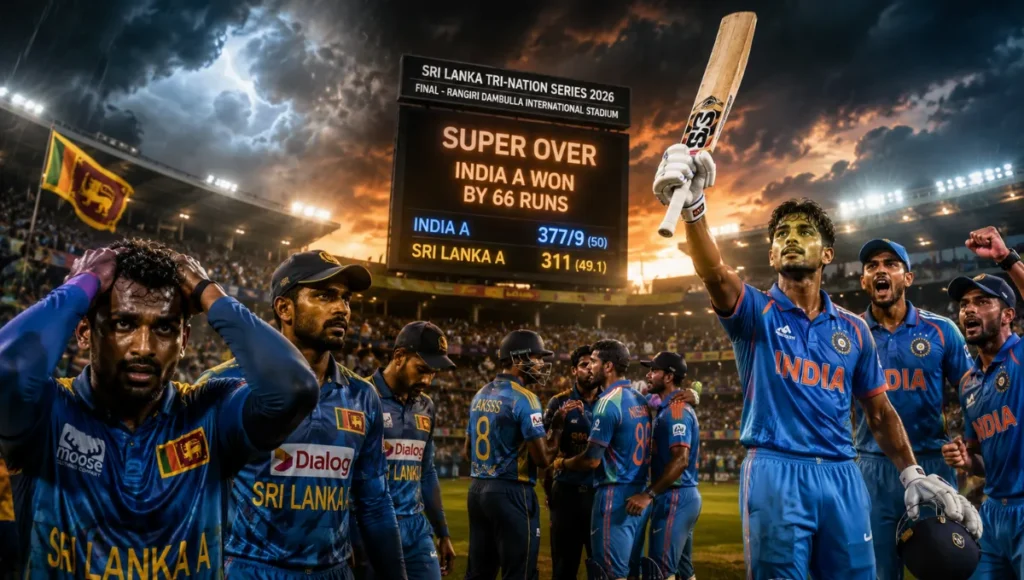

Sri Lanka A topped the group stage table, hosted every single match on home soil, and still walked into the final as underdogs against a rampant India A side.
But here’s the real problem: most coverage of the Tri-Nation Series 2026 gives you the schedule and the final scoreline, but never explains how the tournament’s best-placed team fell apart so completely on the biggest day.
The 2026 Sri Lanka Tri-Nation Series ran from June 9 to June 21, 2026, at the Rangiri Dambulla International Stadium, featuring India A, Sri Lanka A, and Afghanistan A in a double round-robin format followed by a final. India A won the series, beating hosts Sri Lanka A by a massive margin in the final despite finishing the group stage in second place.
What most people miss is that this series had two Super Over-style finishes, a DLS-affected washout, and a mid-tournament on-field altercation involving India A’s own teenage star genuinely rare chaos packed into just seven matches.
Series Summary at a Glance
| Detail | Information |
|---|---|
| Dates | June 9-21, 2026 |
| Venue | Rangiri Dambulla International Stadium, Dambulla (all matches) |
| Format | Double round-robin (List A), 7 matches total, followed by a final |
| Teams | India A, Sri Lanka A, Afghanistan A |
| Winner | India A |
| Captains | Tilak Varma (India A), Sahan Arachchige (Sri Lanka A), Imran Mir (Afghanistan A) |
| Player of the Series (by runs) | Avishka Fernando, Sri Lanka A (288 runs) |
This is where things go wrong for anyone assuming home advantage guarantees a title: Sri Lanka A played every match in their own conditions and still lost the one match that mattered most.
Points Table: How the Standings Unfolded
The group stage was a genuine three-way scrap, with each team playing the other twice before the top two advanced to the final.
| Position | Team | Played | Won | Lost | NRR | Points | Qualification |
|---|---|---|---|---|---|---|---|
| 1 | Sri Lanka A (Host) | 4 | 3 | 1 | +0.913 | 6 | Advanced to final |
| 2 | India A | 4 | 2 | 2 | +0.597 | 4 | Advanced to final |
| 3 | Afghanistan A | 4 | 1 | 3 | -1.727 | 2 | Eliminated |
Read Also:- United Arab Emirates National Cricket Team Vs Nepal National Cricket Team Match Scorecard
Common mistake fans make when reading a table like this: assuming the team with more points and a better net run rate is automatically the stronger side heading into a decider. Sri Lanka A’s group-stage numbers looked commanding, but a single bad day in a winner-takes-all final erased all of that statistical advantage in one afternoon.
Group Stage Highlights and Turning Points
The round-robin phase produced results dramatic enough to fill an entire tournament on their own.
- Match 1 (June 9): India A beat Sri Lanka A by 8 runs, with Ruturaj Gaikwad scoring a composed 101 off 114 balls to anchor India A’s 277/6
- Match 2 (June 11): Afghanistan A stunned India A, chasing down 349 with ease, reaching 177/2 in just 25.5 overs before rain intervened and the DLS method handed them the win
- Match 3 (June 13): Sri Lanka A beat Afghanistan A, with Avishka Fernando smashing an unbeaten 108 off 79 balls to chase down 245 in just 28.1 overs
- Match 4 (June 15): Sri Lanka A beat India A in a Super Over after both teams finished level at 265, with Sri Lanka A scoring 16/0 in the Super Over against India A’s 9/0
- Match 5 (June 17): India A crushed Afghanistan A by over 100 runs, posting 319/9 before bowling Afghanistan out for 218, with Nishant Sindhu picking up 4/31
- Match 6 (June 19): Sri Lanka A beat Afghanistan A again, with Avishka Fernando scoring his second century of the tournament (110 off 97 balls)
What people think vs reality: most fans assume a Super Over loss and a rain-affected DLS defeat in the group stage signal a team in crisis.
Reality: India A used those two defeats as course-correction, going on to dominate their remaining matches and then obliterate Sri Lanka A in the final proof that group-stage stumbles mean far less than how a team peaks when it matters.
The Final: India A vs Sri Lanka A
The final was played on June 21, 2026, with Sri Lanka A winning the toss and choosing to field first a decision that backfired catastrophically.
India A Batting Innings (377/9 in 50 overs)
India A posted the highest total of the entire tournament, built on a stunning innings from their most talked-about player.
| Batter | Runs | Balls | Notes |
|---|---|---|---|
| Vaibhav Sooryavanshi | 94 | 29 | Explosive innings, the standout knock of the final |
| Total | 377/9 | 50 overs |
Vaibhav Sooryavanshi’s 94 off just 29 balls was a strike rate above 324, effectively deciding the match before Sri Lanka A even batted. Wanuja Sahan was Sri Lanka A’s most economical bowler, taking 2 for 39 in his 10 overs, but nothing could stop India A’s onslaught.
Sri Lanka A’s Chase (311 all out in 47.1 overs, lost by 66 runs)
Chasing 378, Sri Lanka A never looked capable of pulling off a genuine miracle.
| Batter | Runs | Balls | Notes |
|---|---|---|---|
| Wanuja Sahan | 62 | 69 | Top-scorer in a losing cause |
| Total | 311 (all out) | 47.1 overs |
Yash Thakur was the standout bowler for India A, finishing with figures of 3 for 45 in 7 overs, capping off a complete team performance in the decider.
Turning point of the final: Sooryavanshi’s 94 off 29 balls set a target so far beyond reach that Sri Lanka A’s chase was essentially a formality from the first over onward this wasn’t a match Sri Lanka A lost through poor batting; it was a match India A won before the second innings even began.
Player Performance Breakdown
| Player | Team | Series Stat | Impact |
|---|---|---|---|
| Avishka Fernando | Sri Lanka A | 288 runs, series’ leading scorer | Powered Sri Lanka A’s group-stage dominance with two centuries |
| Tilak Varma | India A | 275 runs, captain | Led India A to the title despite early group-stage stumbles |
| Vaibhav Sooryavanshi | India A | 94 off 29 in the final | Single-handedly decided the title match |
| Kugathas Mathulan | Sri Lanka A | 8 wickets, team’s leading wicket-taker | Anchored Sri Lanka A’s bowling through the group stage |
| Anukul Roy / Vipraj Nigam | India A | 7 wickets each | Shared the bowling workload across India A’s campaign |
| Farmanullah | Afghanistan A | 10 wickets, tournament’s leading wicket-taker | Best individual bowling return despite Afghanistan A’s early exit |
Read Also:- Pakistan National Cricket Team vs India National Cricket Team Standings 2026
Vaibhav Sooryavanshi’s series arc deserves more attention than a single stat line gives it he struggled through parts of the group stage (including a much-publicized on-field altercation with Sri Lanka A players), only to produce the tournament’s single most destructive innings when the title was on the line. That’s a genuinely bold, high-pressure turnaround that most coverage completely glosses over.
What People Think vs What Actually Happened
Most fans assume that a team topping the group stage table with the best net run rate is the stronger side heading into a final.
Reality: Sri Lanka A finished top with 6 points and a net run rate of +0.913, clearly ahead of India A’s +0.597, yet lost the final by 66 runs after being blown away by a single innings. The common mistake fans make is treating cumulative group-stage numbers as a reliable predictor of a one-off knockout match this final proved that peaking at the right moment matters more than consistent group-stage form.
Key Takeaways for Fans
- Vaibhav Sooryavanshi’s final innings (94 off 29) is the single biggest reason India A won the title, and it came right after a rocky group-stage stretch that included an on-field altercation
- Sri Lanka A’s group-stage dominance, built on Avishka Fernando’s twin centuries, didn’t translate into final-day performance a lesson in not overvaluing points-table position
- Afghanistan A’s Farmanullah finished as the tournament’s leading wicket-taker despite his team’s early elimination, a reminder that individual brilliance doesn’t always translate into team success
- India A’s bowling depth (Anukul Roy, Vipraj Nigam, and Yash Thakur all contributing significantly) proved more valuable in the final than any single Sri Lankan batting effort could counter
- The series’ two rain/Super Over-affected results (Match 2 and Match 4) show how much unpredictability a compressed round-robin schedule can produce in limited-overs cricket
Frequently Asked Questions
Q1. Who won the Tri-Nation Series 2026?
Q2. Where was the Tri-Nation Series 2026 held?
Q3. Who was the leading run-scorer in the Tri-Nation Series 2026?
Q4. Who scored the most runs in the final of the Tri-Nation Series 2026?
Q5. Which teams played in the Tri-Nation Series 2026?
Who won the Tri-Nation Series 2026?
India A won the series, defeating hosts Sri Lanka A by 66 runs in the final on June 21, 2026.wikipedia
Where was the Tri-Nation Series 2026 held?
All matches were played at the Rangiri Dambulla International Stadium in Dambulla, Sri Lanka, from June 9 to 21, 2026.wikipedia
Who was the leading run-scorer in the Tri-Nation Series 2026?
Avishka Fernando of Sri Lanka A finished as the tournament’s leading run-scorer with 288 runs.wikipedia+1
Who scored the most runs in the final of the Tri-Nation Series 2026?
Vaibhav Sooryavanshi scored 94 off 29 balls for India A, the decisive innings of the final.wikipedia
Which teams played in the Tri-Nation Series 2026?
India A, Sri Lanka A, and Afghanistan A competed in the tournament.wikipedia
Did Sri Lanka A top the points table in the Tri-Nation Series 2026?
Yes, Sri Lanka A finished first in the group stage with 6 points and a net run rate of +0.913, but lost the final to India A.wikipedia
Who was the leading wicket-taker in the Tri-Nation Series 2026?
Farmanullah of Afghanistan A finished as the tournament’s leading wicket-taker with 10 wickets.