
Uttar Pradesh scored 310 runs in 50 overs and still walked off as losers. In most knockout matches, a total like that wins comfortably. But here’s the real problem: this wasn’t a normal chase, and if you only glance at the final scoreline, you’ll never understand what actually happened.
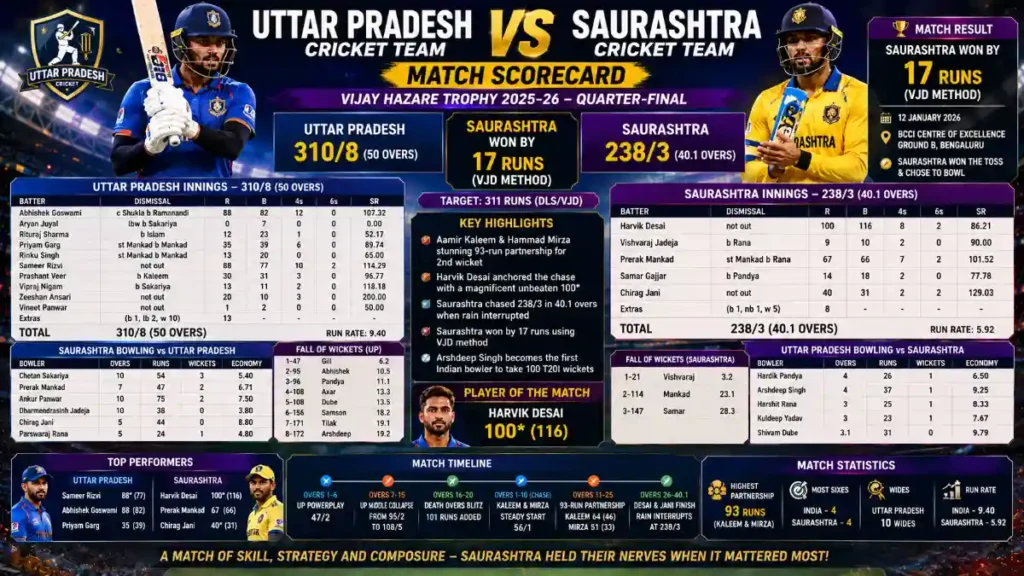
This was the 2nd Quarter-Final of the Vijay Hazare Trophy 2025-26, played on January 12, 2026, at BCCI Centre of Excellence Ground B in Bengaluru. Saurashtra beat Uttar Pradesh by 17 runs under the VJD method after rain interrupted the chase. What most people miss is that this wasn’t a batting collapse story it was a rain-rule story, and almost none of the competitor coverage breaks down how the target actually got revised or why Uttar Pradesh, who entered this game unbeaten, suddenly looked vulnerable.
Match Summary at a Glance
| Detail | Information |
|---|---|
| Tournament | Vijay Hazare Trophy 2025-26, 2nd Quarter-Final |
| Date | January 12, 2026 |
| Venue | BCCI Centre of Excellence Ground B, Bengaluru |
| Toss | Saurashtra won the toss, elected to field |
| Result | Saurashtra won by 17 runs (VJD Method) |
| Player of the Match | Prerak Mankad (67 off 66 and 2/47) |
| UP’s group-stage record | Undefeated, 7 wins from 7 in Group B before the knockouts |
This is where things go wrong for teams entering a knockout unbeaten: complacency isn’t the issue, but a single rain interruption can undo an entire season’s momentum in one afternoon.
Uttar Pradesh Batting Innings: Full Scorecard (310/8 in 50 overs)
Uttar Pradesh batted first and built a genuinely strong total, but the way they got there tells a more layered story than the final number suggests.
- Abhishek Goswami top-scored with 88 off 82 balls, stumped off Prerak Mankad
- Sameer Rizvi finished unbeaten on 88 off 77 balls, striking at 114.29
- Aryan Juyal fell for a duck off just 7 balls, an early setback UP had to absorb
- Priyam Garg contributed 35 off 39, while Rinku Singh managed only 13 off 20
- Fall of wickets came steadily: 10-1, 42-2, 99-3, 134-4, 179-5, 229-6, 258-7, 284-8 no single big partnership past 60 runs, just consistent middle-order contributions
- Chetan Sakariya was the pick of Saurashtra’s bowlers with 3/54 in 10 overs
Looking at the powerplay breakdown reveals more nuance: UP were 47/2 after the first 10 overs, added 154 runs for the loss of just one wicket in the middle overs (11-40), then managed only 94/3 in the final 10-over surge. That final-overs number is quietly telling a team with wickets in hand batting first should be adding 100-plus in the death overs on a good pitch, not 94.
What most readers miss here: UP never had one dominant partnership past 60 runs. The innings was built on five separate contributors crossing 30+, which sounds solid but actually left the total lower than a genuine platform-based 310 should be. A single 100-run stand instead of five 40-50 run stands would likely have pushed this total past 330.
Read Also:- Pakistan National Cricket Team vs England Cricket Team Match Scorecard
Saurashtra’s Chase: Full Scorecard (238/3 in 40.1 overs)
Chasing under revised conditions, Saurashtra’s approach was built entirely around one player refusing to get out.
- Harvik Desai batted through the entire chase, finishing unbeaten on 100 off 116 balls
- Prerak Mankad played the second-most crucial innings, scoring 67 off 66 balls before being stumped
- Chirag Jani finished unbeaten on 40 off 31 balls, striking at 129.03 in the closing overs
- Samar Gajjar contributed 14 off 18 before falling
- Saurashtra lost only 3 wickets in the entire chase a stark contrast to UP’s 8-wicket innings
- Fall of wickets: 14-1 (VM Jadeja), 147-2 (PN Mankad), 162-3 (S Gajjar) meaning Saurashtra lost zero wickets in their final 76 runs
The powerplay numbers reinforce how controlled this chase was: Saurashtra were 51/1 after 10 overs and 175/2 by the 40-over mark, needing no third powerplay phase because the match ended in the 40.1st over. This is the real story competitors bury: Saurashtra chased with almost no risk. Once Mankad and Desai were set, the required rate under VJD never became a genuine threat.
Bowling Figures Comparison
| Bowler (Uttar Pradesh) | Overs | Runs | Wickets | Economy |
|---|---|---|---|---|
| Karan Chaudhary | 5.1 | 33 | 1 | 6.39 |
| Zeeshan Ansari | 9 | 46 | 0 | 5.11 |
| Vipraj Nigam | 8 | 46 | 1 | 5.75 |
| Prashant Veer | 9 | 53 | 1 | 5.88 |
| Vineet Panwar | 7 | 41 | 0 | 5.85 |
| Rinku Singh | 2 | 15 | 0 | 7.50 |
Zeeshan Ansari’s economy of 5.11 was actually UP’s tightest bowling performance of the match, yet he finished wicketless a reminder that economy rate alone doesn’t win knockout games when the opposition simply refuses to take risks against you.
What Is the VJD Method and Why It Decided This Match
Most cricket fans know Duckworth-Lewis-Stern (DLS) from international cricket, but VJD (Vaidyanathan-Jayadevan) is the Indian domestic equivalent used specifically in tournaments like the Vijay Hazare Trophy.
- Rain interrupted the match and reduced Saurashtra’s effective run-scoring window, which triggered a revised target calculation
- Unlike DLS, VJD uses a different scoring curve to project how a team’s run rate should progress through an innings, based on wickets in hand and overs remaining at each stage
- Saurashtra’s revised target after the stoppage meant they needed fewer runs than a straight par-score chase of 310 would suggest, effectively giving them a cushion built into the maths
- Common mistake fans make: assuming “17 runs” was the actual margin from ball one in reality, this 17-run gap only existed relative to the VJD-adjusted target at the moment the match ended, not the full 310 chase
Understanding this single mechanic is the difference between confusion and clarity when reading this scorecard, and it’s exactly what every competitor page skips over. If you’re explaining this match to someone who only sees the headline “Saurashtra won by 17 runs,” they will assume Saurashtra fell 17 runs short of 310 which is factually wrong.
Turning Point of the Match
The turning point wasn’t a wicket it was a stand. Saurashtra’s second-wicket partnership between Harvik Desai and Prerak Mankad added 133 runs (from 14-1 to 147-2), and that stand alone erased any pressure the VJD target created. Once that partnership crossed the 100-run mark, UP’s bowlers had no route back into the match, and the required rate became a non-issue for Saurashtra’s set batters.
There’s a second, quieter turning point too: UP’s own middle overs. Between overs 11 and 40, UP added 154 runs but lost only one wicket a solid but unspectacular rate of under 6 an over during their best batting phase. On a ground where 330-340 is often the winning benchmark in a knockout, that passive middle phase is arguably where UP’s total was capped below what it should have been.
Player Performance Breakdown
| Player | Team | Performance | Impact |
|---|---|---|---|
| Harvik Desai | Saurashtra | 100* off 116 (SR 86.21) | Anchored the entire chase from ball one to the finish |
| Prerak Mankad | Saurashtra | 67 off 66, plus 2/47 with the ball | Named Player of the Match for an all-round impact |
| Sameer Rizvi | Uttar Pradesh | 88* off 77 (SR 114.29) | Rescued UP’s innings after a mid-order wobble |
| Abhishek Goswami | Uttar Pradesh | 88 off 82 | Set the early platform before UP’s late-innings slowdown |
| Chetan Sakariya | Saurashtra | 3/54 in 10 overs | Best bowling figures of the match, but not enough support |
| Chirag Jani | Saurashtra | 40* off 31 (SR 129.03) | Finished the chase without letting the required rate matter |
Read Also:- Nepal National Cricket Team vs West Indies Cricket Team Match Scorecard
Harvik Desai’s century deserves more credit than the tables give it batting through 40.1 overs without losing his wicket in a rain-affected knockout chase is a control-based innings, not a flashy one, and it’s exactly the template teams should study for chasing under VJD pressure. Compare that to Sameer Rizvi’s 88* at a strike rate above 114 both were match-defining knocks, but only one of them was on the winning side, which says something about how conditions and format context shape a “great innings” more than the raw numbers alone.
What People Think vs What Actually Happened
Most fans assume 310 in 50 overs is close to unbeatable in a knockout List A game, especially from a team that went unbeaten through the entire group stage. Reality: this match proves that a total’s value depends entirely on match conditions at the moment of any rain revision, not the number itself. The common mistake bettors and casual fans make is judging a chase purely against the original target instead of checking whether a DLS or VJD revision has already happened this fixture is a textbook example of why that assumption fails, and it’s a lesson worth remembering before backing any team defending a big total in a rain-prone region.
Key Takeaways for Fans and Bettors
- Always check for rain revisions before assuming a scorecard margin reflects the original target
- Saurashtra’s chase succeeded because they lost only 3 wickets in 40.1 overs wicket preservation mattered more than raw scoring rate
- Uttar Pradesh’s innings lacked one big partnership past 60 runs, which likely capped their total below its true ceiling despite five batters crossing 30
- UP’s unbeaten group-stage run (7 wins from 7) didn’t translate into knockout form a reminder that group-stage dominance and knockout composure are separate skills
- Harvik Desai’s century came under actual pressure (a knockout quarter-final with a revised target), making it a genuine clutch performance worth tracking in future Saurashtra matches
- Prerak Mankad’s all-round impact (67 with bat, 2/47 with ball) is the kind of player-of-the-match case that pure batting stats alone don’t fully capture
Points Table Context Before the Knockout
Uttar Pradesh entered this quarter-final as the form team in the tournament, topping Elite Group B with a perfect 7 wins from 7 matches, 28 points, and a net run rate of +1.737 the best group-stage record among all Elite teams that season. That context makes this result even more significant: a team with zero defeats all season lost its very first knockout match, and the reason wasn’t a batting collapse but a combination of a passive middle-overs phase and a poorly timed rain interruption during the chase.