
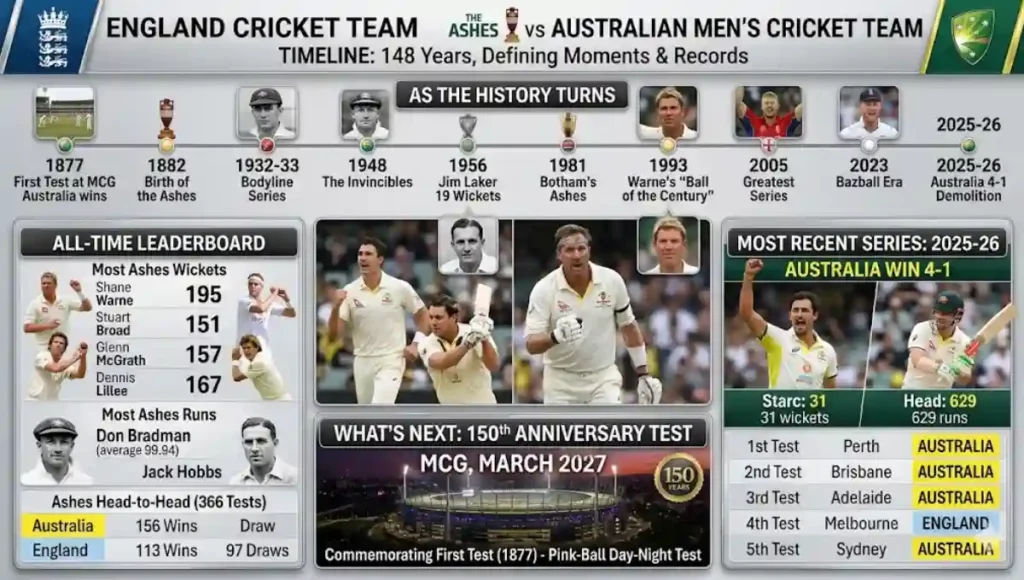

This is not just cricket history. This is 148 years of dominance, collapse, revenge, and reinvention the most fiercely contested rivalry the sport has ever produced. The england cricket team vs australian men’s cricket team timeline is not a list of results. It is a story of national identity, tactical evolution, and moments that changed the game permanently.
Two nations. One urn. No other rivalry in world cricket comes close.
Quick Facts Table
| Fact | Details |
| First Test | March 15, 1877, MCG Australia won by 45 runs |
| Total Tests played | 366 across 148 years |
| All-time leader | Australia 156 wins vs England’s 113 |
| Most Ashes wickets ever | Shane Warne 195 wickets in 36 matches |
| Most recent series | Australia won 4-1 in 2025-26 |
| Next milestone | 150th anniversary pink-ball Test, MCG, March 2027 |
Quick Answer: The england cricket team vs australian men’s cricket team timeline spans from the first-ever Test match in March 1877 which Australia won by 45 runs at the MCG through 148 years and 366 Tests. Australia lead the all-time head-to-head with 156 wins. Key chapters include the 1882 birth of the Ashes, the 1932-33 Bodyline controversy, England’s iconic 2005 comeback, and Australia’s 4-1 Ashes win in 2025-26.
England vs Australia Cricket Timeline at a Glance (1877–2026)
The complete England vs Australia Ashes history in one structured timeline designed for fast scanning and deep reading.
| Year | Event | Result / Impact |
| 1877 | First-ever Test match, MCG | Australia won by 45 runs |
| 1882 | The Oval Test Ashes concept born | Australia won by 7 runs |
| 1882–83 | First official Ashes series | England won 2-1 |
| 1903–04 | England restore control | England won 3-2 |
| 1920–21 | Post-war Australia whitewash | Australia won 5-0 |
| 1930 | Bradman’s 974-run Ashes | Australia dominated average 139.14 |
| 1932–33 | Bodyline series | England won 4-1 diplomatic crisis erupted |
| 1948 | The Invincibles tour | Australia won 4-0 unbeaten |
| 1953 | England’s first win in 19 years | England won 1-0 |
| 1956 | Jim Laker 19 wickets in one Test | England won 2-1 |
| 1977 | MCG Centenary Test | Australia won by exactly 45 runs same as 1877 |
| 1981 | Botham’s Ashes | England won 3-1 |
| 1989 | Australia begin era of dominance | Australia won 4-0 |
| 1993 | Warne’s “Ball of the Century” | Set tone for 14 years of Australian supremacy |
| 2005 | England reclaim the Ashes | England won 2-1 voted greatest Test series |
| 2010–11 | England’s last win in Australia | England won 3-1 |
| 2019 | Series in England | Drawn 2-2 Australia retained Ashes |
| 2021–22 | England demolished before Bazball | Australia won 4-0 |
| 2023 | Bazball’s Ashes debut | Drawn 2-2 England’s scoring rate 4.74 |
| 2025–26 | Australia’s 4-1 demolition | Series retained after 3rd Test |
How It All Began: 1877 The Test Match That Invented a Rivalry
The first Test match between England and Australia was played at the Melbourne Cricket Ground on March 15, 1877. Australia won by 45 runs. Charles Bannerman scored 165 retired hurt the first major innings in Test cricket history.
It was a Melbourne morning when Charles Bannerman walked to the crease and faced the first delivery in Test match history. He scored 165 retired hurt and Australia won by 45 runs. A rivalry that would last 148 years had its opening chapter written by a team England considered a warm-up act.
The england cricket team vs australian men’s cricket team timeline begins not with equal opponents but with an underdog who refused the role. That psychological dynamic has defined this contest ever since.
Why Australia Won Before England Understood the Threat
England arrived as the nation that invented cricket the established power, the gold standard. Australia were colonials, playing in conditions England barely understood. The first lesson of this rivalry was delivered immediately: conditions and belief matter more than reputation.
- England underestimated Australian pitches harder, faster, and more demanding than anything at home
- England underestimated Australian hunger the will to prove themselves against the mother country
- That combination of surface and psychology has beaten England in Australia consistently across generations
1882: The Birth of The Ashes A Satirical Obituary That Became Legend
The Ashes were born in 1882 when Australia beat England at The Oval by 7 runs. A British newspaper published a mock obituary of English cricket, saying the ashes would be taken to Australia. When England toured that winter, Melbourne ladies burned a bail and presented the ashes in a small urn and a legend was created.
In August 1882 at The Oval, Fred Spofforth “The Demon Bowler” took 7 wickets in the second innings as Australia stunned England on home soil by just 7 runs. The margin was almost impossibly tight. The shock was total.
The Sporting Times responded the next morning with a mock obituary: “English cricket has died, and the Ashes will be taken to Australia.” That winter, when England toured under Ivo Bligh, Melbourne ladies burned a bail and presented the ashes in a small urn. A cultural institution was created from a joke.
What the Ashes Urn Actually Represents
Reality Check: Most fans assume the winning team takes the urn home. They do not. The Ashes urn stays permanently at Lord’s Cricket Museum, regardless of which side wins. What transfers between nations is not a physical object it is the right to call yourself holders. The Ashes is a concept and a claim, which is precisely why losing it carries such weight.
This distinction matters in understanding the Ashes cricket history timeline. England can win a series but “regain” the Ashes. Australia can draw a series and “retain” them. It is unlike any other trophy in sport.
Era-by-Era Timeline: The Shifting Balance of Power
The full ENG vs AUS Test timeline spans six distinct eras. Each one changed the rivalry permanently.
1880s–1900: England’s Early Control
England dominated the first two decades with W.G. Grace as their batting cornerstone. Consistent selection and deeper cricketing infrastructure gave them early advantages. But by 1897-98, Australia won 4-1 and in 1899 won their first full series on English soil.
The lesson every era reconfirms: the moment a team believes it has permanently mastered an opponent, the opposition is already building the generation that will end that belief.
1928–1938: Bradman, Bodyline, and a Diplomatic Crisis
No individual has ever dominated a bilateral cricket rivalry the way Donald Bradman dominated England. In the 1930 Ashes, Bradman scored 974 runs at an average of 139.14, including 334 at Headingley. England’s bowlers had no tactical answer.
So England’s captain Douglas Jardine invented one.
In 1932-33, Jardine deployed “Bodyline” fast, short-pitched deliveries directed at the batsman’s body, with a packed leg-side field a tactic engineered specifically to neutralize Bradman. Harold Larwood executed it with frightening precision. England won 4-1.
Key facts about the Bodyline series:
- Bradman’s average fell to 56.57, still elite, but shattered by his own standards
- Three Australian batsmen, Woodfull, Oldfield, and Ponsford, suffered serious injuries
- Australian cricket officials filed a formal diplomatic protest with the MCC
- Cricket’s laws on field placements and short-pitched bowling were subsequently amended
- Relations between the two cricket boards fractured for years
1948: The Invincibles Cricket’s Greatest Touring Side
After World War II, Bradman returned for one final tour of England with The Invincibles a side so dominant it went through the entire tour unbeaten, winning the Ashes 4-0.
In his final Test innings at The Oval, Bradman needed just four runs to finish his career with an average of exactly 100. He was bowled second ball for a duck ending with 99.94.
One duck. The difference between 99.94 and 100.00. Cricket has never produced a more cinematic statistic.
1953–1956: England’s Brief Revival
England broke Australia’s grip in 1953, winning the Ashes for the first time in 19 years with Denis Compton and Alec Bedser as the architects. They won again in Australia in 1954-55, powered by Frank Tyson’s express pace. Then in 1956, Jim Laker took 19 wickets in a single Test at Old Trafford a feat that has never been matched or approached in any Test since.currentaffairs.adda247+1
What People Think vs Reality: England appeared dominant in the 1950s. In reality, this was a four-year window between two long periods of Australian control made to look larger than it was by the sheer drama of Laker’s 19 wickets.
1974–1981: Pace Wars and Botham’s Miracle
The 1974-75 Ashes introduced England to Dennis Lillee and Jeff Thomson two fast bowlers of rare pace and hostility who reduced England’s top order to survival mode. Australia won 4-1. Lillee-Thomson redefined pace bowling across world cricket for the next decade.
In 1981, however, England produced one of sport’s greatest reversals. Forced to follow on at Headingley and given 500-1 odds by bookmakers, Ian Botham’s 149 not out and Bob Willis’s 8 for 43 overturned what seemed like an inevitable Australian victory. England won the series 3-1 in a series that carries Botham’s name permanently.
1989–2007: Warne, McGrath, and Australian Supremacy
From 1989 to 2007, Australia dominated the Ashes with a consistency that placed them among the greatest sides in Test cricket history.
Why Australia were untouchable in this period:
- Shane Warne and Glenn McGrath formed the most lethal bowling partnership in Ashes history Warne finished with 195 Ashes wickets in 36 matches
- Warne’s 1993 debut delivery to Mike Gatting the “Ball of the Century,” pitching outside leg and hitting off stump announced 14 years of Australian dominance
- Batting depth across all positions: Taylor, Slater, the Waugh twins, Ponting, and Gilchrist
- Australia won eight consecutive Ashes series from 1989 to 2002-03, including two 5-0 whitewashes
This was not Ashes dominance alone. This was Australia establishing themselves as the greatest Test team ever assembled. The England vs Australia cricket history of this era is essentially a decade-long tutorial in what sustained excellence looks like.
2005: The Greatest Ashes Series Ever Played
The 2005 Ashes, played in England, is widely regarded as the greatest Test series in cricket history. England beat Australia 2-1 to reclaim the Ashes for the first time in 18 years. The key moment was England winning the 2nd Test at Edgbaston by just 2 runs the narrowest margin in Ashes history.
In 2005, after 18 years of Ashes defeats, England reclaimed the urn in a five-Test series of extraordinary drama.
The turning points that defined the 2005 Ashes:
- Australia won the 1st Test at Lord’s by 239 runs England had every reason to mentally collapse
- England won the 2nd Test at Edgbaston by just 2 runs the narrowest margin in Ashes history.
- Andrew Flintoff’s all-round performances across the series were the standard against which future English performances would always be measured
- Kevin Pietersen’s 158 at The Oval in the final Test secured the draw England needed to win the series 2-1
The 2-run win at Edgbaston is the single most important result in the modern Ashes timeline. It proved Australia, even at full strength, could be beaten within a session. That belief installed by two runs on a Birmingham afternoon lasted England a generation.
2010–11: England’s Last Win in Australia
England toured Australia in 2010-11 and won 3-1 their first Ashes series victory in Australia in 24 years. Andrew Strauss captained Alastair Cook and Jonathan Trott batted with discipline across relentless Australian conditions.
This tour represents the peak of England’s most recent golden era before another long decline. The england cricket team vs australian men’s cricket team timeline has not seen an England victory in Australia since.
2013–2023: The Decline, Draws, and Bazball’s Arrival
England lost in Australia 5-0 in 2013-14, then 4-0 in 2017-18, then again 4-0 in 2021-22. Three tours. Three heavy defeats. The 2019 series in England ended 2-2, with Australia retaining the Ashes.mysterycricket+1
Then in 2022, Ben Stokes became Test captain and Brendon McCullum became head coach. The philosophy they introduced known universally as “Bazball” reset England’s entire identity.
What Bazball actually is:
- Ultra-aggressive batting with run rates well above 4.00 per over regardless of situation
- Minimal defensive intent playing to win in four days, not saving for five
- Fearless chase mentality England set a WTC record by chasing targets previously considered impossible
- Under Stokes-McCullum, England won 16 out of 21 home Tests
The 2023 Ashes in England ended 2-2. England’s scoring rate of 4.74 runs per over compared to Australia’s 3.35 was the largest differential ever recorded in a multi-Test series. Australia held the Ashes by not losing. But the contest was electric, and the Ashes rivalry had found a new gear.
2025–26 Ashes: Australia’s Clinical 4-1 Demolition
Australia won the 2025-26 Ashes series 4-1, retaining the urn after winning the first three Tests. Mitchell Starc was Player of the Series with 31 wickets. Travis Head scored 629 runs. England’s Bazball philosophy was exposed in Australian conditions.
In November 2025, England arrived in Australia with full Bazball confidence. What followed was a systematic tactical dismantling one of the most complete home Ashes wins in modern history.
Series Result by Test
| Test | Venue | Result | Margin |
| 1st Test | Perth | Australia won | By 8 wickets |
| 2nd Test | Brisbane | Australia won | By 8 wickets |
| 3rd Test | Adelaide | Australia won | By 82 runs |
| 4th Test | Melbourne | England won | By 4 wickets |
| 5th Test | Sydney | Australia won | By 5 wickets |
Leading performers:
- Mitchell Starc Player of the Series, 31 wickets
- Travis Head 629 series runs, including 163 at Sydney
- Steve Smith 138 at Sydney
- Joe Root for England 160 at Sydney, a lone resistance innings in a losing cause
Why Bazball Failed in Australian Conditions
Reality Check: England did not lose the 2025-26 Ashes because Bazball is a bad philosophy. They lost because Australia forced them to play a game that Bazball cannot survive one built on sustained pace bowling, true bounce, and ten-over spells that accumulate pressure rather than break it.
In English conditions, swing, seam, and variable bounce generate wickets naturally. Aggressive batting can be justified because the pitch does half the bowling attack’s job. In Australia, pitches are hard and true. Bowlers must earn wickets across long spells of sustained pressure. England’s willingness to play expansive shots early invited dismissals rather than pressure. Their batting approach reduced Australia’s required work significantly.
Bazball had never been tested in conditions that removed its structural advantages. Australia identified that gap and exploited it from the first session of the first Test. The 4-1 result was clinical and arguably could have been 5-0.
All-Time Ashes Records You Should Know
No article on the england cricket team vs australian men’s cricket team timeline is complete without the records that define it.
Most Wickets in Ashes History
| Player | Country | Wickets | Matches |
| Shane Warne | Australia | 195 | 36 |
| Stuart Broad | England | 151 | 40 |
| Glenn McGrath | Australia | 157 | 30 |
| Dennis Lillee | Australia | 167 | 29 |
| Fred Trueman | England | 79 | 19 |
Most Runs in Ashes History
| Player | Country | Notable |
| Don Bradman | Australia | Average 89.78 across Ashes career 974 runs in 1930 alone |
| Jack Hobbs | England | 3,636 Ashes runs |
| David Gower | England | 3,269 Ashes runs |
| Steve Waugh | Australia | 3,200 Ashes runs |
Head-to-Head Record Across All Formats
| Format | Matches | Australia Wins | England Wins | Draws/Ties/NR |
| Tests | 366 | 156 (42.6%) | 113 | 97 draws |
| ODIs | 162 | 92 (56.8%) | 65 | 5 |
| T20Is | 26 | 12 (46.2%) | 12 | 2 |
T20Is are the only format where these two sides are level. In the 2024 Australia tour of England, England won the T20I series while Australia took the ODI series 2-1. In Test cricket where the Ashes rivalry lives Australia lead with a margin that only grows in Australian conditions.
Key Turning Points That Defined This Rivalry
These are the moments where the England-Australia cricket rivalry was permanently altered not just match results, but direction-changers:
- 1877 First Test outcome establishes Australia’s competitive DNA
- 1882 Ashes concept gives the rivalry permanent cultural meaning
- 1932-33 Bodyline proves cricket can be weaponized and legislated against
- 1948 The Invincibles set a touring standard that has never been matched
- 1981 Headingley proves no Ashes match is finished until the final wicket falls
- 2005 Edgbaston’s 2-run win breaks 18 years of Australian psychological dominance
- 2010-11 England’s last Australian tour win marks their modern peak
- 2022 Bazball fundamentally resets England’s Test identity
- 2025-26 Australia’s 4-1 win reveals the limits of Bazball’s portability
Why England Rarely Win in Australia
The Ashes Down Under data is stark. England have won an Ashes series in Australia just five times since 1932-33: 1954-55, 1970-71, 1978-79, 1986-87, and 2010-11. Five wins in more than 90 years on Australian soil.
Three Structural Reasons
1. Pace and bounce in Australian conditions
Australian pitches are harder, faster, and bouncier than English pitches. England’s top-order batters, strong against swing and seam, consistently struggle with deliveries targeting the gloves and ribs over sustained spells. England were dismissed for 172 and 164 in the first Perth Test of 2025-26 not because they played poorly, but because Australian pitches at pace expose technical frailties that English conditions mask.
2. Home crowd psychology
First-morning sessions at the WACA, Gabba, and Adelaide Oval are as psychologically intimidating as they are physically demanding. Australia’s crowd creates pressure before a ball is bowled. England have historically lost the first hour of first-day play in Australia across multiple generations and in Test cricket, momentum lost on morning one is rarely recovered.
3. Selection philosophy
England have historically taken under-powered pace attacks to Australia. The tours where they succeeded share one pattern: express pace that Australia had no answer for Larwood in 1932-33, Tyson in 1954-55, Willis in 1981. Without genuine pace, England are bowling with one hand tied behind their back in Australian conditions.
What’s Next 2026-27 Series and the 150th Anniversary Test in 2027
England tour Australia in November 2026 for white-ball matches, then return in March 2027 for a one-off day-night pink-ball Test at the MCG the 150th anniversary of the first-ever Test match. The full 2027 Ashes series follows in England. The next Australian Ashes is planned for 2029-30.
The england cricket team vs australian men’s cricket team timeline does not pause after a 4-1 defeat. The schedule ahead is already historic.
The 2027 MCG Anniversary Test
England will tour Australia in November 2026 for three ODIs and five T20Is. They will return in March 2027 for a landmark one-off day-night pink-ball Test at the MCG a commemoration of the 150th anniversary of the first Test ever played between the two nations.
Why the 2027 anniversary Test matters:
- Scheduled for March 11-15, 2027
- Will be the first-ever day-night men’s Test played at the MCG
- The 2027 Ashes series in England follows immediately, restoring the full five-match contest
Read More About – Pakistan National Cricket Team Vs Bangladesh National Cricket Team Timeline Every Turning Point From 1999 to 2026
The 45-Run Coincidence That Baffles Statisticians
In 1877, Australia won the first Test by 45 runs. In the 1977 Centenary Test at the same MCG ground, Australia won again by exactly 45 runs, in a coincidence no mathematician has been able to adequately explain. England will be desperate to end that pattern in 2027.icc-cricket+1Cricket Australia has also confirmed that the 2029-30 Ashes in Australia will include a pink-ball day-night Test as part of the series structure a sign that the rivalry continues to evolve its format even as the underlying contest remains unchanging.