

Ben Stokes walked off an English cricket field for the final time as a Test player, having just lost a home series to New Zealand.
But here’s the real problem: most coverage of the New Zealand national cricket team vs England cricket team timeline in 2026 treats their T20 World Cup meeting and their Test series as two completely unrelated events, when they’re actually the same story New Zealand beating England twice in the same calendar year, in two different formats, on two different continents.
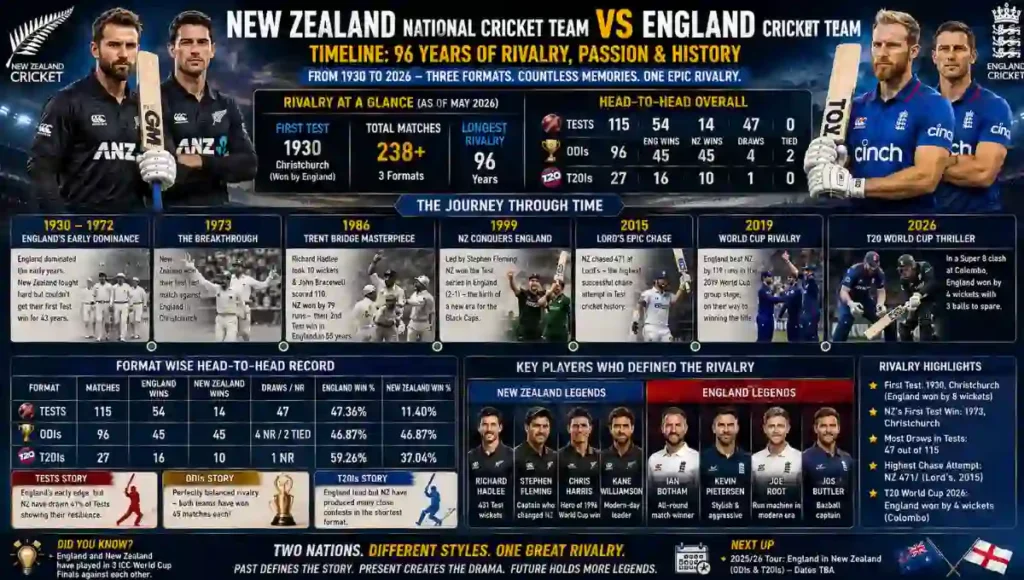
New Zealand and England met twice during 2026 first in the Super Eight stage of the ICC Men’s T20 World Cup on February 27, where England won by 4 wickets, and again during New Zealand’s Test tour of England from June 4 to June 29, where New Zealand won the three-match series 2-1.
What most people miss is that New Zealand’s away Test series win, sealed by margins of 253 runs and 160 runs, ranks among the most emphatic visiting performances in the rivalry’s history, and it directly coincided with the end of Ben Stokes’s Test career.
2026 Meetings at a Glance
| Detail | T20 World Cup (February 27) | Test Series (June 4-29) |
|---|---|---|
| Format | T20I, Super Eights | 3-match Test series |
| Venue | R.Premadasa Stadium, Colombo | Lord’s, The Oval, Trent Bridge |
| Result | England won by 4 wickets | New Zealand won 2-1 |
| Context | Group-stage qualification match | Ben Stokes’s final Test series |
Two very different meetings, but both point to the same underlying story: New Zealand’s growing ability to trouble England across formats, even while losing the format where they had less depth.
Round One: T20 World Cup Super Eights
The first 2026 meeting came during the T20 World Cup, in a tense Super Eight contest that went right down to the final over.
New Zealand Batting Innings (159/7 in 20 overs)
New Zealand posted a competitive total at a neutral venue in Colombo, but it proved just short of a defendable score.
England’s Chase (161/6 in 19.3 overs, won by 4 wickets)
England chased down the target with three balls to spare, needing just 5 runs from the final 6 balls before completing the win. This narrow finish was an early sign that England could still find ways to win tight contests against New Zealand, even in a format where New Zealand’s white-ball depth had grown significantly.
Common mistake fans make when reading this result in isolation: assuming this narrow England win predicted anything about their head-to-head form for the rest of the year.
Reality: this T20 result and the subsequent Test series were decided by completely different skill sets, and New Zealand’s response in the Tests showed this early defeat meant nothing for the bigger picture.
The Test Series: Full Breakdown (June 4-29, 2026)
New Zealand’s tour of England featured three Tests at three iconic venues, and the series swung dramatically after the opening match.
1st Test: Lord’s (June 4-8) England Won by 115 Runs
New Zealand chose to bowl first after winning the toss, but the match unfolded into a low-scoring, England-dominated contest.
| Team | 1st Innings | 2nd Innings |
|---|---|---|
| England | 140 all out (39.4 overs) | 226 all out (56.0 overs) |
| New Zealand | 113 all out (29.5 overs) | 138 all out (40.3 overs) |
Read Also:- T20 World Cup Standings: Full Points Table, Qualification Race
Despite a low-scoring match on both sides, England’s bowling attack proved just sharp enough to force New Zealand’s batting order into repeated collapses, winning by 115 runs to take a 1-0 series lead.
2nd Test: The Oval (June 17-21) — New Zealand Won by 253 Runs
New Zealand responded with one of the most emphatic away Test performances of the year, completely reversing the momentum from the opener.
New Zealand’s batting depth finally clicked at The Oval, setting up a total imposing enough that England’s chase never had a realistic path back into the match. Winning by 253 runs leveled the series at 1-1 heading into the decider.
3rd Test: Trent Bridge (June 25-29) — New Zealand Won by 160 Runs
The series decider produced a genuine batting showcase from New Zealand’s top order, backed by disciplined bowling in the second innings.
| Team | 1st Innings | 2nd Innings |
|---|---|---|
| New Zealand | 438 (Devon Conway 157, Tom Latham 151) | 288/9 declared (Daryl Mitchell 100*, Rachin Ravindra 94) |
| England | 354 (Ben Duckett 113, Jacob Bethell 74, Harry Brook 58) | 212 (Jamie Smith 60) |
Conway and Latham’s twin centuries in the first innings gave New Zealand a platform too big for England to overcome, and despite Ben Stokes and Jamie Smith fighting hard across both innings, New Zealand completed a 160-run win to seal the series 2-1.
Turning Point of the Series
The turning point wasn’t a single ball it was New Zealand’s batting response at The Oval after the Lord’s defeat. Losing the opener by 115 runs could easily have snowballed into a series whitewash the way it often does in modern Test cricket, but New Zealand’s 253-run win at The Oval flipped the entire momentum and psychological edge of the series.
This is where things go wrong for a home side that starts strong: England never recovered the control they had in the first Test, conceding twin centuries in the decider that effectively ended the contest by the end of the first innings.
Player Performance Breakdown
| Player | Team | Series Contribution | Impact |
|---|---|---|---|
| Devon Conway | New Zealand | 157 in the 3rd Test | Set up New Zealand’s series-sealing total |
| Tom Latham | New Zealand | 151 in the 3rd Test | Partnered Conway in a series-defining stand |
| Daryl Mitchell | New Zealand | 100* in the 3rd Test | Extended New Zealand’s lead in the second innings |
| Rachin Ravindra | New Zealand | 94 in the 3rd Test | Key middle-order contribution in the decider |
| Ben Duckett | England | 113 in the 3rd Test | England’s lone real fight in a losing cause |
| Ben Stokes | England | 4 wickets in the 1st Test | Captained his final Test series before retirement |
Read Also:- India Vs West Indies T20 2026: Full Scorecard, Highlights & Turning Points
Devon Conway and Tom Latham’s twin centuries in the same innings at Trent Bridge deserve more attention than a single stat line gives them New Zealand’s top order producing back-to-back hundreds in the series decider, on English soil, against an England attack that had won the opener comfortably, is exactly the kind of statement performance that should define how this entire tour is remembered.
The End of an Era: What This Series Meant
This series carries weight beyond the scoreline. Ben Stokes’s Test career effectively ended with this home series defeat, closing out an era that had defined English cricket’s aggressive “Bazball” identity for several years. In a genuinely striking piece of timing, former New Zealand captain Stephen Fleming was appointed England’s new Test coach shortly after this series concluded, with Joe Root taking over the England captaincy.
This is a genuinely bold observation worth stating plainly: appointing a former New Zealand captain to fix England’s Test setup, right after New Zealand just handed England a home series defeat, is either a deeply ironic coincidence or a very deliberate signal that England’s cricket board wanted exactly the kind of tactical clarity New Zealand had just demonstrated on the field.
What People Think vs What Actually Happened
Most fans watching the Lord’s Test assumed England’s 115-run win signaled a comfortable home series ahead, especially with home advantage and the “Bazball” approach that had defined recent English Test cricket.
Reality: New Zealand responded with two of their most dominant away Test performances in years, winning by 253 runs and then 160 runs to close out the series. The common mistake fans make after a strong series opener is assuming momentum will simply continue this series is proof that Test cricket rewards adjustments between matches far more than early form.
Key Takeaways for Fans
- New Zealand’s response after losing the opening Test (two wins by 253 and 160 runs) is one of the most complete away-series turnarounds in recent Test cricket history
- Devon Conway and Tom Latham’s twin centuries at Trent Bridge should be remembered as the individual highlight of this entire 2026 rivalry
- Ben Stokes’s Test retirement coinciding with this specific series defeat marks a genuine turning point for English cricket’s leadership and tactical identity
- Stephen Fleming’s appointment as England’s Test coach immediately after this series is a decision worth watching closely for how it reshapes England’s approach against New Zealand-style disciplined batting depth
- England’s T20 World Cup win over New Zealand in February meant nothing for the Test series months later — always judge cross-format meetings separately, since skill sets and squad compositions differ significantly