
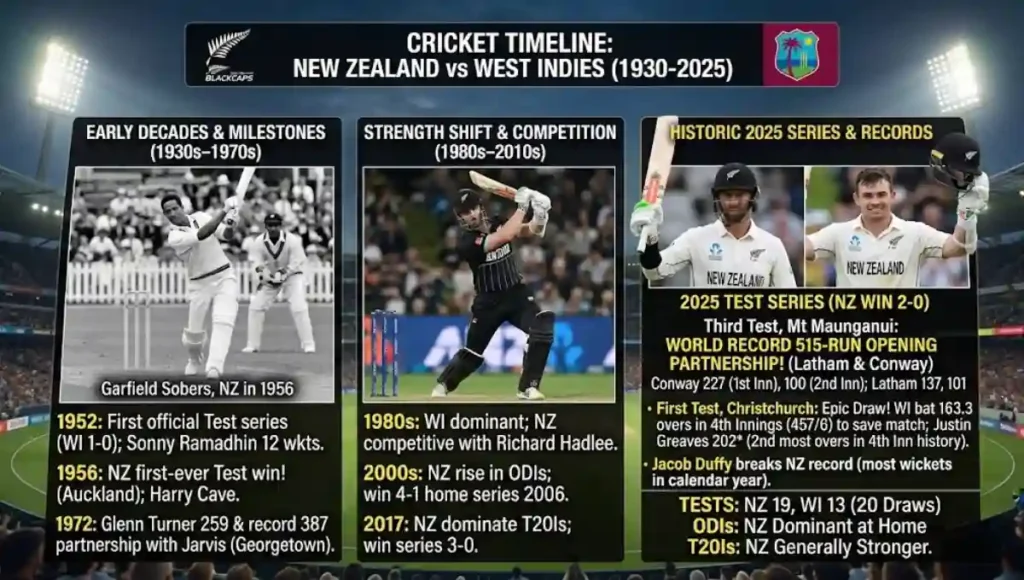

The New Zealand National Cricket Team Vs West Indies Cricket Team Timeline rivalry spans from 1930 tour matches to a record-breaking 2025 Test series. West Indies dominated the early decades. New Zealand became the stronger side from the 2000s onward. The rivalry has produced some of the most extraordinary individual performances and dramatic moments in Test cricket history including a 515-run opening partnership that broke every first-class record ever recorded.
NZ vs WI Timeline
Before we go deep, here is the complete New Zealand vs West Indies cricket timeline at a glance
| Year | Event |
| 1930 | West Indies make their first tour visit to New Zealand no Tests, only tour matches |
| 1952 | First official Test series West Indies win 1–0; Sonny Ramadhin takes 12 wickets |
| 1956 | New Zealand win their first-ever Test match against West Indies at Eden Park, Auckland |
| 1972 | Glenn Turner scores 259 off 759 balls at Georgetown 387-run opening stand with Jarvis |
| 1980 | New Zealand win by 1 wicket at Dunedin in one of the most tense Tests of the era |
| 1984–1995 | West Indies dominate; Richard Hadlee leads NZ’s competitive response |
| 2000s | New Zealand rise in ODIs; win 4 of 5 in 2006 home series |
| 2017 | NZ win T20I series 3–0; post 243/5 and bowl WI out for 124 |
| 2025 | Historic Test series Latham-Conway 515-run stand, Greaves’ 202 not out, Duffy breaks Hadlee’s wicket record |
How the Rivalry Began: The 1930 Tour and the 1952 First Test
The New Zealand vs West Indies cricket rivalry officially began when West Indies toured New Zealand for tour matches in November 1930. These were not Test matches West Indies were travelling to Australia and stopped in New Zealand along the way. New Zealand had only played their first Test in January 1930, just months earlier, against England.
The first official Test series between the sides came in February 1952 at Christchurch, when West Indies arrived as part of their 1951–52 Australasian tour. West Indies won the two-Test series 1–0, with the Christchurch Test ending in a 5-wicket victory.
What Made the 1952 Series Significant
Sonny Ramadhin took 12 wickets across the series. Frank Worrell contributed 233 runs a commanding performance that exposed New Zealand’s batting limitations at the time. New Zealand, captained by Bert Sutcliffe, had no effective counter to elite Caribbean spin.
What most people miss, though: New Zealand’s Tom Burtt took 8 wickets across the series, showing that the Black Caps already had the tools to test world-class batters. The talent was present. The winning mentality would come later.
New Zealand’s First-Ever Test Win A Moment That Changed Everything
New Zealand went 26 years without winning a single Test match 22 losses, 22 draws, zero victories. The drought ended not against a weak opponent, but against one of the most formidable West Indian lineups ever to tour New Zealand.
The 1955–56 series saw West Indies arrive with Garfield Sobers and Everton Weekes in full flow. New Zealand went 3–0 down. The fourth and final Test at Eden Park, Auckland was meant to be a formality.
The Eden Park Turning Point 1956
Instead, it became historic. Harry Cave tore through the West Indies second innings with four wickets. West Indies, needing 268 runs in two sessions, collapsed to 77 all out. New Zealand won by a margin that shocked even their own supporters.
This was more than a scoreline. It was a psychological reset for New Zealand cricket. From that match forward, the Black Caps knew they could compete at the highest level and beat anyone, on their day, regardless of reputation.
New Zealand’s first-ever Test win came against West Indies in February 1956 at Eden Park, Auckland. Harry Cave took four wickets, and West Indies were bowled out for 77 chasing 268. It ended New Zealand’s 26-year wait for a Test victory.
The 1970s: Glenn Turner Rewrites Cricket History Against West Indies
The 1972 New Zealand tour of the West Indies remains the most underrated overseas tour in Black Caps history. No series in the modern era has produced individual batting statistics that rival what Glenn Turner achieved in the Caribbean that summer.
Turner scored four double centuries on that single tour not spread across a career, but on one tour. 202 not out against the Presidents’ XI. 223 in the first Test. 259 against Guyana. And then 259 again in the fourth Test at Georgetown’s Bourda Ground.
The Georgetown Innings: 259 Off 759 Balls
In the fourth Test at Georgetown, Turner and opening partner Terry Jarvis put on 387 runs for the first wicket at the time, one of the most commanding opening stands in Test history. New Zealand replied to West Indies’ declaration of 365 for 7 by ending the innings on 543 for 3.
Turner’s 259 came off 759 deliveries the second-longest innings in Test cricket at the time in terms of balls faced. The series was drawn 0–0.
What people think: West Indies were dominant in this era, and New Zealand were simply making up numbers.
Reality: New Zealand matched West Indies across five Tests in the Caribbean, came home unbeaten, and produced one of the finest batting performances by any touring team in cricket history. The 1972 series established Turner as a genuine world-class opener not a limited-conditions specialist.
Then came 1980. West Indies toured New Zealand, and in the first Test at Dunedin, the Black Caps won by one wicket the tensest of margins, but a margin that proved New Zealand had moved beyond being a team that merely competed.
West Indies’ Dominant Era vs a Rising New Zealand (1980–2000)
West Indies in the 1980s were the best Test team in the world. Four fast bowlers, a batting order of match-winners, and a culture built on intensity and excellence. Clive Lloyd, then Viv Richards, ran a machine.
When West Indies visited or hosted New Zealand through this era, the Black Caps faced conditions designed to dismantle them. Marshall, Holding, Garner, and Walsh gave nothing away.
Richard Hadlee: New Zealand’s Answer
But New Zealand had Richard Hadlee. He was, across the 1980s, arguably the most complete fast bowler in the game. His ability to swing the ball at pace, pick up wickets in clusters, and anchor the lower order with the bat gave New Zealand a genuine trump card in every series.
The head-to-head record through this period remained tilted toward West Indies in Tests, but the series were competitive. New Zealand won Tests in both 1985 and 1986 against West Indies no small achievement when playing the dominant team of the era.
Era phase summary:
- 1952–1975: West Indies clearly dominant
- 1976–1995: Competitive but West Indies still win most series
- 1996–2010: Balance shifts; New Zealand increasingly competitive at home
- 2010–present: New Zealand the stronger outfit in Tests and ODIs
The Modern Era (2000–2020): New Zealand Take Control
The 2000s marked a decisive shift in this rivalry. West Indies cricket entered a structural decline weakening domestic circuits, fragmented player development, and the rise of T20 franchise leagues pulling talent away from international commitments.
New Zealand, by contrast, were building one of the most coherent cricket systems in the world. Consistent selection, strong work ethics, and tactical clarity under coaches like John Bracewell, Mike Hesson, and later Gary Stead turned the Black Caps into a team that punched consistently above its weight.
White-Ball Dominance
In ODI cricket, New Zealand won 4 of 5 matches in the 2006 home series against West Indies a comprehensive display of batting depth and bowling control. In T20Is, the gap widened further. The 2017 home T20I series saw New Zealand win all three matches, including a game where they posted 243 for 5 and dismissed West Indies for 124.
Key tactical observation: New Zealand built white-ball cricket around aggressive openers like Martin Guptill and Brendon McCullum, supported by accurate death bowlers. West Indies had explosive finishers but lacked the structural foundation to construct or defend total reliably across all formats.
In Test cricket, New Zealand reached the ICC World Test Championship Final in 2021 evidence of sustained excellence. The rivalry had shifted from even to clearly one-sided in New Zealand’s favour, outside of T20 cricket where West Indies’ natural power remained a constant threat.
The 2025 Series: The Most Historic in This Rivalry’s History
The 2025–26 West Indies tour of New Zealand was the single most statistically remarkable series in this century-old rivalry. It covered all three formats five T20Is, three ODIs, and three Tests from November to December 2025.
New Zealand won the T20I series 3–1 and took the Test series 2–0.
The Christchurch Test: One of the Greatest Draws in History
The first Test at Hagley Oval, Christchurch (December 2–6, 2025) will be remembered for one of the most extraordinary fourth-innings rearguards ever played. New Zealand set West Indies a target of 531. At 72 for 4, the game was all but over.
What followed defied every cricketing expectation.
- Shai Hope and Justin Greaves added 196 runs for the fifth wicket
- Greaves and Kemar Roach added 180 runs unbeaten the highest seventh-wicket stand in any fourth innings in Test history
- Greaves finished unbeaten on 202
- West Indies batted for 163.3 overs in the fourth innings the second-most overs by a side in a Test match’s final innings
- Combined last two innings in the Test: 923 runs fourth-highest in Test history
- West Indies finished 457 for 6 and saved the match
The counterintuitive truth: West Indies’ greatest achievement in this series was not a win. It was the refusal to lose. But that marathon effort consumed physical and mental reserves that left them unable to compete in the remaining two Tests.
The Wellington Test: Clinical New Zealand
New Zealand won the second Test at Basin Reserve, Wellington, by 9 wickets. West Indies made 205 in their first innings and 128 in their second unable to replicate the Christchurch resistance.
The Mount Maunganui Test: Where Records Shattered
The third Test at Bay Oval, Mount Maunganui (December 18–22, 2025) produced one of the most astonishing batting displays in all of Test cricket history.
Tom Latham and Devon Conway opened New Zealand’s first innings and did not separate until they had put on 515 runs the highest first-wicket partnership in the entire history of first-class cricket.
This broke the record held by Glenn Turner and Terry Jarvis (387 runs) also set against West Indies, also as a New Zealand opening partnership, in Georgetown in 1972. The same two nations were involved in both the old record and the new one, 53 years apart.
- Conway: 227 in the first innings, 100 in the second innings
- Latham: 137 in the first innings, 101 in the second innings
- New Zealand declared at 575 for 8
- New Zealand’s total match aggregate: 881 runs their highest in any Test match
- Jacob Duffy took 5 for 42 in the West Indies second innings, surpassing Sir Richard Hadlee’s record for most wickets in a calendar year by a New Zealand bowler
- New Zealand won by 323 runs, clinching the series 2–0
In the 2025–26 Test series, New Zealand defeated West Indies 2–0. The third Test at Mount Maunganui saw Tom Latham and Devon Conway put on 515 runs the highest first-wicket partnership in first-class cricket history. Jacob Duffy broke Richard Hadlee’s New Zealand wicket record in a calendar year.
Head-to-Head Records Across All Formats
New Zealand and West Indies have played 52 Test matches in the history of this rivalry, with New Zealand winning 19 and West Indies winning 13, with 20 draws.
| Format | NZ Wins | WI Wins | Notes |
| Tests | 19 | 13 (20 draws) | 52 Tests total; NZ stronger post-2000 |
| ODIs | NZ dominant at home | WI competitive at home | NZ won 4 of 5 in 2006 home series |
| T20Is | NZ generally stronger | WI won key T20 World Cup encounters | WI beat NZ at 2024 T20 World Cup |
Biggest Individual Moments in the Rivalry
- 1956 Harry Cave bowls WI out for 77; NZ first-ever Test win
- 1972 Glenn Turner scores 259 off 759 balls at Georgetown
- 1972 Turner and Jarvis put on 387-run opening stand
- 1980 NZ win by 1 wicket at Dunedin
- 2025 Justin Greaves bats 202 not out to save the Christchurch Test
- 2025 Latham and Conway break first-class world record with 515-run opening stand
- 2025 Jacob Duffy breaks Hadlee’s New Zealand wicket record in a calendar year
What This Rivalry Tells Us About Cricket’s Bigger Picture
Three observations that most cricket writing never makes:
First Structure beats talent over time. West Indies dominated this rivalry when they had the most gifted players in the world. New Zealand overtook them not by producing more talent, but by building a more resilient and structured system. The lesson is clear: depth beats genius in the long run.
Second Determination defines the biggest moments. The most memorable results in this rivalry were never comfortable wins. They were the 1-wicket drama at Dunedin in 1980, the epic Christchurch draw in 2025, and the 26-year wait ended in the final Test of the 1956 series. This is a rivalry that rewards grit above everything else.
Third The Glenn Turner era and the Latham-Conway era are mirrors of each other. Both involved New Zealand openers rewriting records against West Indies. Both came 53 years apart. Both happened when New Zealand needed to prove they belonged among the elite. History does not just rhyme in this rivalry it echoes precisely.
Read More About – Pakistan National Cricket Team vs Bangladesh National Cricket Team: Head-to-Head, Stats, and the 2026 Power Shift
What to Expect in Future NZ vs WI Matches
- New Zealand will remain the stronger Test and ODI side as long as their structural systems hold
- West Indies remain a serious T20 threat their power-hitting culture gives them an advantage in the shortest format
- The Caribbean domestic revival, if it arrives, could close the gap in Tests within a decade
Batting partnerships will define outcomes this rivalry has consistently been won by the side that builds long opening stands