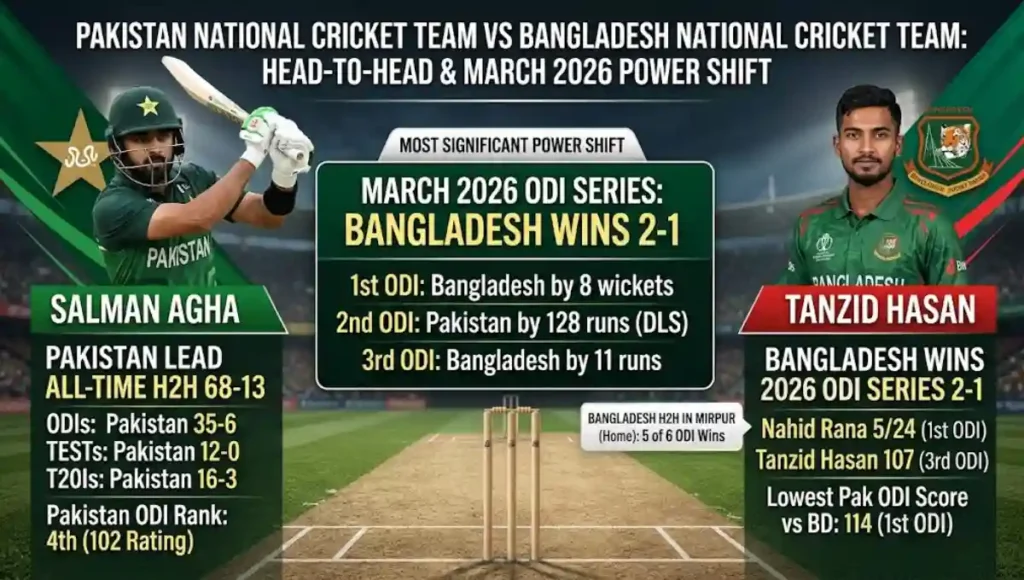

Pakistan leads the all-time head-to-head record against Bangladesh with 68 wins from 82 matches across all formats. However, in March 2026, the Pakistan national cricket team vs Bangladesh national cricket team rivalry hit a turning point Bangladesh won a bilateral ODI series 2-1 at Mirpur, the most significant power shift in this contest’s history.
In ODIs, Pakistan lead 35–6. In Tests, 12–0. In T20Is, 16–3. The numbers look one-sided. But numbers without context are the most misleading thing in cricket analysis. Bangladesh’s six ODI wins tell a very different story when you understand where they happened, how they happened, and why they are happening more frequently.
This is the complete guide to one of Asian cricket’s most underrated rivalries updated through March 2026.
Pakistan vs Bangladesh Head-to-Head: Quick Stats Block
Pakistan vs Bangladesh All-Format Head-to-Head (Updated March 2026)
| Format | Total Matches | Pakistan Wins | Bangladesh Wins | Draw/NR |
| Tests | 12 | 12 | 0 | 1 |
| ODIs | 41 | 35 | 6 | 0 |
| T20Is | 19 | 16 | 3 | 0 |
| Overall | 82 | 68 | 13 | 1 |
Key Quick Facts:
- Pakistan overall win %: 82.9%
- Bangladesh overall win %: 15.9%
- Bangladesh ODI wins at Mirpur (home): 5 of their 6 total wins vs Pakistan
- Pakistan’s current ICC ODI ranking: 4th (Rating: 102)
- Bangladesh’s current ICC ODI ranking: 9th (Rating: 83)
- Biggest Bangladesh ODI upset vs Pakistan: 2015 World Cup, Adelaide won by 79 runs
2026 ODI Series Results: Bangladesh Win 2-1
Bangladesh defeated Pakistan 2-1 in the March 2026 ODI series at Shere Bangla National Stadium, Mirpur. Bangladesh won the 1st ODI by 8 wickets and the 3rd ODI by 11 runs. Pakistan won the 2nd ODI by 128 runs via DLS. It was Bangladesh’s second-ever bilateral ODI series win over Pakistan.
| Match | Date | Winner | Margin | Key Performer |
| 1st ODI | March 11, 2026 | Bangladesh | 8 wickets | Nahid Rana 5/24 |
| 2nd ODI | March 13, 2026 | Pakistan | 128 runs (DLS) | Maaz Sadaqat 75 |
| 3rd ODI | March 15, 2026 | Bangladesh | 11 runs | Tanzid Hasan 107 |
Key Series Stats at a Glance
| Stat | Detail |
| Highest team total | 290/5 Bangladesh, 3rd ODI |
| Lowest team total | 114 Pakistan, 1st ODI (lowest-ever vs Bangladesh) |
| Best bowling figures | Nahid Rana 5/24 Bangladesh, 1st ODI |
| Top individual score | Tanzid Hasan 107 Bangladesh, 3rd ODI |
| Pakistan captain | Shaheen Shah Afridi |
| Bangladesh captain | Mehidy Hasan Miraz |
For Decades, the Same Script. March 2026 Rewrote It.
When the Pakistan national cricket team vs Bangladesh national cricket team meet, history has always produced the same result: Pakistan win, Bangladesh show moments of quality, and the final scoreline reflects Pakistan’s structural superiority.
Then Bangladesh at home, in Mirpur, against a six-uncapped-player Pakistan squad won a bilateral ODI series 2-1 for only the second time in history. Not on a fluke day. Not on a random good performance. Across three matches, over six days, against a full-strength Pakistan bowling attack that included Shaheen Shah Afridi.
But here is the real problem with how this story is usually framed: most headlines call it an upset. It was not an upset. It was the most visible result of a decade-long structural investment Bangladesh has been making in pace bowling, home-ground tactics, and top-order batting intent.
Match-by-Match Breakdown: The 2026 Series in Full Detail
Match 1 Bangladesh Win by 8 Wickets
Pakistan batted first and were dismissed for 114 in 30.4 overs their lowest ODI score against Bangladesh in history.
Nahid Rana took 5/24 in 7 overs, bowling above 145 km/h and targeting the top order with back-of-a-length deliveries that exploited Mirpur’s notorious early-innings bounce. Faheem Ashraf (37) and Sahibzada Farhan (27) were Pakistan’s top scorers two players batting at numbers 7 and 3 respectively. That tells you everything about the top-order failure.
Tanzid Hasan then hit an unbeaten 67 off 42 balls (7 fours, 5 sixes) to chase the target in 15.1 overs. Bangladesh were done before the 16th over.
Turning Point: Rana’s second spell removed three Pakistan middle-order batters in four overs. Pakistan never rebuilt any partnership after the 8th over.
Match 2 Pakistan Win by 128 Runs (DLS)
Pakistan responded with experience and discipline. Maaz Sadaqat scored 75 and Salman Agha added 64, steadying Pakistan to 274. Rain intervened. Under DLS, Bangladesh were set 243 and were bowled out for 114 themselves. Pakistan won by 128 runs and levelled at 1-1.
What this match revealed: Bangladesh’s batting collapses under sudden DLS target recalculations. Pakistan’s middle order, when given structured preparation, still builds competitive totals even with an inexperienced top order.
Match 3 Bangladesh Win by 11 Runs (Series Sealed)
Bangladesh posted 290/5. Tanzid Hasan hit a magnificent 107 controlled, attack-minded, and exactly what a series decider required. Towhid Hridoy added an unbeaten 48 at the death.
Pakistan chased with genuine intent. Salman Agha hit 106 a brilliant, composed century that dragged Pakistan to 260/6 in the 44th over. Pakistan were live. The series was live.
Rishad Hossain stepped up in the death overs. Two crucial late wickets broke Pakistan’s partnership. Pakistan finished 279 all out 11 runs short of their target.
Turning Point: Rishad’s wrist-spin at high pace in the 47th and 48th overs. Bangladesh’s death bowling flexibility unavailable three years ago is now the deciding factor at Mirpur.
Nahid Rana: The Bowler Pakistan Still Cannot Solve
Nahid Rana is a Bangladeshi fast bowler who bowls consistently at 145–148 km/h and has become Pakistan’s most difficult opponent in recent bilateral series. His 5/24 in the 1st ODI of the 2026 series was his maiden ODI five-wicket haul and Pakistan’s lowest ODI total against Bangladesh.
When the Pakistan national cricket team vs Bangladesh national cricket team clash at Mirpur, the one name Pakistan’s camp dreads most is not a spinner. It is a 23-year-old fast bowler who treats Pakistani batting like a personal project.
He does not bowl to contain. He bowls at 145–148 km/h with a plan to destroy targeting top-order batters’ gloves, ribs, and mental composure simultaneously. ESPNcricinfo specifically described Pakistan as Rana’s “cross-format bunnies” meaning the pattern of Pakistani batting wilting against him predates this series.
What Most People Think vs. Reality
Most fans assume Bangladesh’s home advantage comes from slow, turning pitches and off-spin bowlers. In reality, Mirpur’s variable bounce in the first 15 overs makes it one of the most pace-friendly surfaces in Asian cricket. Bangladesh now have a bowler built to exploit it at international level.
Original Analysis: Nahid Rana is not Bangladesh’s ceiling. He is the first visible return on a decade-long investment in fast bowling infrastructure through the Bangladesh Cricket Board’s National Cricket Academy. Under-19 conditioning programs, physical training pipelines, and emerging player tournaments have been quietly building this Rana is where that investment became international-class.
The Mirpur Factor: Why Pakistan Cannot Solve This Venue
Shere Bangla National Stadium, Mirpur is the most tactically layered venue in Asian cricket. Pakistan have won a bilateral ODI series there only once in six attempts.
How Mirpur Works in Three Sessions
| Phase | Overs | Conditions | Danger |
| Early | 1–15 | Variable bounce | Pace bowlers get uneven carry |
| Middle | 15–35 | Surface flattens | Off-spin grips on worn areas |
| Death (D/N) | 35–50 | Evening dew | Ball skids spinners lose control |
Pakistan’s specific 2026 error: They prepared for spin and were ambushed by pace. Six uncapped batting debutants received no tactical instruction for countering Rana’s short-pitch attack at 147 km/h on a surface with extra bounce.
The counterintuitive truth: Bangladesh do not win at Mirpur because they have better players. They win because they have mastered situational cricket at this one venue knowing when to attack with express pace, when to strangle with off-spin, and when to let conditions do the work without over-engineering their plans.
Current Strength Comparison (2026): The Honest Breakdown
This is what most articles about the Pakistan national cricket team vs Bangladesh national cricket team rivalry avoid saying clearly.
| Dimension | Pakistan | Bangladesh |
| Batting (home) | Transitional dependent on senior players | Tanzid + Hridoy in strong form |
| Batting (away/neutral) | Stronger more experienced depth | Inconsistent |
| Pace bowling | Shaheen Afridi world-class | Nahid Rana rapidly rising |
| Spin bowling | Limited ODI options | Rishad Hossain + Shakib (when fit) |
| Squad stability | Rebuilding post-Babar drop | Building settled core |
| ICC ODI Ranking | 4th (Rating 102) | 9th (Rating 83) |
| Home bilateral series | N/A (away) | Favoured at Mirpur |
2026 Power Ranking: Clear and Direct
- Bangladesh at home (Mirpur): Favourites in bilateral ODI series
- Pakistan on neutral venues: Stronger side, higher ranking more depth
- Pakistan in Pakistan: Dominant home record intact
Verdict: The gap is real on neutral ground. But the era of automatic Pakistan dominance at all venues is over.
Historical Flashpoints: The Moments That Defined This Rivalry
The 2015 World Cup The Match That Permanently Changed Everything
On March 9, 2015, at Adelaide Oval, Bangladesh beat Pakistan by 79 runs in a Pool A match at the ICC Cricket World Cup. Rubel Hossain’s four-wicket haul dismantled Pakistan’s lower order. Pakistan were eliminated. Bangladesh advanced.
This result did more than end Pakistan’s 2015 World Cup campaign. It permanently removed the assumption that Pakistan could beat Bangladesh by simply turning up. Every Pakistan camp since 2015 has allocated measurably more preparation time and tactical analysis to Bangladesh encounters.
Original Observation: The 2015 result forced Pakistan into better habits against Bangladesh more preparation, more targeted analysis, more caution. The irony is that those improved habits still haven’t translated into consistent results at Mirpur. Pakistan adapt their approach but not their venue-specific tactics.
Asia Cup: Bangladesh’s Most Competitive Stage
Bangladesh beat Pakistan in the 2016 and 2018 Asia Cup editions both times with the same formula: disciplined bowling in the first 30 overs and calculated chasing with the bat.
Pakistan have recovered at neutral venues. The 2023 Asia Cup in Lahore saw Pakistan win by 7 wickets, and the 2025 Asia Cup T20 encounter in Dubai went Pakistan’s way by 11 runs.
The Asia Cup pattern mirrors the rivalry’s overall dynamic: Bangladesh is competitive at home, Pakistan is dominant at neutral venues, and the gap is narrowing every cycle.
T20I Format: Pakistan’s Strongest Hold
T20Is remain Pakistan’s clearest format advantage against Bangladesh. Pakistan have won 16 of 19 T20I encounters. Bangladesh’s three T20I wins came in 2015, 2016 (home), and 2023 (Asian Games, Hangzhou).
Even here, the trend matters. Bangladesh’s 2023 T20I win at the Asian Games was on neutral ground something genuinely new in the history of this format rivalry.
Pakistan’s Batting Fragility: The Structural Problem Nobody Is Admitting
Pakistan’s 114 all out in Match 1 was not a bad day. It was a selection architecture failure.
The PCB dropped Babar Azam, Saim Ayub, and four other senior players following Pakistan’s poor T20 World Cup performance. Six uncapped players entered the ODI squad many of whom had not played 50-over domestic cricket in months.
Three of those debutants failed in the first ODI. Pakistan’s top scorers were Faheem Ashraf (37) at number 7 and Sahibzada Farhan (27) at number 3 not because they played well, but because everyone ranked above them failed first.
Common Mistake in Analysis: Commentators labeled this a “batting collapse.” It was a selection collapse. You cannot hand five ODI debuts simultaneously to batters with no mutual understanding, no established partnerships, and no format-specific preparation then describe the result as surprising. The surprise would have been if Pakistan had batted well.
Bangladesh’s Batting Evolution: Tanzid Hasan and the New Generation
If Nahid Rana is Bangladesh’s bowling future, Tanzid Hasan Tamim is their batting identity for the next decade.
His 67 off 42 balls in Match 1 (7 fours, 5 sixes) was not a slog against a depleted attack. It was precise, controlled aggression identifying the correct delivery, selecting the right boundary, and not gifting a wicket while doing it. Bangladesh needed no more than a clinical chase. Tanzid provided exactly that.
His 107 in the third ODI was a different kind of innings entirely an anchor knock with a high strike rate. Bangladesh needed 270+ to feel safe in a series decider. Tanzid gave them 290/5. Pakistan, despite Salman Agha’s brilliant 106, could not reach it.
Original Observation: Tanzid’s generation of Bangladesh batters are not conditioned for survival. They are conditioned for home dominance. The combination of Tanzid’s powerplay aggression, Towhid Hridoy’s composure in the middle overs, and Mehidy Hasan Miraz’s ability to bat deep gives Bangladesh a batting structure that no longer depends on a single senior player to hold everything together.
2027 ODI World Cup: Why This Series Mattered Beyond the Scoreline
The Pakistan national cricket team vs Bangladesh national cricket team 2026 series was not just a bilateral result. Both sides entered it with the 2027 ICC ODI World Cup qualification directly in view.
Bangladesh were ranked 9th in ICC ODI rankings sitting on the qualification boundary. A series win over 4th-ranked Pakistan pushed them up the rankings and strengthened their automatic qualification case. After Bangladesh won 2-1, Wisden confirmed Bangladesh re-entered the automatic World Cup qualification race.
Pakistan, despite the series loss, remain 4th in ICC ODI rankings with a Rating of 102 well clear of the automatic qualification threshold. However, the PCB’s decision to experiment with six uncapped players in this series has drawn criticism, with analysts questioning whether the squad-building exercise was worth the ranking points lost.
What This Means Going Into 2027
For Bangladesh:
- Series win strengthens direct World Cup qualification position
- Nahid Rana and Tanzid Hasan are now established match-winners in ODI cricket
- Home form under Mehidy Hasan Miraz’s captaincy is statistically better than any period in their ODI history
For Pakistan:
- PCB has already launched a new domestic white-ball tournament to prepare for the 2027 World Cup cycle
- Babar Azam’s return for future bilateral series is being discussed within the board
- Restoring Babar fixes batting. It does not fix Mirpur. It does not solve Nahid Rana.
Read More About – Zimbabwe National Cricket Team Vs Pakistan National Cricket Team Match Scorecard Full T20I Series Breakdown (2025)
What Should Fans and Analysts Do With This Information?
If you follow Bangladesh cricket:
- Back Bangladesh as home favourites in any future bilateral ODI series at Mirpur against Pakistan
- Nahid Rana is now a proven match-winner track his fitness and selection for upcoming series
- The 2027 World Cup is Bangladesh’s realistic target this series win was step one
If you follow Pakistan cricket:
- Pakistan’s ranking (4th, ODIs) and bowling depth (Shaheen Afridi) still make them strong on neutral ground
- The Babar Azam question needs a permanent answer, not a series-by-series decision
- Pakistan on neutral venues in the 2027 World Cup should be respected Pakistan at Mirpur should not be backed blindly
If you analyse this rivalry:
- Stop reading the all-time head-to-head as a current power indicator. Pakistan’s 12-0 Test lead was built a decade ago. Bangladesh’s ODI wins have all been recent and contextually significant.
- The trend line points toward a genuinely competitive ODI rivalry within two years