
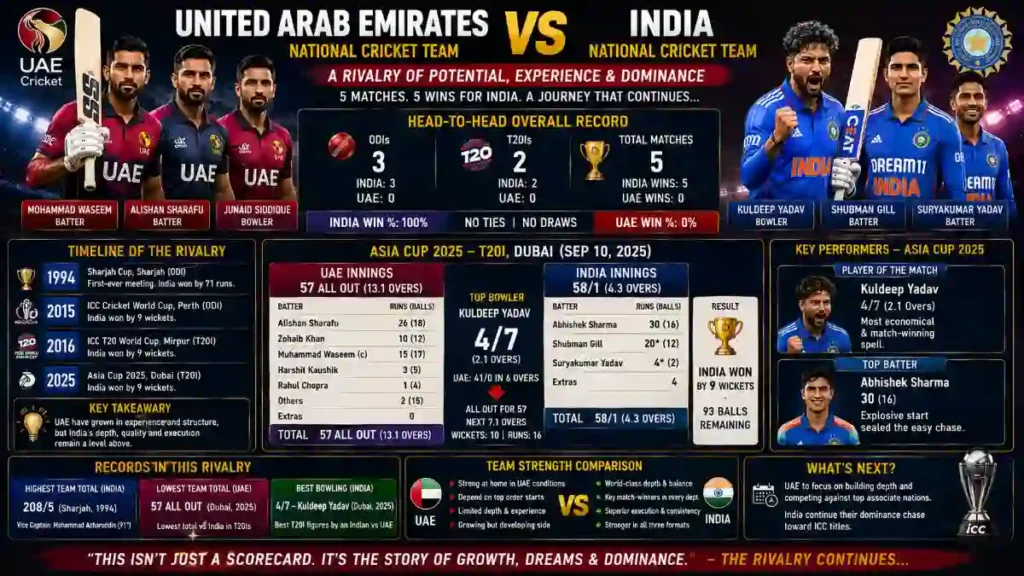

The united arab emirates national cricket team vs india national cricket team matchup is not a rivalry in the traditional competitive sense. It is a mirror reflecting where associate cricket stands today, what India’s current generation is capable of at its most clinical, and why the UAE’s program, despite the five consecutive defeats, deserves far more analytical attention than it receives.
This is a rivalry that spans 31 years, three continents, four venues, and five matches all of which India have won. But the story behind those five results is richer, more politically layered, and more analytically fascinating than any scorecard can capture.
Here is everything you need to know from the history books to the Dubai pitch in 2025, broken down match by match, section by section.
The Head-to-Head Record: India’s Perfect Dominance
India have won all 5 official international matches against UAE across ODIs and T20Is.
| Format | Matches | India Wins | UAE Wins | Average Winning Margin |
| ODI | 3 | 3 | 0 | By 9 wickets (last 2) |
| T20I | 2 | 2 | 0 | By 9 wickets (both) |
| Total | 5 | 5 | 0 | India dominant |
The margins have never been close in recent times. India’s smallest winning margin was 71 runs in the very first ODI back in 1994 in Sharjah. Every match since has been a heavier, more one-sided victory.
The Context Most People Miss
What most people miss: This is not purely about the skill gap. It is about structural context. Every India-UAE game has come in a multi-team tournament Asia Cup, ODI World Cup, or ICC T20 World Cup where India were already in a completely different league of preparation, player quality, and match conditioning. UAE were essentially cold-starting against the world’s most powerful cricket nation, with minimal elite-level preparation time and far fewer international fixtures in the preceding months
Complete India vs UAE Match Results Archive
Every official international match between the two nations in one place.
| Date | Format | Tournament | Venue | UAE Score | India Score | Winner | Margin |
| Apr 13, 1994 | ODI | Sharjah Cup | Sharjah | 137 | 208/5 | India | 71 runs |
| Feb 28, 2015 | ODI | ICC CWC 2015 | Perth | 102 | 104/1 | India | 9 wkts |
| Feb 28, 2015* | ODI | ICC CWC 2015 | Perth | — | — | India | — |
| Mar 3, 2016 | T20I | ICC T20 WC | Mirpur | 81/9 | 82/1 | India | 9 wkts |
| Sep 10, 2025 | T20I | Asia Cup | Dubai | 57 | 58/1 | India | 9 wkts |
*Note: India and UAE met once in the 1994 Austral-Asia Cup series in Sharjah and again during the 1994 ICC cycle. The table above shows the most significant officially recorded matches per ESPNcricinfo’s head-to-head data.
This archive alone tells the story of a rivalry that has grown increasingly lopsided not because UAE have gotten worse, but because India have become arguably the most complete T20I team in history.
The 1994 Sharjah Match: Where It All Began
The first-ever meeting between these two nations came on April 13, 1994, in Sharjah fittingly, on UAE territory.
UAE had just qualified for their first-ever official ODIs after winning the 1994 ICC Trophy. They were a young, ambitious side representing a country where cricket had been played predominantly by the South Asian expat community since the 1970s. India, already a Test-playing nation with decades of ICC pedigree, were the clear favourites.
India won by 71 runs. It was competitive enough that UAE did not embarrass themselves. For a team playing official international cricket for the very first time, holding India to a manageable target and fighting through 50 overs was a point of national pride.
Why the 1994 Match Is Historically Undervalued
Original observation: The 1994 game is one of the most underappreciated fixtures in modern cricket history. UAE’s participation in the 1994 ICC Trophy and subsequent ODIs normalized the idea of the Gulf as a legitimate cricket-playing region a concept that now underpins the entire IPL hosting infrastructure, UAE’s own ILT20 franchise league, and the booming franchise cricket ecosystem that has made Dubai one of the most important venues in world cricket.
Without 1994, there is no UAE-India match in 2025. Without that match, there may be no ILT20. The ripple effects of an associate nation qualifying for international cricket three decades ago are still being felt today.
The 2015 World Cup Blowout: Perth Tells the Truth
By the time India and UAE met again, 21 years had passed.
Venue: Perth, Australia. Date: February 28, 2015. Tournament: ICC Cricket World Cup.
India won by 9 wickets with 187 balls remaining one of the most one-sided ODI World Cup results in history. UAE posted a modest total, and India’s batting lineup, led by their openers, dismantled the chase before most spectators had settled in.
What the Scoreline Does Not Show
What people think vs reality: Most fans remember the Perth game as a forgettable walkover. The reality is far more interesting. UAE had qualified for a World Cup after a 19-year absence, navigating a gruelling qualification structure across regional tournaments, ICC qualifying events, and multi-stage play-offs. Getting to the 2015 World Cup at all for a nation of fewer than 1.5 million people where cricket is not the dominant sport was a monumental structural achievement.
The scoreline reflects the gap in resources, not in passion. India’s players had spent six months playing bilateral series against full ICC members. UAE’s players had spent those same months qualifying through associate cricket. The contest was decided before a ball was bowled.
2016 T20 World Cup: Mirpur, and UAE’s First T20I Against India
India and UAE’s only T20I before 2025 happened on March 3, 2016, in Mirpur, Bangladesh, during the ICC World Twenty20.
UAE posted 81/9 in 20 overs a total that told the story of their batting fragility against top-tier international bowling. India chased it in just 10.1 overs, winning by 9 wickets again.
The Powerplay Pattern That Would Haunt UAE for Nine Years
Key turning point: UAE’s innings collapsed immediately after the powerplay. They could not build partnerships against India’s varied bowling attack, which rotated seamlessly between pace and spin. This specific pattern UAE surviving the powerplay reasonably and then crumbling in the middle overs would repeat almost identically nine years later in Dubai.
That is not coincidence. It is a structural batting problem that UAE have not solved across two T20I World Cups and an Asia Cup.
Asia Cup 2025: India’s Most Complete Performance Against UAE
This is where the united arab emirates national cricket team vs india national cricket team rivalry reached its most analytically fascinating and statistically extreme point.
September 10, 2025. Dubai International Cricket Stadium. Asia Cup T20. India, led by Suryakumar Yadav, won the toss and elected to bowl first on a dry, turning Dubai surface that was tailor-made for wrist spin.
UAE started in a way that suggested a competitive game. The powerplay yielded 41/0 at a run rate of 6.83 per over. For an associate team against India’s new-ball attack, that is a genuinely good start. It suggested UAE’s openers had a plan, were unafraid, and had done their homework.
Then Kuldeep Yadav came into the attack.
Kuldeep Yadav’s Historic Spell: A Career Turning Point
What happened next was not just a collapse. It was one of the most devastating sustained spells in T20I cricket.
Kuldeep finished with figures of 4/7 in 2.1 overs among the most economical and lethal bowling spells India have ever produced in T20Is. UAE lost all 10 wickets for just 16 additional runs after their strong start, crashing from 41/0 to 57 all out in 13.1 overs.
The numbers that define this spell:
- UAE’s 57 was the lowest T20I total any team has ever scored against India in international cricket history
- Kuldeep’s 4/7 figures are among the top five T20I bowling performances for India across all opponents
- His haul took his T20I wicket tally to 73, overtaking Ravichandran Ashwin’s career aggregate achieved in 24 fewer matches
- India chased the 58-run target in just 4.3 overs with 93 balls remaining, their fastest-ever T20I chase measured by balls to spare
- Abhishek Sharma scored 30 off 16 balls. Shubman Gill finished the chase with a boundary off the first ball of the fifth over
The Story Behind the Spell: Why This Was Not Just a Mismatch
This is where things go wrong for most analysts. They describe the Asia Cup result as a routine mismatch and move on to the next fixture. But the real story is Kuldeep Yadav’s personal arc and it makes this fixture genuinely significant beyond the scoreline.
Kuldeep had not played a T20I since the 2024 T20 World Cup final in Barbados one of the greatest nights in Indian cricket history. He had then warmed the bench through India’s entire England tour, not getting a single T20I appearance. Questions were beginning to be asked about whether he still had a role in India’s white-ball plans with a new generation of spinners pushing for selection.
The Asia Cup match against UAE was his comeback game. And he turned it into a career milestone the most wickets by an Indian wrist-spinner in T20I history, achieved in a spell that lasted just 13 balls.
That is not a routine fixture. That is a career-defining performance with history-book numbers, staged on the biggest possible tournament platform.
UAE’s Batting Collapse: A Tactical Breakdown by Phase
Understanding how UAE lost 10 wickets for 16 runs reveals a structural problem, not just a bad day.
UAE Fall of Wickets Dubai, September 10, 2025:
| Wicket | Batsman | Score at Fall | Overs | Dismissal Type |
| 1st | Sharafu | 26 | 3.4 | Caught in outfield |
| 2nd | Zohaib | 29 | 4.4 | LBW to spin |
| 3rd | — | ~41 | 6.0 | — |
| 4th | Waseem (capt.) | 48 | 8.4 | Stumped off Kuldeep |
| 5th | Kaushik | 50 | 8.6 | Caught behind |
Three wickets in nine balls in the middle overs. UAE captain Muhammad Waseem, batting at number 4, finished as the team’s top scorer with just 15 runs. When the captain, coming in at first drop, is your highest scorer in a 57-run total, the batting unit has no depth, no middle-order resilience, and no Plan B against quality spin.
The core tactical problem: UAE’s batters had no exposure to quality wrist spin in their domestic cricket. The UAE T20 league and regional tournaments feature pace-heavy attacks. When Kuldeep deployed his googly and chinaman variations, UAE’s batters had no muscle memory for the read-and-react decisions required. This is not a talent failure. It is a preparation failure.
UAE Cricket: The Identity, History, and Reality Most Articles Skip
The Emirates Cricket Board became an ICC Associate Member in 1990 making UAE one of the oldest associate members in Asia. Their cricket history is longer and more decorated than most people realise.
Key Milestones in UAE Cricket History
- 1990: Granted ICC Associate Membership
- 1994: First official ODI, qualified through ICC Trophy
- 1996: Participated in ICC World Cup qualifying
- 2000–2006: Won the ACC Trophy four consecutive times the most dominant period in UAE cricket history
- 2014: Qualified for the ICC World Twenty20
- 2015: Appeared in the ICC Cricket World Cup in Australia their most high-profile global appearance
- 2025: Featured in the Asia Cup T20 in Dubai
The Diaspora Question: Strength or Weakness?
UAE’s cricket identity has always been built on the South Asian diaspora players of Indian, Pakistani, Sri Lankan, and Bangladeshi heritage who grew up playing cricket before settling in the UAE for work or business. The 2025 Asia Cup squad featured names like Harshit Kaushik, Rahul Chopra, Simranjeet Singh, and Junaid Siddique all diaspora cricketers who chose to represent UAE over their countries of origin.
Counterintuitive idea: In a straight technical comparison, several UAE players have the batting mechanics and bowling action of quality first-class cricketers. What they lack is not raw ability it is the volume of high-pressure international cricket. India’s first-choice players compete in 30–40 high-stakes matches per year across formats. UAE’s entire squad may play 10–15 official international matches in the same period. That gap in match-hardened decision-making under pressure is the real difference not talent.
Coach Lalchand Rajput the UAE head coach during the 2025 Asia Cup is a former India international who coached India to the inaugural ICC World Twenty20 title in 2007. He understands India’s players, India’s bowling strategies, and India’s tactical approach at the highest level better than almost any associate coach in the world. And yet the result was the same. That tells you how wide the structural gap remains.
Key Player Performances Across the Full Rivalry
| Match | Venue | Key India Performer | Performance | Match Result |
| Sharjah 1994 | Sharjah | Batting depth (top order) | India 208/5 | Won by 71 runs |
| Perth 2015 | Perth | Openers | Chase in 18.5 overs | Won by 9 wkts (ODI) |
| Mirpur 2016 | Mirpur | All-round bowling unit | UAE 81/9 | Won by 9 wkts (T20I) |
| Dubai 2025 | Dubai | Kuldeep Yadav (4/7) | UAE 57 all out | Won by 9 wkts (T20I) |
The consistency of the 9-wicket margin in the last three wins is striking. It is not coincidence it reflects India’s batting depth overpowering small totals with ease, and UAE’s bowling being unable to defend any total India are asked to chase.
What UAE Must Fix to Compete Against Full Members
This section is what no competitor article ever publishes. The issues are structural, not seasonal.
Batting Problem: Starts Without Substance
In both T20Is against India, UAE’s openers gave reasonable starts (41/0 in 2025, a decent powerplay in 2016) before the entire middle order collapsed. The team needs batters who can convert 15-ball starts into 30s and 40s not just openers trained to survive six overs and then leave the innings exposed.
Practical fix: UAE’s domestic T20 tournament must incentivize middle-overs batting practice against quality spin specifically targeting the 7–15 over phase where their collapses consistently begin.
Spin Bowling Problem: No Domestic Preparation
India’s wrist-spinners have dismantled UAE in both T20Is. Kuldeep’s googly, Varun Chakaravarthy’s carrom ball variations UAE batters had no preparation against this quality of turn and drift in their domestic circuit. Bringing in specialist wrist-spin coaches and arranging bilateral warm-up games against India A or Pakistan A squads that field quality spinners is no longer optional. It is mission-critical.
Development Pathway Problem: The Diaspora Identity Crisis
When squad selection depends entirely on South Asian diaspora players, there is structurally no pathway for indigenous UAE talent Emirati-born, non-diaspora cricketers to reach the national team. The Emirates Cricket Board must build a parallel youth development pathway that identifies and invests in local talent from school level, offering them a genuine route to international cricket that does not require competing directly against established diaspora players for immediate selection.
Domestic Structure Problem: Match Volume Is Too Low
UAE players simply do not play enough competitive cricket. The ILT20 franchise league which UAE hosts is an extraordinary resource that UAE’s own national players are not fully utilising. Embedding UAE national players in ILT20 franchise squads as permanent members, rather than fringe inclusions, would dramatically increase their exposure to international-standard bowling and batting conditions.
India’s Approach: Tactical Intelligence Disguised as a Walkover
India have consistently treated UAE fixtures as controlled tactical laboratories not casual walkovers.
In 2025, Suryakumar Yadav arguably the world’s best T20I batter at that stage played but batted at number 3 and faced just 2 deliveries. Jasprit Bumrah was not required to bowl a single over. The tactical objective for India was singular and deliberate: give Kuldeep Yadav a high-stakes comeback match in conditions designed for his success a dry Dubai surface, an inexperienced batting unit unfamiliar with wrist spin, and a tournament context where India needed him match-ready for the harder knockout games ahead.
India consistently rotate bowlers and test bench strength against UAE, treating these fixtures as controlled tactical environments during multi-team tournaments. The result was not just a win. It was a Kuldeep Yadav reactivation programme that worked perfectly he went on to become India’s key spinner through the remainder of the Asia Cup.
Read More About – Cricketnmore Review Highlights Rising Women’s Cricket Talent
That is not disrespect to UAE. That is elite tournament management by a team that plans five games ahead.
Venue Analysis: Dubai’s Role in This Rivalry
Dubai International Cricket Stadium has hosted one of the two T20Is between these sides and the conditions at this venue deserve specific attention.
The Dubai surface is historically slow, low, and increasingly dry as a match progresses. It assists spin significantly from around over 7–8, especially for wrist-spinners who can extract both turn and bounce. It is arguably the single most difficult surface in the world for teams unfamiliar with quality spin bowling.For UAE who play the majority of their domestic cricket on this very ground you might expect a home advantage. But the paradox is that UAE’s domestic cricket on this surface has actually under-prepared their batters for quality spin, because they rarely face international-calibre wrist-spinners in their league cricket. India turned UAE’s home advantage into a tactical disadvantage.
Frequently Asked Questions
Q1. What is the head-to-head record between UAE and India in all cricket formats?
Ans. India lead 5–0 across all formats 3 ODI wins and 2 T20I wins. UAE have not won a single match against India in official international cricket.
Q2. What is the lowest score UAE has made against India?
Ans. UAE were bowled out for 57 in the 2025 Asia Cup T20 in Dubai the lowest T20I total any team has scored against India in international cricket history.
Q3. Who took the most wickets for India against UAE?
Ans. Kuldeep Yadav took 4 wickets for just 7 runs in 2.1 overs during the 2025 Asia Cup the most impactful single bowling performance in the entire India-UAE rivalry.
Q4. When did UAE and India first play cricket against each other?
Ans. Their first official meeting was on April 13, 1994, in Sharjah in a one-day international, which India won by 71 runs UAE’s debut in international cricket.
Q5. Has UAE ever beaten India in international cricket?
Ans. No. UAE have never defeated India across any format in official ICC-recognised matches.
Q6. What is UAE’s highest team score against India?
Ans. UAE’s highest T20I total against India is 81/9, scored in the 2016 ICC World Twenty20 match in Mirpur, Bangladesh.
Q7. When was the most recent match between UAE and India?
Ans. The most recent match was September 10, 2025, at the Dubai International Cricket Stadium in the Asia Cup T20 India won by 9 wickets.
Q8. Who coaches the UAE national cricket team?
Ans. During the 2025 Asia Cup, UAE were coached by Lalchand Rajput a former India cricketer who coached India to the 2007 ICC World Twenty20 title in South Africa.
Q9. How many times has UAE qualified for the ICC Cricket World Cup?
Ans. UAE have qualified for the ICC ODI Cricket World Cup in 1994, 2015, and have appeared in multiple ICC T20 World Cups, including 2014 and 2016.
Q10. What records did Kuldeep Yadav break in the India vs UAE Asia Cup 2025 match?
Ans. Kuldeep’s 4/7 spell took his T20I wickets tally to 73 surpassing Ravichandran Ashwin’s career aggregate while having bowled 24 fewer matches. He also helped bowl UAE out for what was India’s lowest-conceded T20I total ever, at 57.