
When the final ball of the second Super Over arrowed toward Keshav Maharaj’s stumps and Rahmanullah Gurbaz fell agonisingly short, cricket witnessed one of its most heartbreaking moments. South Africa survived the T20 World Cup’s group of death by outlasting Afghanistan in a match that went into two Super Overs at Ahmedabad’s Narendra Modi Stadium. This encounter between the South Africa national cricket team vs Afghanistan national cricket team was not just another world‑cup fixture; it became a modern‑era T20 classic, layered with pressure, misjudged runs, and a single missed dive that changed the fate of both teams.
The 2026 showdown redefined the rivalry. It is no longer a simple “champion vs minnow” clash. Afghanistan now pushes South Africa to the absolute edge, and the 2026 thriller proved that the South Africa national cricket team vs Afghanistan national cricket team dynamic is evolving fast.
What Made This Match Different From Every Other SA vs AFG Encounter
The 2026 T20 World Cup game between the South Africa national cricket team and Afghanistan national cricket team stands out because it was the first time any T20 World Cup fixture went into two Super Overs, with both teams scoring 17–17 in the first and then 23–19 in the second. This level of pressure and repetition in deciding overs makes it one of the most dramatic limited‑overs games in recent history.
The 2026 showdown in Ahmedabad turned a routine head‑to‑head statistic into a live‑blog‑style thriller that captivated fans till the very last run. Most SA‑AFG meetings are decided within 20 overs; this one needed 40+ overs in effect, including two Super Overs and a regulation‑time tie at 187–187.
What most people miss about this match
Most fans scroll straight to the “Result” line and remember only the 4‑run win. What they miss is that Afghanistan had three distinct chances to finish the match in regulation time but failed each time. From the 18th over up to the final ball, the game kept swinging in their favour, yet execution in the last 10 balls broke down.
But here’s the real problem for Afghanistan
Afghanistan needed just two runs off three balls in the 20th over of the main innings, with Fazalhaq Farooqi at the non‑striker’s end. He did not dive for a single that could have sealed the game inside the 20‑over limit. That one missed run later became the symbolic reason Afghanistan lost not once, but twice – in the match and then in the first Super Over.
South Africa’s edge was their ability to reset mentally after the tie and then execute under pressure in the Super Overs. That contrast – risk‑taking in the 20th over versus discipline in the Super Overs – is what separated the sides on the day.
Complete Head‑to‑Head Record: South Africa vs Afghanistan Across All Formats
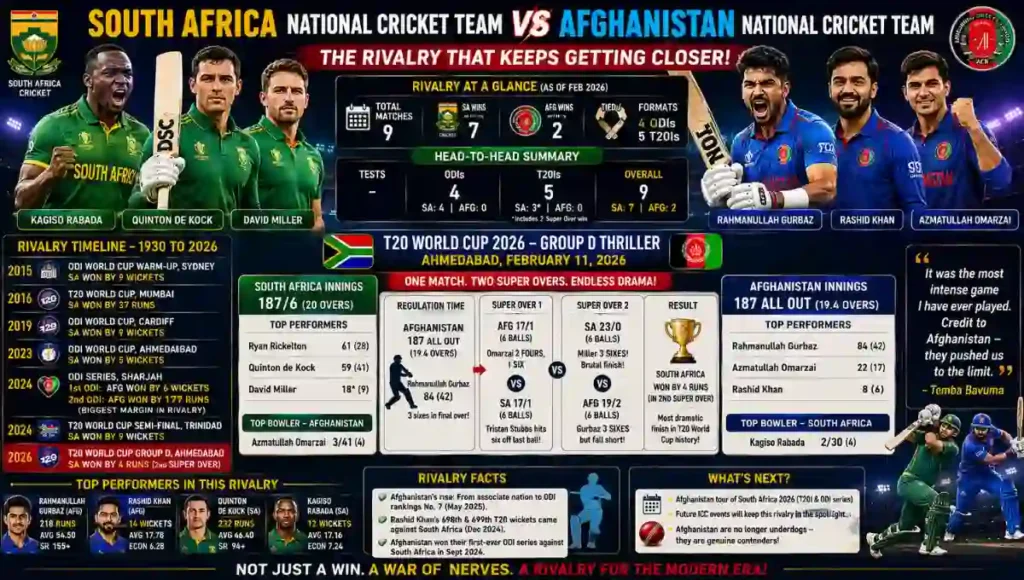
In head‑to‑head cricket, the South Africa national cricket team vs Afghanistan national cricket team rivalry spans 9 matches across formats, with South Africa winning 7 and Afghanistan 2. T20Is, however, tell a different story: South Africa have won all 4 T20Is they have played against Afghanistan, including the 2026 T20 World Cup thriller decided by two Super Overs.
Overall head‑to‑head snapshot
| Criterion | Details |
| Total matches | 9 |
| South Africa wins | 7 |
| Afghanistan wins | 2 |
| Tied / No Result | 0 / 0 |
This split shows that while South Africa overwhelmingly dominate overall, Afghanistan have already broken the ODI barrier and remain competitive in major tournaments.
T20I head‑to‑head record
| Criterion | Details |
| T20I matches | 4 |
| South Africa wins | 4 |
| Afghanistan wins | 0 |
Before the 2026 T20 World Cup, South Africa had already won 3 T20Is against Afghanistan, including a 2016 World Cup game and a 2024 contest where Afghanistan collapsed for 56, skittled by Kagiso Rabada and Lungi Ngidi.
Key Match Results history
- Feb 11, 2026 – South Africa won by 4 runs (2nd Super Over) at Ahmedabad – T20 World Cup 2026
- Jun 26, 2024 – South Africa won by 9 wickets at Tarouba – T20 World Cup 2024
- Sep 20, 2024 – Afghanistan won by 177 runs at Sharjah – ODI (largest margin in this rivalry)
- Sep 18, 2024 – Afghanistan won by 6 wickets at Sharjah – 1st ODI; their first‑ever ODI win over South Africa
- Mar 20, 2016 – South Africa won by 37 runs at Wankhede – T20 World Cup
- May 5, 2010 – South Africa won by 59 runs at Bridgetown – T20I
What this tells us: The last three ODI results in 2024 are the turning point where the “minnow vs champion” narrative fell apart. Afghanistan does not just compete; they now win series against South Africa.
What People Think vs Reality: The Afghanistan Rise Story
Many fans still think the South Africa national cricket team vs Afghanistan national cricket team fixture is a predictable affair where South Africa always win. The reality is that Afghanistan have climbed to 7th in the ICC ODI rankings, won their first bilateral ODI series against South Africa, and produced a 2026 T20 World Cup thriller that went to two Super Overs, proving they are now a top‑7 white‑ball side, not a fringe opponent.
What people think
- Afghanistan are a track‑outfit side that South Africa can comfortably beat in any format.
- Their T20 World Cup runs are “one‑off flukes”.
The reality
- Afghanistan sit at 7th in ICC ODI rankings (rating 93), above England, West Indies, and Bangladesh.
- Rashid Khan sits at 700 T20 wickets, with his 698th and 699th scalps claimed against South African batters in the same series that culminated in the 2026 T20 World Cup thriller.
- Azmatullah Omarzai is the world No. 1 ODI all‑rounder, a ranking built partly on performances against South Africa.
Counterintuitive takeaway: South African batters helped Rashid Khan reach 700 wickets, even as Afghanistan’s ODI team beat South Africa by 177 runs in Sharjah in 2024 – the biggest defeat the Proteas have suffered in this head‑to‑head.
Why this rivalry matters more now
The 2024 ODI series in Sharjah flipped the script. Afghanistan:
- Won their first bilateral ODI series against South Africa.
- Followed a 6‑wicket win in the 1st ODI with a 177‑run blowout in the 2nd, where Rahmanullah Gurbaz scored 105 and Rashid Khan took 5/19.
That 177‑run hammering is not a fluke. It proves Afghanistan can dominate South Africa in limited‑overs cricket, and the 2026 T20 World Cup thriller proves they can push them to the edge in T20s as well.
Match‑by‑Match Breakdown: The 2026 T20 World Cup Thriller
The 2026 T20 World Cup clash between the South Africa national cricket team vs Afghanistan national cricket team ended regulation time at 187–187, then the first Super Over at 17–17, and only settled in the second Super Over when South Africa posted 23/0 and Afghanistan fell short at 19/2. This is the only T20 World Cup match so far to go into two Super Overs, making it a landmark in tournament history.
What happened in the 2026 game
- Date: February 11, 2026
- Venue: Narendra Modi Stadium, Ahmedabad, India
- Stage: T20 World Cup 2026, Group D
- Toss: Afghanistan won and chose to bowl
Both teams posted 187 in 20 overs, then failed to separate via the first Super Over (17–17), and finally South Africa edged ahead in the second Super Over (23–19).
First innings: South Africa’s fightback after a fragmented start
South Africa’s 187/6 was built around two key innings:
- Quinton de Kock – 59 (41 balls): Anchored the innings after early wickets and kept the scoring rate safe in the middle overs.
- Ryan Rickelton – 61 (28 balls): Accelerated from the start, turning 160‑ish into a challenging 187 target.
Azmatullah Omarzai’s 3/41 for Afghanistan kept the score in visible range for the chase.
Without Rickelton’s aggression and de Kock’s control, South Africa may have stalled around 160–170, which would have been comfortable for Afghanistan’s explosive line‑up.
Afghanistan’s chase: Three opportunities to win
Afghanistan’s 187 all out in 19.4 overs was built around:
- Rahmanullah Gurbaz – 84 (42 balls): A high‑strike‑rate knock that kept the asking rate within reach till the final over.
- Azmatullah Omarzai – 22 (17 balls): Provided quick cameos and rotation that kept the pressure balanced.
The biggest moment came in the 20th over when Rahmanullah Gurbaz smashed three consecutive sixes off Keshav Maharaj. Technically, he could have rotated strike and finished the game in two balls, but the failed run‑out and later missed run turned an 8‑run over into a tied score and extra pressure on the tail‑enders.
The Super Over drama
First Super Over:
- Afghanistan: 17/1 (Rahmanullah Gurbaz stumped)
- South Africa: 17/1 (Dewald Brevis dismissed)
- Result: Tied
Second Super Over:
- South Africa: 23/0 (David Miller hit 16 off 4 balls)
- Afghanistan: 19/2 (Rahmanullah Gurbaz bowled with 5 needed off the final ball)
South Africa won by 4 runs in the second Super Over. This is the first T20 World Cup to go this far in deciding overs, and it happened in the South Africa national cricket team vs Afghanistan national cricket team clash.
Key Players Who Defined This Rivalry
In the South Africa national cricket team vs Afghanistan national cricket team rivalry, Ryan Rickelton and Rahmanullah Gurbaz have emerged as the most explosive batters, while Rashid Khan and Lungi Ngidi anchor the bowling combat. South Africa’s dependability comes from David Miller’s Super Over intent, while Afghanistan’s challenge is how they finish matches that are effectively already won.
South Africa’s match winners
- Ryan Rickelton – 61 (28 balls): His explosive start in the 2026 match forced Afghanistan’s bowlers to over‑think length early.
- Quinton de Kock – 59 (41 balls): The classic anchor‑cum‑anchor combo that keeps the run‑rate safe in high‑stakes T20 games.
- Lungi Ngidi – 3/26 in 4 overs: Provided the death‑over control that pinned Afghanistan just below a 190‑run comfort zone.
- David Miller – 16 (4 balls in 2nd Super Over): The “X‑factor” in the Super Over; his 16‑run burst from 4 deliveries turned 17 into 23.
- Kagiso Rabada – 2/30 in the 20th over: Bowled the final over needing 13 runs, with two no‑balls adding to the pressure yet still keeping the length disciplined.
Afghanistan’s heroes who came up short
- Rahmanullah Gurbaz – 84 (42 balls): The core of the chase. His 84‑off‑42‑balls performance is one of the most explosive in SA‑AFG history.
- Rashid Khan – 2/28 & toss‑winning captain: Won the toss, chose to bowl, and read the pitch correctly – a red‑soil, batter‑friendly surface at Ahmedabad.
- Azmatullah Omarzai – 3/41 & 22 (17): The all‑round impact that Afghanistan increasingly leans on against top‑order‑heavy sides.
Key insight: Omarzai’s 3/41 shows he can still trouble South Africa’s batters, even as he later chipped in with quick runs. This dual‑role threat is why Afghanistan now presents a tougher matchup than they did in 2010 or 2016.
Pitch and Conditions: Why Ahmedabad Favored Seamers
The 2026 T20 World Cup clash between the South Africa national cricket team vs Afghanistan national cricket team was played on a red‑soil surface at the Narendra Modi Stadium, which naturally favors seamers and fast‑bowling all‑rounders over pure spinners. This gave South Africa’s six‑man pace‑heavy attack a quiet edge, even though Rashid Khan downplayed the pitch advantage publicly.
Why Ahmedabad’s surface helped South Africa
- Red‑soil surfaces generate more bounce and seam movement than typical black‑soil, spin‑friendly Indian pitches.
- South Africa’s six‑seamer lineup aligned well with the conditions, especially in the 17th–20th overs.
- Afghanistan’s reliance on spin (Rashid Khan, Mujeeb‑ur‑Rahman, Noor Ahmad) became slightly riskier when the ball kept skidding and leaping.
The psychological nuance:
Rashid Khan stated that the pitch was equal for both teams because conditions were shared. That’s a subtle but important point. The pitch was not “unfair,” but it did amplify skill under bounce and pressure instead of just spin‑turn chaos.
Tactical Analysis: Where Afghanistan Lost This Match
Afghanistan did not lose the 2026 T20 World Cup match once; they lost it in three phases – the 18th–19th over, the 20th‑over hat‑trick of sixes, and the first Super Over. The critical tactical error was death‑over mis‑management and a missed run‑dive in the 20th over, which turned a two‑run finish into a Super‑Over minefield. South Africa’s edge came from better super‑over planning and death‑over clarity.
Common mistakes Afghanistan repeated
- Death‑over mis‑management:
- Afghanistan needed 13 runs off the final over with one wicket in hand.
- After the first two balls, they were still in the hunt, but the third‑to‑sixth‑ball intent stayed conservative instead of going for 2‑run‑per‑ball.
- The no‑dive incident:
- With two runs required off three balls, Fazalhaq Farooqi failed to dive for a single.
- Rashid Khan later admitted that one dive could have finished the game inside the 20th over.
- Three missed finishing opportunities:
- In the 18th–19th overs, when they still had wickets.
- In the 20th over, when Gurbaz hit three sixes but ended on the final ball.
- In the first Super Over, where they had 17 runs to defend but still failed to push the pressure enough.
The takeaway: Afghanistan’s senior players executed well in the middle overs, but the tactical failure was in the micro‑moments at the death.
What South Africa did right
- Ngidi’s death‑over control:
- 3/26 in the 17th–20th overs kept Afghanistan below 190 – just under the par‑run‑rate threshold for a chasing team in high‑stakes T20s.
- Miller’s Super Over intent:
- Instead of rotating the strike, Miller attacked with 20th‑over‑style length from the first ball, hitting three‑figure‑strike‑rate boundaries that turned 17 into 23.
- Rabada’s line‑length discipline:
- Even with two no‑balls, he largely bowled stump‑to‑stump with a heavy yorker‑bias, not letting the tail‑enders settle for singles.
Coaching lesson: Over‑by‑over plans mean little if the match‑by‑match psychology at the death is not drilled into the players.
Current Team Rankings: Where Both Teams Stand Now
As of 2026, the South Africa national cricket team vs Afghanistan national cricket team rivalry pits a top‑4 ODI team against a top‑7 ODI team. South Africa sit at 4th in ICC ODI rankings with a rating of 102, while Afghanistan stand at 7th with 93, above England and West Indies. This positioning makes future SA‑AFG encounters genuine clashes rather than one‑sided assignments.
ICC ODI team rankings snapshot (top 8)
| Rank | Team | Rating |
| 1 | India | 118 |
| 2 | New Zealand | 113 |
| 3 | Australia | 109 |
| 4 | South Africa | 102 |
| 5 | Pakistan | 98 |
| 6 | Sri Lanka | 96 |
| 7 | Afghanistan | 93 |
| 8 | England | 89 |
What this means:
Afghanistan’s rise to 7th place has changed the perception of the South Africa national cricket team vs Afghanistan national cricket team contest. It is no longer a “top‑tier vs fringe‑tier” fixture but a top‑4 vs top‑7 tussle with real ranking implications.
T20 World Cup 2026 implications
- After the Ahmedabad thriller, Afghanistan entered a precarious position, needing results from other matches to stay alive in the group stage.
- South Africa’s two‑Super‑Over survival in the “group of death” put them on a smoother path toward the Super Eight stage.
What Most Analysts Miss About This Rivalry
Most analysts still see the South Africa national cricket team vs Afghanistan national cricket team rivalry as a routine “South Africa will win” matchup. What they miss is that Afghanistan have already won an ODI series against South Africa, won the 2nd ODI by 177 runs, climbed to 7th in ICC ODI rankings, and pushed the 2026 T20 World Cup to two Super Overs. The gap is no longer in talent; it’s in micro‑decision‑making at the death.
The “dominance” narrative is outdated
The common line – “South Africa always beat Afghanistan” – ignores the 2024 Sharjah ODI series, where Afghanistan:
- Won their first‑ever bilateral ODI series against South Africa.
- Beat them by 177 runs in the 2nd ODI, the largest margin in this head‑to‑head.
So when commentators call South Africa “favourites”, they must also acknowledge that Afghanistan have already dismantled them in ODIs.
South Africa literally helped Rashid Khan reach 700 wickets
Rashid Khan’s 700th T20 wicket came against UAE, but 698th and 699th scalps were taken off South African batters just days before. This means South Africa batters were the bridges to a historic 700‑wicket milestone, and the 2026 SA‑AFG match put that chapter in the spotlight.
Potential vs execution gap
Afghanistan’s semi‑final run in the 2024 T20 World Cup proved they can beat top‑tier teams on the big stage. The 2026 T20 World Cup loss in Ahmedabad, however, highlighted that emotion and pressure still leak through their finishing. The gap is now micro‑decisions in the last 10 balls, not raw talent.
Practical Takeaways: What Fans and Analysts Should Watch Next
For the South Africa national cricket team vs Afghanistan national cricket team rivalry to evolve further, both teams must tighten death‑over planning and micro‑decision‑making. South Africa should clarify 17th–20th over roles for Ngidi and Rabada, while Afghanistan must train diving‑between‑wickets drills and top‑order finishing in the 19th over.
For South Africa
- Batting depth: Can they consistently back up top‑order fifties with 70–80‑run contributions from numbers 4–6?
- Death‑over clarity: Should Ngidi and Rabada stick to predefined roles (middle‑over swing vs death‑over yorkers) to avoid confusion?
- Super‑over planning: Identify two designated Super‑over batters and bowlers early, not just one “hero” option.
For Afghanistan
- Running between the wickets: Train diving‑for‑singles drills in the last 10 balls, especially for tail‑enders.
- Death‑batting intent: If the team is close to the target in the 19th over, the top order must finish; relying on tail‑end fireworks increases risk.
- Spin‑vs‑seam balance: On red‑soil pitches, slot in more seam‑friendly bowlers like Noor Ahmad and Fazalhaq Farooqi rather than pure spin‑only plans.
What to watch in future SA‑AFG clashes
- Afghanistan Tour of South Africa 2026 – A bilateral T20/ODI series that will test both teams’ conditions‑adaptability.
- Next World Cup encounters – Both teams are now regulars in knockout‑stage matches, so expect high‑stakes SA‑AFG games.
- Azmatullah Omarzai’s development – As the world’s top‑ranked ODI all‑rounder, his white‑ball evolution will shape Afghanistan’s balance against South Africa.
The Future of This Rivalry: Where It’s Headed
The South Africa national cricket team vs Afghanistan national cricket team rivalry is evolving from a one‑sided contest to a top‑4 vs top‑7 tussle, driven by Afghanistan’s rise to 7th in ICC ODI rankings and their 2024 ODI series win. Future clashes in tours and World Cups will likely stay low‑score‑but‑high‑drama affairs, with nail‑biting chases and tight‑run‑chase‑finales becoming the norm.
What lies ahead
- Afghanistan’s climb to 7th in ODI rankings means South Africa can no longer treat them as a soft opponent.
- The 2024 ODI series proved Afghanistan can not only beat South Africa but destroy them by 177 runs.
- Bilateral tours and future World Cups will keep this rivalry in the spotlight, especially as both teams compete for top‑six/top‑eight finishes.
Upcoming fixtures to track:
- Afghanistan Tour of South Africa 2026 – Exact venues and format TBD, but this bilateral series will be a key stress‑test of both teams’ conditions‑adaptability.
- Future T20 World Cups – Both teams are now fixtures in group‑stage “groups of death”, so expect more SA‑AFG duels.
South Africa vs Afghanistan Cricket Rivalry
The South Africa national cricket team vs Afghanistan national cricket team rivalry has seen 9 meetings across formats, with South Africa winning 7 and Afghanistan 2. South Africa have won all 4 T20Is against Afghanistan, including a 2026 T20 World Cup thriller that went into two Super Overs. Afghanistan’s 177‑run ODI win in 2024 remains the biggest margin in this series, while Rahmanullah Gurbaz and Ryan Rickelton are the most explosive batters in SA‑AFG history.
Read More About – South Africa National Cricket Team vs Afghanistan National Cricket Team Timeline: From First Clash to Double Super Over Thriller
Final Verdict: Why This Rivalry Will Define the Next Era of T20 Cricket
The South Africa national cricket team vs Afghanistan national cricket team rivalry now sits at the intersection of top‑tier tradition and rising‑tier aggression. South Africa bring World Cup pedigree and death‑over experience, while Afghanistan bring explosive batting, 700‑wicket spinners, and 177‑run ODI victories. The 2026 T20 World Cup thriller, decided by two Super Overs, proved that any future SA‑AFG meeting can become a nail‑biting contest, not a foregone conclusion.
“South Africa national cricket team vs Afghanistan national cricket team” is now a best‑of‑both‑worlds fixture:
- A classic powerhouse with World Cup pedigree on one side.
- A rising tier‑two force that has already beaten them in ODIs and pushed them to two Super Overs in a T20 World Cup on the other.
The 2026 thriller at Ahmedabad proved that Afghanistan can compete with anyone on the biggest stage, even if execution in the final 10 balls still stumbles. South Africa’s nerves under pressure and David Miller’s Super Over heroics remind everyone why they remain among the top T20 sides in the world.
What you should do next:
- Watch the YouTube highlights of Tristan Stubbs’ clutch six that forced the second Super Over.
- Re‑watch Rahmanullah Gurbaz’s three consecutive sixes off Keshav Maharaj and the missed run‑out and un‑dive that cost Afghanistan the game.
- Track the upcoming Afghanistan Tour of South Africa 2026 to see how both teams recalibrate their strategies for the next round of this evolving rivalry.
In the next five years, this head‑to‑head may not add many more runs, but it will add more drama, more records, and more stories that T20‑World‑Cup‑nostalgia segments will quote for years to come.
Frequently Asked Questions
Q1. What is the overall head‑to‑head record between South Africa and Afghanistan?
Ans. South Africa leads 7–2 across 9 matches in Tests, ODIs, and T20Is combined.
Q2. How many T20I matches have South Africa and Afghanistan played?
Ans. They have played 4 T20Is, with South Africa winning all of them, including the 2026 T20 World Cup thriller decided by two Super Overs.
Q3. When did Afghanistan first beat South Africa in ODIs?
Ans. September 18, 2024, at Sharjah. Afghanistan won by 6 wickets in the 1st ODI of the bilateral series, marking their first‑ever ODI win over South Africa.
Q4. What was the biggest margin of victory in South Africa vs Afghanistan matches?
Ans. Afghanistan’s 177‑run win in the 2nd ODI at Sharjah on September 20, 2024 is the largest margin.
Q5. Who are the top run‑scorers in South Africa vs Afghanistan head‑to‑head games?
Ans. In T20Is, Ryan Rickelton leads with 103 runs in three matches.
Q6. Who are the top wicket‑takers in South Africa vs Afghanistan head‑to‑head games?
Ans. Among the standout performers, Azmatullah Omarzai has the most impact across formats, with crucial wickets in both T20Is and ODIs.
Q7. What happened in the 2026 T20 World Cup South Africa vs Afghanistan match?
Ans. Regulation time ended 187–187, the first Super Over ended 17–17, and in the second Super Over South Africa posted 23/0 while Afghanistan folded for 19/2, making it a 4‑run win.
Q8. Where was the 2026 T20 World Cup South Africa vs Afghanistan match played?
Ans. Narendra Modi Stadium, Ahmedabad, India, on February 11, 2026.
Q9. What is Afghanistan’s current ICC ODI ranking?
Ans. Afghanistan stand at 7th place in ICC ODI rankings, with a rating of 93 as of 2026.
Q10. What is South Africa’s current ICC ODI ranking?
Ans. South Africa sit at 4th place in ICC ODI rankings, with a rating of 102.