
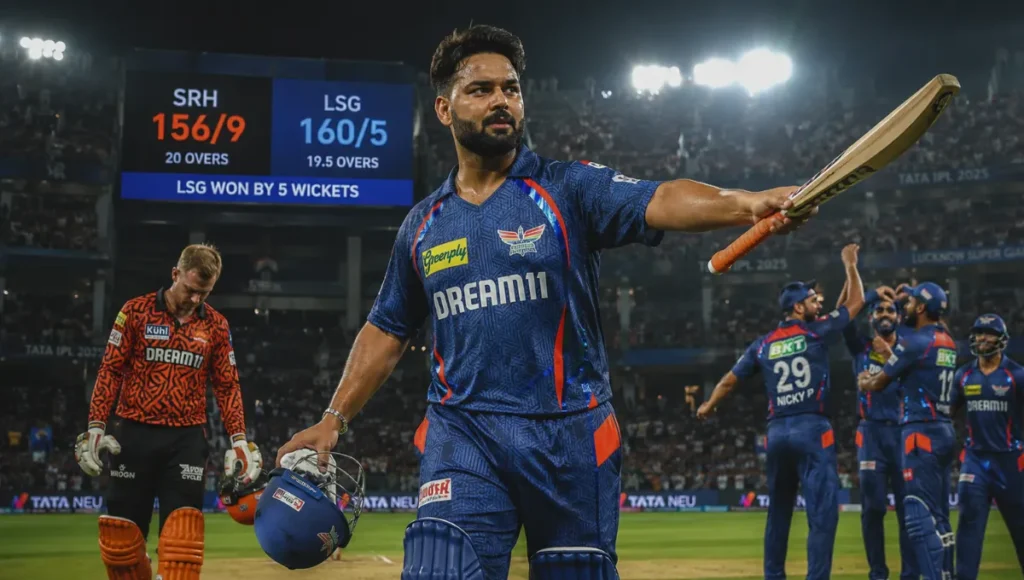

Sunrisers Hyderabad were 26 for 4. Then Heinrich Klaasen and Nitish Kumar Reddy added 116 runs and dragged the innings back from the edge.
It should have been the kind of recovery that wins a home game.
Instead, SRH finished on 156/9. Lucknow Super Giants replied with 160/5 in 19.5 overs. Rishabh Pant stayed unbeaten on 68 and hit the winning boundary in the final over.
This Lucknow Super Giants vs Sunrisers Hyderabad match scorecard tells you the full IPL 2026 Match 10 result. But the figures only make sense when you see the two opening phases together: SRH stumbled to 22/3 in their powerplay; LSG reached 53/1 in theirs. That was the gap the rest of the match never truly erased.
SRH vs LSG Match in 30 Seconds
| Detail | Match information |
|---|---|
| Match | Sunrisers Hyderabad vs Lucknow Super Giants, Match 10 |
| Tournament | Indian Premier League 2026 |
| Date | 5 April 2026 |
| Venue | Rajiv Gandhi International Stadium, Hyderabad |
| Toss | Lucknow Super Giants won the toss and chose to field |
| SRH score | 156/9 in 20 overs |
| LSG score | 160/5 in 19.5 overs |
| Result | Lucknow Super Giants won by 5 wickets |
| Player of the Match | Mohammed Shami — 2/9 in 4 overs |
The one-line story: Mohammed Shami’s new-ball spell put SRH at 22/3 in the powerplay, and although Klaasen and Nitish Reddy rebuilt the innings, Rishabh Pant’s 68* made 157 a chase LSG could control.
But here is the real problem for SRH: their recovery was brave, not complete. They turned 26/4 into 142/5, but then lost four wickets for 14 runs. A side that recovers that well must finish at 175 or above at Hyderabad. At 156, they left LSG with too much room to make mistakes.
Lucknow Super Giants vs Sunrisers Hyderabad Match Scorecard
Sunrisers Hyderabad innings: 156/9 in 20 overs
| Batter | Runs | Balls | 4s | 6s | Strike rate | Dismissal |
|---|---|---|---|---|---|---|
| Travis Head | 7 | 8 | 1 | 0 | 87.50 | c Markram b Shami |
| Abhishek Sharma | 0 | 2 | 0 | 0 | 0.00 | c Siddharth b Shami |
| Ishan Kishan (c, wk) | 1 | 4 | 0 | 0 | 25.00 | b Prince Yadav |
| Liam Livingstone | 14 | 20 | 0 | 1 | 70.00 | c Pant b Digvesh Singh |
| Heinrich Klaasen | 62 | 41 | 5 | 2 | 151.22 | c Pant b Avesh Khan |
| Nitish Kumar Reddy | 56 | 33 | 3 | 5 | 169.70 | c Prince Yadav b Siddharth |
| Aniket Verma* | 2 | 5 | 0 | 0 | 40.00 | not out |
| Harsh Dubey | 0 | 1 | 0 | 0 | 0.00 | b Avesh Khan |
| Shivang Kumar | 5 | 4 | 1 | 0 | 125.00 | b Prince Yadav |
| Harshal Patel | 4 | 2 | 1 | 0 | 200.00 | run out (Pant) |
| Extras | 5 | — | — | — | — | 1 b, 1 lb, 3 wd |
| Total | 156/9 | 20 overs |
Fall of wickets: 1/1 (1.0), 8/2 (2.1), 11/3 (3.3), 26/4 (7.1), 142/5 (17.4), 144/6 (18.1), 144/7 (18.2), 151/8 (19.3), 156/9 (20.0).
LSG bowling figures
| Bowler | Overs | Runs | Wickets | Economy |
|---|---|---|---|---|
| Mohammed Shami | 4 | 9 | 2 | 2.25 |
| Digvesh Singh | 4 | 46 | 1 | 11.50 |
| Prince Yadav | 4 | 34 | 2 | 8.50 |
| Manimaran Siddharth | 4 | 29 | 1 | 7.25 |
| Avesh Khan | 4 | 36 | 2 | 9.00 |
Lucknow Super Giants innings: 160/5 in 19.5 overs
| Batter | Runs | Balls | 4s | 6s | Strike rate | Dismissal |
|---|---|---|---|---|---|---|
| Aiden Markram | 45 | 27 | 6 | 2 | 166.67 | c Livingstone b Shivang Kumar |
| Mitchell Marsh | 14 | 12 | 2 | 0 | 116.67 | c Nitish Reddy b Eshan Malinga |
| Rishabh Pant (c, wk) | 68* | 50 | 9 | 0 | 136.00 | not out |
| Ayush Badoni | 12 | 9 | 1 | 0 | 133.33 | st Kishan b Harsh Dubey |
| Nicholas Pooran | 1 | 4 | 0 | 0 | 25.00 | run out (Ishan Kishan) |
| Abdul Samad | 16 | 12 | 2 | 0 | 133.33 | c Livingstone b Harsh Dubey |
| Mukul Choudhary* | 2 | 5 | 0 | 0 | 40.00 | not out |
| Extras | 2 | — | — | — | — | 1 b, 1 lb |
| Total | 160/5 | 19.5 overs |
Fall of wickets: 37/1 (4.4), 77/2 (9.2), 102/3 (12.1), 105/4 (13.1), 139/5 (17.4).
SRH bowling figures
| Bowler | Overs | Runs | Wickets | Economy |
|---|---|---|---|---|
| Harsh Dubey | 4 | 18 | 2 | 4.50 |
| Nitish Kumar Reddy | 1 | 14 | 0 | 14.00 |
| Jaydev Unadkat | 3.5 | 50 | 0 | 13.04 |
| Eshan Malinga | 4 | 30 | 1 | 7.50 |
| Harshal Patel | 3 | 16 | 0 | 5.33 |
| Shivang Kumar | 4 | 30 | 1 | 7.50 |
Read Also:- Kolkata Knight Riders Vs Chennai Super Kings Match Scorecard
Highlights and Key Moments
1. Shami’s 2/9 made SRH’s powerplay a survival exercise
Mohammed Shami’s spell began with control and ended with a scorecard that looks almost unreal: 4 overs, 9 runs, 2 wickets.
He dismissed Abhishek Sharma for 0 and Travis Head for 7. Those are not ordinary wickets. They are SRH’s primary powerplay attackers. By the time Ishan Kishan fell at 11/3, SRH had lost their top three before the fourth over.
What people think: SRH lost because their middle order did not score fast enough.
Reality: SRH lost the chance to dictate the match before their middle order arrived. A 22/3 powerplay creates a debt. Klaasen and Nitish paid much of it back, but the innings still carried the cost into the final overs.
2. Klaasen and Nitish produced a rescue, not a launchpad
At 26/4, SRH needed stability. Klaasen’s 62 off 41 and Nitish Reddy’s 56 off 33 delivered exactly that. Their 116-run fifth-wicket stand lifted SRH to 142/5 in the 18th over.
That partnership deserves credit. Klaasen struck five fours and two sixes. Nitish hit three fours and five sixes. They did not simply survive; they rebuilt at enough pace to restore belief.
But this is where things go wrong: a rescue partnership can look more complete than it is. SRH had only 14 runs left after Nitish fell at 17.4. Klaasen departed at 18.1. The remaining batters lost four wickets for 14 runs and could not turn the recovery into a 170-plus finish.
Original observation: A fifth-wicket partnership should not be judged only by the runs it adds. It should be judged by how many finishing balls it leaves to the best hitters. Here, SRH’s best two were gone before the final 12 balls.
3. Markram’s 45 created the chase before Pant finished it
Aiden Markram made 45 off 27. The number is easy to overlook because Pant was unbeaten at the end, but Markram’s innings did the heavier early work.
LSG reached 53/1 in the powerplay. That was 31 runs more than SRH scored for the loss of two fewer wickets. Markram hit six fours and two sixes, removing the possibility of a slow, nervous chase.
Counterintuitive point: Pant’s finish was possible because Markram made the target feel ordinary before the middle overs. In a 157 chase, the opener who takes the new ball apart often contributes more to match control than the batter who hits the final boundary.
4. Pant’s 68* was a chase-management innings
Pant’s 68 not out came from 50 balls, with nine fours and no sixes. On a surface where Markram said the new ball was the best time to score and the pitch slowed later, that method made sense.
Pant did not need to force a highlight-reel innings. After Markram fell at 77/2, LSG lost Badoni and Pooran in quick succession to be 105/4. The chase could have tilted. Pant refused to let it.
He rotated, found boundaries at key points, and completed the job in the final over. The winning boundary off Jaydev Unadkat was not merely a finish; it was proof that LSG had kept their best decision-maker at the crease long enough.
Player Performance Breakdown
Mohammed Shami: 2/9: the new-ball spell that created every later advantage
Shami’s 2/9 is the match’s most important number.
| Shami’s impact | Why it mattered |
|---|---|
| Dismissed Abhishek Sharma for 0 | Removed SRH’s immediate powerplay threat |
| Dismissed Travis Head for 7 | Denied SRH their second aggressive opener |
| Conceded 9 in 24 balls | Forced SRH to make up runs against the rest of LSG’s attack |
| SRH powerplay: 22/3 | Left the middle order rebuilding instead of accelerating |
A T20 bowler does not always need three wickets to dominate. Shami’s spell was domination because it deleted SRH’s preferred first-six-over plan.
Practical lesson for bowlers: when facing an aggressive batting side, attack their two highest-value roles first. Keeping a batter quiet is useful; removing the batters who set the team’s tempo is transformative.
Rishabh Pant: 68* off 50: the captain who kept the chase under control
Pant’s innings contained no sixes, which is unusual in a modern successful chase. That is precisely why it matters.
He understood that 157 was not a target requiring constant power. The collapse risk after 105/4 was real. His job was to be the stable batter while Samad attacked in short bursts and the lower order helped finish.
Bold opinion: Pant’s best T20 innings are not always his fastest. This was more valuable than a 35 off 18 because it kept LSG’s lower order from facing a 30-run final-over equation.
Heinrich Klaasen and Nitish Kumar Reddy high-quality rescue, incomplete finish
Klaasen’s 62 and Nitish’s 56 were elite responses after 26/4. They pushed SRH from a collapse toward a competitive total.
Still, the final evaluation must be tough. Their partnership added 116, but the innings closed at 156/9. That means SRH’s remaining resources added only 14 runs after the stand broke.
The tactical fix is not to criticise the pair. It is to plan the 16th-to-20th-over phase earlier. If the recovery pair is carrying the innings, one must preserve strike and one must keep a boundary option in reserve. SRH lost both set batters within three balls of each other.
Aiden Markram: 45 off 27: the innings that changed LSG’s odds
Markram’s six fours and two sixes gave LSG their 53/1 powerplay. He attacked before the pitch slowed and made SRH defend a target rather than attack a new-ball opportunity.
He also revealed an important strategic contrast. SRH’s openers played 14 balls for 7 runs combined. LSG’s top two made 59 from 39. That is not a small difference; it is the match’s hidden scorecard.
Harsh Dubey: 2/18: SRH’s best chance to turn the chase
Harsh Dubey produced 2/18 from four overs, dismissing Badoni and Samad. He gave SRH a route back by reducing LSG from 102/2 to 139/5.
But a single excellent spell cannot defend a below-par total without support. Unadkat conceded 50 from 3.5 overs, and SRH could not make Pant take a low-percentage option in the last two overs.
Analysis: Why SRH Lost in Hyderabad
The powerplay deficit never disappeared
| Phase | SRH | LSG | Match impact |
|---|---|---|---|
| Powerplay | 22/3 | 53/1 | LSG began with 31 more runs and two more wickets in hand |
| Middle phase | Klaasen–Nitish rebuilt | Markram–Pant kept chase calm | SRH restored runs but not full control |
| Closing phase | 14 runs, 4 wickets after 142/5 | Pant stayed unbeaten | SRH left the target short and could not force a gamble |
Read Also:- Lucknow Super Giants vs Punjab Kings Match Scorecard
This table is the match in one glance.
What people think: SRH had a bad start but recovered, so the powerplay did not matter.
Reality: the powerplay shaped everything. It forced Klaasen and Nitish to spend part of their partnership stabilising. It ensured SRH had too little batting depth left for the final two overs. And it made 156 a total LSG could approach with patience.
Why 116 runs for the fifth wicket did not fix the innings
A 116-run stand normally wins praise. It should. But context decides whether it is enough.
SRH were 26/4. They needed a partnership. Then they needed a second surge. They got the first part, but not the second.
At 142/5 in 17.4 overs, 180 was still possible if the set batters survived or if the following players could launch immediately. Instead:
- Nitish fell at 17.4.
- Klaasen fell at 18.1.
- Harsh Dubey was out at 18.2.
- SRH ended 156/9.
The common mistake is believing that any recovery stands on its own. In high-scoring T20s, a recovery must have a closing plan attached.
SRH could not force Pant into a high-risk finish
After 105/4, SRH had a genuine opening. Pant was set but LSG had lost Pooran and Badoni. The opportunity was to create dots, force Pant to hit over the longer boundary, and push the required rate beyond 10 for the last four overs.
Instead, the equation remained manageable. Pant held the innings together; Samad’s 16 off 12 helped; and the final over required only a boundary to end it.
The difference between defending 156 and defending 176 is not just 20 runs. It changes what a captain can do with field placements, matchups, and risk. SRH’s total removed those options.
What SRH should change next time
- Protect one opener’s role in a difficult powerplay. Both Head and Abhishek cannot play identical all-out attacking roles when the opposition has a bowler of Shami’s calibre with a new ball.
- Use a recovery protocol after 20/3. The next two batters need a defined 18-ball target: retain wickets, run hard, and identify the one bowler to attack.
- Keep finishing resources available. If Klaasen and Nitish are both set, do not allow both to be exposed in the same death-over matchup without a plan for the next batter.
- Make Pant hit the hard boundary. In a low defence, packed boundary fields and slower-ball plans must force the set batter to take a genuine risk.
Result, Season Meaning and 2025 vs 2026 Entity Check
LSG’s five-wicket win was their first victory of IPL 2026, according to the Cricbuzz match report. It gave the team momentum after an earlier loss and showed that their bowling unit could create a defendable chase by removing an aggressive top order early.
For SRH, the result was a warning rather than a disaster. Klaasen and Nitish showed that the middle order can recover from trouble. But a side built to score rapidly cannot repeatedly hand opponents a 22/3 powerplay and expect every recovery to reach 180.
Do not mix the 2025 and 2026 meetings
| Fixture | Correct result | How to use it |
|---|---|---|
| SRH vs LSG, IPL 2026 Match 10 | SRH 156/9; LSG 160/5; LSG won by 5 wickets | Main article and current scorecard |
| LSG vs SRH, IPL 2025 Match 61 | LSG 205/7; SRH 206/4; SRH won in 18.2 overs | A separately labelled past-meeting or head-to-head link only |
The 2025 match was a 206 chase, while the 2026 contest was a 157 chase. Treating them as one continuous scorecard narrative would make the page less trustworthy than a simple verified match report.