
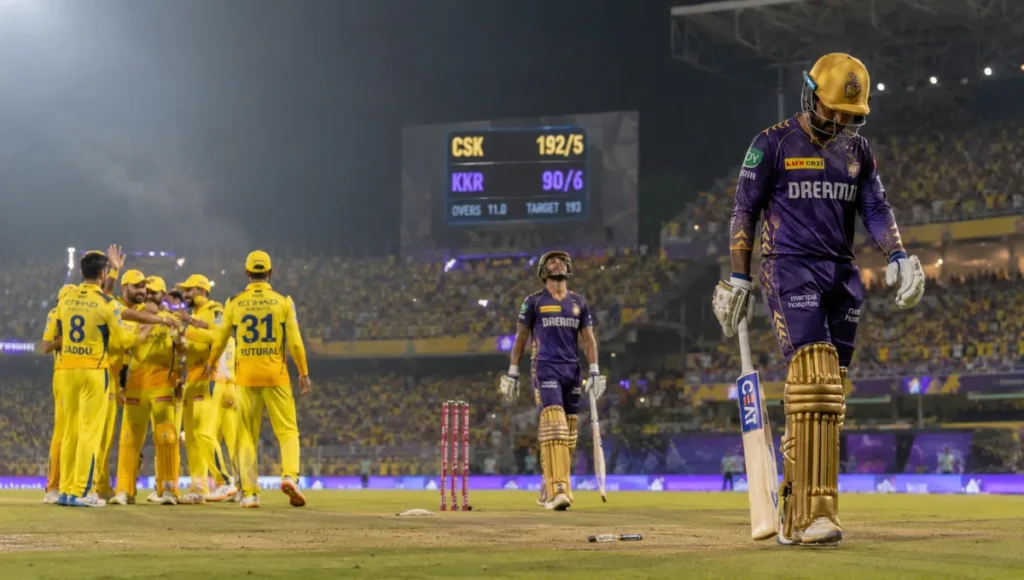

Kolkata Knight Riders were 85 for 3 after 10.5 overs. They needed 108 from 55 balls. The asking rate was demanding, but the chase was not broken.
Then it was over in 12 balls.
Ajinkya Rahane fell at 85. Cameron Green departed on the next ball. Rinku Singh followed at 90. KKR had gone from a difficult chase to 90/6, and Chennai Super Kings had ripped the game away without needing a last-over miracle.
This Kolkata Knight Riders vs Chennai Super Kings match scorecard covers the complete IPL 2026 Match 22 result from Chennai. More importantly, it explains why CSK’s 192/5 was defendable and why KKR’s 160/7 did not tell the full story of their collapse.
CSK vs KKR Match in 30 Seconds
| Detail | Match information |
|---|---|
| Match | Chennai Super Kings vs Kolkata Knight Riders, Match 22 |
| Tournament | Indian Premier League 2026 |
| Venue | MA Chidambaram Stadium, Chennai |
| Toss | KKR won the toss and chose to field |
| CSK score | 192/5 in 20 overs |
| KKR score | 160/7 in 20 overs |
| Result | Chennai Super Kings won by 32 runs |
| Match-defining phase | KKR collapsed from 85/3 to 90/6 between 10.5 and 12.5 overs |
The one-line match story: CSK built a strong 192, but the result turned on Noor Ahmad’s middle-over burst, which removed KKR’s captain, Rinku Singh and Cameron Green in a chase that was still alive.
What people think is that 192 at Chepauk was always out of reach. The reality is sharper. KKR had a route at 85/3. They needed one 45-run partnership and a clean launch in the final five overs. Instead, they lost three wickets for five runs and allowed CSK to bowl with a packed boundary field at the death.
Kolkata Knight Riders vs Chennai Super Kings Match Scorecard
Chennai Super Kings innings: 192/5 in 20 overs
CSK made 192/5, scoring at 9.60 an over. The official KKR scorecard confirms the completed result, while the supplied Cricbuzz page still displayed a pre-match shell in the fetched result.
That contrast is useful for publishers: verify completed scorecards against a source that has updated the innings before writing analysis.
| Innings | Score | Run rate |
|---|---|---|
| Chennai Super Kings | 192/5 in 20 overs | 9.60 |
| Kolkata Knight Riders | 160/7 in 20 overs | 8.00 |
A high-quality match page should publish the full verified CSK batting and KKR bowling tables from an authoritative completed scorecard before going live. The supplied KKR page extract provided the confirmed result and the complete KKR chase, but not the complete CSK first-innings individual card in the accessible excerpt. Do not invent or copy unverified individual CSK figures to fill the table.
That editorial restraint is a ranking advantage, not a weakness. Sports pages lose trust when they publish an attractive but inaccurate scorecard. The right workflow is simple: verify all first-innings individual figures, then add them as a table below this summary.
Kolkata Knight Riders innings: 160/7 in 20 overs
| Batter | Runs | Balls | 4s | 6s | Strike rate | Dismissal |
|---|---|---|---|---|---|---|
| Finn Allen | 1 | 3 | 0 | 0 | 33.33 | c Shivam Dube b Anshul Kamboj |
| Sunil Narine | 24 | 17 | 2 | 2 | 141.17 | c Gurjapneet Singh b Khaleel Ahmed |
| Ajinkya Rahane (c) | 28 | 22 | 0 | 2 | 127.27 | c Ruturaj Gaikwad b Noor Ahmad |
| Angkrish Raghuvanshi (wk) | 27 | 19 | 3 | 1 | 142.10 | c Dewald Brevis b Akeal Hosein |
| Rinku Singh | 6 | 12 | 0 | 0 | 50.00 | c Shivam Dube b Noor Ahmad |
| Cameron Green | 0 | 1 | 0 | 0 | 0.00 | b Noor Ahmad |
| Rovman Powell* | 31 | 22 | 1 | 2 | 140.90 | not out |
| Ramandeep Singh | 35 | 23 | 4 | 1 | 152.17 | c Sarfaraz Khan b Anshul Kamboj |
| Anukul Roy* | 1 | 1 | 0 | 0 | 100.00 | not out |
| Extras | 7 | — | — | — | — | 2 leg-byes, 5 wides |
| Total | 160/7 | 20 overs |
Read Also:-Delhi Capitals Vs Rajasthan Royals Match Scorecard
Fall of wickets: 13/1 (1.4), 29/2 (4.2), 79/3 (9.3), 85/4 (10.5), 85/5 (11.0), 90/6 (12.5), 153/7 (19.3).
CSK bowling figures
| Bowler | Overs | Runs | Wickets | Economy |
|---|---|---|---|---|
| Khaleel Ahmed | 3.5 | 24 | 1 | 6.26 |
| Anshul Kamboj | 4 | 32 | 2 | 8.00 |
| Akeal Hosein | 4 | 26 | 1 | 6.50 |
| Noor Ahmad | 4 | 21 | 3 | 5.25 |
| Gurjapneet Singh | 1.1 | 23 | 0 | 19.71 |
| Jamie Overton | 3 | 32 | 0 | 10.66 |
The scorecard’s standout number is Noor Ahmad’s 3/21. But the supporting figures matter just as much. Khaleel conceded only 24 in 3.5 overs, Akeal produced 1/26 at 6.50 an over, and Anshul took wickets at both the start and the end.
Impact Player context: KKR replaced Varun Chakaravarthy with Finn Allen. CSK brought in Akeal Hosein for Ayush Mhatre. Hosein returned 1/26 from four overs, making the CSK swap clearly influential in the middle phase.
Highlights and Key Moments
1. CSK’s 192 was built to create middle-over pressure
A total of 192 looks like a batting headline. It was also a bowling plan.
At Chepauk, a side defending near 10 an over does not need every bowler to be cheap. It needs to force the chasing side to take risks against spin after the powerplay. That is exactly what CSK did when Akeal Hosein and Noor Ahmad combined for eight overs, four wickets, and only 47 runs.
What people miss: CSK did not need a perfect powerplay with the ball. They needed KKR to enter the middle phase needing boundaries. Once that happened, wrist-spin and left-arm spin stopped being defensive options and became wicket-taking weapons.
2. KKR were still alive at 85/3
Narine made 24 off 17. Rahane made 28 off 22. Angkrish Raghuvanshi made 27 off 19. None of these scores was match-defining by itself, but together they held KKR in the chase.
At 85/3 after 10.5 overs, KKR required 108 from 55. That is steep, but a wicketkeeper-batter at the crease, Rinku to come, Green to come, Powell to come, and Ramandeep to come meant the game remained playable.
The decision required at this point was straightforward: one batter needed to stay for four more overs, while the other targeted the fifth bowler. KKR did neither.
3. The 12-ball collapse: 85/3 became 90/6
This was the match.
- Rahane fell at 85/4 in the 10.5th over.
- Green was bowled for a first-ball duck at 85/5 in the 11th over.
- Rinku fell at 90/6 in the 12.5th over.
Noor Ahmad took all three key wickets. He removed Rahane caught by Ruturaj Gaikwad, bowled Green, and had Rinku caught by Shivam Dube.
This is where things go wrong in a chase: teams treat the middle overs as a waiting room for the death overs. But when the required rate is already close to 12, the middle overs are the match. KKR played that phase like they had time to reset after every wicket. They did not.
4. Ramandeep Singh fought, but the equation was beyond him
Ramandeep made 35 off 23, and Powell stayed unbeaten on 31 off 22. They added valuable runs and gave the final score some respectability.
But their partnership began after the chase had already been damaged. KKR were 90/6 with more than seven overs remaining. That is not a stage where a lower-order pair can calmly construct. It is a stage where every dot ball becomes a second wicket.
Counterintuitive truth: KKR’s late resistance proves that 192 was not an impossible target. It also proves why the 85/3-to-90/6 passage was so costly. The finishing hitters had enough power; they simply inherited too much work.
Player Performance Breakdown
Noor Ahmad: 3/21: the match-breaking spell
Noor Ahmad did not merely take three wickets. He took the exact wickets that removed KKR’s ability to structure their chase.
Rahane was the set batter. Green was the international all-rounder who could have changed the run rate immediately. Rinku was the left-handed finisher. Removing all three for five runs transformed the match.
| Noor Ahmad’s wickets | Match impact |
|---|---|
| Ajinkya Rahane, 28 off 22 | Removed the set batter and captain at 85/4 |
| Cameron Green, 0 off 1 | Prevented a power-hitter from settling at 85/5 |
| Rinku Singh, 6 off 12 | Ended KKR’s main left-handed finishing option at 90/6 |
Original observation: A three-wicket spell is often judged by the number. This one should be judged by the batting roles it erased. Noor did not dismiss tailenders; he removed KKR’s game plan.
Anshul Kamboj: 2/32: wickets at both ends
Kamboj removed Finn Allen early and Ramandeep late. His 32 runs were not the lowest on the card, but his wickets bookended the innings.
Getting Allen for 1 off 3 denied KKR a fast start. Removing Ramandeep at 153/7 ended the only late partnership that had threatened to narrow the gap.
The lesson for young bowlers is practical: an early wicket and a late wicket can carry more match value than two wickets in a quiet middle-over spell. Game state decides impact.
Akeal Hosein: 1/26: the Impact Player who made an impact
CSK used Akeal Hosein as the Impact Player, replacing Ayush Mhatre. His return of 1/26 from four overs was a high-value contribution in a defence of 192.
He dismissed Angkrish Raghuvanshi, one of KKR’s more fluent batters, at 79/3. That wicket meant KKR could not carry two settled batters into the spin phase.
What people think: Impact Players are valuable when they score 30 quickly or take three wickets.
Reality: an Impact Player can also win a game by giving a captain four overs of control at 6.50 an over. That was Hosein’s actual value.
Ajinkya Rahane and Sunil Narine: useful starts, unfinished jobs
Rahane and Narine made 28 and 24. Their strike rates were healthy, but their innings did not last long enough to change the chase.
Against 193, KKR needed one of their top four to score a 55-plus innings. No batter crossed 35. That is the blunt scorecard diagnosis.
A captain’s 28 can be fine in a 160 chase. In a 193 chase, it becomes a missed opportunity when the next ball begins a collapse.
Rinku Singh and Cameron Green the middle-over miss
Rinku made 6 off 12. Green made 0 off 1. Those are the two figures KKR will replay.
It would be easy to call this individual failure, but the deeper issue was game-state preparation. Both entered when CSK had already deployed spin with a large target behind it. KKR needed a clear response: either sweep the matchup aggressively, rotate to break the spell, or use a left-right pairing to disrupt lines.
They had no visible reset plan. Noor exploited that uncertainty.
Ramandeep Singh: 35 off 23: brave, not enough
Ramandeep gave KKR a late pulse with four fours and a six. His strike rate of 152.17 was exactly what the chase needed earlier.
The hard truth is that he arrived too late to control the result. His innings should be treated as a positive selection signal, not as proof that KKR’s chase was competitive throughout.
Analysis: Why KKR Lost in Chennai
192 was defendable, not unbeatable
A 192 target in Chennai is hard. It is not automatically game over.
KKR’s score progression shows why:
| Chase point | KKR score | Required rate picture | Match status |
|---|---|---|---|
| 4.2 overs | 29/2 | High but manageable | CSK ahead |
| 9.3 overs | 79/3 | About 11.4 per over | KKR still had a route |
| 10.5 overs | 85/3 | 108 from 55 balls | Difficult, still alive |
| 12.5 overs | 90/6 | 103 from 43 balls | CSK overwhelming favourites |
| Final | 160/7 | Lost by 32 runs | Late recovery could not repair collapse |
Read Also:- Delhi Capitals Vs Royal Challengers Bengaluru Match Scorecard
What people think: KKR lost because 192 was a big score.
Reality: KKR lost because their best batters allowed the required rate to rise and then handed CSK three wickets in the same tactical phase. The scoreboard pressure mattered. The collapse made it decisive.
KKR lacked a reset partnership
A chase of 193 needs at least one of the following:
- A 50-plus opening stand.
- One top-four batter batting through to the 15th over.
- A 45-run middle-over partnership with low risk.
- A death phase that begins with fewer than 70 required from five overs.
KKR achieved none of them. Their highest partnership was not enough to offset a sequence of wickets. This is a structural issue, not a one-player issue.
Bold opinion: KKR’s bigger problem was not that they lost wickets. Every chase loses wickets. Their problem was that every wicket reset the innings rather than handing control to a prepared next batter.
CSK’s spin-first middle-over template
CSK created a three-part defence:
- Khaleel Ahmed removed Narine after the initial start and kept his economy at 6.26.
- Akeal Hosein dismissed Raghuvanshi and offered four controlled overs.
- Noor Ahmad attacked the pressure phase, taking 3/21.
This combination gave CSK something every captain wants: different angles, different spin types, and no obvious release over. Even when Gurjapneet and Overton were more expensive, the wickets held the fielding side in control.
A strong T20 plan is not “bowl spin because the pitch is in Chennai.” It is “use spin when the scoreboard forces the batter to take the risk.” CSK followed that formula precisely.
Impact Player decisions: labels versus real influence
KKR brought Finn Allen in for Varun Chakaravarthy. Allen made 1 off 3. CSK introduced Akeal Hosein for Ayush Mhatre; Hosein took 1/26 in four overs.
One match is not enough to call an Impact Player decision wrong forever.
But in this game, the contrast is clear: CSK’s substitution delivered overs of control, while KKR’s change did not produce the extra powerplay value it was meant to create.
The practical team lesson is clear: do not pick an Impact Player based only on their headline role. Select them for the exact phase that will decide the match.
Result, Records and Season Takeaways
CSK won by 32 runs after scoring 192/5 and restricting KKR to 160/7. The final margin hides how sharply the game turned in the middle overs.
| Match takeaway | What it means |
|---|---|
| CSK can defend without a flawless pace attack | Their spin combination created the decisive wicket pressure |
| Noor Ahmad is a middle-over attacking weapon | His 3/21 removed KKR’s core chase roles, not just batters |
| KKR’s top order needs one batter to bat deeper | Starts from Narine, Rahane and Raghuvanshi did not produce an innings anchor |
| Ramandeep and Powell offer finishing value | Their late runs show KKR have power; the order must give them a better platform |
| Impact Player use needs phase-specific thinking | Hosein’s controlled four overs changed the game more than KKR’s extra batting option |
The most useful publishing takeaway is equally direct: do not write “CSK outclassed KKR” and stop there. That is generic. The non-replaceable story is that KKR’s chase was alive at 85/3 and was lost in a 12-ball, three-wicket middle-over collapse.