
India needed 17 runs off the last six balls. That should have been the end of it.
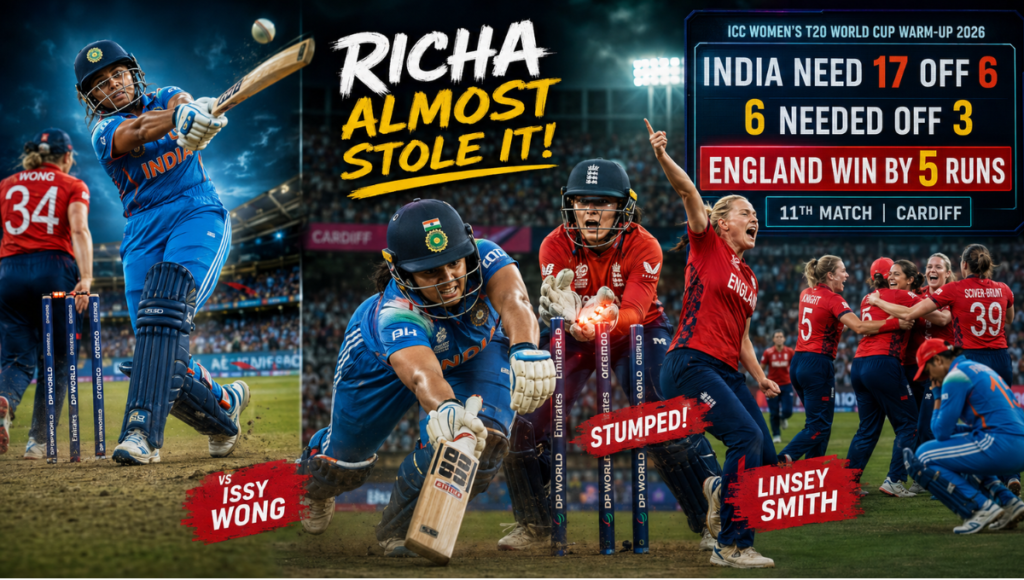
Instead, Richa Ghosh took Issy Wong and Linsey Smith apart, brought the equation down to 6 needed off 3 balls, and then was stumped attempting the shot that could have won it. England held on to win by exactly 5 runs.
This India Women’s National Cricket Team vs England Women’s National Cricket Team match scorecard covers the 11th Match of the ICC Women’s T20 World Cup Warm-up Matches 2026 at Cardiff. It was only a warm-up game, but it produced one of the tensest finishes either side will have played all year.
Match in 30 Seconds
| Detail | Match information |
|---|---|
| Match | 11th Match, ICC Women’s T20 World Cup Warm-up Matches 2026 |
| Venue | Sophia Gardens, Cardiff |
| Date | 10 June 2026 |
| England Women score | 171/6 in 20 overs |
| India Women score | 166 all out in 19.5 overs |
| Result | England Women won by 5 runs |
| Standout performer | Richa Ghosh — 68 off 36 balls for India |
The one-line story: England built a competitive total through Nat Sciver-Brunt’s captaincy and a middle-order stand, then survived a stunning Richa Ghosh counterattack that fell just short in the final over.
What people think is that a team bowled out with two balls unused clearly never had a real chance to win.
The reality here was tighter than that framing suggests: India needed just 6 off the final 3 balls after Ghosh’s assault, meaning this “warm-up defeat” was a genuine last-ball-level thriller, not a comfortable England win.
India Women’s National Cricket Team vs England Women’s National Cricket Team Match Scorecard
England Women’s innings: 171/6 in 20 overs
England built their total around a middle-order partnership involving captain Nat Sciver-Brunt and Amy Jones, followed by a strong finish in the closing overs. Sciver-Brunt described the pitch as “scratchy” in the first 30 balls before the scoring became easier once she returned to the crease.
India bowling
| Bowler | Notable contribution |
|---|---|
| Renuka Singh | Part of India’s opening attack |
| Shree Charani | Bowled at the death, went for runs late |
India Women’s innings: 166 all out in 19.5 overs
| Batter | Runs | Balls | 4s | 6s | Strike rate | Dismissal |
|---|---|---|---|---|---|---|
| Shafali Verma | — | — | — | 1 | — | fell early after brief momentum |
| Richa Ghosh (wk) | 68 | 36 | 9 | 2 | 188.89 | st Capsey b Linsey Smith |
| Radha Yadav | — | — | — | — | — | part of a 33-run stand with Ghosh |
| Shree Charani | 5 | 2 | 1 | 0 | 250.00 | not out |
| Renuka Singh | 0 | 1 | 0 | 0 | 0.00 | c Charlie Dean b Linsey Smith |
| Total | 166 | 19.5 overs |
Key sequence: India were 155/8 after 19 overs before Ghosh’s final-over assault. At 19.1, India needed 17 off 6 balls; by 19.5, they needed just 6 off 3 before Ghosh was stumped attempting to finish the chase.
England bowling figures
| Bowler | Contribution |
|---|---|
| Linsey Smith | Set the tone early with the wicket of Smriti Mandhana, then closed out the final over |
| Tilly Corteen-Coleman | Took two vital wickets, including India captain Harmanpreet Kaur |
| Charlie Dean | Bowled tight and took two wickets in a game-changing 18th over |
| Danielle Gibson | Carried batting momentum into her bowling spell |
Read Also:- Royal Challengers Bengaluru Vs Gujarat Titans Stats
Highlights and Key Moments
1. India’s flat start left too much work for the middle order
Chasing 172, India never looked fully in control from the start. Shafali Verma provided a brief spark with a quick four and six before falling early, but England’s disciplined attack led by Linsey Smith’s early wicket of Smriti Mandhana and Tilly Corteen-Coleman’s two scalps, including captain Harmanpreet Kaur choked the scoring rate and built sustained pressure.
What most people miss: a slow start in a run-chase does not just cost runs in isolation it forces every batter who follows to take on more risk than the situation would otherwise demand. India’s middle overs were effectively played from behind before Ghosh even arrived at the crease.
2. The 33-run stand that revived India’s chase
A 33-run partnership off just 19 balls between Richa Ghosh and Radha Yadav briefly lifted India’s hopes, injecting real intent into an innings that had lacked it. Radha fell soon after to break the stand, but the platform had been built for Ghosh to take full control.
Counterintuitive point: most rescue partnerships in T20 chases are remembered for their overall total, but the real value here was tempo-setting the stand reset India’s scoring rate at exactly the moment Ghosh needed room to accelerate without immediately facing an impossible equation.
3. The final-over thriller, ball by ball
With India needing 17 off the final over, bowled by Linsey Smith, Ghosh took a single early to retain strike for teammate Shree Charani, then took over herself: a four, followed by a six that brought up her fifty and cut the equation to 6 off 3. Two balls later, attempting to finish the match with a big shot down the ground, she was stumped by Alice Capsey. The very next ball, Renuka Singh was caught by Charlie Dean off Smith to end the match.
This is where things go wrong for a chasing side, even a heroic one: a batter forced to attempt boundary-or-nothing cricket in the final two balls of a tight chase accepts a genuinely elevated dismissal risk. Ghosh’s stumping was not a batting error in isolation it was the mathematically necessary risk of trying to close a gap that should never have been that wide with two balls left.
4. Charlie Dean’s 18th over changed the equation before the final-over drama even began
Before Ghosh’s final assault, Charlie Dean bowled a genuinely game-changing 18th over, taking two wickets and keeping things tight at a stage when India desperately needed acceleration, not further setbacks.
Bold opinion: Dean’s over deserves more credit than it will likely receive, precisely because the match ended in such dramatic fashion around Ghosh. Without Dean’s control and wickets in that specific over, England’s eventual 5-run margin might never have needed a nervy final-over finish at all the game could easily have been settled well before the last six balls.
Player Performance Breakdown
Richa Ghosh: 68 off 36: a near-miracle chase
Richa Ghosh’s 68 off 36 balls, including nine fours and two sixes, single-handedly dragged India back from the brink of a heavy defeat. Her captain, Harmanpreet Kaur, was unequivocal in her praise: “only Richa played a blinder,” and the innings gave the squad “a big belief that, you know, if we stay on the pitch, we can turn the game anytime.”
Original observation: the true value of Ghosh’s innings is not fully captured by “68 off 36” alone. It’s captured by the shift in equation she created in six deliveries from 17 needed off 6 to 6 needed off 3. That is one of the steepest single-over required-rate swings possible in T20 cricket, and it happened because of one batter’s shot selection under maximum pressure, not a gradual team recovery.
Linsey Smith: composure in the death overs
Linsey Smith set the tone early by dismissing Smriti Mandhana, then returned to bowl the tense final over, finishing with figures that included the crucial wickets of both Ghosh and Renuka Singh in the space of two balls.
Practical lesson for death-overs bowling: Smith’s success in the final over came from tossing the ball up outside off stump rather than bowling defensively into the pitch a plan that induced Ghosh’s mistimed shot rather than simply trying to avoid the boundary. Attacking a dangerous batter’s technique, even at the death, can be more effective than pure containment.
Nat Sciver-Brunt captaincy and a crucial partnership
England’s captain contributed with both bat and leadership, noting that “the plan became simpler” once she returned to the crease after the pitch had “scratched” through the first 30 balls. Her partnership with Amy Jones provided the platform for England’s eventual 171.
What people think vs reality: casual readers might assume a warm-up match carries reduced captaincy pressure. Sciver-Brunt’s own comments describing the game as “a good warm-up for all facets” before turning attention to “the business end” reveal that even a low-stakes fixture was treated as genuine tactical preparation, not a throwaway exhibition.
Charlie Dean the spinner who broke India’s middle order
Dean’s two wickets in the 18th over were the least-discussed but arguably most impactful bowling contribution of the match, arriving at the exact moment India needed to build momentum rather than lose it.
Common mistake in analysis: focusing entirely on the dramatic final over and overlooking the over that actually made England’s eventual margin survivable. Dean’s spell is the clearest example in this match of a “quiet” bowling performance doing more real damage than a flashier one.
Analysis: Why India Fell 5 Runs Short
Harmanpreet’s “missed partnerships” diagnosis
India’s captain was direct in her post-match assessment: “I think it’s about partnerships and I think we missed [them] only Richa played a blinder. In T20 cricket you need a few partnerships in the middle, which we missed today.”
Bold opinion: this is the single most useful diagnostic sentence from either team all match. India did not lose because of a lack of individual talent they lost because their innings depended on isolated cameos (Shafali’s early burst, the Ghosh-Radha stand, Ghosh’s own assault) rather than one sustained middle-overs partnership that could have kept the required rate manageable throughout, rather than needing a miracle at the death.
England’s three-phase bowling plan
England’s attack worked in three connected phases: Linsey Smith and Tilly Corteen-Coleman applied early pressure and took key wickets in the powerplay and middle overs; Charlie Dean tightened the screws further with two wickets in the 18th over; and Smith returned to close out the final over with an attacking, technique-targeting plan rather than pure containment.
Practical takeaway for bowling captains: a complete bowling performance rarely depends on one standout spell. England’s win came from three different bowlers contributing at three different, connected moments proof that a well-sequenced plan across the full 20 overs matters more than any single over of brilliance.
What this warm-up match means for the World Cup opener
Both captains explicitly framed this match as preparation. Sciver-Brunt said the team was “really excited for the competition to start” and ready “to feel that heat first up.” Harmanpreet echoed the sentiment from India’s side, specifically flagging their tournament opener against Pakistan in Birmingham as the moment that mattered most, adding that the two practice games had given the squad “a lot of confidence” to “play fearless cricket.”
Practical lesson for reading warm-up results: a 5-run margin in a fixture explicitly designed for experimentation should not be treated as a reliable form guide. Harmanpreet’s own framing that everyone got a “fair chance” before the tournament proper signals that team selection and risk-taking in this match were not the same as they will be once the World Cup begins.
Read Also:- Ireland Cricket Team Vs India National Cricket Team Match Scorecard
Format Guardrail, Records and Tournament Context
Understanding the different India-England women’s fixtures
| Fixture | Format / competition | Correct use |
|---|---|---|
| India Women vs England Women, T20 World Cup Warm-up (this article) | T20I warm-up match, Cardiff, June 2026 | This article’s core scorecard |
| India Women tour of England 2026 — 1st and 2nd T20I | Bilateral T20I series | Separate historical/format-specific article only |
| India Women tour of England 2026 — Only Test | Bilateral Test match | Entirely different format; must not be blended with T20 figures |
| India Women vs England Women, ICC Women’s Cricket World Cup (Indore) | 50-over ODI World Cup group match, 2025 | A different tournament, format, and year entirely |
For example, in the 50-over World Cup match at Indore, England won by 4 runs after Heather Knight’s 109 anchored a total of 288/8, while India replied with 284/6 built around Smriti Mandhana’s 88 and Harmanpreet Kaur’s 70. These figures belong to an entirely different tournament and year, and must never be presented as part of this T20 World Cup warm-up scorecard.