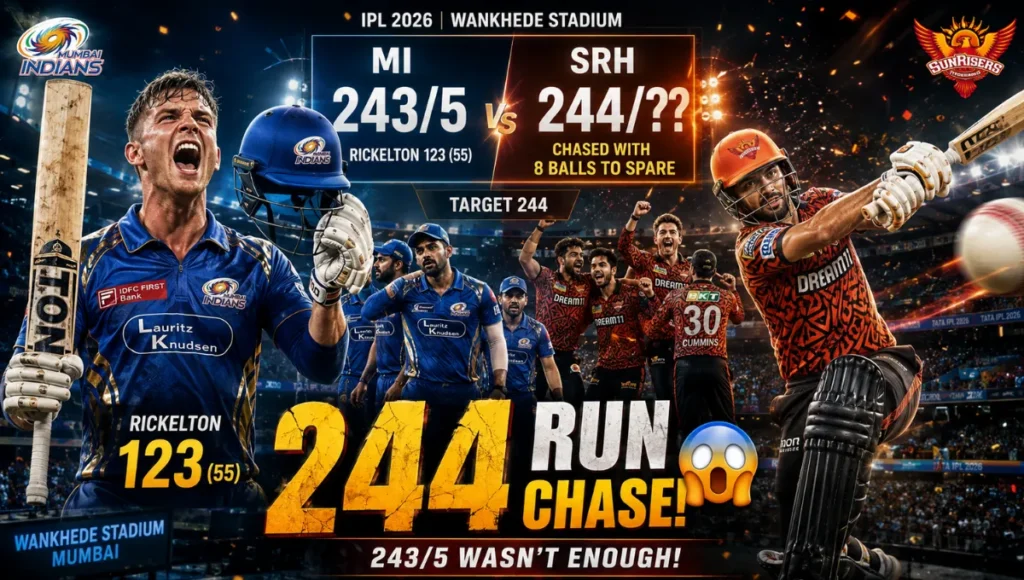

Ryan Rickelton scored 123 not out off 55 balls. Mumbai Indians posted 243/5. In most IPL seasons, that combination wins comfortably.
Sunrisers Hyderabad chased it down anyway, with eight balls to spare.
This Mumbai Indians vs Sunrisers Hyderabad match scorecard covers the full 41st Match of IPL 2026 at Wankhede Stadium a match that produced the highest successful run-chase in IPL history at that specific venue. Rickelton’s century wasn’t the story. The story is how a 244-run target simply stopped being safe.
Match in 30 Seconds
| Detail | Match information |
|---|---|
| Match | 41st Match, Indian Premier League 2026 |
| Venue | Wankhede Stadium, Mumbai |
| Date | 29 April 2026 |
| Toss | Mumbai Indians won the toss and elected to bat |
| Mumbai Indians score | 243/5 in 20 overs |
| Sunrisers Hyderabad score | 249/4 in 18.4 overs |
| Result | Sunrisers Hyderabad won by 6 wickets |
| Player of the Match | Heinrich Klaasen — 65* off 30 |
The one-line story: Ryan Rickelton’s century gave Mumbai Indians a genuinely strong total, but Abhishek Sharma and Travis Head’s 129-run opening stand made the chase feel routine before Heinrich Klaasen finished it off with an unbeaten 65, handing SRH their fifth straight win.
What people think is that a century from your best batter, combined with a 243 total, should be close to a guaranteed win. The reality in IPL 2026, as this match proved, is that totals once considered match-winning are now merely competitive and SRH’s top three treated 244 as an ordinary target, not an extraordinary one.
Mumbai Indians vs Sunrisers Hyderabad Match Scorecard
Mumbai Indians innings: 243/5 in 20 overs
| Batter | Runs | Balls | 4s | 6s | Strike rate | Dismissal |
|---|---|---|---|---|---|---|
| Will Jacks | 46 | 22 | 5 | 3 | 209.09 | c Kishan b Nitish Kumar Reddy |
| Ryan Rickelton (wk) | 123 | 55 | 10 | 8 | 223.64 | not out |
| Suryakumar Yadav | 5 | 5 | 1 | 0 | 100.00 | c Sharma b Malinga |
| Naman Dhir | 22 | 17 | 3 | 0 | 129.41 | c Dubey b Hinge |
| Hardik Pandya (c) | 31 | 15 | 2 | 2 | 206.67 | c Klaasen b Sakib Hussain |
| Tilak Varma | 7 | 5 | 0 | 1 | 140.00 | c Klaasen b Hinge |
| Robin Minz | 1 | 1 | 0 | 0 | 100.00 | not out |
| Extras | 8 | — | — | — | — | 1 lb, 7 w |
| Total | 243/5 | 20 overs |
Fall of wickets: 93/1 (Will Jacks, 7.1), 110/2 (Suryakumar Yadav, 8.3), 165/3 (Naman Dhir, 13.4), 221/4 (Hardik Pandya, 18.1), 232/5 (Tilak Varma, 19.3).
SRH bowling figures
| Bowler | Overs | Runs | Wickets | Economy |
|---|---|---|---|---|
| Pat Cummins | 4 | 39 | 0 | 9.75 |
| Praful Hinge | 4 | 54 | 2 | 13.50 |
| Eshan Malinga | 4 | 29 | 1 | 7.25 |
| Harsh Dubey | 3 | 50 | 0 | 16.66 |
| Sakib Hussain | 3 | 39 | 1 | 13.00 |
| Nitish Kumar Reddy | 2 | 31 | 1 | 15.50 |
Sunrisers Hyderabad innings: 249/4 in 18.4 overs
| Batter | Runs | Balls | 4s | 6s | Strike rate | Dismissal |
|---|---|---|---|---|---|---|
| Abhishek Sharma | 45 | 24 | 4 | 3 | 187.50 | c Boult b Ghazanfar |
| Travis Head | 76 | 30 | 4 | 8 | 253.33 | c Jacks b Hardik Pandya |
| Ishan Kishan (wk) | 0 | 1 | 0 | 0 | 0.00 | b Ghazanfar |
| Heinrich Klaasen | 65 | 30 | 7 | 4 | 216.67 | not out |
| Nitish Kumar Reddy | 21 | 17 | 3 | 0 | 123.53 | c Yadav b Boult |
| Salil Arora | 30 | 10 | 2 | 3 | 300.00 | not out |
| Extras | 12 | — | — | — | — | 4 lb, 8 w |
| Total | 249/4 | 18.4 overs |
Fall of wickets: 129/1 (Abhishek Sharma, 8.4), 129/2 (Ishan Kishan, 8.5), 133/3 (Travis Head, 9.4), 213/4 (Nitish Kumar Reddy, 16.2).
MI bowling figures
| Bowler | Overs | Runs | Wickets | Economy |
|---|---|---|---|---|
| Trent Boult | 4 | 41 | 1 | 10.25 |
| Jasprit Bumrah | 4 | 54 | 0 | 13.50 |
| Will Jacks | 1 | 19 | 0 | 19.00 |
| Allah Ghazanfar | 4 | 51 | 2 | 12.75 |
| Ashwani Kumar | 2 | 41 | 0 | 20.50 |
| Hardik Pandya | 3.4 | 39 | 1 | 10.63 |
Highlights and Key Moments
1. Rickelton’s century in a losing cause
Ryan Rickelton’s 123 not out off 55 balls, with 10 fours and 8 sixes, was comfortably the best individual batting performance of the match. It also wasn’t enough he became the fifth batter in IPL 2026 alone to score a century while ending up on the losing side.
What most people miss: a batting-side century is often treated as an automatic guarantee of a competitive, if not winning, total. Five instances of this exact outcome happening in a single IPL season is not a coincidence it reflects a tournament-wide scoring environment where even brilliant individual innings can be matched or exceeded by the chasing side.
2. The 129-run stand that decided the match early
Abhishek Sharma and Travis Head added 129 runs for SRH’s first wicket, reaching that mark inside the ninth over. By the time both had been dismissed in the space of five balls Sharma at 129/1 and Head at 133/3 SRH already needed just 111 more from roughly 11 overs, with wickets in hand and the asking rate well under control.
Counterintuitive point: most readers assume a chase is decided in the final overs, when the required rate becomes visible pressure. Here, the match was effectively decided by the ninth over everything that followed, including two quick wickets, was simply the formality of confirming a result that a 129-run opening stand had already made highly likely.
3. Klaasen’s calculated risk-taking finishes the chase
Heinrich Klaasen’s unbeaten 65 off 30 balls came with a specific method he explained afterward: “Big gap at cow corner so had to take a risk early… The left shoulder gave me some issues, so I am not as strong over cow corner.” He built his innings around risk-free strokes before accelerating, precisely targeting the parts of the ground his body allowed him to attack effectively.
This is where things go wrong for a bowling side facing an in-form finisher: MI’s attack bowled “on both sides of the wicket,” in ESPN’s own assessment, and kept offering scoring opportunities rather than forcing Klaasen away from his preferred zones. A finisher who has openly identified his own physical limitation should be bowled to specifically around that limitation, not given room to work around it.
4. The Impact Player decision that never happened
Mumbai Indians named Shardul Thakur as their Impact Player substitute for this match and then never brought him on. ESPN’s analysis called the decision “baffling,” alongside MI’s separate choice not to open with Will Jacks despite an obvious off-spin matchup against both Abhishek Sharma and Travis Head.
Bold opinion: naming a specialist Impact Player and then not using him at all is not a neutral decision it’s a wasted resource in a format where every tactical option matters. If Shardul wasn’t needed in this specific match state, that itself raises the question of why he was selected as the Impact Player in the first place, rather than a batting or fielding-focused alternative.
Player Performance Breakdown
Heinrich Klaasen: Player of the Match under real pressure
Klaasen’s 65 not out off 30 balls, including seven fours and four sixes, closed out the chase with calm authority.
He was explicit about his mindset: “Not at all [feeling invincible]. Humble. New day tomorrow.”
He also credited the momentum created by Abhishek Sharma and Travis Head: “You can feel them putting the bowlers under pressure. If they are going, it makes your job easier.”
Original observation: Klaasen’s honesty about his own physical limitation (his left shoulder affecting his cow-corner power) is a rare, genuinely useful data point for opposition analysts.
Most finishers won’t publicly reveal a specific tactical weakness; his willingness to do so, immediately after exploiting the gap it created, shows a player confident enough in his broader game to be transparent about one part of it.
Ryan Rickelton a century that still wasn’t enough
Rickelton’s 123 off 55 balls was a genuinely exceptional individual performance, and ESPN’s own reporting specifically noted that his “presence was important for MI” even in defeat. He struck 10 fours and 8 sixes at a strike rate of 223.64.
Practical lesson for batting orders: a match-winning individual performance from one batter cannot fully compensate for a total the bowling attack cannot defend. MI’s other batters combined for just 120 runs across the remaining wickets meaning the team’s fate rested almost entirely on Rickelton’s shoulders rather than a genuinely deep collective effort.
Abhishek Sharma and Travis Head the powerplay that decided everything
Sharma’s 45 off 24 and Head’s 76 off 30 combined for a 129-run opening stand that set the tone for the entire chase. Sharma, holding the Orange Cap at the time, explained his simple philosophy afterward: “If you see the total every team is scoring, you have to step up and do it for your team… Watch the ball and react.”
What people think vs reality: fans often credit a finisher like Klaasen entirely for “winning” a chase. In reality, this match was substantially decided before the tenth over the finisher’s job was made dramatically easier by an opening stand that had already reduced the equation to a formality.
Hardik Pandya: an honest captain’s admission
MI’s captain was unusually direct in his post-match reflection: “I don’t think dew played much of a role, just that they played some good shots, we bowled bad balls… As an overall unit, we have not been able to do what MI stands for.”
Common mistake in analysis: attributing a high-scoring chase primarily to external conditions like dew or a flat pitch. Hardik’s own assessment explicitly rejects that explanation, pointing instead to specific bowling execution failures a far more useful and honest diagnosis than blaming the conditions.
Analysis: Why 243 Wasn’t Enough
The new IPL reality Cummins described
What people think: 243 is comfortably a match-winning total in T20 cricket, regardless of the season or venue.
Reality: SRH captain Pat Cummins articulated the shift directly: “Now, even 12 an over, you can chase as a batting unit, so you have to reset your expectations as a bowling unit.” His own team chased 244 at a required rate that peaked around 12-13 an over without ever looking under serious pressure.
MI’s tactical errors, self-admitted
Beyond the unused Impact Player, MI’s specific bowling execution described by Hardik himself as “bad balls” allowed SRH’s top three to convert scoring opportunities into boundaries at will. ESPN’s analysis noted MI “bowled on both sides of the wicket” rather than committing to one consistent line against SRH’s aggressive top order.
Bold opinion: this match should be read less as “SRH were brilliant” (though they were) and more as “MI’s tactical execution from team selection to bowling lines compounded an already difficult defending task.” A genuinely elite bowling unit facing this SRH top order might still have lost, but MI’s specific, self-admitted errors made the margin far more comfortable than it needed to be.
What this result meant for both teams’ seasons
This was SRH’s fifth straight win, continuing a genuinely dominant run of form. For Mumbai Indians, the defeat continued a difficult season, with Hardik Pandya candidly acknowledging the team had “not been able to do what MI stands for” and flagging limited squad options as a compounding issue.
Practical takeaway for team analysis: a five-time champion franchise struggling to string together complete performances, as MI did across IPL 2026, often reflects a combination of tactical execution issues and genuine squad-depth limitations not simply a stretch of bad luck. This match’s specific, named errors (the unused Impact Player, the batting-order sequencing, the bowling lines) are the kind of fixable issues a team in MI’s position needs to address directly.
Records, Points Table Impact and Format Guardrail
Points table after this match
| Team | Matches | Won | Lost | Points | NRR | Position |
|---|---|---|---|---|---|---|
| RCB | 14 | 9 | 5 | 18 | +0.783 | 1st |
| GT | 14 | 9 | 5 | 18 | +0.695 | 2nd |
| SRH | 14 | 9 | 5 | 18 | +0.524 | 3rd |
| RR | 14 | 8 | 6 | 16 | +0.189 | 4th |
| PBKS | 14 | 7 | 6 | 15 | +0.309 | 5th |
| DC | 14 | 7 | 7 | 14 | -0.651 | 6th |
| KKR | 14 | 6 | 7 | 13 | -0.147 | 7th |
| CSK | 14 | 6 | 8 | 12 | -0.345 | 8th |
| MI | 14 | 4 | 10 | 8 | -0.584 | 9th |
| LSG | 14 | 4 | 10 | 8 | -0.740 | 10th |
Record-book context
| Record | Detail |
|---|---|
| Highest successful run-chase at Wankhede Stadium | SRH’s 249/4 chasing MI’s 243/5, IPL 2026 |
| Batters scoring a century in a losing cause, IPL 2026 | Ryan Rickelton became the 5th instance this season alone |
| SRH’s win streak at the time | Extended to 5 consecutive wins |
| MI’s Impact Player usage | Shardul Thakur named but never used — a specific, self-evident tactical gap |
Format and fixture guardrail
| Fixture | Correct context |
|---|---|
| MI vs SRH, 41st Match, IPL 2026 (this article) | The record-breaking match — this article’s core scorecard |
| SRH vs MI, 41st Match, IPL 2025 | A completely different season with the identical match number — a genuine confusion risk |
| SRH vs MI, 2018 (Punjab Kings archive) | An even older, unrelated season |
Do not present the IPL 2025 41st Match or the 2018 fixture’s figures as part of this 2026 scorecard, despite the identical match-number coincidence with the 2025 game. Each belongs to a separate season entirely.
Frequently Asked Questions
Ans. Sunrisers Hyderabad won by 6 wickets. MI scored 243/5, and SRH chased it down at 249/4 in 18.4 overs at Wankhede Stadium, Mumbai.
Ans. Mumbai Indians scored 243/5, led by Ryan Rickelton’s 123 not out. Sunrisers Hyderabad replied with 249/4 in 18.4 overs, with Travis Head’s 76 and Heinrich Klaasen’s unbeaten 65 the key contributions, as SRH won by 6 wickets.
Ans. Yes. SRH’s chase of 244 in this match is the highest successful run-chase ever completed at Wankhede Stadium in IPL history.
Ans. Heinrich Klaasen was Player of the Match for his unbeaten 65 off 30 balls, which finished off the record-breaking chase.
Ans. Rickelton’s century gave MI a strong total, but SRH’s openers, Abhishek Sharma and Travis Head, added 129 runs for the first wicket, making the 244-run target feel routine well before the death overs.