
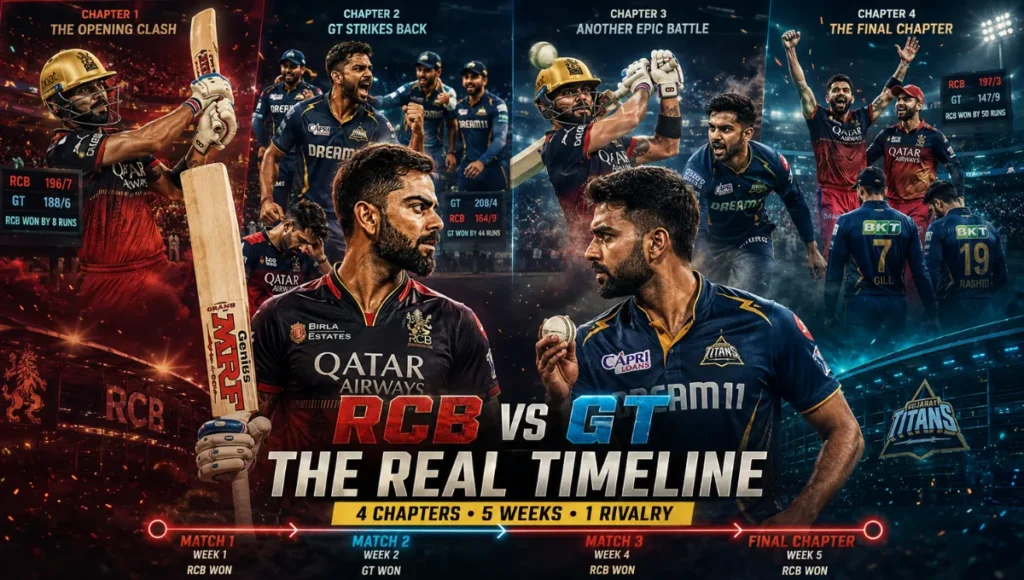

Most fans remember this rivalry as a clean story: RCB dominated Gujarat Titans on their way to a second straight title. That’s not quite what happened.
The real story has four chapters, spread across five weeks, and one of them belongs entirely to Gujarat Titans. This is the complete Royal Challengers Bengaluru vs Gujarat Titans timeline every match, in order, with the moments that actually built the rivalry’s final shape.
The Timeline at a Glance
| Chapter | Date | Match | Venue | Result |
|---|---|---|---|---|
| 1 | 24 April 2026 | 34th Match | M Chinnaswamy Stadium, Bengaluru | RCB won by 5 wickets (18.5 overs) |
| 2 | 30 April 2026 | 42nd Match | Narendra Modi Stadium, Ahmedabad | Gujarat Titans won by 4 wickets (15.5 overs) |
| 3 | 26 May 2026 | Qualifier 1 | HPCA Stadium, Dharamsala | RCB won by 92 runs |
| 4 | 31 May 2026 | Final | Narendra Modi Stadium, Ahmedabad | RCB won by 5 wickets (18 overs) |
The one-sentence season story: RCB won three of four meetings against Gujarat Titans in IPL 2026, but the one match they lost six days after their first win forced a tactical correction that directly shaped how they closed out the title.
Chapter 1: 24 April The Chase That Announced RCB’s Depth
RCB won the toss and chose to field, on what their own match report described as a “deadbeat” surface that favoured batters. Sai Sudharsan and Shubman Gill made the most of it, adding 128 runs in the first 13 overs, with Sudharsan reaching a century off 58 balls. Gujarat Titans eventually posted 205/3, with a late Jason Holder cameo an unbeaten 23 off 10 balls pushing them past 200.
What most people miss: RCB’s chase did not start well. Jacob Bethell, in for the injured Phil Salt, fell early to Mohammed Siraj, and the pressure was squarely on the next batter.
That next batter was Devdutt Padikkal, and what happened next set the tone for the entire rivalry. His first ball, a 153kph delivery from Kagiso Rabada, was flicked over deep square leg for six. He and Virat Kohli then added 115 runs in just 59 balls, with Padikkal reaching his fifty off 20 balls and Kohli bringing up his 66th IPL half-century.
This is where things go wrong for a bowling side defending 200-plus: once Padikkal and Kohli found their rhythm, GT had no answer, even on a surface that had initially looked to favour their own batters. RCB lost both set batters in quick succession afterward, slipping to 173/5 needing 33 off 27 balls, but Krunal Pandya’s unbeaten 23 off 12 and Tim David’s calm finish closed it out with seven balls to spare. Kohli was named Player of the Match for his 81 off 44.
Bold opinion: this chase, RCB’s highest-ever successful run chase at Chinnaswamy, should have been the moment everyone recognised RCB’s specific formula for the season survive an early wicket, then let one destructive middle-overs stand do the damage. Instead, six days later, that exact formula would fail them.
Chapter 2: 30 April The Result That Exposed a Flaw
Six days after RCB’s statement win, the two sides met again in Ahmedabad and Gujarat Titans turned the rivalry on its head.
Shubman Gill attacked from the very first over, racing to 43 off 18 balls before Bhuvneshwar Kumar’s three wickets finishing with figures of 3/28 dragged RCB back into the contest. Devdutt Padikkal’s 40 off 24 balls was RCB’s best individual effort, but the side was bowled out for 155 in 19.2 overs, with Arshad Khan taking 3/22. Gujarat Titans chased the target down at 158/6 in just 15.5 overs.
Counterintuitive point: this defeat is usually remembered, if at all, as a routine group-stage loss with little consequence.
The reality is that it directly exposed the one tactical gap in RCB’s otherwise dominant season: an inability to control the middle overs when a chasing side’s top order got away early, exactly the mirror image of what RCB themselves had done to GT six days earlier.
What people think vs reality: many assume RCB’s dominant playoff run means their season was a smooth, uninterrupted march to the title. This result is proof it wasn’t. Gujarat Titans, at full strength and playing with real intent, had already shown they could beat this RCB side and would need to be handled differently next time.
Read Also:- India National Cricket Team Vs Afghanistan National Cricket Team Timeline
The 27-Day Gap: What Changed
Between the 42nd Match and Qualifier 1, both teams played out the remainder of the group stage. RCB finished top of the table with 18 points, level with Gujarat Titans on points but ahead on net run rate (+0.783 to +0.695). Both teams secured direct passage to Qualifier 1, skipping the Eliminator entirely.
Practical takeaway for reading a season’s arc: a 27-day gap between meetings is not “nothing happening.” It’s the period where a team like RCB has time to review exactly what went wrong in a specific defeat and adjust before facing the same opponent in a win-or-bust playoff match. The next chapter shows exactly that correction in action.
Chapter 3: 26 May The Correction
Qualifier 1 was RCB’s chance to prove the 42nd Match was an aberration, not a pattern. Rajat Patidar, RCB’s captain, later explained the specific plan: get Gujarat Titans’ top three batters out inside the powerplay, denying them the same explosive start that had won them the earlier meeting.
RCB posted 254/5, built on Patidar’s own explosive 93 off 33 balls. In reply, Gujarat Titans lost half their side inside the powerplay the exact opposite of what had happened in the 42nd Match and collapsed to 51/5, eventually finishing 162 all out. Only Rahul Tewatia’s defiant 68 off 43 offered resistance. RCB won by 92 runs, at the time the second-biggest margin by runs in IPL knockout history.
Original observation: this match is the clearest possible illustration of a team learning from a specific defeat and executing the fix under maximum pressure. The 42nd Match failure letting Gill and GT’s top order dictate the powerplay became the exact blueprint RCB reversed in Qualifier 1. That is not coincidence; it’s a direct tactical response, confirmed by Patidar’s own words after the game.
Chapter 4: 31 May The Rivalry’s Final Word
Five days later, the two sides met for a fourth and final time, this time with the title itself on the line. Gujarat Titans were restricted to 155/8. RCB chased it down at 161/5 in 18 overs, with Virat Kohli scoring 75 off 42 balls his fastest-ever IPL fifty, arriving in his 19th season in the competition.
Bold opinion: the fact that Kohli’s fastest IPL fifty came in this specific Final, against this specific opponent, is the rivalry’s most fitting conclusion. Across four matches, Kohli’s role had shifted from anchor (81 in Chapter 1) to a smaller contributor in Chapter 3, and finally to out-and-out aggressor when the stakes were highest. The Final wasn’t just RCB beating GT one more time it was the culmination of a batting evolution that played out specifically across this one rivalry.
RCB’s win completed back-to-back IPL titles, making them only the third franchise, after Chennai Super Kings and Mumbai Indians, to achieve the feat.
Player Performance Breakdown Across the Timeline
| Player | Chapter 1 (34th) | Chapter 2 (42nd) | Chapter 3 (Qualifier 1) | Chapter 4 (Final) |
|---|---|---|---|---|
| Virat Kohli | 81 (44) — POTM | Did not feature prominently | Contributed in the middle order | 75 (42) — POTM, fastest IPL fifty |
| Devdutt Padikkal | 55 (27) in the chase | 40 (24), RCB’s top scorer | Featured in the top order | Part of RCB’s batting unit |
| Rajat Patidar | Captaincy debut phase | RCB’s captain in a losing effort | 93 (33) — POTM | Captain, lifted the trophy |
| Shubman Gill | Anchored GT’s innings (32) | 43 (18), explosive start | Dismissed cheaply in GT’s collapse | GT’s captain, restricted to 155/8 |
| Jason Holder | Late cameo, 23* (10) | Contributed to GT’s chase | Part of GT’s middle order | Featured for GT in the Final |
| Bhuvneshwar Kumar | 1/31, economical | 3/28, kept RCB in the contest | 2/28, part of the bowling unit | Season-long wicket-taking leader for RCB |
Read Also:- Afghanistan National Cricket Team Vs Bangladesh National Cricket Team Timeline
Analysis: Reading the Full Arc
The narrative only makes sense in order
What people think: this rivalry was a one-sided story of RCB dominance from start to finish, given the eventual scoreline of 3 wins to 1.
Reality: the sequence matters as much as the final count. RCB’s early win (Chapter 1) created a false sense of superiority, immediately punished six days later (Chapter 2). That specific defeat then directly informed the tactical plan that produced RCB’s most dominant win of the entire rivalry (Chapter 3), before the Final (Chapter 4) closed the story on RCB’s terms. Read out of order, this is just “RCB won three times.” Read in order, it’s a genuine story of adaptation under pressure.
A rivalry defined by one repeatable battle
Every chapter in this timeline circles back to the same tactical question: can the bowling side control the opposition’s top three batters inside the powerplay? RCB failed that test in Chapter 2 and lost. They passed it decisively in Chapter 3 and won by 92 runs. That single, repeatable battle not overall squad quality is what actually decided this rivalry’s shape.
Common mistake in analysis: treating a season-long rivalry as a collection of unrelated results rather than a connected narrative where each match’s outcome plausibly shapes the next one’s tactics. This timeline shows exactly why that connected reading matters.
Frequently Asked Questions
Ans. RCB and Gujarat Titans played four times in IPL 2026: the 34th Match on 24 April, the 42nd Match on 30 April, Qualifier 1 on 26 May, and the Final on 31 May.
Ans. The correct chronological order is: the 34th Match (RCB won by 5 wickets), the 42nd Match (Gujarat Titans won by 4 wickets), Qualifier 1 (RCB won by 92 runs), and the Final (RCB won by 5 wickets).
Ans. Yes. Gujarat Titans beat RCB in the 42nd Match on 30 April 2026, six days after RCB had beaten them in the 34th Match.
Ans. The 42nd Match defeat is the timeline’s key turning point. It exposed RCB’s vulnerability to an explosive powerplay start from Gujarat Titans, a flaw they directly corrected in Qualifier 1 by targeting GT’s top three batters early.
Ans. Virat Kohli was Player of the Match twice, in the 34th Match and the Final, while Rajat Patidar’s 93 in Qualifier 1 was the single most destructive innings across the four-match rivalry.