
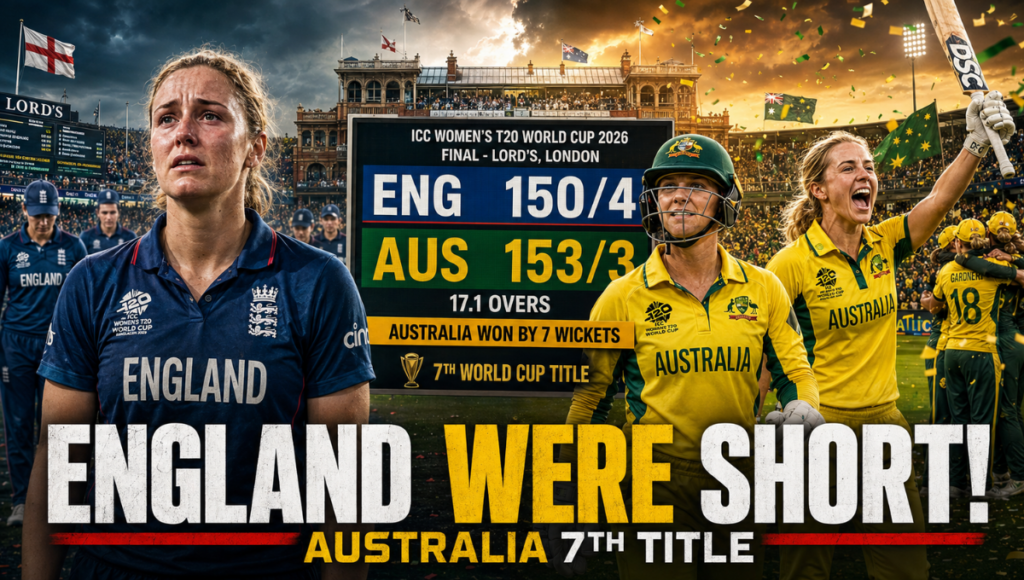

England’s captain admitted it herself, standing on the Lord’s outfield minutes after the final wicket fell: “We were short of a par score on that wicket.”
That single sentence explains the entire match. England posted 150/4 in front of their own crowd, in their own World Cup final. Australia chased it down in 17.1 overs, completing the fastest 150-plus run-chase in Women’s T20 World Cup history, to win their record-extending seventh title.
This England Women’s National Cricket Team vs Australia Women’s National Cricket Team match scorecard covers the full Final of the ICC Women’s T20 World Cup 2026 at Lord’s, London. It also explains, in the words of the players who lived it, exactly why the result never felt in doubt for long.
Match in 30 Seconds
| Detail | Match information |
|---|---|
| Match | Final, ICC Women’s T20 World Cup 2026 |
| Venue | Lord’s Cricket Ground, London |
| Date | 5 July 2026 |
| Toss | Australia Women won the toss and elected to field |
| England Women score | 150/4 in 20 overs |
| Australia Women score | 153/3 in 17.1 overs |
| Result | Australia Women won by 7 wickets |
| Player of the Match | Beth Mooney — 64 (49) |
| Player of the Tournament | Beth Mooney |
The one-line story: Nat Sciver-Brunt and Freya Kemp’s unbeaten 80-run stand rescued England’s innings to a respectable 150, but Beth Mooney and Phoebe Litchfield’s 100-run partnership turned the chase into the fastest 150-plus run-chase in Women’s T20 World Cup history.
What people think is that a home final at Lord’s, in front of a partisan crowd, should have given England a genuine psychological edge.
The reality, in Sciver-Brunt’s own words, was blunter: England knew their total was short before Australia had faced a single ball of the chase.
England Women’s National Cricket Team vs Australia Women’s National Cricket Team Match Scorecard
England Women’s innings: 150/4 in 20 overs
| Batter | Runs | Balls | 4s | 6s | Strike rate | Dismissal |
|---|---|---|---|---|---|---|
| Amy Jones | 6 | 6 | 1 | 0 | 100.00 | c Voll b Hamilton |
| Danni Wyatt-Hodge | 8 | 9 | 1 | 0 | 88.89 | c Mooney b Sutherland |
| Alice Capsey | 23 | 20 | 2 | 1 | 115.00 | b Molineux |
| Nat Sciver-Brunt (c) | 58 | 53 | 5 | 0 | 109.43 | not out |
| Freya Kemp | 44 | 28 | 4 | 1 | 157.14 | not out |
| Extras | 9 | — | — | — | — | 4 lb, 3 w, 2 nb |
| Total | 150/4 | 20 overs |
Fall of wickets: 7/1 (Amy Jones, 1.2), 32/2 (Danni Wyatt-Hodge, 4.5), 67/3 (Alice Capsey, 9.4), remaining wicket data through Sciver-Brunt and Kemp’s unbeaten 80-run partnership taking England to 150/4.
Australia bowling figures
| Bowler | Overs | Runs | Wickets | Economy |
|---|---|---|---|---|
| Kim Garth | 4 | 20 | 1 | 5.00 |
| Lucy Hamilton | 3 | 19 | 1 | 6.33 |
| Annabel Sutherland | — | — | 1 | — |
| Sophie Molineux | — | — | 1 | — |
Australia Women’s innings: 153/3 in 17.1 overs
| Batter | Runs | Balls | 4s | 6s | Strike rate | Dismissal |
|---|---|---|---|---|---|---|
| Georgia Voll | 9 | 6 | 2 | 0 | 150.00 | b Bell |
| Phoebe Litchfield | 48 | 35 | — | — | 137.14 | — |
| Beth Mooney | 64 | 49 | — | — | 130.61 | not out |
| Total | 153/3 | 17.1 overs |
England bowling figures
| Bowler | Overs | Runs | Wickets | Economy |
|---|---|---|---|---|
| Lauren Bell | — | — | 1 | — |
| Sophie Ecclestone | 3.1 | 24 | 1 | 7.58 |
| Charlie Dean | 4 | 28 | 1 | 7.00 |
Read Also:- Sunrisers Hyderabad Vs Kolkata Knight Riders Match Scorecard
Highlights and Key Moments
1. Sciver-Brunt and Kemp’s unbeaten stand rescued a stuttering innings
England lost Amy Jones for 6 in the second over and Danni Wyatt-Hodge for 8 by the fifth. Alice Capsey’s 23 off 20 gave the innings some momentum before she too fell, bowled by Sophie Molineux, at 67/3.
From there, Nat Sciver-Brunt and Freya Kemp added an unbeaten 80 runs to take England to 150/4. Sciver-Brunt finished on 58 off 53, while Kemp’s 44 off 28 provided the acceleration.
What most people miss: an unbeaten 80-run stand at the end of an innings is usually read as a triumphant rescue. Here, it was closer to damage control. Sciver-Brunt’s own strike rate of 109.43 reflects a batter accumulating carefully under pressure, not one dictating terms exactly the “scratching around a little bit, trying to find the middle of the bat” she described afterward.
2. Voll’s early fall, then the 100-run stand that settled it
Australia’s chase began with an early setback. Georgia Voll, promoted to open, was bowled by Lauren Bell for 9 off just 6 balls, having still managed two boundaries in her brief innings.
Phoebe Litchfield then took over “from ball one,” in Beth Mooney’s own description, and the pair added exactly 100 runs together before Litchfield’s dismissal, by which point the match had been comprehensively settled.
Counterintuitive point: most finals are remembered for their tension. This one is remarkable precisely because there wasn’t much. A 100-run partnership completed at better than 8.5 runs an over, against a World Cup final’s bowling attack, reflects batters who never felt the occasion weighing on them Litchfield credited “throwing the first punch” as their explicit shared plan.
3. The record-chase echo: 2009 to 2026
Australia completed the chase in 17.1 overs the quickest 150-plus run-chase in Women’s T20 World Cup history, narrowly beating the 17.2 overs England themselves took to chase 164 against Australia in the 2009 semi-final at The Oval.
Bold opinion: this is one of the most poetically fitting records in the sport’s short T20 history. The two nations that set the previous record against each other, in the opposite direction, met again 17 years later to reset it and this time, it was Australia doing the record-breaking chasing, not England. That symmetry deserves far more attention than a passing stat-box mention.
4. Molineux’s first World Cup as captain
Sophie Molineux led Australia to the title in her first World Cup as captain, with senior players like Ellyse Perry and Ashleigh Gardner explicitly crediting her calm leadership. Perry described her as “the heartbeat of the group,” while Mooney praised how she “put her own spin on the captaincy” without looking “too flustered.”
Practical lesson for succession planning in team sport: Molineux’s smooth transition into the captaincy, backed by senior players rather than undermined by them, shows how a team can hand over leadership without losing continuity the senior players’ willingness to actively support a new captain, rather than simply tolerate her, was repeatedly cited as central to the calm under pressure Australia displayed throughout the tournament.
Player Performance Breakdown
Beth Mooney a career-defining double-double
Mooney’s 64 off 49 balls made her the first player or female, to win Player of the Match in a Women’s T20 World Cup final twice she also won it in 2023. She is separately the first player to win Player of the Tournament twice, having previously done so in 2020.
| Mooney’s T20 WC final scores | Year | Result |
|---|---|---|
| 14 (15) | 2018 | Runner-up |
| 78* (54) | 2020 | Champions |
| 74* (53) | 2023 | Champions |
| 64 (49) | 2026 | Champions |
Original observation: Mooney’s explanation of her own method “it’s really important to settle the dugout in the powerplay in a big game” reveals a player whose primary value isn’t raw power but composure transmission. She described Voll’s early dismissal as “unfortunate,” then immediately noted “Phoebe came out and nailed it from ball one,” suggesting her calm was less about her own runs and more about creating an environment where her partner could play freely.
Phoebe Litchfield: the calm foil in a record chase
Litchfield’s 48 off 35 balls formed the other half of the tournament-deciding 100-run stand.
She described the pair’s specific tactical target: “trying to get the run rate down to six as fast as possible,” treating the asking rate itself as the opponent to be dismantled rather than focusing purely on the target total.
Practical lesson for chasing partnerships: Litchfield’s stated method targeting a specific required-rate number rather than simply “scoring runs” gives batting pairs a clear, measurable shared objective during a chase. Once the required rate fell below six, the pressure genuinely shifted onto the bowling side rather than the batters.
Nat Sciver-Brunt a captain’s fight in a losing cause
Sciver-Brunt’s unbeaten 58 off 53 was the innings that gave England a defendable-looking total after a difficult start.
Her post-match honesty was striking: “I actually went back for a… because I was desperate for a wee,” she said of her mental state during a bathroom break mid-innings, before adding candidly that she wished she’d won the toss and bowled first.
What people think vs reality: fans often assume a captain’s job during a rescue innings is pure tactical focus. Sciver-Brunt’s humanising admission openly describing a basic physical distraction during the most pressured innings of her career is a reminder that elite performers are managing ordinary human realities even in a World Cup final, not operating as flawless tactical machines.
Freya Kemp: the finishing partner England needed
Kemp’s 44 off 28 balls, including four fours and a six, gave England’s total the acceleration it badly needed after the middle-order wobble. Her strike rate of 157.14 was comfortably the most aggressive innings of England’s chase.
Common mistake in analysis: crediting only the top-order batters for a rescued total. Kemp’s contribution was arguably the difference between England defending a genuinely par score and defending a well-below-par one without her acceleration, 150 could easily have been closer to 125.
Analysis: Why England’s 150 Was Short
Sciver-Brunt’s own diagnosis
What people think: a home final total of 150 at Lord’s, backed by a passionate crowd, gives the batting side a real fighting chance.
Reality: Sciver-Brunt herself rejected that framing directly: “We were short of a par score on that wicket. It felt tricky to gain momentum throughout the innings with the bat… when the pressure’s on, their bowlers hit their areas and made it very difficult for us.” This is a captain explicitly stating, in the immediate aftermath, that her team’s total was inadequate before the chase even began.
Australia’s calm under pressure, by design
Sophie Molineux described a specific, deliberate team process behind Australia’s composure: “We’ve done a lot of work on that. We probably looked at the last couple of World Cups and in moments like that where we’ve been on the back foot, we haven’t known what to do. And I think the answer for us was to stay calm and use our brains.”
Bold opinion: this quote should be treated as a genuine leadership case study, not a throwaway soundbite. Molineux is describing a specific, named process reviewing past tournament failures, then building deliberate calmness as a trained skill rather than an innate trait. That is a repeatable methodology any team, in any sport, could study and apply.
What this result means for both teams going forward
Australia’s win extended their winning streak to 10 straight T20Is and confirmed a completely unbeaten tournament run their fourth in Women’s T20 World Cup history. For England, Sciver-Brunt was clear that the tournament as a whole had given the team “so much to be proud of,” even while admitting the final loss “feels a bit sour in the mouth.”
Practical takeaway for reading a tournament result: a single final defeat should not overwrite a genuinely strong overall campaign. England’s run to a home final, and their fight to post a defendable total after early wickets, both remain real positives the specific tactical gap (bowling execution and total-building under the exact conditions Sciver-Brunt described) is the fixable lesson to carry forward, not a wholesale reassessment of the team’s quality.
Read Also:- India Women’s National Cricket Team Vs England Women’s National Cricket Team Match Scorecard
Records, Tournament Legacy and Format Guardrail
Records set or extended in this final
| Record | Detail |
|---|---|
| Australia’s Women’s T20 World Cup titles | 7 (2010, 2012, 2014, 2018, 2020, 2023, 2026) — a record |
| Fastest 150-plus chase in Women’s T20 WC history | 17.1 overs by Australia, beating 17.2 overs by England vs Australia in the 2009 semi-final |
| Second-highest target chased in Women’s T20 WC knockouts | 151, behind England’s chase of 164 vs Australia in the 2009 semi-final |
| Beth Mooney’s POTM record | First to win Player of the Match in a Women’s T20 WC final twice (2023, 2026) |
| Beth Mooney’s POTT record | First to win Player of the Tournament twice (2020, 2026) |
| Australia’s consecutive T20I wins | Extended to 10 |
| Teams with an unbeaten Women’s T20 World Cup run | England (2009), Australia (2010, 2023, 2026) |
| England Women’s home World Cup record | 11 wins, 1 loss (this final) across 12 home World Cup matches |
Format and fixture guardrail
| Fixture | Correct context |
|---|---|
| England Women vs Australia Women, Final, ICC Women’s T20 World Cup 2026 (this article) | The title decider — this article’s core scorecard |
| England Women vs Australia Women, T20 World Cup Warm-up 2026 | A separate, lower-stakes preparation fixture before the tournament |
| England Women vs Australia Women, Women’s Ashes Test, Trent Bridge | A completely different format (multi-day Test) and bilateral context, not a World Cup match |
| Cricinfo all-time head-to-head records | Aggregate historical data across all formats and years, not specific to this Final |
For example, in the Women’s Ashes Test referenced in the competitor set, Australia won by 89 runs after Beth Sutherland’s unbeaten 137 and Ellyse Perry’s 99 anchored a first-innings 473. That result belongs to an entirely different format and series, and must never be presented as part of this T20 World Cup Final scorecard.
Frequently Asked Questions (FAQs)
Ans. Australia Women won by 7 wickets. England scored 150/4, and Australia chased it down at 153/3 in 17.1 overs at Lord’s, London.
Ans. England Women scored 150/4 in 20 overs, led by Nat Sciver-Brunt’s unbeaten 58 and Freya Kemp’s 44. Australia Women replied with 153/3 in 17.1 overs, with Beth Mooney’s 64 and Phoebe Litchfield’s 48 the key contributions, winning by 7 wickets.
Ans. Beth Mooney was Player of the Match for her 64 off 49 balls. She was also named Player of the Tournament, becoming the first player to win both awards twice across Women’s T20 World Cup history.
Ans. Australia has won a record 7 Women’s T20 World Cup titles: 2010, 2012, 2014, 2018, 2020, 2023, and 2026.
Ans. Yes. Australia completed the chase in 17.1 overs, the fastest 150-plus run-chase in Women’s T20 World Cup history, narrowly beating the 17.2 overs England took to chase 164 against Australia in the 2009 semi-final.