
Chennai Super Kings lost their first three matches of IPL 2026. Then Delhi Capitals walked into Chepauk, and everything changed.
But here’s the real problem: most coverage of Delhi Capitals vs Chennai Super Kings gives you the scorecard from that night and a separate scorecard from their next meeting, without ever connecting the two into the story of how CSK used the same opponent to fix two completely different problems.
Delhi Capitals and Chennai Super Kings met twice in IPL 2026 first on April 11 at MA Chidambaram Stadium, where CSK won by 23 runs to end their 0-3 start, and again on May 5 at the same venue, where CSK won by 8 wickets behind a Sanju Samson masterclass.
What most people miss is that these two wins were built on completely different foundations one was a bowling-led defense, the other a batting-led chase showing CSK actually had two separate methods of beating the same team.
Match Summary at a Glance
| Detail | Match 18 (April 11, 2026) | Match 48 (May 5, 2026) |
|---|---|---|
| Venue | MA Chidambaram Stadium, Chennai | MA Chidambaram Stadium, Chennai |
| Result | Chennai Super Kings won by 23 runs | Chennai Super Kings won by 8 wickets |
| Player of the Match | Sanju Samson (115* off 56) | Sanju Samson (87* off 52) espn |
| Season context | CSK’s first win after a 0-3 start | CSK’s second win over DC in a month |
Two matches, same venue, same winning team, and two completely different tactical stories.
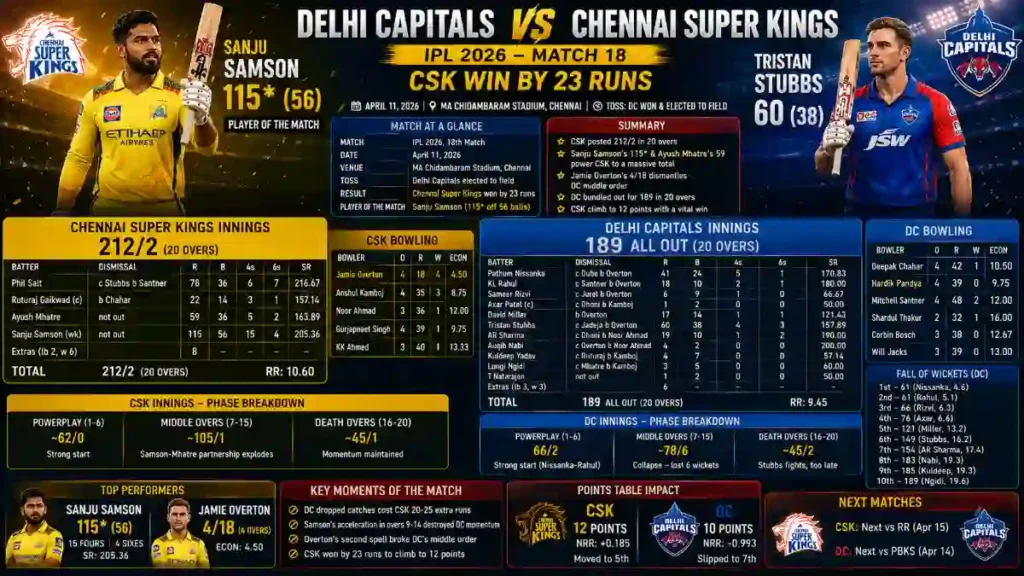
Match 18: Full Scorecard (April 11, 2026, CSK’s First Win)
Chennai Super Kings arrived at this match with three straight losses and desperately needed a response at home.
Chennai Super Kings Batting Innings (212/6 in 20 overs)
CSK’s batting finally clicked, powered by a career-best knock from their wicketkeeper-batter.
| Batter | Runs | Balls | Notes |
|---|---|---|---|
| Sanju Samson | 115* | 56 | Player of the Match, season’s standout knock |
| Ayush Mhatre | 59 | 36 | Explosive support at the top |
| Dewald Brevis | — | — | Returned to the playing XI, made an impact |
Samson and Mhatre gave CSK the fast start they’d been missing all season, before Samson finished the innings with a blistering 115 not out off just 56 balls. Axar Patel was Delhi’s most economical bowler, but none of DC’s attack could stop CSK crossing 200.
Delhi Capitals’ Chase (189 all out in 19.2 overs, lost by 23 runs)
Chasing 213, Delhi Capitals fought hard through the middle overs but ran out of partners at the death.
| Batter | Runs | Balls | Notes |
|---|---|---|---|
| Tristan Stubbs | 60 | 38 | Valiant fightback in a losing cause |
| KL Rahul | 15 | 18 | Fell early in the powerplay |
Jamie Overton delivered the standout bowling performance of the match, finishing with figures of 4 for 18 in his 4 overs, dismissing Sameer Rizvi, David Miller, and finally Tristan Stubbs in the 19th over to end DC’s resistance. Anshul Kamboj added 3 for 35, sharing the death-overs workload that sealed CSK’s first win of the season.
Bowling Figures Comparison (Match 18)
| Bowler | Team | Overs | Runs | Wickets |
|---|---|---|---|---|
| Jamie Overton | Chennai Super Kings | 4.0 | 18 | 4 |
| Anshul Kamboj | Chennai Super Kings | 4.0 | 35 | 3 |
| Axar Patel | Delhi Capitals | 4.0 | 39 | 1 |
Read Also:- Kolkata Knight Riders Vs Rajasthan Royals Match Scorecard
Jamie Overton’s spell is exactly the kind of performance that gets undersold in a stat line 4 for 18 against a lineup that included Stubbs, Miller, and Rizvi is a genuinely elite death-overs display, and it’s the real reason CSK’s season turned around that night.
Match 48: Full Scorecard (May 5, 2026, Samson’s Masterclass)
Three weeks later, the two sides met again, and this time Delhi Capitals batted first but never found the momentum they needed.
Delhi Capitals Batting Innings (155/7 in 20 overs)
Delhi Capitals’ innings never accelerated the way it needed to on an improving surface.
| Batter | Runs | Balls | Notes |
|---|---|---|---|
| Sameer Rizvi | 40 | 24 | Not out, top-scorer |
| Tristan Stubbs | 38 | 31 | Best of the middle order |
Noor Ahmad was the pick of CSK’s bowlers, taking 2 for 33, while Akeal Hosein chipped in with a wicket of his own to keep DC below 160.
Chennai Super Kings’ Chase (159/2 in 17.3 overs, won by 8 wickets)
Chasing 156, Chennai Super Kings made it look simple behind another standout innings from the same player who won them Match 18.
| Batter | Runs | Balls | Notes |
|---|---|---|---|
| Sanju Samson | 87* | 52 | Player of the Match again; 7 fours, 6 sixes |
| Kartik Sharma | 41* | 31 | Unbeaten finishing partnership |
Samson and Kartik Sharma put together an unbroken stand that carried CSK home with 15 balls to spare, finishing the match with 11 runs off the 17th over to seal it. Lungi Ngidi and Axar Patel each picked up a wicket for Delhi, but neither could break the game-winning partnership.
Bowling Figures Comparison (Match 48)
| Bowler | Team | Overs | Runs | Wickets |
|---|---|---|---|---|
| Noor Ahmad | Chennai Super Kings | 3.0 | 22 | 2 |
| Lungi Ngidi | Delhi Capitals | 4.0 | 30 | 1 |
| Axar Patel | Delhi Capitals | 4.0 | 25 | 1 |
Turning Point of Each Match
Match 18: The specific turning point was Jamie Overton’s introduction in the middle overs, when he dismissed Sameer Rizvi and David Miller in quick succession before finishing off Tristan Stubbs in the 19th over.
One overlooked detail some analysts point to as the real shift: Noor Ahmad saving a certain six earlier in Delhi’s innings, a fielding moment that kept the required rate manageable long enough for Overton’s spell to matter.
Match 48: The turning point was Delhi Capitals failing to build any partnership beyond 40 runs in their innings, which capped their total at a modest 155 a score that never had enough cushion against Samson’s form. Once Samson and Kartik Sharma’s stand crossed 100, the chase was never in doubt.
Player Performance Breakdown
| Player | Match | Performance | Impact |
|---|---|---|---|
| Sanju Samson | Match 18 | 115* off 56, Player of the Match | Ended CSK’s 0-3 start with a career-defining knock |
| Sanju Samson | Match 48 | 87* off 52, Player of the Match | Sealed CSK’s second win over DC in a month |
| Jamie Overton | Match 18 | 4/18 | Single-handedly dismantled DC’s chase |
| Tristan Stubbs | Match 18 | 60 off 38 | Best DC batting effort, still not enough |
| Ayush Mhatre | Match 18 | 59 off 36 | Gave CSK the fast start they’d been missing |
| Kartik Sharma | Match 48 | 41* off 31 | Unbeaten partner in the game-sealing stand |
Read Also:- India National Cricket Team Vs United States National Cricket Team Match Scorecard
Sanju Samson being Player of the Match in both encounters against the same opponent is the single most underreported storyline here most coverage treats each match as a standalone event, but Samson’s back-to-back standout performances against Delhi specifically deserve to be framed as a genuine matchup dominance.
What People Think vs What Actually Happened
Most fans watching Match 18 assumed Tristan Stubbs’ fighting 60 off 38 balls meant Delhi Capitals came agonizingly close to pulling off the chase.
Reality: by the time Stubbs was dismissed in the 19th over, DC still needed more runs than they could realistically get from the remaining balls, because Overton’s earlier wickets had already pushed the required rate beyond a comfortable range.
The common mistake fans make is judging a chase by the final margin (23 runs) rather than by when the game was actually decided this match was effectively over the moment Overton removed Miller in the middle overs.
Key Takeaways for Fans and Bettors
- Sanju Samson has now won Player of the Match in both CSK meetings with Delhi Capitals this season, making him the single biggest threat in this specific fixture
- Jamie Overton’s middle-overs spell (4/18) proves CSK’s death-bowling depth can single-handedly win matches, not just support a big batting total
- Delhi Capitals’ batting has shown a repeated pattern against CSK strong individual contributions (Stubbs’ 60, Rizvi’s 40) without a partnership big enough to set up a genuinely competitive total
- CSK’s turnaround from a 0-3 start to consecutive wins over the same opponent shows how quickly form can shift once a top-order partnership clicks
- Noor Ahmad’s all-round value (a crucial fielding save in Match 18, wickets in Match 48) makes him a name worth tracking closely in future CSK matches
Frequently Asked Questions
Q1. Who won the most recent Delhi Capitals vs Chennai Super Kings match?
Ans. Chennai Super Kings won Match 48 by 8 wickets on May 5, 2026, chasing down 156 in 17.3 overs.
Q2. Who was Player of the Match in both Delhi Capitals vs Chennai Super Kings matches in IPL 2026?
Ans. Sanju Samson won Player of the Match in both encounters, scoring 115* in Match 18 and 87* in Match 48.
Q3. Who won the earlier Delhi Capitals vs Chennai Super Kings match in IPL 2026?
Ans. Chennai Super Kings won Match 18 by 23 runs on April 11, 2026, ending their 0-3 start to the season.
Q4. What were Jamie Overton’s bowling figures against Delhi Capitals?
Ans. Jamie Overton took 4 wickets for 18 runs in Match 18, the standout bowling performance of that game.
Q5. Where were both Delhi Capitals vs Chennai Super Kings matches played?
Ans. Both matches were played at the MA Chidambaram Stadium in Chennai.