
A target of 226 should make a chasing team nervous. It should force a near-perfect innings, create panic after every wicket, and leave no margin for a quiet over.
Delhi Capitals did not chase it like that.
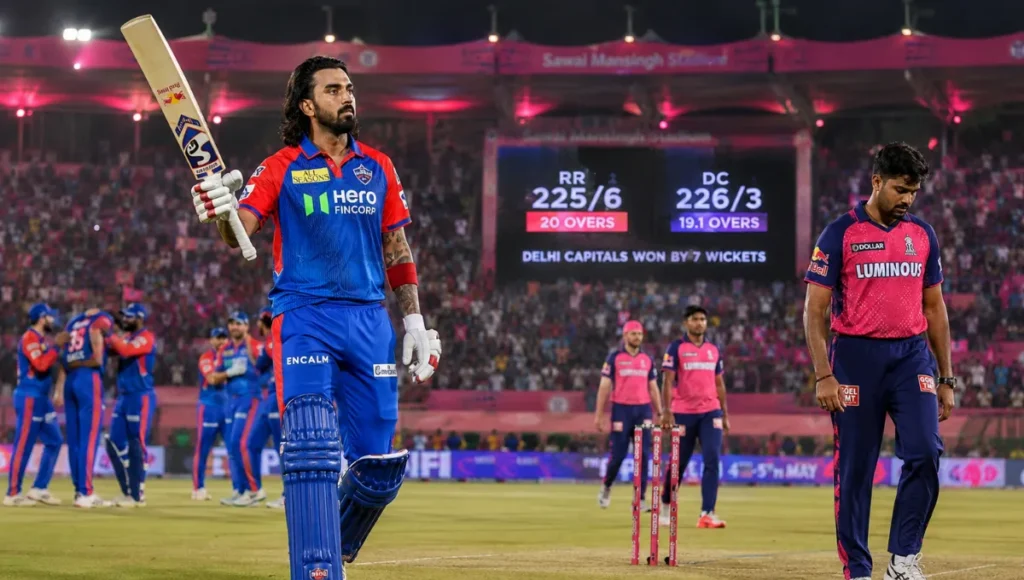
They absorbed Rajasthan Royals’ best phase, used the powerplay to remove the fear from the equation, and then let KL Rahul control the chase until the finish was in sight. RR made 225/6 at Jaipur. DC replied with 226/3 in 19.1 overs to win by seven wickets.
This Delhi Capitals vs Rajasthan Royals match scorecard gives you the full figures first. More importantly, it explains why a huge total still was not enough.
RR vs DC Match in 30 Seconds
| Detail | Match information |
|---|---|
| Match | Rajasthan Royals vs Delhi Capitals, 43rd Match, IPL 2026 |
| Date | 1 May 2026 |
| Venue | Sawai Mansingh Stadium, Jaipur |
| Toss | Rajasthan Royals won the toss and chose to bat |
| RR score | 225/6 in 20 overs |
| DC score | 226/3 in 19.1 overs |
| Result | Delhi Capitals won by 7 wickets, with 5 balls remaining |
| Player of the Match | KL Rahul — 75 off 40 balls |
The one-line story: RR had the runs, but DC had the better chase architecture an explosive start from Pathum Nissanka, control from KL Rahul, and enough calm at the end from Tristan Stubbs and Ashutosh Sharma.
But here is the real problem for RR: 225 was not their finished product. At 160/2 after 14 overs, they had a 240-plus platform. They added only 65 in the final six overs and lost four wickets. Against a deep batting side, that is the difference between a difficult chase and a truly suffocating one.
Delhi Capitals vs Rajasthan Royals Match Scorecard
Rajasthan Royals innings: 225/6 in 20 overs
| Batter | Runs | Balls | 4s | 6s | Strike rate |
|---|---|---|---|---|---|
| Riyan Parag | 90 | 50 | 8 | 5 | 180.00 |
| Donovan Ferreira* | 47 | 14 | — | — | 335.71 |
| Other RR batters | 88 | 56 | — | — | — |
| Extras | — | — | — | — | — |
| Total | 225/6 | 20 overs |
DC bowling highlights:
| Bowler | Overs | Runs | Wickets | Economy |
|---|---|---|---|---|
| Mitchell Starc | 4 | 40 | 3 | 10.00 |
| Axar Patel | 4 | 39 | 1 | 9.75 |
RR’s card looks powerful because it was powerful. Riyan Parag made 90 off 50, a controlled innings built around 78% control according to ESPN’s performance data. Donovan Ferreira’s unbeaten 47 off 14 then gave the innings late violence.
Yet a scorecard can flatter a batting effort. RR were 160/2 after 14 overs. The final six overs delivered 65 runs but also four wickets. In a high-scoring season, 225 is defendable only if the bowling unit creates early doubt. RR did not.
Delhi Capitals innings: 226/3 in 19.1 overs
| Batter | Runs | Balls | 4s | 6s | Strike rate |
|---|---|---|---|---|---|
| Pathum Nissanka | 62 | 33 | — | — | 187.88 |
| KL Rahul | 75 | 40 | 6 | 5 | 187.50 |
| Nitish Rana | 33 | 17 | — | — | 194.12 |
| Tristan Stubbs* | 18 | 11 | — | — | 163.64 |
| Ashutosh Sharma* | 25 | 15 | — | — | 166.67 |
| Extras | 13 | — | — | — | — |
| Total | 226/3 | 19.1 overs |
RR bowling figures:
| Bowler | Overs | Runs | Wickets | Economy |
|---|---|---|---|---|
| Jofra Archer | 4 | 46 | 1 | 11.50 |
| Nandre Burger | 3 | 41 | 0 | 13.66 |
| Tushar Deshpande | 4 | 38 | 1 | 9.50 |
| Brijesh Sharma | 3.1 | 35 | 0 | 11.05 |
| Ravi Bishnoi | 2 | 28 | 0 | 14.00 |
| Ravindra Jadeja | 3 | 33 | 1 | 11.00 |
Read Also:- Kolkata Knight Riders Vs Sunrisers Hyderabad Match Scorecard
DC fall of wickets: 110/1, 171/2, 177/3.
That sequence tells the match. The opening partnership reached 110. DC did not lose a wicket until they were almost halfway to the target. Then Nitish Rana kept the run rate moving, so Rahul never had to abandon the innings-building role. By the time RR created a brief opening late in the chase, the required rate had already fallen below panic level.
Match Highlights and Key Moments
1. Riyan Parag’s 90 gave RR a winning-looking total
Parag’s 90 off 50 was the innings that made 225 possible. He did not simply attack blindly; his productive shot was the flick, which brought him 20 runs. That matters because he used the leg side to rotate pressure rather than relying only on low-percentage boundary attempts.
What people think: a 90 in a 225 total means the batter has done everything required.
Reality: in T20 cricket, a top-order 90 has to produce a finish as well as a platform. At 160/2 after 14, RR had enough wickets to target 240. The innings ended at 225/6. The scoring did not collapse, but its acceleration did.
The practical lesson for teams is blunt: when you have eight wickets in hand at the 14-over mark, do not treat 225 as safety. Treat it as the floor.
2. Mitchell Starc’s return was more valuable than his economy rate
Starc returned after a long absence and finished with 3/40. Ten an over is not a stat that usually earns praise, but this was one of those spells where wickets mattered more than economy.
He removed key batters and helped DC pull RR back from an even more dangerous final total. Axar Patel later said the bowling group had adjusted after the powerplay, using changes of pace and fuller planning on a ground with manageable boundaries.
Counterintuitive point: Starc did not “win” the bowling innings by shutting down runs. He won it by ensuring RR’s best platform had a ceiling. Without those wickets, 225 could easily have become 245.
3. Nissanka changed the chase before Rahul had to
Pathum Nissanka’s 62 off 33 was not a supporting act. It was the chase’s emotional turning point.
DC scored 70 in the powerplay and their opening pair added 110. That did two things:
- It cut the asking rate before the middle overs.
- It allowed Rahul to bat as an organiser instead of a desperate hitter.
This is what most people miss about modern successful chases. You do not need both openers to play the same role. Nissanka was the accelerator. Rahul was the stabiliser who still struck at 187.50. That role split is far more dangerous than two batters trying to dominate every ball.
4. The Ferreira over changed the finish
With 35 needed from the last three overs, RR had a window. It was not a large one, but it was real. Then Riyan Parag used Donovan Ferreira against two left-handers, a decision he later described as a matchup-based attempt to avoid another over from Dasun Shanaka.
Ferreira conceded 16 runs. One over later, the chase was effectively under DC’s control.
This is where things go wrong: captains often explain a bowling decision through matchups alone. But a matchup only works if the bowler has a dependable defensive ball. At the death, a part-time option without a yorker or a repeatable wide line is not a tactical surprise. It is an invitation.
Player Performance Breakdown
KL Rahul: 75 off 40: control with modern intent
Rahul was Player of the Match because he gave the chase a brain. His 75 included six fours and five sixes, but the more important number was 40 balls. He stayed long enough to make every later partnership easier.
He openly said strike rate had been a major focus and that he had changed his approach for modern T20 demands. This innings showed the result: he was not merely anchoring. He scored at 187.50 while keeping the batting group calm.
Original observation: Rahul’s evolution is not about becoming a reckless opener. It is about choosing the exact moments when a conventional shot is better than an ambitious one. At Jaipur, that distinction mattered more than raw power.
Pathum Nissanka: 62 off 33: the powerplay accelerator
Nissanka reached 62 at 187.88. His task was simple and difficult: make the new ball feel ordinary.
He did it. The 110-run partnership meant RR’s bowlers never got to bowl with scoreboard fear on their side. When he fell, DC still had time, wickets, and a controlled required rate.
Common mistake: calling a fast opener “aggressive” without asking whether the aggression served the innings. Nissanka’s did. He attacked early so the more experienced Rahul could manage the middle phase.
Mitchell Starc: 3/40: wickets that limited the damage
Starc’s 3/40 was not a perfect comeback spell, but it was a high-impact one. His wickets stopped RR from converting their 14-over platform into a total beyond 240.
For analysts, this is a useful reminder: do not judge every T20 bowler by economy in isolation. A wicket at the right moment changes who faces the next 12 balls.
Riyan Parag: 90 off 50: brilliant, but not enough
Parag was RR’s best batter by distance. He carried the innings, struck eight fours and five sixes, and gave the home side a powerful total.
Still, a captain’s knock has two jobs. Make runs, then make the game hard to lose. RR did the first. Their last six overs with the bat, and their middle overs with the ball, undid the second.
That is not criticism of Parag’s 90.
It is the uncomfortable truth about captaincy in high-scoring matches: great individual batting cannot erase poor collective game management.
Analysis: Why Rajasthan Royals Lost After Making 225
The 65-run finishing gap
RR were 160/2 after 14 overs. They finished 225/6.
| RR innings phase | Score/wickets | Runs added | What it meant |
|---|---|---|---|
| After 14 overs | 160/2 | — | Set for 240+ |
| Final 6 overs | 65/4 | 65 | Good output, but too many wickets and not enough sustained acceleration |
| Final total | 225/6 | — | Competitive, not untouchable |
Read Also:- India Vs Ireland T20 Series 2026: Full Scorecard, Analysis & Player Breakdown
The headline says 225. The tactical truth says RR left roughly 15 to 20 runs on the table. In a chase eventually won with five balls remaining, that margin is enormous.
RR never created a middle-overs choke
The opening pair gave DC 110 runs, but RR still had a chance after Nissanka fell. The critical failure was not one expensive over. It was that the bowling side could not produce two quiet overs in a row after the field spread.
A 225 defence needs one of these:
- Two wickets in the first six overs.
- A middle-overs stretch below eight an over.
- A death phase where the required rate rises above 13.
RR achieved none of them consistently. That is why the chase felt less dramatic than the target suggested.
Fielding and decision-making added pressure to RR
Cricbuzz’s report noted poor fielding and a misjudged boundary chance in the closing stages. Riyan Parag himself called the fielding “very poor” and said the group had not been good enough in energy, skill, or execution.
This is a bold but fair conclusion: RR did not lose because DC chased exceptionally well alone. They lost because DC were excellent and RR gave them too many ways to stay comfortable.
A championship team treats 225 as a total to defend with discipline. RR defended it like a side hoping a big score would do the work for them.
Records and Points-Table Impact
| Milestone | Detail |
|---|---|
| DC’s highest successful IPL chase | 226 against RR in Jaipur, surpassing their previous best of 210 against LSG in 2025 |
| Second-highest successful chase against RR | Only behind Sunrisers Hyderabad’s 229 chase at Jaipur earlier in IPL 2026 |
| KL Rahul Player of the Match awards | His 17th IPL Player of the Match award, joining Ravindra Jadeja on that total among Indian players |
| IPL 2026 trend | This was the 11th successful 200-plus chase of the season at that point |
The result ended DC’s three-match losing run and kept their campaign alive. It also stopped RR from pulling away from the chasing pack.
The bigger strategic message, however, was about RR’s profile: their batting can build match-winning totals, but their bowling and fielding must become far more reliable when a game reaches a high-scoring finish.