
New Zealand were 84 for 6.
Sri Lanka had the match exactly where a bowling side wants it: the opposition’s top order was gone, the middle order was exposed, and a total near 140 looked realistic.
Then the game changed. Mitch Santner and Cole McConchie rebuilt the innings with an 84-run seventh-wicket stand. New Zealand finished on 168/7. Sri Lanka then began their reply with a first-ball wicket and never truly recovered, finishing 107/8.
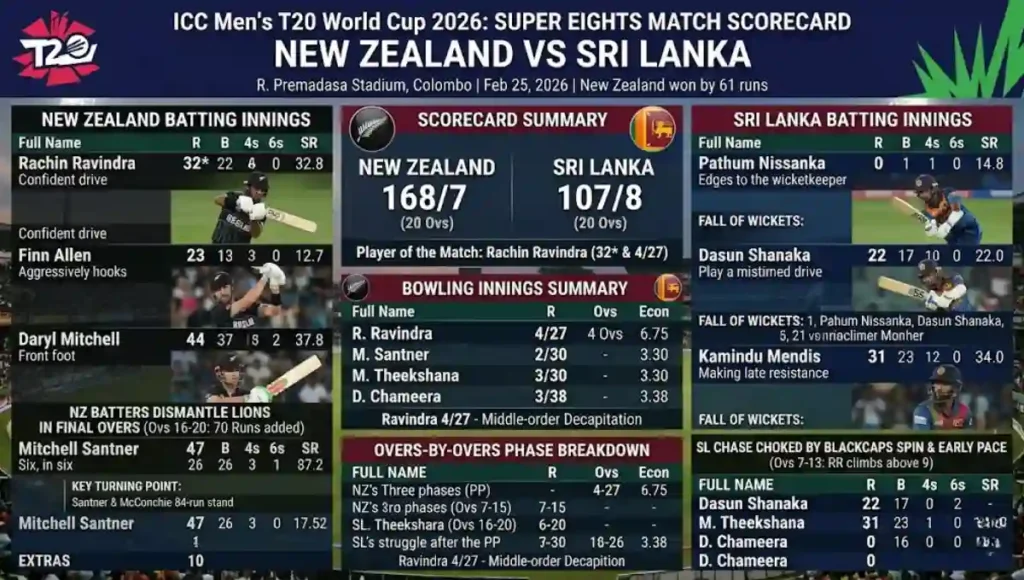
This New Zealand National Cricket Team vs Sri Lanka National Cricket Team match scorecard covers the full figures from the ICC Men’s T20 World Cup 2026 Super Eights match in Colombo. More importantly, it explains why 168 became a 61-run win.
Match in 30 Seconds
| Detail | Match information |
|---|---|
| Match | Sri Lanka vs New Zealand, 46th Match, Super Eights Group 2 |
| Tournament | ICC Men’s T20 World Cup 2026 |
| Venue | R Premadasa Stadium, Colombo |
| Toss | Sri Lanka won the toss and chose to field |
| New Zealand score | 168/7 in 20 overs |
| Sri Lanka score | 107/8 in 20 overs |
| Result | New Zealand won by 61 runs |
| Key match phase | New Zealand recovered from 84/6 through an 84-run seventh-wicket partnership |
The one-line story: Sri Lanka won the first half of New Zealand’s innings but lost the match because they could not finish the job with the ball or survive New Zealand’s layered bowling attack with the bat.
What people think is simple: 168 is an average T20 total, and Sri Lanka should have chased it at home. The reality is more precise. At Colombo, against a side with Henry’s new-ball control, Santner’s left-arm spin, Ravindra’s wicket-taking variation, and support from Phillips, the target became difficult only after Sri Lanka gave away the first 12 overs.
New Zealand National Cricket Team vs Sri Lanka National Cricket Team Match Scorecard
New Zealand innings: 168/7 in 20 overs
| Batter | Runs | Balls | 4s | 6s | Strike rate |
|---|---|---|---|---|---|
| Tim Seifert | 8 | 9 | 1 | 0 | 88.89 |
| Finn Allen | 23 | 13 | 3 | 1 | 176.92 |
| Rachin Ravindra | 32 | 22 | 3 | 1 | 145.45 |
| Glenn Phillips | 18 | 18 | 1 | 0 | 100.00 |
| Daryl Mitchell | 3 | 7 | 0 | 0 | 42.86 |
| Mark Chapman | 0 | 2 | 0 | 0 | 0.00 |
| Mitchell Santner (c) | 47 | 26 | 2 | 4 | 180.77 |
| Cole McConchie* | 31 | 23 | 3 | 2 | 134.78 |
| Extras | 6 | — | — | — | — |
| Total | 168/7 | 20 overs |
Fall of wickets: 30/1 (Finn Allen, 3.1), 34/2 (Tim Seifert, 4.2), 75/3 (Glenn Phillips, 9.3), 84/4 (Rachin Ravindra, 11.2), 84/5 (Mark Chapman, 11.4), 84/6 (Daryl Mitchell, 12.1), 168/7 (Mitchell Santner, 20.0).
Sri Lanka bowling figures
| Bowler | Overs | Runs | Wickets | Economy |
|---|---|---|---|---|
| Dushmantha Chameera | 4 | 38 | 3 | 9.50 |
| Maheesh Theekshana | 4 | 30 | 3 | 7.50 |
| Dunith Wellalage | 4 | 27 | 1 | 6.75 |
| Dilan Madushanka | 3 | 34 | 0 | 11.33 |
| Charith Asalanka | 3 | 16 | 0 | 5.33 |
| Dushan Hemantha | 2 | 22 | 0 | 11.00 |
Sri Lanka innings: 107/8 in 20 overs
| Batter | Runs | Balls | 4s | 6s | Strike rate |
|---|---|---|---|---|---|
| Pathum Nissanka | 0 | 1 | 0 | 0 | 0.00 |
| Kusal Mendis | 11 | 22 | 1 | 0 | 50.00 |
| Charith Asalanka | 5 | 9 | 1 | 0 | 55.56 |
| Pavan Rathnayake | 10 | 18 | 0 | 0 | 55.56 |
| Kamindu Mendis | 31 | 23 | 4 | 0 | 134.78 |
| Dasun Shanaka | 3 | 5 | 0 | 0 | 60.00 |
| Dushan Hemantha | 3 | 6 | 0 | 0 | 50.00 |
| Dunith Wellalage | 29 | 23 | 2 | 1 | 126.09 |
| Dushmantha Chameera* | 7 | 12 | 0 | 0 | 58.33 |
| Maheesh Theekshana* | 1 | 1 | 0 | 0 | 100.00 |
| Extras | 7 | — | — | — | — |
| Total | 107/8 | 20 overs |
Fall of wickets: 0/1 (Pathum Nissanka, 0.1), 6/2 (Charith Asalanka, 2.1), 27/3 (Kusal Mendis, 8.1), 29/4 (Pavan Rathnayake, 8.2), 46/5 (Dasun Shanaka, 10.3), 59/6 (Dushan Hemantha, 12.2), 77/7 (Kamindu Mendis, 14.6), 105/8 (Dunith Wellalage, 19.4).
New Zealand bowling figures
| Bowler | Overs | Runs | Wickets | Economy |
|---|---|---|---|---|
| Matt Henry | 2 | 3 | 2 | 1.50 |
| Mitchell Santner | 4 | 19 | 1 | 4.75 |
| Lockie Ferguson | 1 | 2 | 0 | 2.00 |
| Ish Sodhi | 2 | 13 | 0 | 6.50 |
| Rachin Ravindra | 4 | 27 | 4 | 6.75 |
| Glenn Phillips | 4 | 21 | 1 | 5.25 |
| Cole McConchie | 3 | 20 | 0 | 6.66 |
Read Also:- India National Cricket Team Schedule: Full 2026 Calendar & Season Recap
Highlights and Key Moments
1. Sri Lanka’s bowlers had New Zealand at 84/6
This was Sri Lanka’s best phase. Theekshana took 3/30, Chameera took 3/38, and Wellalage removed Daryl Mitchell. At 12.1 overs, New Zealand were six down for 84.
That score is not merely a statistic. It was a tactical opportunity. Sri Lanka had taken wickets across the innings instead of allowing one batter to settle. Theekshana’s wicket of Finn Allen removed early momentum; his later strikes pushed New Zealand from a stable 75/2 into a genuine collapse.
Common mistake: looking at Chameera’s 9.50 economy and deciding he had an expensive day. In a T20 innings, three wickets can be more important than a tidy economy rate especially when those wickets expose the lower middle order.
2. Santner and McConchie turned a rescue into a defendable total
At 84/6, a total of 140 felt plausible. Santner and McConchie added 84 for the seventh wicket and changed the target from manageable to psychologically heavy.
Santner made 47 off 26 with four sixes.
McConchie’s unbeaten 31 off 23 gave him the ideal partner: someone who could rotate, take calculated boundary options, and avoid handing Sri Lanka another wicket.
What most people miss: the partnership mattered not just because it added 84 runs. It also used 47 balls. That denied Sri Lanka the chance to bowl at New Zealand’s tail for the last seven overs. The recovery was a form of risk management, not only late hitting.
3. Matt Henry’s 2/3 decided the chase before it looked dramatic
Nissanka fell for a first-ball duck. Asalanka followed at 6/2. Matt Henry’s figures 2 overs, 3 runs, 2 wickets are astonishing in a 20-over chase where the defending side made 168.
Early wickets create a second scoreboard: the required rate and the available batters. Sri Lanka had enough overs remaining, but they no longer had the right batting order to attack without risk.
Real-world lesson: against a defendable total, the new-ball bowling objective is not always to bowl four economical overs. It is to remove the top two batters before the fielding side starts protecting boundaries. Henry completed that job almost perfectly.
4. Ravindra broke the rebuild
Sri Lanka were 27/2. They were not out of the chase. Then Rachin Ravindra removed Kusal Mendis and Pavan Rathnayake in consecutive balls during the ninth over. He finished with 4/27.
Those back-to-back wickets were the match’s cleanest turning point. They transformed a rebuilding phase into a collapse. Sri Lanka went from 30/2 to 77/7, losing the ability to control the required rate.
This is where things go wrong in a chase: teams mistake survival for recovery. Sri Lanka survived a few overs after the early wickets, but they did not build a partnership with enough rotation or boundary pressure to recover the run rate.
Player Performance Breakdown
Mitch Santner: 47 off 26: a captain’s innings under pressure
Santner’s 47 off 26 was the highest score of New Zealand’s innings and the most valuable. He arrived when New Zealand had lost six wickets and needed someone to judge risk correctly.
His four sixes changed the scoring rate.
But the bigger point is timing: he did not attempt to rescue the innings alone. He partnered with McConchie, kept wickets in hand, and attacked once the innings had a base.
Original observation: Santner’s most impressive quality here was not power. It was judgment. Captains are often praised for field placements; this was a captain deciding which balls were worth turning into an innings-changing shot.
Cole McConchie: 31* off 23: the quiet half of the decisive stand
McConchie’s unbeaten 31 can disappear behind Santner’s 47. That would be a mistake.
He played the stabilising role in the 84-run stand. A lower-order partnership fails when both batters chase the same boundary ball. McConchie gave Santner strike, kept the score moving, and hit three fours and two sixes when he had the right matchups.
The practical takeaway for developing finishers is simple: a not-out 31 that supports a match-saving partnership can be more valuable than a 40 made after the game has already slipped away.
Rachin Ravindra: 32 and 4/27: the complete impact player
Ravindra contributed 32 off 22 with the bat, then took 4/27 with the ball. His wickets included the key double strike that ended Sri Lanka’s rebuilding attempt.
Counterintuitive idea: his batting 32 mattered because New Zealand were already under pressure before the Santner stand. His bowling four-for mattered because it ensured 168 was never tested by Sri Lanka’s main batters for long. This is the definition of two-innings impact.
Matt Henry: 2/3: a spell that rewrote the chase
Two overs, three runs, two wickets. Henry did not need a full four-over spell to be decisive.
He removed Nissanka and Asalanka before Sri Lanka could establish a chase rhythm. His spell deserves more attention than a generic “early breakthrough” label. It gave Santner the option to attack with spin rather than defend with it.
Maheesh Theekshana and Dushmantha Chameera a strong spell without a complete team finish
Theekshana’s 3/30 and Chameera’s 3/38 gave Sri Lanka six wickets. That should have been enough to keep New Zealand below 150.
But cricket’s difficult truth is that wickets do not guarantee a win if the next partnership is allowed to reset the innings. Sri Lanka needed either a second spinner to shut down Santner and McConchie or a clearer death-over plan. They got neither consistently.
Analysis: Why Sri Lanka Lost After Restricting New Zealand to 168
The target was difficult, not impossible
168 was not an unbeatable total. But it became too large because Sri Lanka lost their top order too quickly.
| Chase phase | Score/wickets | What it meant |
|---|---|---|
| After 0.1 over | 0/1 | Nissanka’s first-ball dismissal handed New Zealand immediate control |
| After 2.1 overs | 6/2 | Sri Lanka lost their top two attacking options |
| After 8.2 overs | 29/4 | The rebuild turned into a collapse |
| After 14.6 overs | 77/7 | The chase was effectively decided |
| Final score | 107/8 | New Zealand won by 61 runs |
Read Also:- India Vs West Indies T20 2026: Full Scorecard, Highlights & Turning Points
What people think is that the middle order “failed.” The deeper reality is that the innings never had a defined recovery plan. After 6/2, Sri Lanka needed a 35-to-40-run partnership with low risk, followed by a controlled acceleration phase. Instead, they lost wickets in pairs.
Sri Lanka lost the rebuild phase
Kamindu Mendis made 31 off 23 and Wellalage made 29 off 23. Those are useful contributions in isolation, but the pair were separated by the seventh wicket at 77. They did not have a stable top-order base to convert their runs into a chase.
A strong T20 chase does not need everyone to score quickly. It needs one pair to decide: “For the next four overs, no risky singles, no low-percentage lofts, and no chasing a six every ball.” Sri Lanka did not get that reset.
Bold opinion: Sri Lanka’s issue was not a shortage of attacking talent. It was a shortage of innings ownership. Too many batters played short bursts; no one managed the game state.
New Zealand used a three-layer bowling plan
New Zealand’s bowlers did not win with one style.
- Layer 1: Matt Henry’s new-ball damage. He removed the openers and created a fragile batting order.
- Layer 2: Santner’s control. His 1/19 across four overs made risk feel necessary for Sri Lanka.
- Layer 3: Ravindra and Phillips’ wicket pressure. Ravindra’s 4/27 supplied the breakthroughs; Phillips took 1/21 and prevented any easy release.
This is what good tournament bowling looks like. Not every bowler must take four wickets. One creates the problem, one holds it in place, and one ends the innings.
Records, Super Eights Impact and Entity Check
Match significance
New Zealand’s 61-run win was built on a remarkable recovery: 84/6 became 168/7 through Santner and McConchie’s 84-run seventh-wicket partnership. Ravindra then delivered 4/27, while Henry’s 2/3 set the tone for Sri Lanka’s 107/8. The scorecard shows a complete reversal: Sri Lanka dominated the middle of the first innings, then New Zealand dominated the middle of the second.
Senior match vs A-team match: do not mix them
Search results can group similar names together, but these are different fixtures:
| Fixture | Format / level | Correct use on your site |
|---|---|---|
| Sri Lanka vs New Zealand, T20 World Cup 2026 | Senior men’s international T20 | This article’s core match |
| Sri Lanka A vs New Zealand A, April 2026 | Men’s unofficial ODIs | Separate scorecard or related-link module only |
| Sri Lanka A Women vs New Zealand A Women | Women’s A-team ODI | Separate article only; never use it as match history for senior men |
For example, Sri Lanka A beat New Zealand A by 140 runs in the first unofficial ODI after making 261 and bowling NZ A out for 121. In the second, Sri Lanka A made 368/9 and won by 44 runs under DLS after the match was shortened. These facts belong to the A-team series, not this T20 World Cup scorecard.