
Pakistan needed 12 runs off the last over in Mirpur. They finished 11 short of Bangladesh’s 290. Five months later, they didn’t even reach 120 in a T20I at the same country, crawling to 110/9 as Bangladesh chased it with seven wickets and 15 balls in hand.
What people miss is that these aren’t just two separate bad days for Pakistan. They’re a pattern. Bangladesh are learning how to finish games against Pakistan in ODIs and T20Is without needing miracles. That’s new in this rivalry.
Series Snapshot: ODI Decider and T20 Shock
The Pakistan tour of Bangladesh 2025‑26 has three important scorecards:
- 3rd ODI, Mirpur (March 2026)
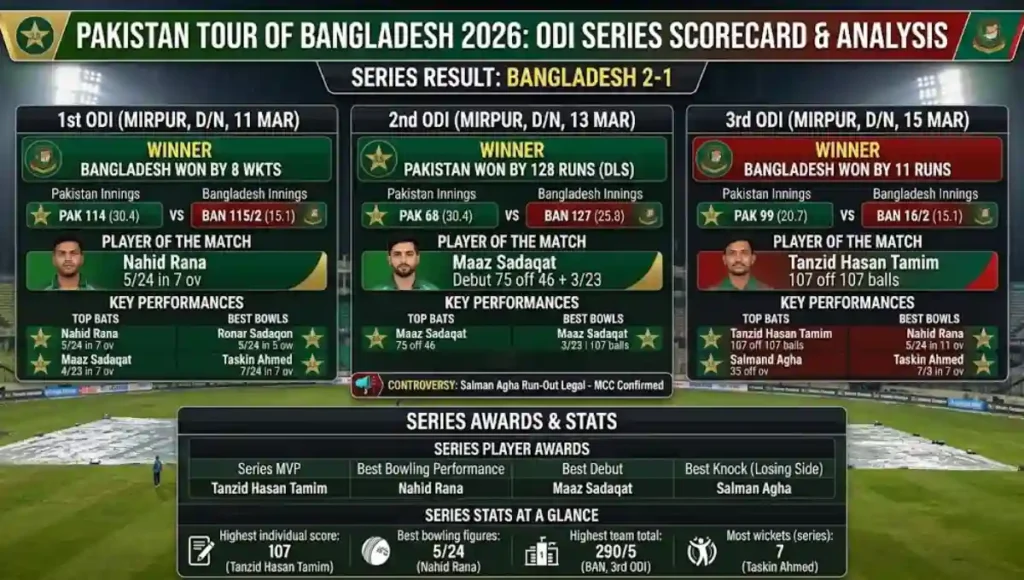
Bangladesh: 290/5 in 50 overs.
Pakistan: 279 all out in 50 overs.
Bangladesh win by 11 runs. - 1st T20I, Dhaka (July 2025)
Pakistan: 110/9 in 19.2 overs.
Bangladesh: 111/3 in 17.3 overs.
Bangladesh win by 7 wickets. - Head‑to‑Head context
Pakistan still lead the combined Test‑ODI‑T20I record comfortably, but Bangladesh are now winning ODI deciders and opening T20Is at home.
The tension here: Pakistan still see themselves as the big brother in this rivalry. The scorecards say the younger sibling is no longer scared in Dhaka.
3rd ODI Mirpur: Bangladesh 290/5 vs Pakistan 279 All Out
The 3rd ODI at Shere Bangla was exactly the kind of match Pakistan dominated for two decades: series tied, decider in Asia, opponent in green. Instead, Bangladesh walked away with an 11‑run win.
Bangladesh’s Innings: Why 290 Was Enough
Bangladesh finished on 290/5, scoring at 5.8 runs per over on a surface that was not a flat road.
Key patterns from the scorecard:
- Top order gave a stable base no early collapse, no 20/3 nightmare.
- Middle order built through singles and twos; boundaries came in controlled bursts.
- Only five wickets lost in 50 overs the batting innings lasted the full quota.
What most people think:
“Bangladesh should have aimed for 320+ in modern ODIs.”
What the pitch and scorecard say instead
- Pakistan, chasing, were bowled out for 279 11 runs short.
- That means 290 was more than par on this surface.
- The fact that Bangladesh still had five wickets in hand at the end tells you they balanced aggression and control almost perfectly.
The unique insight: 290 wasn’t a failure to reach 300+. It was a calculated ceiling based on conditions and Pakistan’s chasing tendencies: absorb pressure early, leave Pakistan to do the risk‑taking later on a pitch that got slower under lights.
From a practical point of view, this is what works for Bangladesh at home:
- Top three bat 30–35 overs with wickets in hand.
- One of the middle‑order batters (4 or 5) takes responsibility for finishing the innings, not just accelerating for a cameo.
- 275–295 becomes a winning band in Dhaka, not a “par that needs 20 extra.”
The Mirpur scorecard shows Bangladesh executed that plan almost exactly.
Pakistan’s Chase: Where 291 Slipped Away
Pakistan were bowled out for 279 in exactly 50 overs. Scoreboard‑wise, that looks like they “almost got there.” The over‑by‑over pattern says something sharper:
- They stayed in touch with the required rate for large parts of the chase.
- Wickets fell in clusters the classic Pakistan ODI problem.
- Lower order had too much to do at the death; the chase became a slog, not a finish.
NDTV’s live coverage described Pakistan as “bundled out” for 279 in response to Bangladesh’s 290/5. That word choice matters. It implies the chase didn’t end with a brave last‑over attempt; it ended with Pakistan structurally short of control in overs 41‑50.
What’s different from old Pak vs Ban series is that:
- Bangladesh’s bowlers didn’t need a freak spell.
- They used the scoreboard, pitch, and Pakistan’s known collapse tendencies to squeeze.
Read Also:- Mumbai Cricket Team Vs Hyderabad Cricket Team Match Scorecard
For Pakistan analysts, Mirpur 2026 should be a red‑flag chase:
- The top order can’t just “set a platform” without converting.
- Middle‑order roles (numbers 4‑6) need clarity: who is the anchor, who is the finisher?
- Lower order can’t keep walking out with 8–9 RPO required on slow Asian pitches.
1st T20I Dhaka: Pakistan 110/9, Bangladesh Cruise
T20Is are supposed to flatten gaps. Pakistan’s problem in Dhaka is that the gap widened.
Pakistan finished on 110/9 in 19.2 overs, with only one batter crossing 20 Abbas Afridi unbeaten on 22. Bangladesh chased 111/3 in 17.3 overs, with Parvez Hossain Emon scoring a composed half‑century.
That’s not a nail‑biter. That’s a statement.
Taskin, Ebadot and Co: How 110 Became a Winning Target
ESPN’s scorecard and Hindustan Times’ highlights show how this 110 happened:
- Pakistan never got out of second gear in the powerplay.
- Taskin Ahmed bowled a 2/22 spell, mixing lengths and pace changes.
- Pakistan’s middle order misread the pitch, aiming for shots that weren’t on, instead of rebuilding.
Pakistan’s innings structure by phase:
- Overs 1–6: conservative, but not stable. Wickets and dot balls together.
- Overs 7–15: no sustained partnership, no set batter batting through.
- Overs 16–20: too few wickets in hand to launch; they crawled to 110.
What makes this different from some past Pakistan collapses is that the conditions weren’t unplayable. Bangladesh’s bowlers executed a very clear plan:
- Use Taskin and another quick to attack hard lengths early.
- Bring spinners in when Pakistani batters feel compelled to break the shackles.
- Deny boundaries in the middle overs, force risky strokes for release.
The practical takeaway for Bangladesh:
- Their bowling attack is now good enough to control a Pakistan lineup, not just react.
- Taskin’s role as powerplay enforcer and death‑overs option has real teeth on home pitches.
- They don’t need 180+ to beat Pakistan in T20s in Dhaka 140 is enough if the bowlers execute.
Emon’s Chase Template: Risk, Not Recklessness
Bangladesh’s chase of 111/3 in 17.3 overs sounds gentle, but scoreline and coverage show it was a professional job, not a nervous one.
Key elements:
- Parvez Hossain Emon scored a half‑century, anchoring the chase.
- Bangladesh never lost back‑to‑back wickets.
- They didn’t let dot‑ball pressure build; singles and twos kept coming.
What people think:
“Chasing 110 is easy, anyone could do it.”
What actually happened:
- Bangladesh treated 111 like a proper chase, not a gimme.
- They avoided the classic mistake of throwing wickets away trying to finish in 12 overs.
- They finished in 17.3, still with seven wickets in hand maximum control.
The chase template here is a blueprint for how Bangladesh should chase similar targets against Pakistan in future:
- One top‑order batter plays the anchor role (Emon did it here).
- The others bat around him at 120–135 SR, not 90 or 180.
- Risk is applied selectively after drinks, not in the first two overs.
From Scorecards to Story: What This Means for the Rivalry
Historically, Pakistan have dominated Bangladesh across formats, especially in high‑stakes games. The combined H2H record still reflects that.
But 2025‑26 has three very specific signals:
- Bangladesh can now defend totals like 290 in deciders against Pakistan.mykhel+1
- Bangladesh can restrict Pakistan to 110/9 in T20Is at home.espn+1
- Pakistan’s old habit of collapsing in clusters has resurfaced in both formats.
Two original observations:
- Bangladesh no longer need perfect days to beat Pakistan.
Mirpur’s 290 was solid, not spectacular; Dhaka’s chase of 111/3 was calm, not heroic. These are wins built on execution, not miracles. - Pakistan’s crisis is format‑agnostic in South Asia.
They’re failing in ODI chases and T20 first innings in the same country, under similar pressure. That points to a shared mental and tactical problem, not a format‑specific glitch.
Read Also:- Madhya Pradesh Cricket Team vs Punjab Cricket Team Match Scorecard
What People Think vs What Actually Happened
- Myth 1: “Pakistan lost the 3rd ODI because they misjudged the pitch.”
Reality: They stayed in touch with the chase but let wickets fall in clusters; Bangladesh’s 290/5 was a calculated, winning total, not an undershoot. - Myth 2: “110 all out in a T20 is just Pakistan being reckless.”
Reality: Bangladesh’s bowlers, led by Taskin Ahmed, executed a specific plan to keep Pakistan under constant scoring pressure; it was structured bowling, not random collapse. - Myth 3: “Head‑to‑head stats still prove Pakistan are miles ahead.”
Reality: H2H tables don’t show that Bangladesh are winning the most recent deciders and opening games, which is exactly where psychological momentum is built in a rivalry.
Player Performance Ratings
| Player | Team | Match / Role |
|---|---|---|
| Bangladesh top order | Bangladesh | Anchored 290/5 in 3rd ODI |
| Bangladesh bowlers (ODI) | Bangladesh | Bowled Pakistan out for 279 |
| Pakistan middle order (ODI) | Pakistan | Failed to finish 291 chase |
| Taskin Ahmed | Bangladesh | 2/22 in 1st T20I, control spell espn+1 |
| Parvez Hossain Emon | Bangladesh | Match‑defining T20I fifty |
| Pakistan T20 middle order | Pakistan | 110/9 — no partnership of note |