
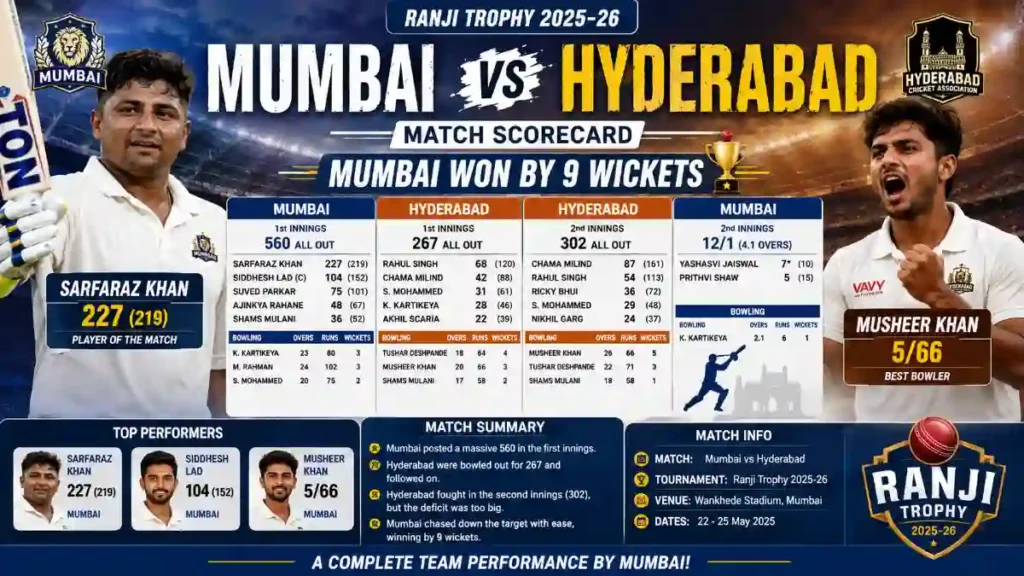

Sarfaraz Khan walked out to bat in a Ranji Trophy quarterfinal push, not an India cap in sight, and made the selectors’ phones buzz anyway. But here’s the real problem: most coverage of this Mumbai vs Hyderabad match reduces a genuinely dominant four-day performance into a one-line scoreline.
This was Match 109 of the Ranji Trophy 2025-26, Elite Group D, played from January 22 to 25, 2026, at the Rajiv Gandhi International Stadium in Hyderabad. Mumbai won by 9 wickets after enforcing the follow-on, and if you only see “9 wickets,” you’ll miss how completely one-sided this contest actually was. What most people miss is that this wasn’t just a win it was Mumbai stamping their title credentials with an innings-and-a-half margin, built on a double century that pushed one player into cricket’s all-time record books.
Match Summary at a Glance
| Detail | Information |
|---|---|
| Tournament | Ranji Trophy 2025-26, Elite Group D, Match 109 |
| Dates | January 22-25, 2026 (4-day match) |
| Venue | Rajiv Gandhi International Stadium, Hyderabad |
| Toss | Hyderabad won the toss, elected to field first |
| Result | Mumbai won by 9 wickets |
| Player of the Match | S N Khan (Sarfaraz Khan), Mumbai |
| Points awarded | Mumbai 6, Hyderabad 0 |
This is where things go wrong for a bowling attack facing in-form batting: Hyderabad chose to bowl first, and it backfired so badly that Mumbai never needed to bat a second time in any meaningful sense.
Mumbai’s First Innings: Full Scorecard (560/10 in 123.2 overs)
Mumbai batted first and built a total that effectively ended the contest before Hyderabad even had their first turn.
- Akhil Herwadkar got the innings started but fell for 27 off 71 balls, caught off Rohit Rayudu
- Akash Anand added 35 off 77 balls before being dismissed off Mohammed Siraj
- Musheer Khan managed just 11 off 29 balls, trapped lbw by Nitin Sai Yadav
- Siddhesh Lad steadied the innings with a century, scoring 104 off 179 balls before falling lbw to Rohit Rayudu
- Sarfaraz Khan then took over completely, finishing unbeaten on 173 off 191 balls in the passage recorded before the innings closed, extending to 227 by the end his fifth first-class double century
- Suved Parkar chipped in with 38 off 45 balls at a strike rate above 84
- Extras added 13 runs (4 byes, 2 wides, 5 no-balls, 2 leg-byes)
- Mumbai closed on 560 all out in 123.2 overs at a run rate of 4.54
- Fall of wickets: 60-1 (23.3 ov), 66-2 (26.2 ov), 82-3 (31.4 ov), 331-4 (85.4 ov), 334-5 (88.5 ov) showing the Lad-Sarfaraz partnership alone added 249 runs for the fourth wicket
What most readers miss here: this wasn’t a flat-pitch inflated score built by everyone contributing equally. This was two set batters Sarfaraz and Lad refusing to give Hyderabad’s bowlers a single sniff for nearly two full sessions combined, adding 249 runs together before either fell. That single partnership did more damage to Hyderabad’s morale than the final total itself.
Hyderabad’s Bowling Figures in Mumbai’s Innings
| Bowler | Overs | Runs | Wickets | Economy |
|---|---|---|---|---|
| Mohammed Siraj | 15 | 41 | 1 | 2.73 |
| CV Milind | 11 | 33 | 0 | 3.00 |
| C Rakshan Readdi | 12 | 34 | 0 | 2.83 |
| K Rohit Rayudu | 12 | 48 | 1 | 4.00 |
| N Nitin Sai Yadav | 8 | 47 | 1 | 5.87 |
Read Also:- Sri Lanka National Cricket Team vs Zimbabwe National Cricket Team Match Scorecard
Even Mohammed Siraj, Hyderabad’s most experienced bowler and newly appointed captain, could only manage figures of 1 for 41 across 15 overs a sign of how little assistance the pitch offered once Mumbai’s set batters got in.
Hyderabad’s First Innings and the Follow-On Decision (267 all out in 82.2 overs)
Facing a mountain of runs, Hyderabad’s reply collapsed into a genuine batting failure.
- Hyderabad were bowled out for just 267 in 82.2 overs, giving Mumbai a first-innings lead of 293 runs
- That lead was comfortably beyond the 200-run threshold that allows a captain to enforce the follow-on in first-class cricket
- Mumbai’s captain chose to send Hyderabad straight back in to bat again instead of batting a second time themselves
Here’s a common mistake casual readers make: assuming “follow-on” means the losing team gets an easy second chance to save the game. In reality, the follow-on rule exists specifically because a 200-plus run deficit is considered close to match-defining. Mumbai enforcing it here wasn’t just a tactical option it was a statement of confidence in their bowling attack’s ability to finish the job inside four days rather than risk a draw by batting again themselves.
Hyderabad’s Second Innings: Full Scorecard (302 all out in 69.5 overs)
Batting again immediately after their first-innings collapse, Hyderabad showed some late fight but ultimately fell short of saving the game.
- Hyderabad were dismissed for 302 in 69.5 overs, a modest improvement over their first innings but nowhere near enough to avoid defeat
- Chama Milind’s contribution stood out during the follow-on, with a fighting innings of 59 off 93 balls recorded partway through the chase to save the match
- This meant Mumbai needed only 10 runs to complete victory, since Hyderabad’s combined two-innings total (267 plus 302) still left them 10 runs short of Mumbai’s 560
- The second-innings run rate of 4.32 was actually higher than the first innings’ 3.24, showing genuine intent that simply arrived too late in the match to change the result
At one stage during the follow-on, Hyderabad were 237/8 chasing to survive, trailing by 56 runs with only two wickets in hand a position that made the eventual result a formality rather than a genuine contest.
Mumbai’s Winning Chase (12/1 in 3.2 overs)
Mumbai needed just 10 runs to win, and they got there for the loss of one wicket in barely over three overs.
- The chase was a formality by design Mumbai’s bowlers and top-order batters had already done the real work across the first three innings of the match
- Losing one wicket in a token chase like this happens often in first-class cricket and carries no real significance beyond completing the formality of victory
Turning Point of the Match
The turning point wasn’t a single wicket or six it was the toss decision compounded by Sarfaraz Khan’s application. Hyderabad’s decision to bowl first looked reasonable on paper, but once Siddhesh Lad and Sarfaraz Khan got past the new-ball period without losing their wickets, the match had effectively already tilted in Mumbai’s favor. From that point, every session added to Mumbai’s lead and drained Hyderabad’s chances of mounting a competitive reply.
The second real turning point came when Hyderabad were bowled out for just 267 in their first innings, a total built without any partnership large enough to threaten Mumbai’s total. Conceding a 293-run first-innings deficit in a four-day match against a team with Mumbai’s bowling depth is close to unrecoverable, and Hyderabad’s second innings of 302 confirmed exactly that pattern.
Player Performance Breakdown
| Player | Team | Performance | Impact |
|---|---|---|---|
| Sarfaraz Khan | Mumbai | 227 in the first innings, Player of the Match wisden+1 | Set up Mumbai’s 560 and extended his record for most first-class double centuries by an Indian this decade |
| Siddhesh Lad | Mumbai | 104 off 179 balls | Partnered Sarfaraz in a 249-run stand that broke Hyderabad’s resistance |
| Chama Milind | Hyderabad | 59 off 93 balls in the follow-on | The only real fight Hyderabad showed across both innings |
| Mohammed Siraj | Hyderabad | 1/41 in 15 overs, captaincy debut | A tough first match leading the side, with little bowling reward |
| Rohit Rayudu | Hyderabad | 2 wickets across Mumbai’s innings | The most productive bowler on a difficult day for Hyderabad |
Read Also:- England Women’s National Cricket Team vs India Women’s National Cricket Team Match Scorecard
Sarfaraz Khan’s 227 deserves more context than a single number in a table. Wisden’s own season tracking shows he scored 329 runs at a strike rate of 203 in the Syed Mushtaq Ali Trophy and 303 runs at an average of 75.75 in the Vijay Hazare Trophy earlier in this same domestic season. This double century isn’t an isolated peak it’s the continuation of a genuinely dominant all-format domestic campaign, and that’s the story competitors’ bare scorecards completely fail to tell.
What People Think vs What Actually Happened
Most fans assume a 560 first-innings total against a competitive Ranji Trophy side means a comfortable but reasonably contested match. Reality: Hyderabad’s own batting fell apart twice, managing only 267 and 302 across both innings combined against Mumbai’s attack, without a single partnership crossing 100 runs in either innings until Chama Milind’s rearguard effort.
The common mistake fans and analysts make is judging a lopsided result purely by the final winning margin “9 wickets” sounds relatively narrow without checking that the actual match was decided by an innings-level batting gap enforced through the follow-on. A 9-wicket chase of just 10 runs is about as dominant as a result gets in first-class cricket, even though the number “9 wickets” alone doesn’t communicate that scale of dominance to a casual reader.
Points Table Context
This win pushed Mumbai to the top of Elite Group D standings, while Hyderabad struggled to keep pace in the same group after this defeat. Mumbai’s dominant showing here wasn’t an outlier it was consistent with a squad that Wisden described as showing genuine title credentials, storming toward the quarterfinals on the back of this win and taking another step toward what would be a record 43rd Ranji Trophy title for the franchise. Hyderabad, on the other hand, picked up zero points from.
This fixture while Mumbai collected the full six, a gap that matters heavily in a group format where net run rate and points separate teams heading into the knockouts.
Key Takeaways for Fans and Bettors
- Mumbai’s decision-making after winning the toss battle (via Hyderabad’s choice to bowl) proved decisive a 293-run first-innings lead is close to insurmountable in four-day cricket
- Sarfaraz Khan’s form across all three domestic formats this season (Syed Mushtaq Ali Trophy, Vijay Hazare Trophy, and now Ranji Trophy) makes him a player to track regardless of his current international selection status
- Hyderabad’s back-to-back batting failures (267 and 302) point to a deeper top-order fragility that opposition bowling attacks should target in future fixtures
- Mohammed Siraj’s tough captaincy debut is worth monitoring leadership transitions often take a match or two to settle, and this result won’t help early confidence heading into the rest of the season
- When a team enforces the follow-on and only needs single-digit runs to finish the chase, treat the “wickets margin” as a formality, not the real measure of dominance in the match
Frequently Asked Questions
Q1. Who won the Mumbai vs Hyderabad Ranji Trophy match?
Ans. Mumbai won by 9 wickets after enforcing the follow-on against Hyderabad.
Q2. Who scored a double century in the Mumbai vs Hyderabad match?
Ans. Sarfaraz Khan scored 227 in Mumbai’s first innings, his fifth first-class double century, and was named Player of the Match.
Q3. What is a follow-on in cricket and why was it enforced here?
Ans. A follow-on lets the team batting first ask the opposition to bat again immediately if they lead by 200 or more runs; Mumbai enforced it after leading by 293 runs.
Q4. What was Hyderabad’s total in both innings?
Ans. Hyderabad were bowled out for 267 in their first innings and 302 in their second innings, both well short of Mumbai’s 560.
Q5. Where was this Mumbai vs Hyderabad match played?
Ans. The match was played at the Rajiv Gandhi International Stadium in Hyderabad from January 22 to 25, 2026.