
One scoreless innings can change an Orange Cap race. In IPL 2026, the pressure became even sharper because the leader was not simply accumulating runs; he was scoring at a rate that made every challenger’s good innings feel slightly inadequate.
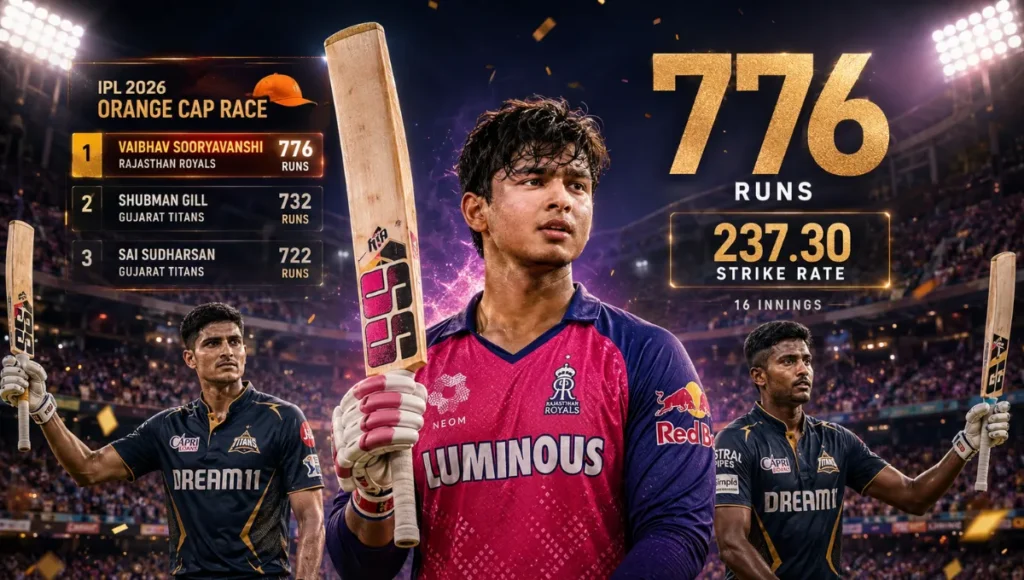
Vaibhav Sooryavanshi of Rajasthan Royals won the Orange Cap in IPL 2026 with 776 runs in 16 innings. He finished ahead of Gujarat Titans pair Shubman Gill (732) and Sai Sudharsan (722), while producing a strike rate of 237.30 the defining number behind his campaign.
But here’s the real problem with most Orange Cap pages: they show a leaderboard, then stop. A list tells you who finished first. It does not tell you how difficult the chase was, why a batter’s runs mattered, or whether the leader won through consistency, volume, match-winning speed, or a combination of all three. This page does all four.
Orange Cap IPL 2026: Final Standings
The Orange Cap is awarded to the batter with the most runs in an IPL season. During the tournament, the current leading run-scorer wears the cap while fielding. At the end of the season, the highest scorer is the official winner.
| Rank | Player | Team | Innings | Runs | Average | Strike rate | 100s | 50s |
|---|---|---|---|---|---|---|---|---|
| 1 | Vaibhav Sooryavanshi | Rajasthan Royals | 16 | 776 | 48.50 | 237.30 | 1 | 5 |
| 2 | Shubman Gill | Gujarat Titans | 16 | 732 | 45.75 | 163.02 | 1 | 6 |
| 3 | Sai Sudharsan | Gujarat Titans | 17 | 722 | 45.13 | 157.98 | 1 | 8 |
| 4 | Virat Kohli | Royal Challengers Bengaluru | 16 | 675 | 56.25 | 165.84 | 1 | 5 |
| 5 | Heinrich Klaasen | Sunrisers Hyderabad | 15 | 624 | 48.00 | 160.00 | 0 | 6 |
| 6 | Ishan Kishan | Sunrisers Hyderabad | 15 | 602 | 40.13 | 182.42 | 0 | 6 |
| 7 | KL Rahul | Delhi Capitals | 14 | 593 | 45.62 | 174.41 | 1 | 5 |
| 8 | Abhishek Sharma | Sunrisers Hyderabad | 15 | 563 | 40.21 | 204.72 | 1 | 4 |
| 9 | Mitchell Marsh | Lucknow Super Giants | 13 | 563 | 43.31 | 163.18 | 1 | 3 |
| 10 | Jos Buttler | Gujarat Titans | 17 | 526 | 37.57 | 152.46 | 0 | 4 |
Read Also:- IPL Points Table 2026: Final Standings, Playoff Race & Key Moments
Quick answer: Vaibhav Sooryavanshi won the Orange Cap in IPL 2026 after scoring 776 runs for Rajasthan Royals in 16 innings. His 237.30 strike rate was extraordinary for a season-long run-scoring leader.
What the final list really says
The gap between first and second was 44 runs. That sounds narrow until you look at scoring speed. Sooryavanshi reached 776 from only 327 balls, including 63 fours and 72 sixes. Gill’s 732 was an elite season, but Sooryavanshi’s extra acceleration created a much larger match impact than the final 44-run gap suggests.
What people think: Orange Cap is only about finishing with the most runs.
Reality: in modern IPL cricket, the best Orange Cap campaigns combine volume with intent. A player who scores 50 off 30 can influence a game more than one who scores 65 off 50, even if the latter looks safer on a traditional scorecard.
Who Won the Orange Cap in IPL 2026?
Vaibhav Sooryavanshi won the Orange Cap in IPL 2026 for Rajasthan Royals. His 776 runs made him the season’s top run-scorer, and his 72 sixes reveal the scale of his dominance more clearly than the cap itself.
This was not a typical accumulation-first campaign. Sooryavanshi scored at 237.30, hit one century and five fifties, and never relied on not-outs to inflate his average; all 16 innings ended with a dismissal. That matters. His 48.50 average was built through repeated high-impact starts rather than protected finishing cameos.
The record-breaking part
His strike rate was higher than that of every previous Orange Cap winner across the first 18 IPL seasons. The older benchmark for raw season runs remains Virat Kohli’s 973 in 2016, while Shubman Gill’s 890 in 2023 is another towering modern standard. Sooryavanshi did not pass those volume totals, but he changed the template for how an Orange Cap season can look.
A bold but logical view: this was a more disruptive batting season than many bigger run totals from slower IPL eras. In 2026, bowlers faced a batter who could turn a 35-run powerplay into a 60-run powerplay without needing reckless cricket. That raises a team’s scoring ceiling before the middle overs even begin.
Why age is not the full story
Sooryavanshi became the youngest Orange Cap winner in IPL history. That headline is important, but it can also distract from the cricketing point. Young players are often praised for fearlessness.
The stronger explanation is decision-making: he consistently attacked balls in his range and did not let reputation dictate the matchup.
The practical lesson for analysts: do not judge a new batter solely by the number of attacking shots. Track when those shots arrive. A player who targets a bowler’s weaker phase, protects a new partner, then resets after a wicket is building an IPL-calibre innings, not merely playing highlights cricket.
The Orange Cap Race: Key Moments
The final standings make the competition look settled. It was not. The race had several pressure points where one strong chase or one early dismissal could have changed the leader.
Early-season warning: the cap was never safe
Early Orange Cap updates had Heinrich Klaasen leading after five matches with 224 runs, while Sanju Samson registered the first IPL century of the season with an unbeaten 115. Sooryavanshi was already among the leading scorers, but he was not the obvious finished product at that point.
This is where live-ranking pages become predictable. They report the table after every game but do not distinguish between a five-match burst and a campaign that can survive 14 or more innings. The useful question is not “Who leads today?” It is “Who has a repeatable scoring method against new ball, spin and death bowling?”
The six-hitting surge changed the equation
Sooryavanshi’s 72 sixes became the race’s clearest turning point. Sixes do more than add runs. They force captains to alter field placements, change bowling lengths and move their best bowlers away from ideal overs. That creates secondary scoring opportunities for the other batter.
For a content creator covering a match, this is the detail to highlight: a six is not always just a six. If it makes a captain remove a spinner after one expensive over, it can decide the next three overs as well. That is performance analysis, not scorecard repetition.
Gujarat Titans kept the pressure alive
Gill and Sudharsan gave Gujarat Titans two credible Orange Cap contenders at once. Gill’s final 732 runs included a century, while Sudharsan made 722 with eight half-centuries the most among the top five.
Their campaigns were built on a different strength: repeated top-order stability.
What most people miss is that two high-scoring openers can compete for an individual award while helping each other. A stable partner reduces the need for desperate shots. Still, it can also split the scoring opportunities. Gujarat had two elite batters sharing the same 120 balls; Rajasthan’s leading scorer had a more aggressive claim on his team’s attacking volume.
Final-day tension
Gill and Sudharsan remained capable of overtaking Sooryavanshi heading into the final. Gill needed 55 runs to move beyond 776, but the Gujarat Titans openers fell cheaply against Royal Challengers Bengaluru. That locked the Orange Cap for the Rajasthan Royals batter.
The lesson is counterintuitive: a season award often turns on a small final-game event, but it is earned through the innings played weeks earlier. Final-day drama gets clicks. The sustained run base is what wins the cap.
Player Performance Breakdown
A good Orange Cap article should not pretend that every top-five campaign had the same shape. The following breakdown shows how each leading contender created runs.
| Player | Batting identity in IPL 2026 | Standout metric | What it meant |
|---|---|---|---|
| Vaibhav Sooryavanshi | Aggressive top-order disruptor | 72 sixes, 237.30 SR | Put opposition plans under immediate stress |
| Shubman Gill | High-class control batter | 732 runs, 6 fifties | Kept Gujarat’s top order stable deep into games |
| Sai Sudharsan | Consistent accumulation specialist | 8 fifties | Offered the most repeatable innings-to-innings output |
| Virat Kohli | Anchor with late acceleration | 56.25 average | Combined reliability with efficient finishing |
| Heinrich Klaasen | Middle-order pressure hitter | 624 runs in 15 innings | Attacked spin and pace during the game’s most volatile phase |
Read Also:- England Cricket Team Vs India National Cricket Team Players
Vaibhav Sooryavanshi: impact over safety
Sooryavanshi’s 776-run season was built on attacking tempo. His strike rate was about 74 percentage points higher than Gill’s. That gap is not cosmetic. Across a 50-run innings, it can mean reaching the target roughly seven to eight balls earlier, or giving a finishing unit another over against a weaker bowler.
Common mistake: calling high-strike-rate batting “luck” because it involves risk. Risk is part of T20 cricket, but repeatable boundary options are a skill. A batter who hits 72 sixes has not stumbled into one good afternoon.
Shubman Gill: the closest challenger
Gill’s 732 runs at 45.75 were a high-quality Orange Cap campaign in almost any IPL season. His challenge was timing. Sooryavanshi’s faster scoring meant Gill had to make up both a run deficit and an intent deficit.
Gill’s strength was control rather than chaos. His century and six fifties showed he could build an innings across phases. For Gujarat, that was essential. For the individual race, it meant he needed a truly large final-game score to overtake a leader who had created a 44-run cushion.
Sai Sudharsan: consistency without the cap
Sudharsan’s eight fifties are the key number. He was not the most explosive top-five scorer, but he may have been the most dependable at creating a playable score from the opening slot.
This is a useful “what people think vs reality” case. Fans often say the Orange Cap is lost because a player did not score enough centuries. Sudharsan proves that regular 50-plus contributions can build a 700-run season. The limitation was not consistency; it was that the eventual winner converted scoring opportunities into boundaries at a historic rate.
Virat Kohli: the average tells a different story
Kohli’s 675 runs came at an average of 56.25, the best in the top five. He also had four not-outs. This is why average must be read with context. Not-outs reflect successful chases and finishing value, but they also mean a batter may face fewer balls than an opener in a losing or completed chase.
The practical takeaway: compare average, strike rate, balls faced and batting role together. Never use a single metric to declare a batter the season’s best.
Highlights That Defined IPL 2026 Batting
- Sooryavanshi scored 776 runs, the most in the league, and struck 72 sixes.
- Gill and Sudharsan both passed 700 runs, making Gujarat Titans the only side with two top-three Orange Cap finishers.
- Kohli’s 56.25 average was the highest among the top five run-scorers.
- Klaasen, Ishan Kishan and Abhishek Sharma gave Sunrisers Hyderabad three top-eight scorers, underlining their high-tempo batting identity.
- KL Rahul’s unbeaten 152 was the highest individual score among the top 10 Orange Cap finishers.
One original observation: IPL coverage often treats the Orange Cap as a batting trophy detached from team tactics. It is actually a clue to the side’s batting architecture. Rajasthan’s cap winner reflects an attack-first model. Gujarat’s two top-three finishers reflect a partnership-first model. Neither approach is automatically better, but they produce very different pressure on opponents.
Orange Cap Winners List: 2008 to 2026
| Season | Winner | Team | Runs |
|---|---|---|---|
| 2008 | Shaun Marsh | Kings XI Punjab | 616 |
| 2009 | Matthew Hayden | Chennai Super Kings | 572 |
| 2010 | Sachin Tendulkar | Mumbai Indians | 618 |
| 2011 | Chris Gayle | Royal Challengers Bengaluru | 608 |
| 2012 | Chris Gayle | Royal Challengers Bengaluru | 733 |
| 2013 | Michael Hussey | Chennai Super Kings | 733 |
| 2014 | Robin Uthappa | Kolkata Knight Riders | 660 |
| 2015 | David Warner | Sunrisers Hyderabad | 562 |
| 2016 | Virat Kohli | Royal Challengers Bengaluru | 973 |
| 2017 | David Warner | Sunrisers Hyderabad | 641 |
| 2018 | Kane Williamson | Sunrisers Hyderabad | 735 |
| 2019 | David Warner | Sunrisers Hyderabad | 692 |
| 2020 | KL Rahul | Kings XI Punjab | 670 |
| 2021 | Ruturaj Gaikwad | Chennai Super Kings | 635 |
| 2022 | Jos Buttler | Rajasthan Royals | 863 |
| 2023 | Shubman Gill | Gujarat Titans | 890 |
| 2024 | Virat Kohli | Royal Challengers Bengaluru | 741 |
| 2025 | Sai Sudharsan | Gujarat Titans | 759 |
| 2026 | Vaibhav Sooryavanshi | Rajasthan Royals | 776 |
Read Also:- Zimbabwe National Cricket Team Vs India National Cricket Team Players
Historical context
Virat Kohli holds the record for the highest Orange Cap-winning tally, with 973 runs in 2016. David Warner has won the award three times, the most by any player. Sooryavanshi’s 2026 total sits below the largest historical totals, but his scoring rate gives it a distinctive place in the list.
Do not make the lazy comparison that 973 automatically makes every other season inferior. Run totals depend on match count, pitch conditions, team balance, chase opportunities and a batter’s role. The smarter comparison is whether a batter dominated the scoring environment of his own season. In that measure, Sooryavanshi belongs in the conversation.
How the Orange Cap Works
The Orange Cap goes to the player with the highest aggregate runs in an IPL season. A player can hold it temporarily during the tournament, and it changes hands when another batter moves ahead.
If two batters finish level on runs, the official tournament playing conditions should be checked for the applicable tie-break sequence. For readers tracking a live race, total runs remain the first metric. Strike rate, average, boundaries and player popularity do not decide the cap unless the rules specifically require a tie-break.
Best practice for live updates: show the timestamp, matches and innings beside every player. A 300-run leader after seven innings is not directly comparable to a 300-run leader after five. This one addition makes a leaderboard more useful than most generic competitor pages.