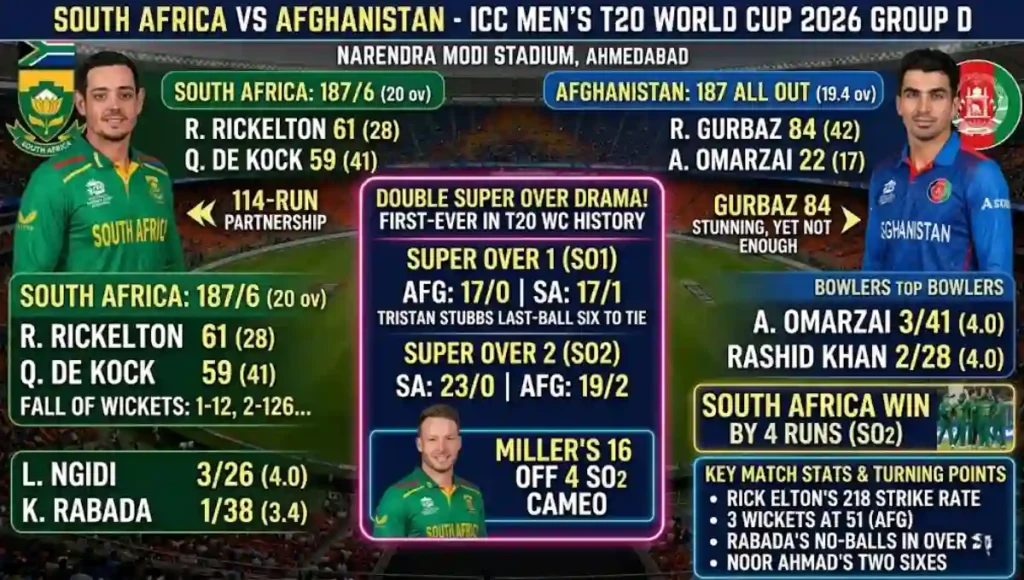

The South Africa national cricket team vs Afghanistan national cricket team match scorecard from ICC Men’s T20 World Cup 2026 Group D tells the story of the most extraordinary game in T20 World Cup history. The match ended tied at 187 apiece. The first Super Over ended tied at 17 apiece. South Africa finally won the second Super Over by four runs making this the first-ever double Super Over match in T20 World Cup history.
Full Scorecard South Africa Innings
South Africa were put in to bat and posted 187/6 in 20 overs, anchored by back-to-back half-centuries from Quinton de Kock and Ryan Rickelton. This is the complete South Africa national cricket team vs Afghanistan national cricket team match scorecard for the batting innings.
South Africa Batting Full Scorecard
| Batsman | Dismissal | R | B | 4s | 6s | SR |
| Aiden Markram (c) | caught | 12 | — | — | — | — |
| Quinton de Kock | caught | 59 | 41 | 5 | 2 | 143.9 |
| Ryan Rickelton | — | 61 | 28 | 5 | 4 | 217.8 |
| Dewald Brevis | — | — | — | — | — | — |
| David Miller | — | — | — | — | — | — |
| Tristan Stubbs | six (last ball SO1) | — | — | — | — | — |
| Others | — | — | — | — | — | — |
| Extras | (w, nb, lb) | — | — | — | — | — |
| Total | 187/6 | 20 ov |
Fall of Wickets (SA): 1-12 (Markram), 2-126 (de Kock), then three wickets between overs 12–18
South Africa Bowling vs Afghanistan
| Bowler | O | R | W | Econ |
| Lungi Ngidi | 4.0 | 26 | 3 | 6.5 |
| Keshav Maharaj | 4.0 | 27 | 1 | 6.75 |
| Kagiso Rabada | 3.4 | 38 | 1 | 10.36 |
| Gerald Linde | 3.0 | 39 | 1 | 13.0 |
| Marco Jansen | 4.0 | 42 | 1 | 10.5 |
| Aiden Markram | 1.0 | 14 | 0 | 14.0 |
The Rickelton-De Kock Partnership That Decided the Match
Ryan Rickelton’s 61 off 28 balls was the innings’ decisive passage of play. His strike rate of 218 is extraordinary even by T20 standards. He hit 5 fours and 4 sixes a calculated assault rather than a slog. Quinton de Kock brought up his fifty with a pull for four off 41 balls, providing the platform while Rickelton attacked. Together they built a 114-run stand (from 12/1 to 126) that transformed South Africa’s innings from cautious to explosive.
What most analysts miss: de Kock’s 59 was the harder innings to play. Rickelton fed off width and went aerial immediately. De Kock rotated, assessed, and then exploded a high-IQ knock that set the tempo.
South Africa’s Middle-Order Wobble
Azmatullah Omarzai (3/41) was the wrecker-in-chief in the middle overs, removing three South African batters between overs 12 and 18. Rashid Khan’s 2/28 kept the Proteas under pressure in that phase, preventing them from reaching 200+. South Africa were 155/4 by the 17th over. They scored their final 32 runs from three overs workable, but below what the powerplay had promised.
Full Scorecard Afghanistan Innings
Afghanistan chased 188 and reached 187 all out in 19.4 overs one run and a run-out short of completing one of T20 cricket’s great comebacks. This section of the south africa national cricket team vs afghanistan national cricket team match scorecard shows just how close Afghanistan came.
Afghanistan Batting Full Scorecard
| Batsman | Dismissal | R | B | 4s | 6s |
| Rahmanullah Gurbaz | caught | 84 | 42 | 4 | 7 |
| Ibrahim Zadran | bowled | 12 | — | — | — |
| Gulbadin Naib | caught | 0 | — | — | — |
| Sediqullah Atal | caught | 0 | — | — | — |
| Darwish Rasooli | run out | 15 | — | — | — |
| Azmatullah Omarzai | caught | 22 | 17 | — | — |
| Mohammad Nabi | caught | 5 | — | — | — |
| Rashid Khan | caught | 20 | — | — | — |
| Mujeeb Ur Rahman | run out | 0 | — | — | — |
| Noor Ahmad | not out | 15 | 9 | — | 2 |
| Fazalhaq Farooqi | run out | 0 | — | — | — |
| Extras | (lb 1, w 11, nb 2) | 14 | — | — | — |
| Total | all out | 187 | 19.4 ov |
Fall of Wickets (AFG): 1-51 (Zadran), 2-51 (Naib), 3-51 (Atal), 4-84 (Rasooli), 5-122 (Gurbaz), 6-139 (Omarzai), 7-153 (Nabi), 8-153 (Mujeeb), 9-177 (Rashid), 10-187 (Farooqi)
Gurbaz’s 84 Stunning, Yet Ultimately Not Enough
Rahmanullah Gurbaz’s 84 off 42 balls, with 4 fours and 7 sixes, was one of the great individual T20 World Cup innings in recent memory. He scored at a strike rate of 200, carrying the Afghanistan chase almost single-handedly through the powerplay and into the middle overs. The chase looked comfortable at 122/1 with Gurbaz in full flow.
But here is the real problem: Gurbaz’s brilliance concealed how brittle the middle order was. Three batters Naib, Atal, and Mujeeb contributed a combined zero. Three wickets fell at exactly 51 runs with Afghanistan barely settled. The chase was always one wicket away from crisis, and when Gurbaz departed for 84, that crisis arrived immediately.
The Last-Over Chaos That Made History
Kagiso Rabada’s last over is the moment everything changed. Afghanistan needed 13 off the final over with one wicket in hand. Rabada bowled two no-balls a shocking lapse of discipline under World Cup pressure and a running error allowed Afghanistan to tie the match. Noor Ahmad’s unbeaten 15 off 9 balls, including two crucial sixes, levelled the scores off the final delivery.
The counterintuitive reality: Afghanistan should have won this match in overs 15–18, not scrambled to tie it in over 20. Omarzai’s dismissal at the 139-run mark with 49 still needed from 24 balls was the real killing blow to Afghanistan’s chase, not Gurbaz’s dismissal.
Super Over Scorecard The Full Breakdown
This is what makes the south africa national cricket team vs afghanistan national cricket team match scorecard unique in T20 World Cup history: two separate Super Overs, both dramatic, the second decided on the final ball.
First Super Over A Dead Heat (Both: 17 runs)
| Team | Runs | Wickets | Key Bat | Key Bowl |
| Afghanistan (batted 1st) | 17 | 0 | — | — |
| South Africa | 17 | 1 (Dewald Brevis) | Tristan Stubbs (last-ball six) | Fazalhaq Farooqi |
Afghanistan posted 17/0. South Africa needed a six off the last ball to tie and Tristan Stubbs hit it. A last-ball maximum in a Super Over at Ahmedabad. The crowd inside the Narendra Modi Stadium was witnessing something no T20 World Cup had seen before.
Second Super Over South Africa Win by 4 Runs
| Team | Runs | Wickets | Key Bat | Key Bowl |
| South Africa (batted 1st) | 23 | 0 | Miller 16(4), Stubbs | Omarzai |
| Afghanistan | 19 | 2 | Gurbaz (3 sixes) | Keshav Maharaj |
David Miller was the match-winner in the second Super Over. He hammered 16 runs off just 4 balls against Omarzai, including two massive sixes. South Africa posted 23/0. Chasing 24, Afghanistan were in trouble immediately when Mohammad Nabi fell to Keshav Maharaj. Gurbaz came in and hit three consecutive sixes he needed four off the final ball to win or tie. Maharaj held his nerve. Gurbaz was dismissed on the last ball. Afghanistan lost by four runs.
Match Timeline Over-by-Over Momentum Map
Understanding the SA vs AFG T20 WC 2026 scorecard means tracking momentum, not just runs.
| Phase | Overs | What Happened | Momentum |
| SA Powerplay | 1–6 | De Kock & Rickelton attack | SA dominance |
| SA Middle | 7–15 | Rickelton blitz, then 3 wickets | Balanced |
| SA Death | 16–20 | SA consolidate 155 to 187 | AFG slight edge |
| AFG Powerplay | 1–6 | Gurbaz in full flow, but 3/51 | Balanced |
| AFG Middle | 7–15 | Gurbaz dismissed at 122/5 | SA advantage |
| AFG Death | 16–19 | Collapse from 139/6 to 175/9 | SA in control |
| AFG Over 20 | — | Rabada no-balls + Noor Ahmad ties match | Chaos |
| Super Over 1 | SO1 | Both teams score 17 tied | Deadlock |
| Super Over 2 | SO2 | Miller 23/0 vs AFG 19/2 | SA win |
Performance Ratings Who Won and Lost Individual Battles
| Player | Team | Contribution | Verdict |
| Ryan Rickelton | SA | 61 off 28 (SR 218) | Match-changer set the total |
| Quinton de Kock | SA | 59 off 41 (SR 143) | High-IQ innings platform builder |
| Rahmanullah Gurbaz | AFG | 84 off 42 (SR 200) | Outstanding nearly won it twice |
| Lungi Ngidi | SA | 3/26, Super Over defense | Player of the Match decisive |
| David Miller | SA | 16 off 4 in SO2 | Match-winning Super Over cameo |
| Tristan Stubbs | SA | Last-ball six in SO1 | Clutch kept SA in it |
| Azmatullah Omarzai | AFG | 3/41 + 22 off 17 | Dual contribution, critical dismissal |
| Noor Ahmad | AFG | 15* off 9, two sixes | Extraordinary tail cameo |
| Kagiso Rabada | SA | 2 no-balls in over 20 | Costly lapse in pressure moment |
| Keshav Maharaj | SA | 1/27 + last ball SO2 | Composure under fire |
Five Turning Points That Decided the Match
The south africa national cricket team vs afghanistan national cricket team match scorecard cannot be read in isolation these moments explain the numbers.
1. The Rickelton Blitz (Overs 6–13)
Rickelton’s 61 off 28 took the target from a recoverable 165 to an imposing 187. At a strike rate of 218, he hit the Afghanistan attack to every part of the ground. This is not normal T20 batting it is batting that resets a match.
2. Three Wickets at 51 Afghanistan’s Invisible Collapse
When Ibrahim Zadran was bowled, Afghanistan were 51/1 and then 51/4 within five deliveries. Naib and Atal fell for ducks in the same passage of play. The scorecard shows the chase was in control. The fall of wickets tells a completely different story.
3. Gurbaz Dismissed at 84 The Pivot Moment
Afghanistan were 122/5 when Gurbaz was caught. In the 12 balls that followed, they scored only 17 runs and lost three more wickets. The match swung irreversibly at that moment or so everyone thought.
4. Rabada’s No-Balls + Noor Ahmad’s Sixes
This is the moment that created history. Rabada bowled two no-balls in the final over. Afghanistan needed 12 off 4 legal balls with one wicket remaining. Noor Ahmad hit two sixes and ran a two. The match was tied. Kagiso Rabada one of the finest T20 bowlers of his generation handed Afghanistan a lifeline through pure execution failure.
Read More About – New Zealand National Cricket Team Vs West Indies Cricket Team Timeline: Full History, Records & Key Moments (1930–2025)
5. Miller’s 16 off 4 in Super Over 2 The Killer Blow
David Miller is the player most coverage forgets in this match. He scored 16 off 4 balls two sixes off Omarzai to push South Africa to 23/0 in Super Over 2. That total proved just beyond Gurbaz, who needed four sixes in a row and got three.
Group D Implications What This Result Means
The SA vs AFG T20 World Cup 2026 Group D table shifted dramatically after this match. South Africa have two wins from two matches and are in pole position alongside New Zealand to qualify for the next stage.
For Afghanistan, this is a qualification crisis. They have lost both their opening Group D games. They need to win their remaining matches by large margins and rely on other results going their way. The psychological damage of tying a match twice and still losing off the final ball of a second Super Over is something that does not leave a dressing room quickly.
What people think: Afghanistan lost because they were too dependent on Gurbaz.
Reality: Afghanistan lost because Kagiso Rabada bowled two no-balls in regulation and because David Miller produced an unheralded Super Over masterclass. Without those two moments, Afghanistan win comfortably. Their batting was extraordinary. Their luck was not.
What This Means for Fantasy Picks and Match Watchers
For the ICC T20 World Cup 2026 fantasy cricket audience looking at this scorecard:
- Back Lungi Ngidi as a bowling pick in every South Africa game. Economy 6.5 in a match with a 9+ run-rate pitch is elite death bowling
- Rahmanullah Gurbaz remains the highest-ceiling pick at the top of the Afghanistan order but the middle order is a liability to watch
- David Miller is criminally underrated. He has now delivered twice in Super Overs. He performs when it matters most
- Avoid Afghanistan’s No. 3–5 batting slots for fantasy: Naib (0), Atal (0), and Rasooli (15 off unknown) offer no floor value
- Ryan Rickelton is a must-pick for the SA opener slot 61 off 28 at a World Cup is not a fluke
Frequently Asked Questions
Q1: What was the final result of South Africa vs Afghanistan T20 World Cup 2026?
Ans. South Africa beat Afghanistan by four runs in the second Super Over. The main match ended tied at 187. The first Super Over also tied at 17 runs each. South Africa scored 23/0 in the second Super Over and restricted Afghanistan to 19/2.
Q2: Who won Player of the Match in the SA vs AFG T20 WC 2026 game?
Ans. Lungi Ngidi was named Player of the Match for his figures of 3/26 in four overs (economy rate 6.5) during regulation play, along with his critical bowling performance in the Super Overs.
Q3: How many Super Overs were played between South Africa and Afghanistan?
Ans. Two Super Overs were played a first in T20 World Cup history. The first Super Over ended tied at 17/0 each. The second Super Over saw South Africa score 23/0 and Afghanistan 19/2. South Africa won by four runs.
Q4: How many runs did Rahmanullah Gurbaz score against South Africa?
Ans. Gurbaz scored 84 runs off 42 balls in regulation play (4 fours, 7 sixes, SR 200). He then batted in both Super Overs, hitting three sixes in the second Super Over before being dismissed on the final ball.
Q5: Why did the match go to two Super Overs?
Ans. The main match ended tied at 187 runs. The first Super Over also ended tied Afghanistan scored 17/0 and South Africa also scored 17/1 (Tristan Stubbs hit a last-ball six to tie). ICC rules required a second Super Over to decide the match.
Q6: What did Ryan Rickelton score in SA vs AFG T20 WC 2026?
Ans. Ryan Rickelton scored 61 runs off 28 balls a strike rate of approximately 218 with 5 fours and 4 sixes. It was the highest individual score in the match and the innings that built South Africa’s imposing total.
Q7: Who scored for South Africa in the second Super Over?
Ans. David Miller and Tristan Stubbs batted in the second Super Over for South Africa. Miller scored 16 off just 4 deliveries, including two sixes off Azmatullah Omarzai. South Africa finished at 23/0.
Q8: What was Afghanistan’s bowling figures against South Africa?
Ans. Afghanistan’s best bowlers were Azmatullah Omarzai (3/41) and Rashid Khan (2/28). Omarzai also contributed 22 runs off 17 balls with the bat. Kagiso Rabada’s bowling cost South Africa dearly his two no-balls in the final over allowed Afghanistan to tie the match.
Q9: Is this the first double Super Over in T20 World Cup history?
Ans. Yes. The SA vs AFG match on 11 February 2026 was the first-ever T20 World Cup match to require two Super Overs. It was only the third instance in all men’s T20 internationals previously India vs Afghanistan (January 2024) and Netherlands vs Nepal also required multiple Super Overs.
Q10: What are Afghanistan’s qualification chances after this defeat?
Ans. Afghanistan have lost both their Group D matches (vs New Zealand and vs South Africa). Their qualification chances are now extremely slim. They need to win their remaining matches convincingly and hope other results favour them. South Africa and New Zealand are currently in pole position with two wins each.