
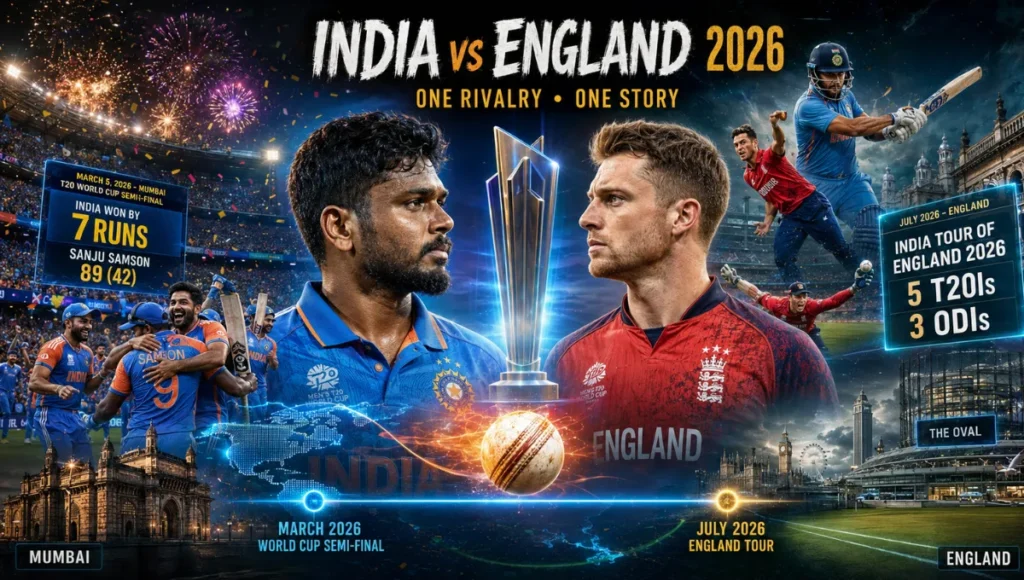

March 5, 2026, Mumbai. India needed to beat England for the second time in three T20 World Cup semifinals just to reach the final. They won by 7 runs, with Sanju Samson scoring 89 off 42 balls.
Four months later, in July 2026, the same two teams were back at it this time across five T20Is and three ODIs on English soil.
Here’s the real problem with most schedule pages: they treat these as two unrelated events. What most people miss is that this entire 2026 India-England rivalry is one continuous storyline, not separate fixtures and tracking it that way changes how you read every match.
The Context Behind This Rivalry
India and England have met in three consecutive T20 World Cup semifinals across recent tournament cycles, a pattern almost no other rivalry in modern cricket can match. That repetition alone makes every fresh meeting between these two sides carry extra tension, since both squads already know each other’s tendencies intimately.
What most people miss is that this familiarity cuts both ways. England knows exactly how India built their 253-run total in Mumbai. India knows exactly how close Bethell came to chasing it down. Both teams walked into the July 2026 bilateral series with genuine unfinished business, not just a routine tour to fill the calendar.
The Complete 2026 India vs England Timeline
Most fans check one series at a time and lose the bigger picture. Here’s the full year mapped out in one place.
| Phase | Dates | Format | Location |
|---|---|---|---|
| T20 World Cup Semifinal | March 5, 2026 | T20I (knockout) | Mumbai |
| T20I Bilateral Series | July 1-11, 2026 | 5 T20Is | England |
| ODI Bilateral Series | July 14-19, 2026 | 3 ODIs | England |
Read Also:- India National Cricket Team Vs West Indies Cricket Team Players
What people think vs reality: fans assume the July tour is just a routine bilateral series. Reality this is England’s direct chance to avenge back-to-back T20 World Cup semifinal losses to India, and India’s chance to prove their World Cup form travels to English conditions.
The T20 World Cup Semifinal: Where This Rivalry Peaked
India and England met for the third consecutive time in a T20 World Cup semifinal in March 2026. England won the first of these three meetings easily. India won the second. This third match was billed as genuinely unpredictable.
The Turning Point: Samson’s Powerplay Assault
Sanju Samson was dropped by Harry Brook off Jofra Archer’s bowling when he was just 15. That drop changed everything. Samson reached fifty off 26 balls, and India raced to 67/1 in the first six overs.
He finished with 89 off 42 balls, matching Virat Kohli’s record for the highest score by an Indian in a T20 World Cup knockout innings. India posted 253/7 the highest total ever recorded in a T20 World Cup match.
Why England’s Chase Fell Just Short
Jacob Bethell fought back hard with 105 off 48 balls, and England reached 246/7. This is where things go wrong for most recaps they call it a “close loss” and move on. The real story is that Bumrah’s spell of 1/33 off his four overs kept just enough pressure on England’s middle order to prevent a complete chase. India won by 7 runs.
Match Summary At A Glance
| Team | Score | Key Performer |
|---|---|---|
| India | 253/7 | Sanju Samson, 89 off 42 balls |
| England | 246/7 | Jacob Bethell, 105 off 48 balls |
| Result | India won by 7 runs | Highest T20 World Cup total ever recorded |
My bold take: that dropped catch off Samson is the single most consequential moment of India’s entire 2026 T20 World Cup campaign. Without it, England likely wins their third semifinal meeting, and the whole tournament narrative changes.
A Second Bold Observation
Look closely at how both totals compare. India scored 253 batting first; England, chasing, still managed 246. That combined 499-run match reveals something worth naming directly both bowling attacks struggled to control the death overs on flat Mumbai conditions, and this pattern is worth watching again whenever these two teams meet on similarly high-scoring surfaces.
The T20I Series In England: July 2026
India’s new T20I era under captain Shreyas Iyer began against England on July 1, 2026, at the Riverside Ground, Chester-le-Street. This wasn’t just another bilateral series it was explicitly framed as preparation for the 2028 T20 World Cup.
Full T20I Schedule
| Match | Date | Venue |
|---|---|---|
| 1st T20I | July 1, 2026 | Riverside Ground, Chester-le-Street |
| 2nd T20I | July 4, 2026 | Old Trafford, Manchester |
| 3rd T20I | July 7, 2026 | Trent Bridge, Nottingham |
| 4th T20I | July 9, 2026 | County Ground, Bristol |
| 5th T20I | July 11, 2026 | The Rose Bowl, Southampton |
What most people miss: this series introduced Vaibhav Sooryavanshi into the senior T20I setup for the first time, a signal that India is already building its next generation alongside experienced hands like Samson, Axar Patel, and Arshdeep Singh.
Squad Comparison: Youth Meets Experience
| Team | Captain | Notable Names |
|---|---|---|
| India | Shreyas Iyer | Tilak Varma (vc), Sanju Samson, Vaibhav Sooryavanshi |
| England | Harry Brook | Jos Buttler, Jofra Archer, Jacob Bethell |
England, under Harry Brook, went into this series seeking redemption after their World Cup semifinal loss. That framing matters this wasn’t a low-stakes series for either side.
Why This Series Wasn’t Business As Usual
Most previews frame a five-match bilateral T20I series as routine calendar filler. That undersells it here. England specifically wanted a chance to prove Bethell’s near-miracle semifinal chase wasn’t a one-off, while India used this series to test whether their next generation of batters could function without leaning entirely on Samson’s tournament heroics.
The ODI Series In England: July 14-19, 2026
Right after the T20Is, India shifted format for a three-match ODI series, bringing back senior stars Rohit Sharma and Virat Kohli for the first time since January 2026. Jasprit Bumrah also returned for his first national assignment since the IPL 2026.
Full ODI Schedule
| Match | Date | Venue |
|---|---|---|
| 1st ODI | July 14, 2026 | Edgbaston |
| 2nd ODI | July 16, 2026 | Sophia Gardens |
| 3rd ODI | July 19, 2026 | Lord’s |
This is where things go wrong for most previews they treat the ODI squad as a simple continuation of the T20I group. It wasn’t. Shubman Gill led a completely different squad built around senior returnees, not the youth-focused T20I unit.
Why The Squad Shift Matters
What people think vs reality: fans assume India rotates squads randomly between formats. Reality the T20I series tested Iyer’s new-generation core, while the ODI series brought back Kohli, Rohit, and Bumrah specifically because ODI cricket still leans heavily on experience and match-reading ability. Mohammed Siraj’s notable omission from the ODI squad, despite his recent form, also signals selectors are actively re-evaluating the pace bowling pecking order heading into future assignments.
The Common Mistake Fans Make Here
Many assume that once a player breaks into the T20I setup, an ODI recall automatically follows. This series proves otherwise. India ran two genuinely separate selection tracks in the same month a clear signal that format-specific specialization is now a deliberate selection strategy, not an accident of scheduling.
What Fans Should Actually Track From This Timeline
This isn’t just a busy cricket calendar it’s a live experiment in squad transition. What should a fan or analyst actually do with this information?
- Compare Samson’s semifinal form directly against his July T20I output consistency here would confirm he’s now India’s genuine white-ball anchor
- Watch how Vaibhav Sooryavanshi performs against senior England bowlers, since this series is his real audition for a longer-term T20I role
- Track whether Bumrah’s return to ODI cricket restores the same control he showed in the World Cup semifinal
- Note England’s batting approach with Bethell and Buttler across formats, since their semifinal chase showed real firepower that a home series could amplify further
- Compare England’s team selection philosophy between formats against India’s both squads reveal separate strategic priorities worth studying side by side
For India, the practical decision is clear: use this English tour to confirm whether the T20 World Cup semifinal performance was a peak moment or a repeatable standard, especially since the format split between youth-led T20Is and experience-led ODIs will reveal exactly where the squad’s real depth lies.
Read Also:- India National Cricket Team Vs West Indies Cricket Team
The Bigger Picture Heading Into 2027
Everything happening in this 2026 timeline points toward one central question: can India sustain two parallel pipelines a youth-driven T20I core and an experience-driven ODI core without either one weakening the other? The answer likely won’t be clear until later in the year, but the July England tour is the first real data point worth watching closely.